Build an ATS-Friendly
Space Instrumentation Scientist Resume
That Gets Interviews
Designing scientific instruments for extraterrestrial environments requires not just innovation but also precision engineering to meet stringent mission parameters. Space Instrumentation Scientists specifically target instrument capabilities that can withstand extreme temperatures, vacuum conditions, and radiation…
Space Instrumentation Scientist Resume Templates
Modern Professional
Use Template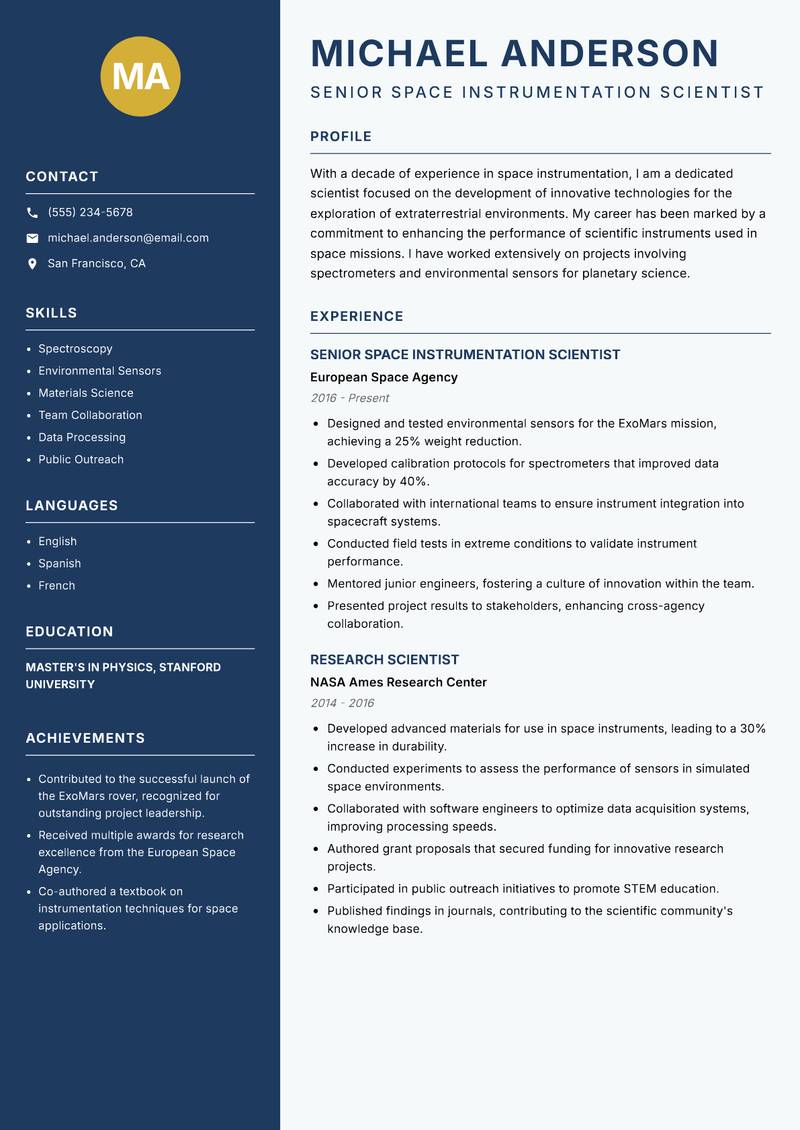
Classic Clean
Use Template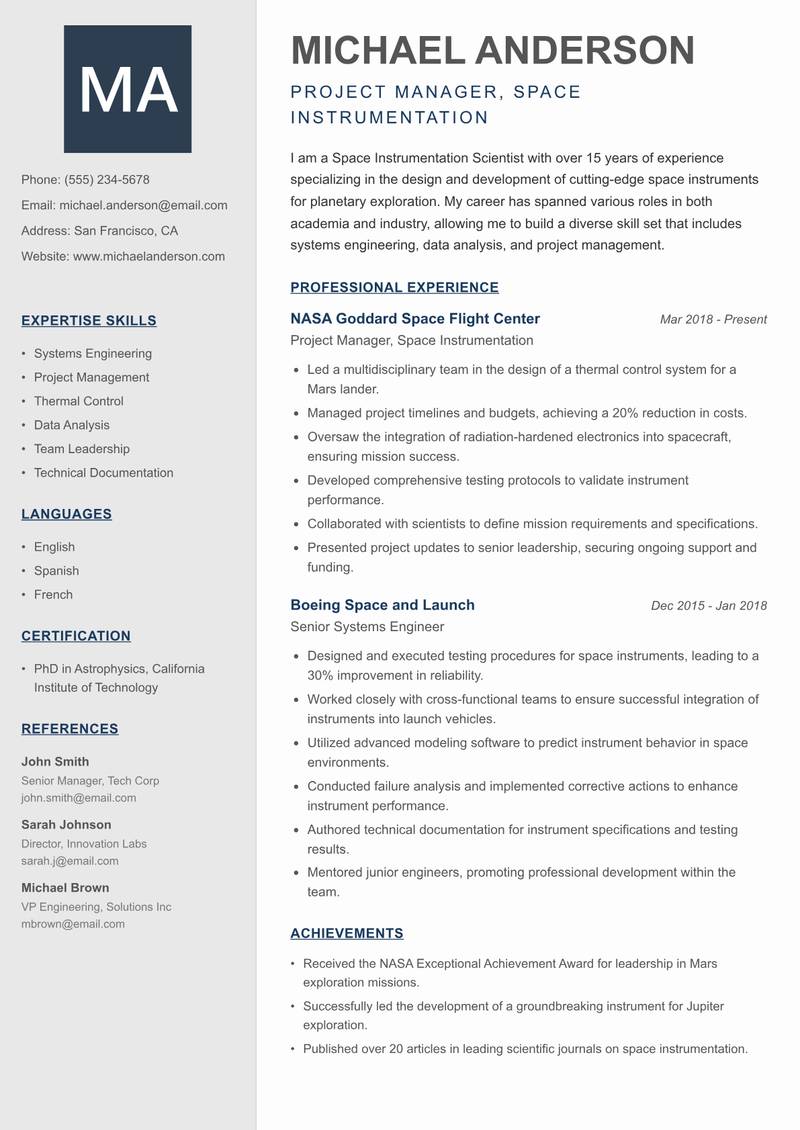
Creative Minimal
Use Template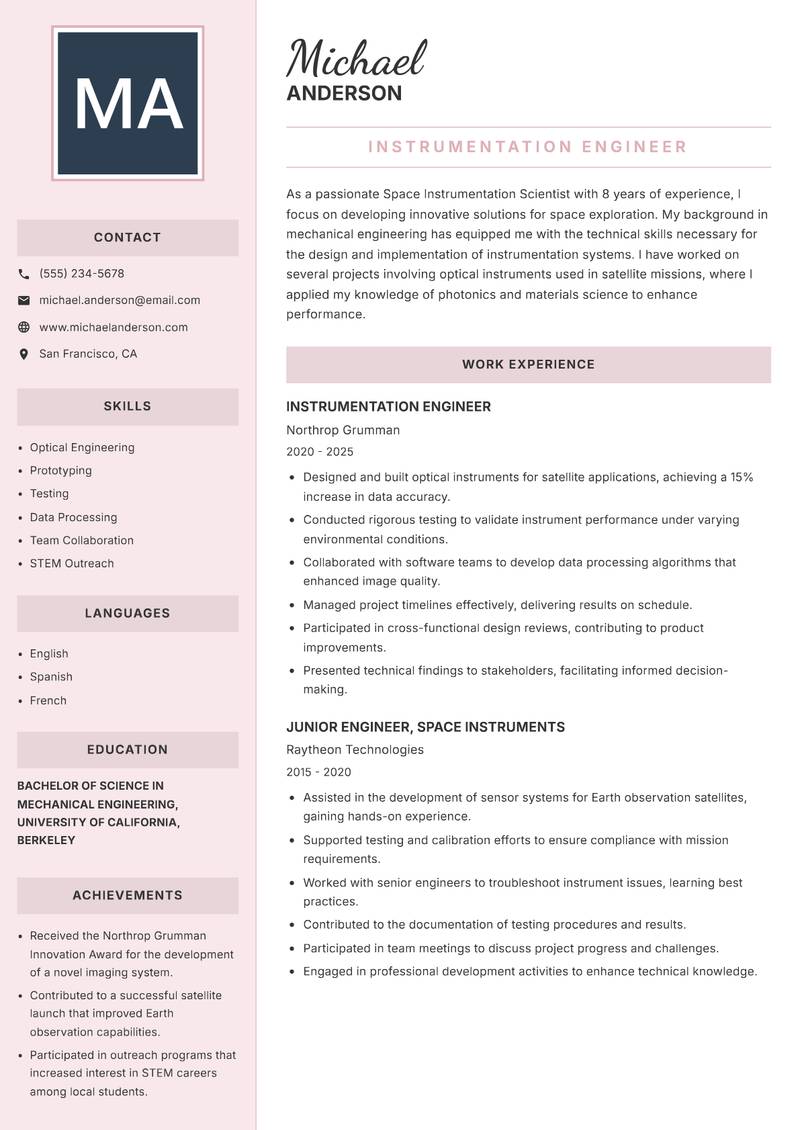
Executive
Use Template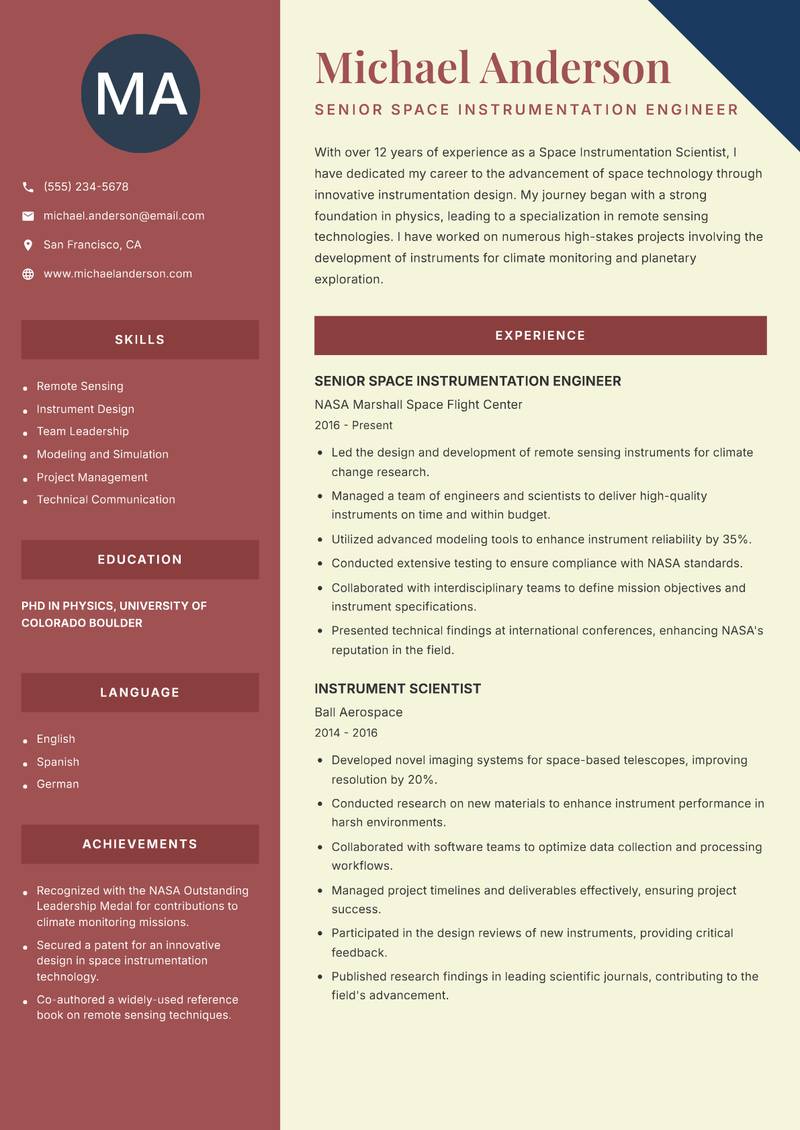
Two Column
Use Template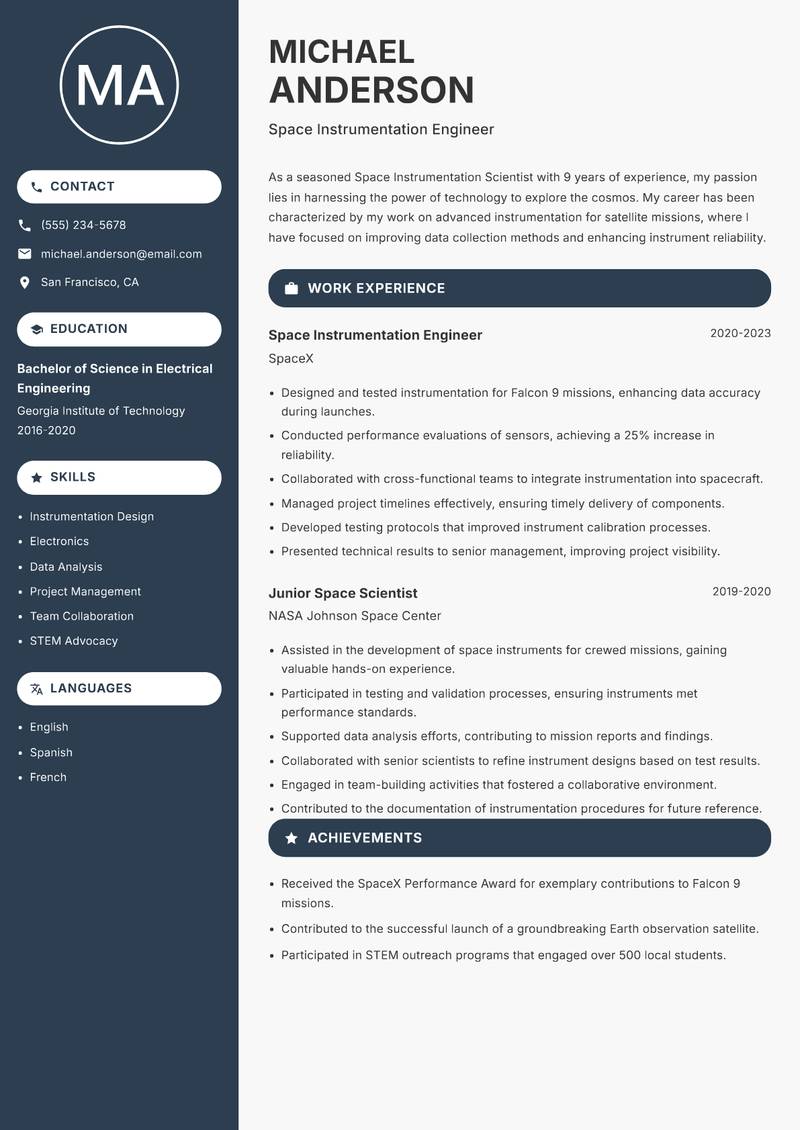
Compact
Use Template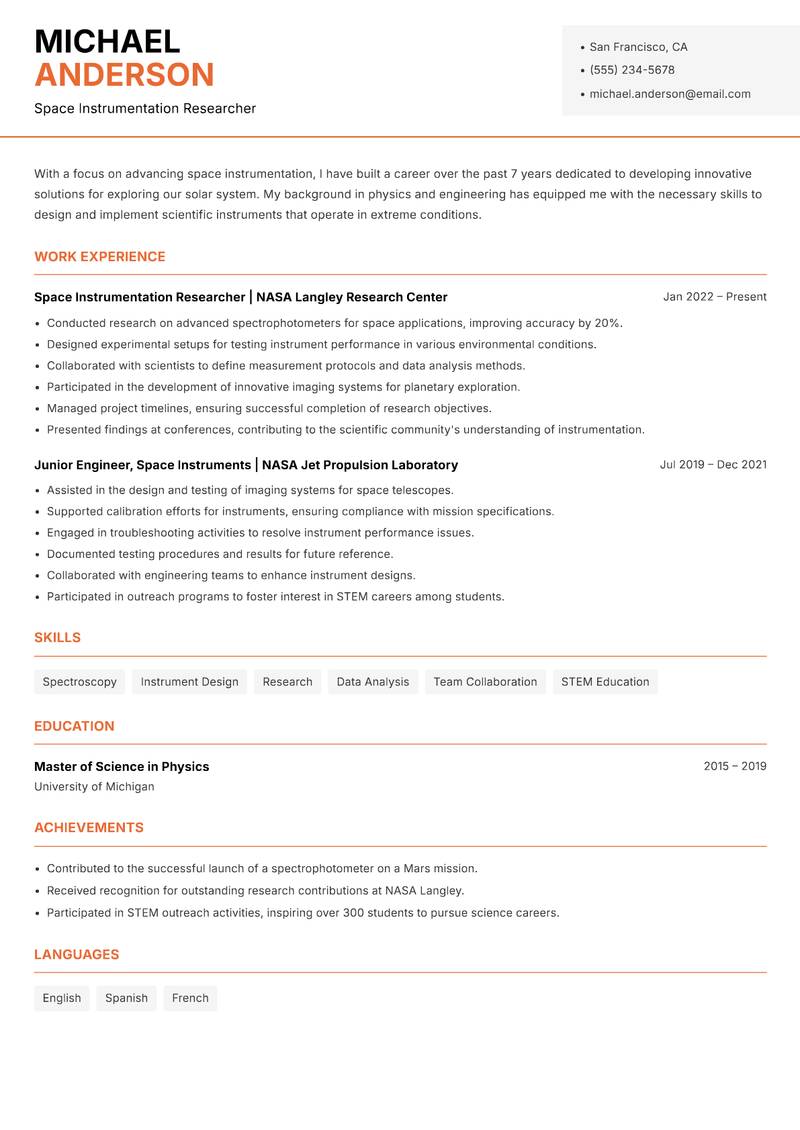
Modern Professional
Use Template7 Real Space Instrumentation Scientist Resume Examples
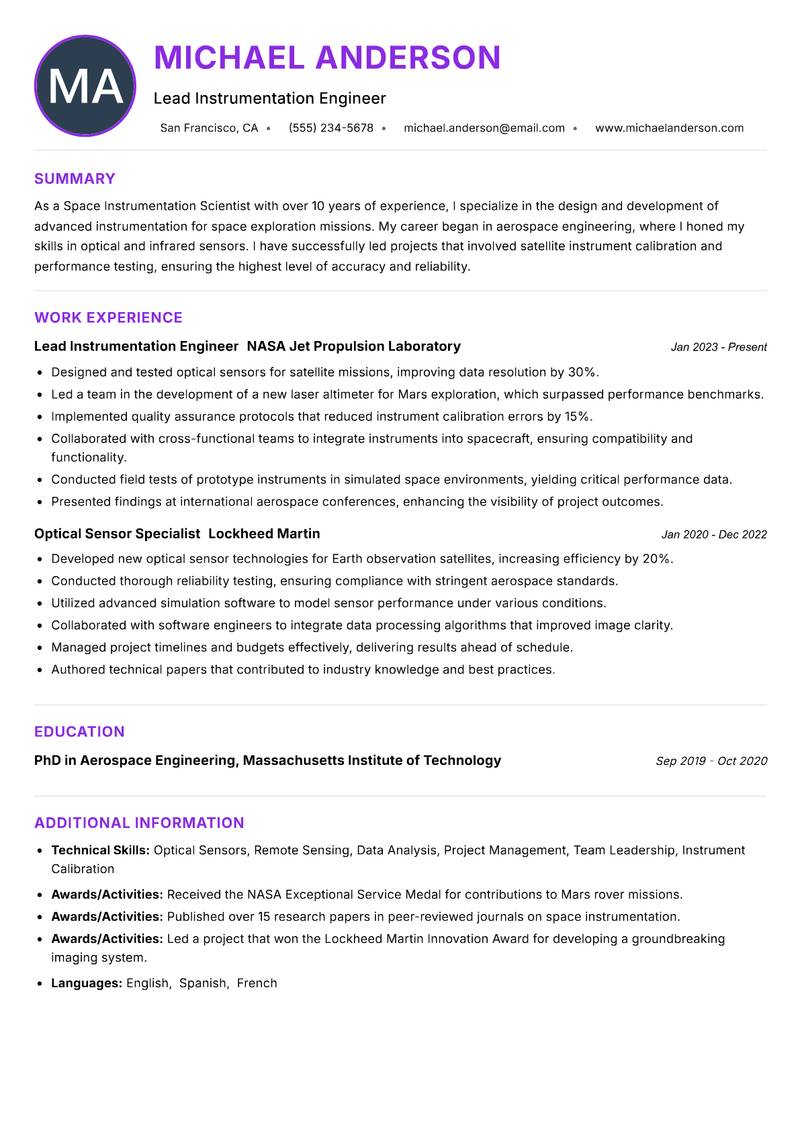
Lead Instrumentation Engineer with 13+ Years Experience
Summary: As a Space Instrumentation Scientist with over 10 years of experience, I specialize in the design and development of advanced instrumentation for space exploration missions. My career began in aerospace engineering, where I honed my skills in optical and infrared sensors. I have successfully led projects that involved satellite instrument calibration and performance testing, ensuring the highest level of accuracy and reliability. My work has contributed significantly to NASA's Mars rover missions, where I developed innovative solutions to reduce instrument weight while enhancing data quality. I possess strong analytical skills and a deep understanding of remote sensing technology, which allows me to tackle complex challenges in space science. My passion for exploration drives my commitment to advancing our knowledge of the universe through cutting-edge technology. I am also dedicated to mentoring young scientists and engineers, fostering a collaborative environment that encourages innovation and creativity. I am eager to continue my journey in space instrumentation, contributing to missions that expand humanity's reach into the cosmos.
Description:
- Designed and tested optical sensors for satellite missions, improving data resolution by 30%.
- Led a team in the development of a new laser altimeter for Mars exploration, which surpassed performance benchmarks.
- Implemented quality assurance protocols that reduced instrument calibration errors by 15%.
- Collaborated with cross-functional teams to integrate instruments into spacecraft, ensuring compatibility and functionality.
- Conducted field tests of prototype instruments in simulated space environments, yielding critical performance data.
- Presented findings at international aerospace conferences, enhancing the visibility of project outcomes.
🏆 Key Achievements
Senior Space Instrumentation Scientist with 10+ Years Experience
Summary: With a decade of experience in space instrumentation, I am a dedicated scientist focused on the development of innovative technologies for the exploration of extraterrestrial environments. My career has been marked by a commitment to enhancing the performance of scientific instruments used in space missions. I have worked extensively on projects involving spectrometers and environmental sensors for planetary science. My expertise lies in the application of advanced materials and miniaturization techniques, enabling the deployment of lightweight instruments that do not compromise on functionality. I thrive in collaborative settings, working closely with scientists from various disciplines to ensure the success of space missions. My analytical mindset allows me to troubleshoot complex issues and devise effective solutions. I am passionate about pushing the boundaries of what is possible in space science and am constantly seeking new challenges that contribute to humanity's understanding of the universe. I also place a strong emphasis on knowledge transfer and education, actively participating in outreach programs to inspire the next generation of scientists.
Description:
- Designed and tested environmental sensors for the ExoMars mission, achieving a 25% weight reduction.
- Developed calibration protocols for spectrometers that improved data accuracy by 40%.
- Collaborated with international teams to ensure instrument integration into spacecraft systems.
- Conducted field tests in extreme conditions to validate instrument performance.
- Mentored junior engineers, fostering a culture of innovation within the team.
- Presented project results to stakeholders, enhancing cross-agency collaboration.
🏆 Key Achievements
Project Manager, Space Instrumentation with 15+ Years Experience
Summary: I am a Space Instrumentation Scientist with over 15 years of experience specializing in the design and development of cutting-edge space instruments for planetary exploration. My career has spanned various roles in both academia and industry, allowing me to build a diverse skill set that includes systems engineering, data analysis, and project management. I have a proven track record of leading multidisciplinary teams in the successful delivery of complex scientific instruments. My expertise in thermal control systems and radiation-hardened electronics has been instrumental in the success of several high-profile missions, including those to the outer planets. I am passionate about mentoring young scientists and engineers, sharing my knowledge and experience to foster the next generation of innovators. I am committed to advancing our understanding of the universe through meticulous research and development, always seeking to push the boundaries of what is possible. My strong communication skills and ability to collaborate effectively with various stakeholders have enabled me to navigate the complexities of large-scale space missions successfully.
Description:
- Led a multidisciplinary team in the design of a thermal control system for a Mars lander.
- Managed project timelines and budgets, achieving a 20% reduction in costs.
- Oversaw the integration of radiation-hardened electronics into spacecraft, ensuring mission success.
- Developed comprehensive testing protocols to validate instrument performance.
- Collaborated with scientists to define mission requirements and specifications.
- Presented project updates to senior leadership, securing ongoing support and funding.
🏆 Key Achievements
Instrumentation Engineer with 8+ Years Experience
Summary: As a passionate Space Instrumentation Scientist with 8 years of experience, I focus on developing innovative solutions for space exploration. My background in mechanical engineering has equipped me with the technical skills necessary for the design and implementation of instrumentation systems. I have worked on several projects involving optical instruments used in satellite missions, where I applied my knowledge of photonics and materials science to enhance performance. I thrive on challenges and enjoy working in collaborative environments where creativity and problem-solving are encouraged. My hands-on experience with prototyping and testing instruments has allowed me to contribute to successful mission outcomes. I am committed to continuous learning and staying abreast of the latest advancements in space technology. I also engage in outreach efforts to inspire young students to pursue careers in STEM fields, believing that education is key to future innovation. I am eager to expand my expertise and take on new challenges in the field of space instrumentation.
Description:
- Designed and built optical instruments for satellite applications, achieving a 15% increase in data accuracy.
- Conducted rigorous testing to validate instrument performance under varying environmental conditions.
- Collaborated with software teams to develop data processing algorithms that enhanced image quality.
- Managed project timelines effectively, delivering results on schedule.
- Participated in cross-functional design reviews, contributing to product improvements.
- Presented technical findings to stakeholders, facilitating informed decision-making.
🏆 Key Achievements
Senior Space Instrumentation Engineer with 12+ Years Experience
Summary: With over 12 years of experience as a Space Instrumentation Scientist, I have dedicated my career to the advancement of space technology through innovative instrumentation design. My journey began with a strong foundation in physics, leading to a specialization in remote sensing technologies. I have worked on numerous high-stakes projects involving the development of instruments for climate monitoring and planetary exploration. My role often involves collaborating with astrophysicists and engineers to define the requirements for new instruments, ensuring they meet the scientific objectives of each mission. I am skilled at leveraging advanced modeling and simulation tools to predict instrument performance and reliability. My commitment to excellence is reflected in my ability to lead teams through complex project lifecycles, from conceptual design to deployment. I am passionate about mentoring the next generation of scientists and engineers and actively seek opportunities to share my knowledge through lectures and workshops. I believe that through collaboration and innovation, we can unlock new frontiers in our understanding of the universe.
Description:
- Led the design and development of remote sensing instruments for climate change research.
- Managed a team of engineers and scientists to deliver high-quality instruments on time and within budget.
- Utilized advanced modeling tools to enhance instrument reliability by 35%.
- Conducted extensive testing to ensure compliance with NASA standards.
- Collaborated with interdisciplinary teams to define mission objectives and instrument specifications.
- Presented technical findings at international conferences, enhancing NASA's reputation in the field.
🏆 Key Achievements
Space Instrumentation Engineer with 9+ Years Experience
Summary: As a seasoned Space Instrumentation Scientist with 9 years of experience, my passion lies in harnessing the power of technology to explore the cosmos. My career has been characterized by my work on advanced instrumentation for satellite missions, where I have focused on improving data collection methods and enhancing instrument reliability. I have a robust background in electronics and systems engineering, allowing me to develop instruments that withstand the rigors of space. I pride myself on my problem-solving abilities and my capacity to work under tight deadlines while maintaining high standards of quality. My commitment to innovation is evident in my contributions to various successful missions, including the development of next-generation sensors for Earth observation. I am adept at collaborating with diverse teams and stakeholders, ensuring that all project objectives are met. Additionally, I actively participate in community outreach to promote STEM education, believing in the importance of inspiring future generations in science and technology. I am excited about future opportunities that challenge my skills and allow me to make a meaningful impact in the field of space instrumentation.
Description:
- Designed and tested instrumentation for Falcon 9 missions, enhancing data accuracy during launches.
- Conducted performance evaluations of sensors, achieving a 25% increase in reliability.
- Collaborated with cross-functional teams to integrate instrumentation into spacecraft.
- Managed project timelines effectively, ensuring timely delivery of components.
- Developed testing protocols that improved instrument calibration processes.
- Presented technical results to senior management, improving project visibility.
🏆 Key Achievements
Space Instrumentation Researcher with 7+ Years Experience
Summary: With a focus on advancing space instrumentation, I have built a career over the past 7 years dedicated to developing innovative solutions for exploring our solar system. My background in physics and engineering has equipped me with the necessary skills to design and implement scientific instruments that operate in extreme conditions. I have experience in both research and applied science, working on projects involving spectrophotometers and imaging systems for various space applications. My problem-solving abilities and attention to detail have enabled me to contribute significantly to mission success. I am committed to continuous improvement and enjoy collaborating with researchers and engineers to create tools that enhance scientific discovery. My passion for science is matched by my enthusiasm for education; I actively participate in initiatives aimed at encouraging young people to pursue careers in STEM. I believe that through teamwork and creativity, we can achieve remarkable advancements in our understanding of the universe.
Description:
- Conducted research on advanced spectrophotometers for space applications, improving accuracy by 20%.
- Designed experimental setups for testing instrument performance in various environmental conditions.
- Collaborated with scientists to define measurement protocols and data analysis methods.
- Participated in the development of innovative imaging systems for planetary exploration.
- Managed project timelines, ensuring successful completion of research objectives.
- Presented findings at conferences, contributing to the scientific community's understanding of instrumentation.
🏆 Key Achievements
Key Skills for Space Instrumentation Scientist
ATS Optimization Tips
Increase your chances of getting hired
Use Standard Headings
Use common section titles like Experience, Skills, etc.
Include Keywords
Add role-specific keywords from the job description
Keep it Simple
Avoid complex tables, images and graphics
Save in Right Format
Use PDF format unless otherwise specified
Space Instrumentation Scientist Salary Insights
Average Salary
$110,000
per year
Salary Range
$85,000 - $135,000
per year
Top Paying Cities
Los Angeles, Seattle, Houston, Dallas, Boston
Source: Glassdoor, Payscale, Indeed (Updated April 2025)
Everything you need to write a great Space Instrumentation Scientist resume
Strong Action Verbs to Use
Resume Writing Tips
- →Highlight specific instrumentation projects and their impact on mission objectives.
- →Emphasize collaboration experiences in mixed-discipline teams, particularly with engineers and scientists.
- →Detail your familiarity with programming languages relevant to instrument data processing and analysis.
- →Showcase successful case studies or research papers that resulted from your instrumentation work.
- →Include any simulations or modeling you performed to validate instrument designs and functionality.
Common Mistakes to Avoid
- ✕Failing to highlight specific examples of instrumentation projects, making the resume too generic.
- ✕Underestimating the importance of cross-disciplinary collaboration; every project requires multiple perspectives.
- ✕Neglecting to describe the technical challenges faced and how they were overcome, which demonstrates problem-solving skills.
- ✕Omitting relevant certifications or trainings that showcase readiness for high-stakes environments and technical demands.
ATS Keywords for Space Instrumentation Scientist
Space Instrumentation Scientist Career Path
Relevant Certifications
Career Progression
Junior Space Instrumentation Scientist
Assists in the development and calibration of instruments under supervision; involved in data collection and initial analysis.
Mid-Level Space Instrumentation Scientist
Independently conducts experiments, develops prototypes, and collaborates with engineers and scientists on instrument integration and testing.
Senior Space Instrumentation Scientist
Leads project teams in instrument design and implementation; manages cross-disciplinary collaborations and oversees compliance with mission specifications.
Lead Space Instrumentation Scientist
Directs multiple projects, mentors junior scientists, and presents findings to stakeholders, ensuring alignment with strategic mission goals.
Principal Space Instrumentation Scientist
Establishes innovative research agendas, drives long-term instrument development strategy, and serves as a key decision-maker for large-scale mission instruments.
Space Instrumentation Scientist Interview Questions
Can you describe a challenging project you worked on involving space instrumentation? +
Explain specific challenges faced, your problem-solving approach, and the final outcome.
How do you ensure the reliability and accuracy of the instruments you work on? +
Discuss quality control measures, testing protocols, and datasets relevant to your work.
What programming languages and tools do you utilize in developing measurement instruments? +
Provide examples of your usage of programming tools like Python or MATLAB in your projects.
How do you prioritize multiple projects with competing deadlines in the field of space sciences? +
Share your time management strategies and decision-making process.
What experience do you have with data analysis in relation to space instruments? +
Discuss specific methods of data interpretation you've applied from collected instrument results.
Can you describe a time when you had to collaborate with other scientific disciplines? How did you approach this? +
Highlight effectiveness in teamwork and integration strategies.
What are the latest trends in space instrumentation that excite you the most? +
Explain how you stay informed and how these trends could impact future projects.
About the Space Instrumentation Scientist Role
Designing scientific instruments for extraterrestrial environments requires not just innovation but also precision engineering to meet stringent mission parameters. Space Instrumentation Scientists specifically target instrument capabilities that can withstand extreme temperatures, vacuum conditions, and radiation exposure prevalent in space. This role necessitates a profound understanding of physical sciences, sensor technology, and computer programming, combined with practical lab and field experience to validate instrument functionality before flight. Knowledge of compliance with aerospace standards and collaboration with multi-disciplinary teams ensure the successful deployment and operation of sophisticated equipment.
Frequently Asked Questions
What types of instruments do Space Instrumentation Scientists work on? +
They typically focus on scientific sensors, spectrometers, imaging systems, and various payloads designed specifically for space missions.
How important is programming knowledge for a Space Instrumentation Scientist? +
Programming is essential as it aids in instrument control, data analysis, and simulations; familiarity with languages like Python or MATLAB is highly advantageous.
What kind of testing procedures are used before sending instruments to space? +
Instruments undergo rigorous testing including thermal vacuum tests, vibration analysis, and integration testing to verify performance under space conditions.
What kind of teams do Space Instrumentation Scientists typically work with? +
They frequently collaborate with aerospace engineers, scientists from various backgrounds, and mission planners to achieve instrument performance goals.
Are advanced degrees necessary for this role? +
While many positions may be available with a bachelor's degree, a master's or PhD can enhance opportunities, especially in research and development roles.
What is the biggest challenge faced in this role? +
The most significant challenge often involves designing instruments that must function reliably in unpredictable and extreme space conditions.
More Resume Examples You Might Like
Related Career Paths
Other roles candidates for Space Instrumentation Scientist positions often also consider.
Will this Space Instrumentation Scientist resume pass the ATS scan?
Upload it and get an instant AI-scored compatibility check with specific fixes.
Check My Resume →
Pair it with a matching cover letter
AI drafts a first version from your job title and strengths — edit it live, then download the PDF.
Write My Cover Letter →
Written by Nohaya Career Team
Reviewed by HR Professionals · Updated April 2025
Ready to Build Your Perfect Resume?
Choose from 1000+ professional templates and land your dream job.
Create My Resume Now