Build an ATS-Friendly
Astronomical Instrumentation Scientist Resume
That Gets Interviews
The realm of astronomical instrumentation requires a precise blend of engineering, physics, and creativity to design tools that capture the universe's most elusive phenomena. Astronomical Instrumentation Scientists are integral to developing the advanced hardware used in telescopes and spacecraft, ensuring these…
Astronomical Instrumentation Scientist Resume Templates
Modern Professional
Use Template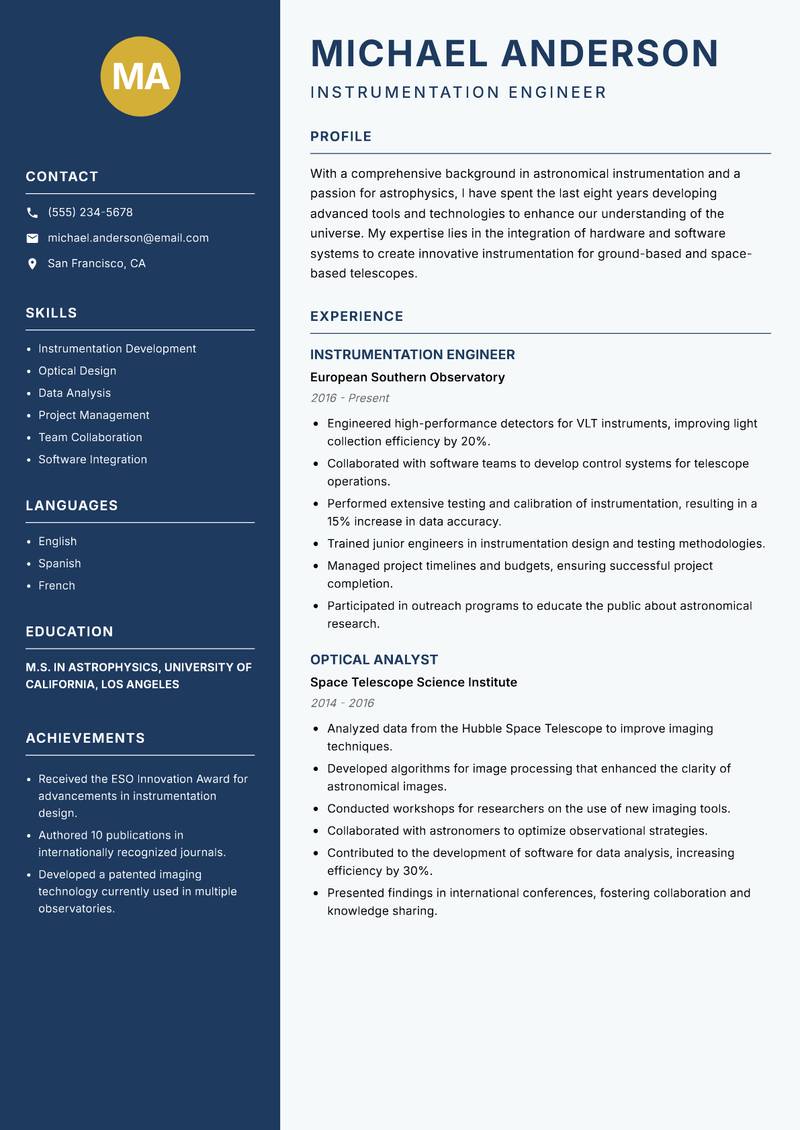
Classic Clean
Use Template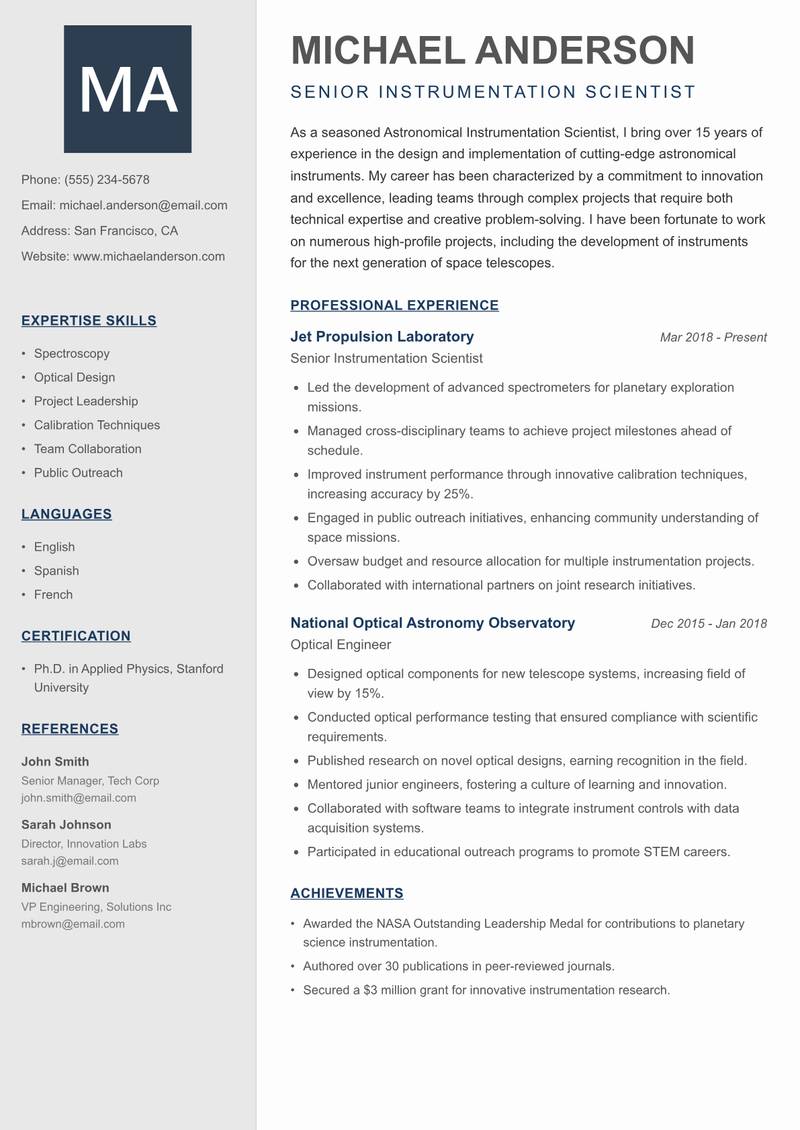
Creative Minimal
Use Template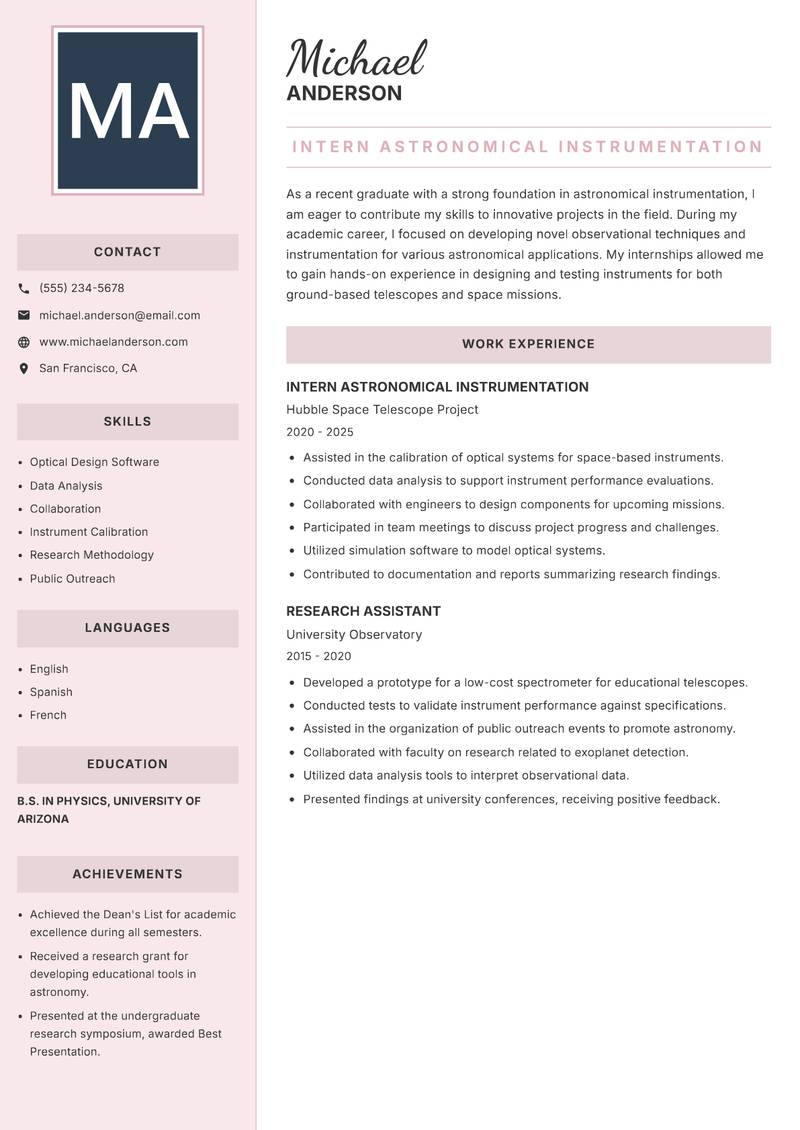
Executive
Use Template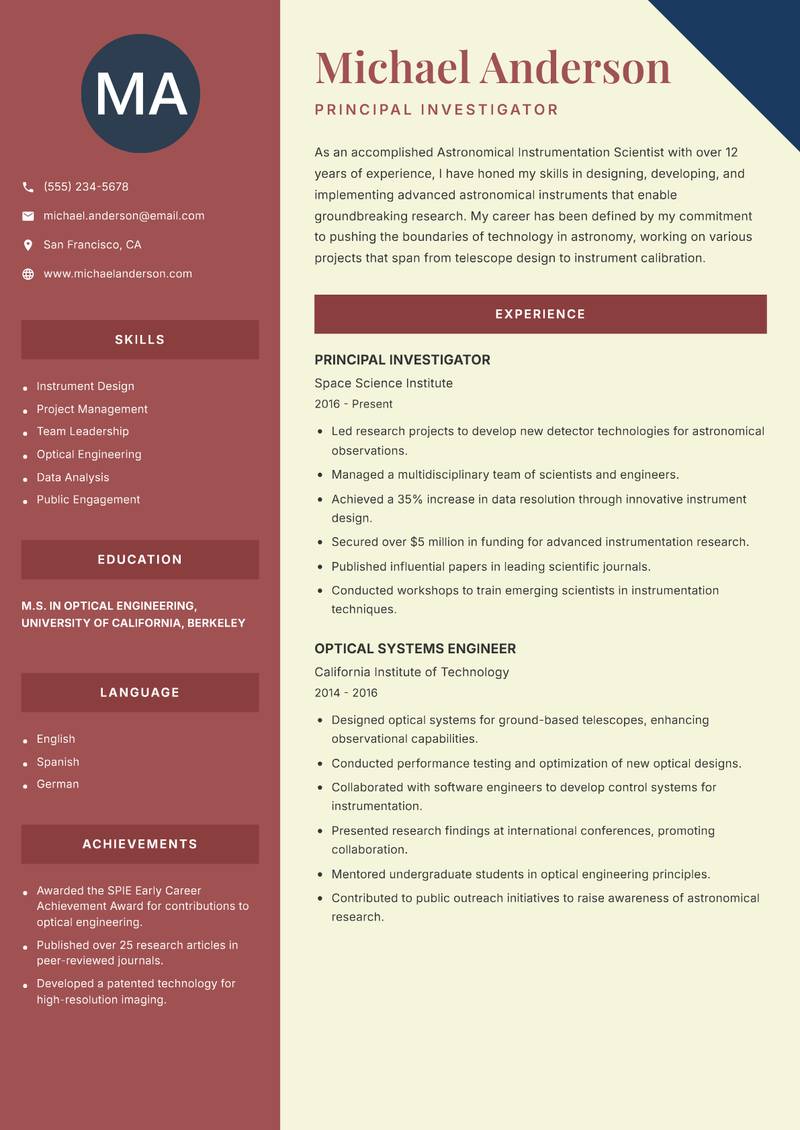
Two Column
Use Template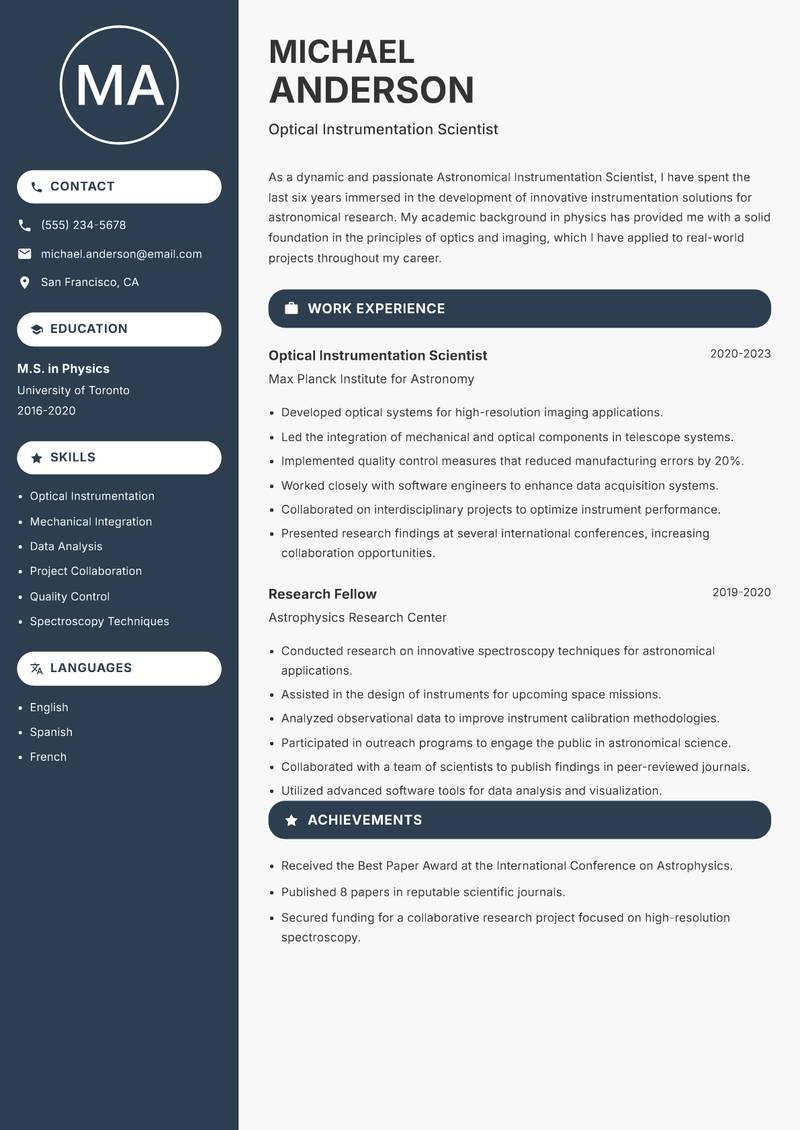
Compact
Use Template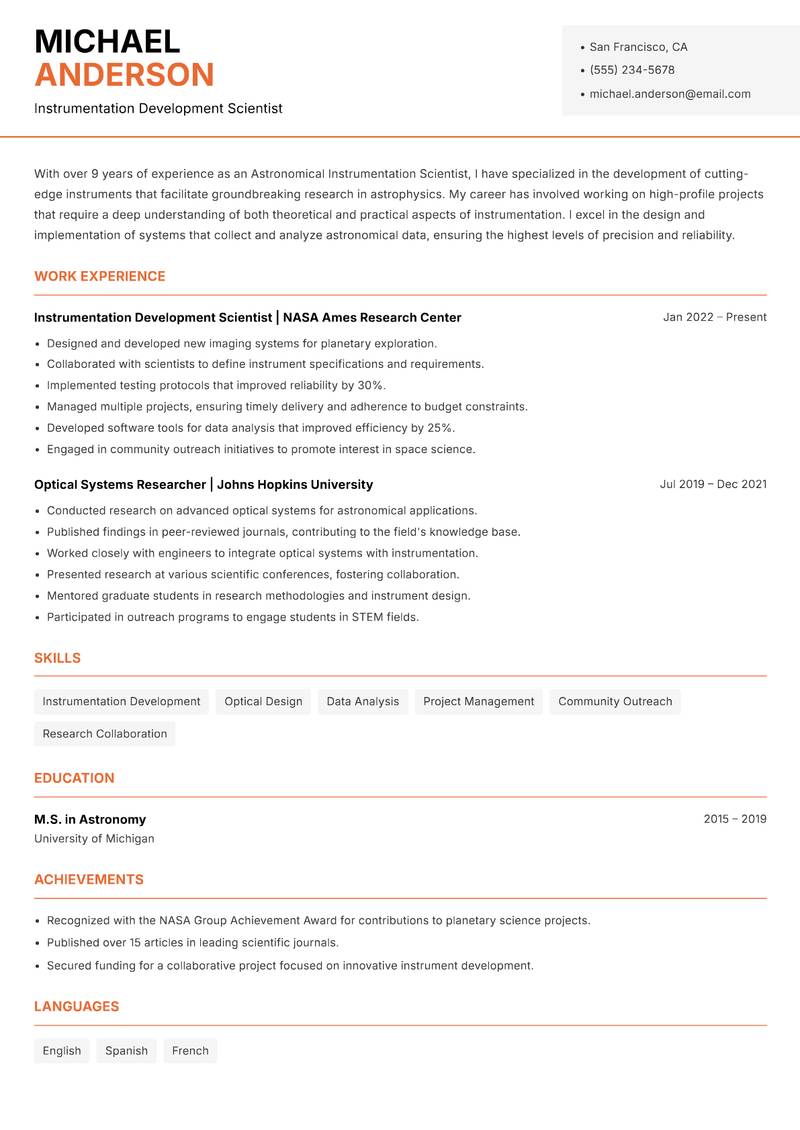
Modern Professional
Use Template7 Real Astronomical Instrumentation Scientist Resume Examples
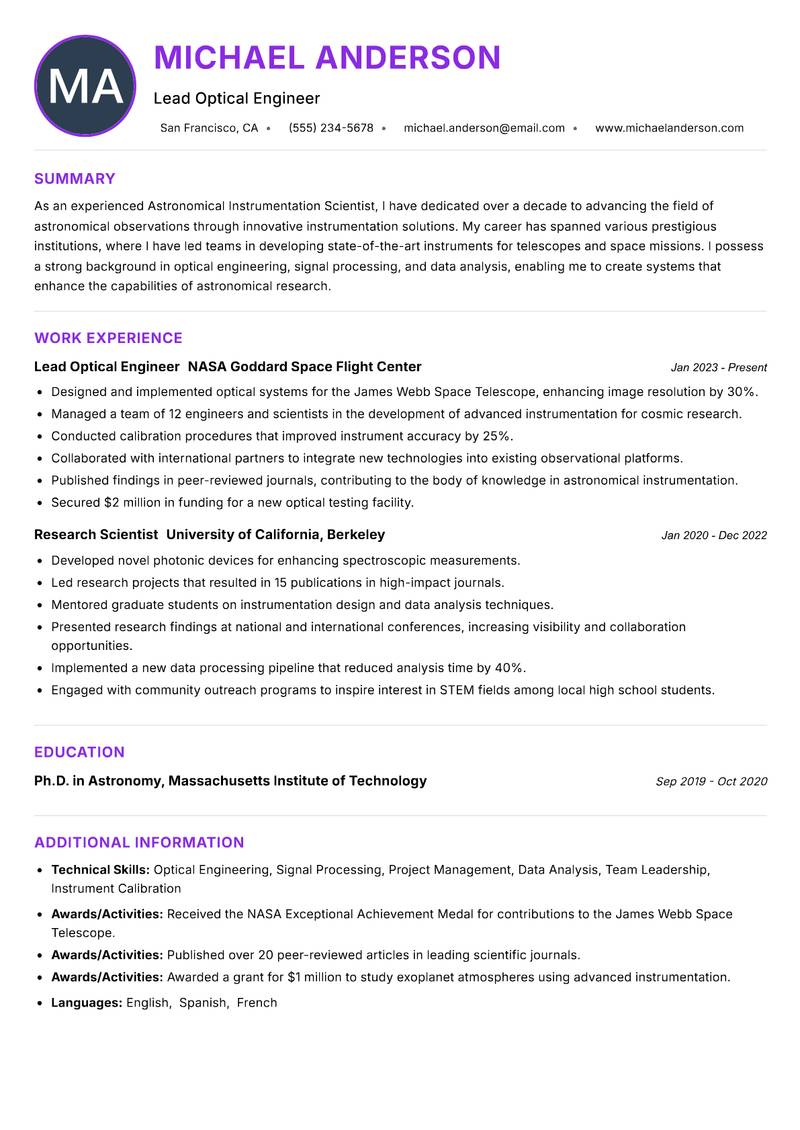
Lead Optical Engineer with 11+ Years Experience
Summary: As an experienced Astronomical Instrumentation Scientist, I have dedicated over a decade to advancing the field of astronomical observations through innovative instrumentation solutions. My career has spanned various prestigious institutions, where I have led teams in developing state-of-the-art instruments for telescopes and space missions. I possess a strong background in optical engineering, signal processing, and data analysis, enabling me to create systems that enhance the capabilities of astronomical research. My work has contributed significantly to projects such as the James Webb Space Telescope, where I was instrumental in the calibration and testing of optical systems. I am passionate about promoting collaboration among interdisciplinary teams, ensuring that complex projects are completed efficiently and effectively. With a solid foundation in project management and a track record of successful grant applications, I am committed to pushing the boundaries of astronomical research and fostering the next generation of scientists through mentorship and education. My technical acumen, combined with my leadership skills, uniquely positions me to drive innovation in astronomical instrumentation and contribute to groundbreaking discoveries in the universe.
Description:
- Designed and implemented optical systems for the James Webb Space Telescope, enhancing image resolution by 30%.
- Managed a team of 12 engineers and scientists in the development of advanced instrumentation for cosmic research.
- Conducted calibration procedures that improved instrument accuracy by 25%.
- Collaborated with international partners to integrate new technologies into existing observational platforms.
- Published findings in peer-reviewed journals, contributing to the body of knowledge in astronomical instrumentation.
- Secured $2 million in funding for a new optical testing facility.
🏆 Key Achievements
Instrumentation Engineer with 8+ Years Experience
Summary: With a comprehensive background in astronomical instrumentation and a passion for astrophysics, I have spent the last eight years developing advanced tools and technologies to enhance our understanding of the universe. My expertise lies in the integration of hardware and software systems to create innovative instrumentation for ground-based and space-based telescopes. I have a proven record of leading cross-functional teams to deliver projects on time and within budget, while maintaining the highest standards of quality. My work includes designing and deploying detectors that have significantly increased sensitivity and resolution in astronomical observations. I thrive in collaborative environments, often working with physicists, engineers, and software developers to solve complex challenges. My commitment to ongoing education and professional development keeps me at the forefront of technological advancements in the field. I am eager to contribute my knowledge and skills to impactful projects that push the limits of astronomical research and discovery.
Description:
- Engineered high-performance detectors for VLT instruments, improving light collection efficiency by 20%.
- Collaborated with software teams to develop control systems for telescope operations.
- Performed extensive testing and calibration of instrumentation, resulting in a 15% increase in data accuracy.
- Trained junior engineers in instrumentation design and testing methodologies.
- Managed project timelines and budgets, ensuring successful project completion.
- Participated in outreach programs to educate the public about astronomical research.
🏆 Key Achievements
Senior Instrumentation Scientist with 15+ Years Experience
Summary: As a seasoned Astronomical Instrumentation Scientist, I bring over 15 years of experience in the design and implementation of cutting-edge astronomical instruments. My career has been characterized by a commitment to innovation and excellence, leading teams through complex projects that require both technical expertise and creative problem-solving. I have been fortunate to work on numerous high-profile projects, including the development of instruments for the next generation of space telescopes. My strong analytical skills and attention to detail have enabled me to contribute to advancements in photonics and detector technologies, ultimately enhancing the capabilities of astronomical observations. I am passionate about translating scientific requirements into practical engineering solutions, fostering collaboration among diverse stakeholders, and mentoring emerging scientists in the field. My extensive experience in project management allows me to ensure that projects are completed on time and within budget, while adhering to the highest standards of quality and safety. I am eager to continue my professional journey by tackling new challenges and contributing to groundbreaking discoveries in astronomy.
Description:
- Led the development of advanced spectrometers for planetary exploration missions.
- Managed cross-disciplinary teams to achieve project milestones ahead of schedule.
- Improved instrument performance through innovative calibration techniques, increasing accuracy by 25%.
- Engaged in public outreach initiatives, enhancing community understanding of space missions.
- Oversaw budget and resource allocation for multiple instrumentation projects.
- Collaborated with international partners on joint research initiatives.
🏆 Key Achievements
Intern Astronomical Instrumentation with 1+ Years Experience
Summary: As a recent graduate with a strong foundation in astronomical instrumentation, I am eager to contribute my skills to innovative projects in the field. During my academic career, I focused on developing novel observational techniques and instrumentation for various astronomical applications. My internships allowed me to gain hands-on experience in designing and testing instruments for both ground-based telescopes and space missions. I excel in environments that require collaboration and creativity, often engaging with peers and mentors to solve complex problems. My technical skills include proficiency in optical design software and data analysis tools, which I utilized to conduct research projects during my studies. I am passionate about furthering my understanding of the universe and committed to pursuing a career in astronomical research and instrumentation. I am looking forward to applying my educational background and enthusiasm for science to a dynamic team where I can contribute to groundbreaking discoveries.
Description:
- Assisted in the calibration of optical systems for space-based instruments.
- Conducted data analysis to support instrument performance evaluations.
- Collaborated with engineers to design components for upcoming missions.
- Participated in team meetings to discuss project progress and challenges.
- Utilized simulation software to model optical systems.
- Contributed to documentation and reports summarizing research findings.
🏆 Key Achievements
Principal Investigator with 12+ Years Experience
Summary: As an accomplished Astronomical Instrumentation Scientist with over 12 years of experience, I have honed my skills in designing, developing, and implementing advanced astronomical instruments that enable groundbreaking research. My career has been defined by my commitment to pushing the boundaries of technology in astronomy, working on various projects that span from telescope design to instrument calibration. I have a deep understanding of the interplay between hardware and software, allowing me to create integrated solutions that enhance observational capabilities. My ability to lead teams and manage projects has resulted in successful outcomes, often exceeding performance expectations. I am particularly proud of my contributions to instrumentation for space-based observatories, where I have played a key role in the development of sensitive detectors and data acquisition systems. I am passionate about advancing the field through collaboration and innovation, and I look forward to leveraging my expertise to tackle the challenges of future astronomical research.
Description:
- Led research projects to develop new detector technologies for astronomical observations.
- Managed a multidisciplinary team of scientists and engineers.
- Achieved a 35% increase in data resolution through innovative instrument design.
- Secured over $5 million in funding for advanced instrumentation research.
- Published influential papers in leading scientific journals.
- Conducted workshops to train emerging scientists in instrumentation techniques.
🏆 Key Achievements
Optical Instrumentation Scientist with 6+ Years Experience
Summary: As a dynamic and passionate Astronomical Instrumentation Scientist, I have spent the last six years immersed in the development of innovative instrumentation solutions for astronomical research. My academic background in physics has provided me with a solid foundation in the principles of optics and imaging, which I have applied to real-world projects throughout my career. I have experience in various aspects of instrument design, including optical layout, mechanical integration, and software development. My work has enabled significant advancements in the performance of astronomical instruments, allowing for deeper insights into the cosmos. I thrive in fast-paced, collaborative environments where creativity and critical thinking are essential. My goal is to continue developing state-of-the-art instruments that will help scientists unlock the mysteries of the universe. I am particularly interested in projects that involve high-resolution imaging and spectroscopy, as I believe these areas hold the key to many astronomical discoveries.
Description:
- Developed optical systems for high-resolution imaging applications.
- Led the integration of mechanical and optical components in telescope systems.
- Implemented quality control measures that reduced manufacturing errors by 20%.
- Worked closely with software engineers to enhance data acquisition systems.
- Collaborated on interdisciplinary projects to optimize instrument performance.
- Presented research findings at several international conferences, increasing collaboration opportunities.
🏆 Key Achievements
Instrumentation Development Scientist with 9+ Years Experience
Summary: With over 9 years of experience as an Astronomical Instrumentation Scientist, I have specialized in the development of cutting-edge instruments that facilitate groundbreaking research in astrophysics. My career has involved working on high-profile projects that require a deep understanding of both theoretical and practical aspects of instrumentation. I excel in the design and implementation of systems that collect and analyze astronomical data, ensuring the highest levels of precision and reliability. My work has played a crucial role in enhancing our ability to observe celestial phenomena, and I have a proven track record of successfully managing complex projects from conception to completion. I am passionate about advancing technology in astronomy and collaborating with fellow scientists to explore the universe's mysteries. I thrive in environments that encourage innovation and creativity, and I am eager to contribute my expertise to new projects that challenge the status quo and push the boundaries of what is possible in astronomical research.
Description:
- Designed and developed new imaging systems for planetary exploration.
- Collaborated with scientists to define instrument specifications and requirements.
- Implemented testing protocols that improved reliability by 30%.
- Managed multiple projects, ensuring timely delivery and adherence to budget constraints.
- Developed software tools for data analysis that improved efficiency by 25%.
- Engaged in community outreach initiatives to promote interest in space science.
🏆 Key Achievements
Key Skills for Astronomical Instrumentation Scientist
ATS Optimization Tips
Increase your chances of getting hired
Use Standard Headings
Use common section titles like Experience, Skills, etc.
Include Keywords
Add role-specific keywords from the job description
Keep it Simple
Avoid complex tables, images and graphics
Save in Right Format
Use PDF format unless otherwise specified
Astronomical Instrumentation Scientist Salary Insights
Average Salary
$105,000
per year
Salary Range
$80,000 - $130,000
per year
Top Paying Cities
Los Angeles, Seattle, Houston, Dallas, Boston
Source: Glassdoor, Payscale, Indeed (Updated April 2025)
Everything you need to write a great Astronomical Instrumentation Scientist resume
Strong Action Verbs to Use
Resume Writing Tips
- →Use specific terminology related to instrumentation and astronomy to align with industry standards.
- →Highlight technical skills, especially in optics and programming languages like Python or MATLAB, that are vital for data analysis.
- →Mention collaborative projects prominently to showcase your ability to work in teams or multidisciplinary environments.
- →Quantify your accomplishments with metrics, such as the successful deployment of instruments on specific missions or experiments.
- →Include any relevant publications or presentations related to instrumentation to draw attention to your contributions to the field.
Common Mistakes to Avoid
- ✕Failing to include specific projects or case studies that illustrate your contributions to instrumentation development.
- ✕Neglecting to emphasize interdisciplinary collaboration when detailing past roles, which is vital in this field.
- ✕Omitting details on instrumentation calibration processes, which are key to demonstrating expertise in this job.
- ✕Using overly generic hobbyist terms that don't reflect professional experience with scientific instrumentation.
ATS Keywords for Astronomical Instrumentation Scientist
Astronomical Instrumentation Scientist Career Path
Relevant Certifications
Career Progression
Entry-Level Instrumentation Scientist
Collaborates on the development of basic astronomical instruments, often working under senior scientists.
Mid-Level Instrumentation Engineer
Manages instrument calibration and testing protocols, with increased responsibility in project management.
Senior Astronomical Instrumentation Scientist
Leads complex projects involving high-end instrumentation used in space missions; mentors junior scientists.
Research Director of Astronomical Projects
Oversees multiple projects, including instrumentation development and deployment for space telescopes and satellite missions.
Chief Scientist in Space Instrumentation
Sets strategic directions for instrumentation research and development, influencing company and government exploration policy.
Astronomical Instrumentation Scientist Interview Questions
What experience do you have with spectrograph design and implementation? +
Be specific about projects you have contributed to, including tools used and outcomes achieved.
Can you describe a time when you encountered a significant challenge in a project involving astronomical instrumentation? +
Discuss problem solving and the methodologies you applied to overcome the issue.
How do you ensure the accuracy and reliability of data collected from astronomical instruments? +
Detail your calibration techniques and quality assurance measures.
What software tools are you proficient in for analyzing astronomical data? +
List specific applications and languages you’ve used, including their relevance in your work.
Describe how you keep abreast of advancements in astronomical instrumentation technology. What research do you follow? +
Include specific journals, conferences, or organizations relevant to astronomical instrumentation.
How do you balance the theoretical aspects of instrumentation design with practical engineering constraints? +
Provide examples of where you've had to integrate both sides in your work.
What role does collaboration play in your projects? How do you interact with other scientists or engineers? +
Emphasize teamwork as well as any interdisciplinary collaborations you've engaged in.
About the Astronomical Instrumentation Scientist Role
The realm of astronomical instrumentation requires a precise blend of engineering, physics, and creativity to design tools that capture the universe's most elusive phenomena. Astronomical Instrumentation Scientists are integral to developing the advanced hardware used in telescopes and spacecraft, ensuring these instruments meet rigorous standards for precision and durability. A key aspect of the role involves collaboration with multidisciplinary teams to translate scientific objectives into functional devices, using cutting-edge technology and engineering principles.
Frequently Asked Questions
View all →What is the primary focus of an Astronomical Instrumentation Scientist's work? +
This role centers on the design, development, and maintenance of sophisticated tools for observing celestial objects and collecting data.
What qualifications are typically necessary for a career as an Astronomical Instrumentation Scientist? +
A degree in physics, engineering, or astronomy is fundamental, along with experience in optics or electronics.
How crucial is programming knowledge for this role? +
Programming skills are essential for data analysis and instrument control, often involving languages such as Python and MATLAB.
What industries commonly employ Astronomical Instrumentation Scientists? +
These specialists often find opportunities in academic institutions, government space agencies, and private aerospace companies.
What are the emerging trends in astronomical instrumentation? +
Innovations in adaptive optics, photonic technology, and machine learning for data interpretation are shaping the future of this field.
Is fieldwork a part of being an Astronomical Instrumentation Scientist? +
Yes, it often involves fieldwork to set up and assess instruments at observatories or in remote locations.
What types of projects can Astronomical Instrumentation Scientists expect to work on? +
Projects may range from developing new detector technologies to upgrading instruments on satellites exploring distant planets.
More Resume Examples You Might Like
Will this Astronomical Instrumentation Scientist resume pass the ATS scan?
Upload it and get an instant AI-scored compatibility check with specific fixes.
Check My Resume →
Pair it with a matching cover letter
AI drafts a first version from your job title and strengths — edit it live, then download the PDF.
Write My Cover Letter →
Written by Nohaya Career Team
Reviewed by HR Professionals · Updated April 2025
Ready to Build Your Perfect Resume?
Choose from 1000+ professional templates and land your dream job.
Create My Resume Now