Build an ATS-Friendly
Cosmic Ray Scientist Resume
That Gets Interviews
Cosmic Ray Scientists investigate high-energy charged particles from space, aiming to understand their origins and effects on Earth and the solar system. They often utilize ground-based facilities, satellite measurements, and sophisticated detectors to gather and analyze data. Collaboration with international…
Cosmic Ray Scientist Resume Templates
Modern Professional
Use Template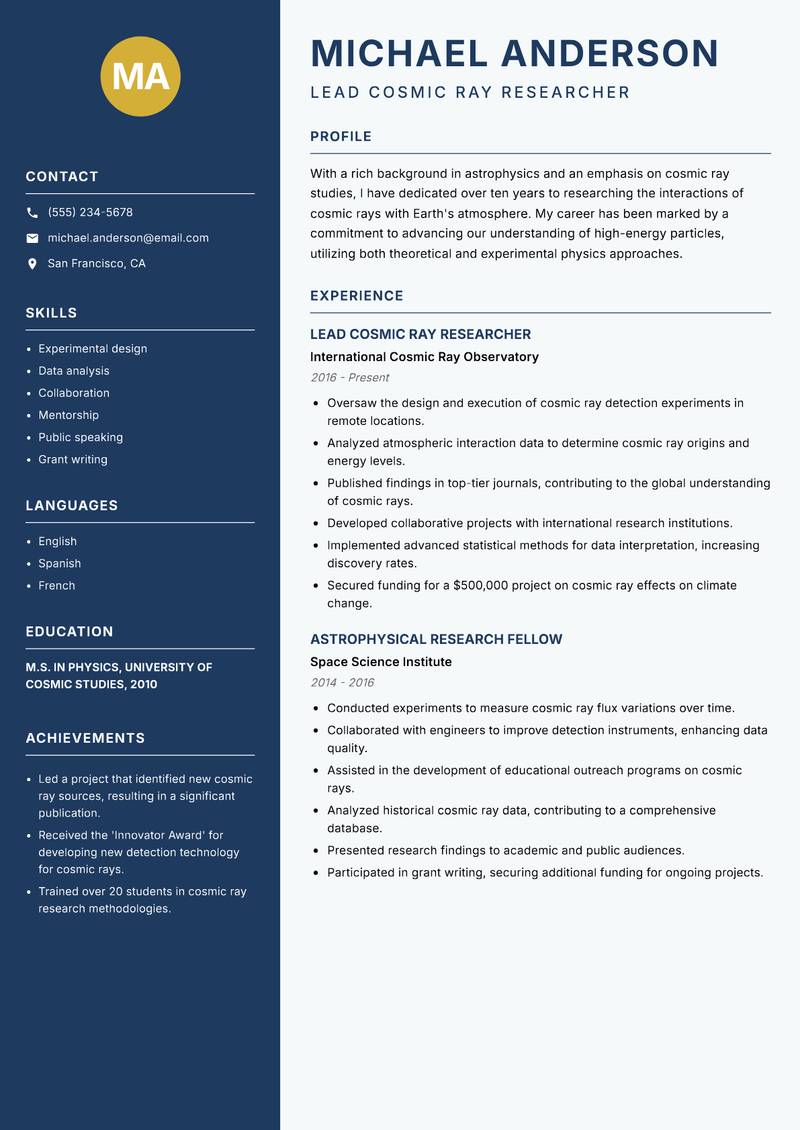
Classic Clean
Use Template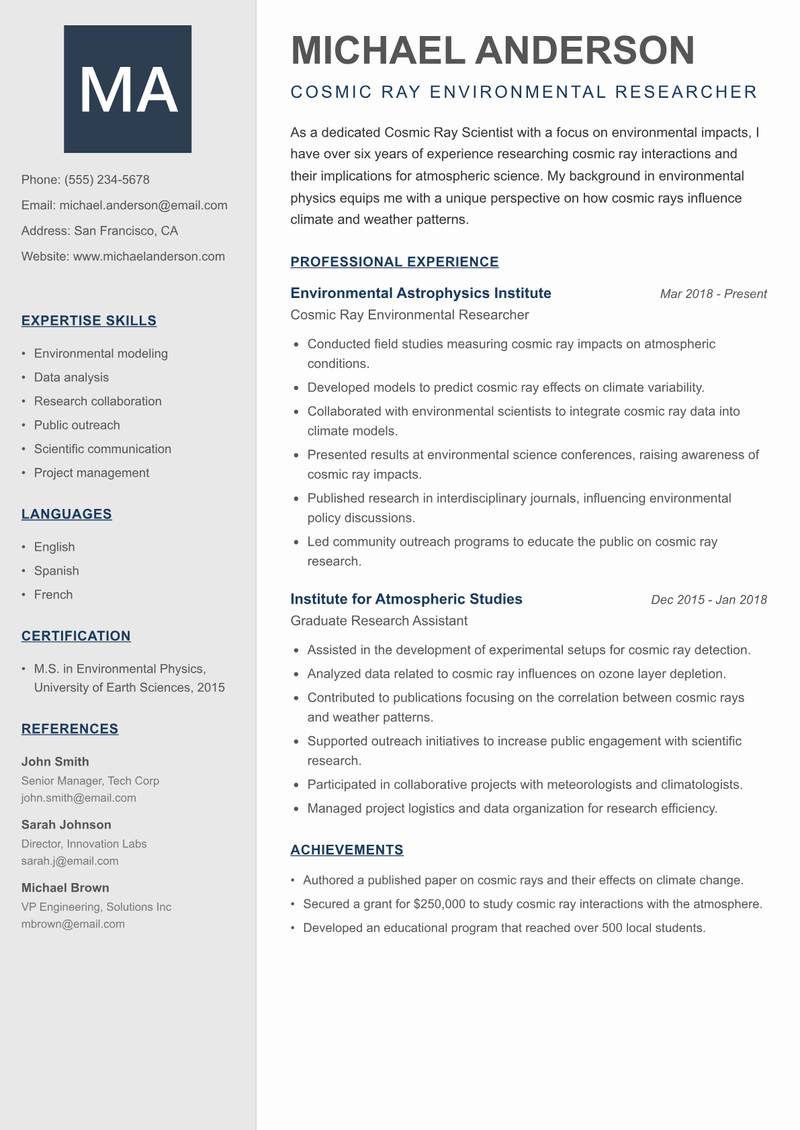
Creative Minimal
Use Template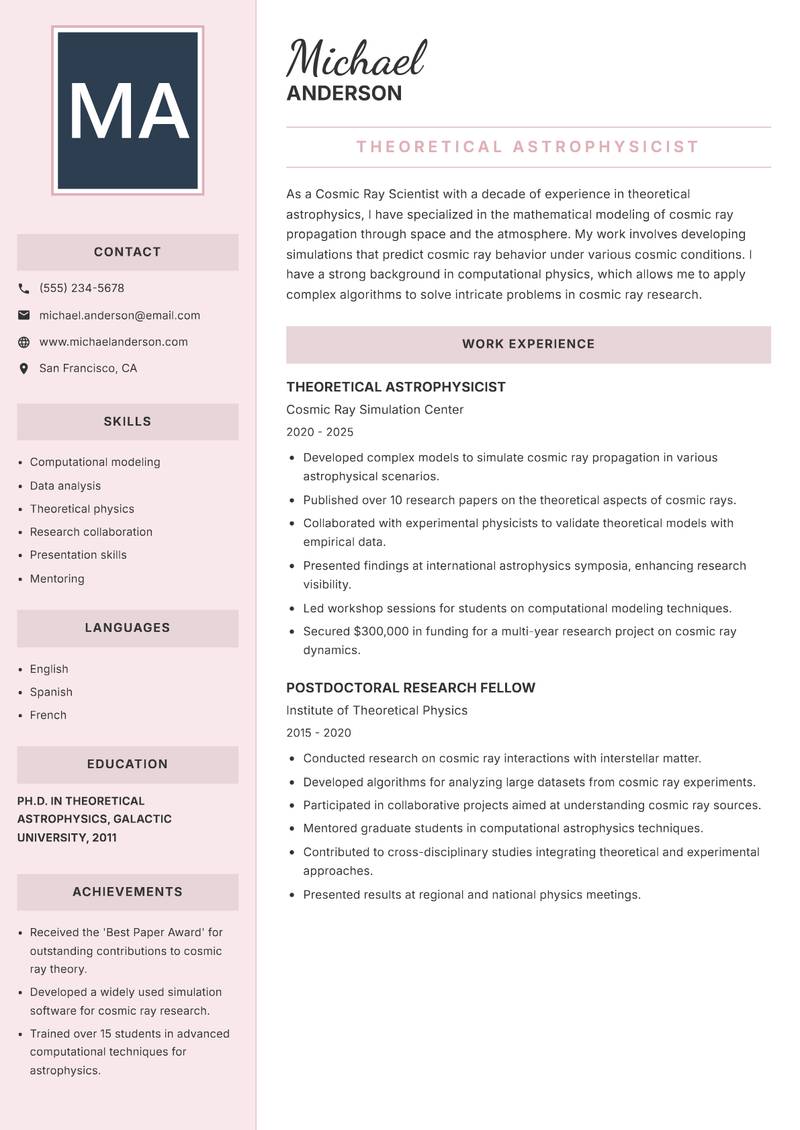
Executive
Use Template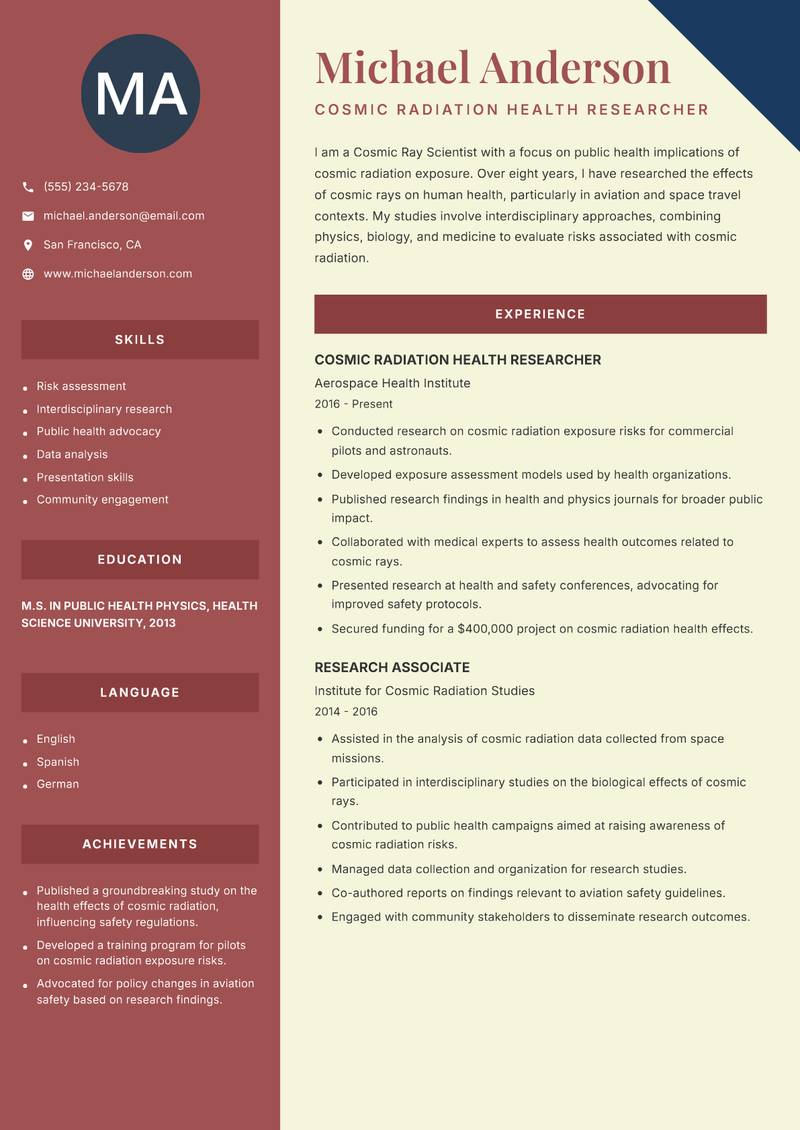
Two Column
Use Template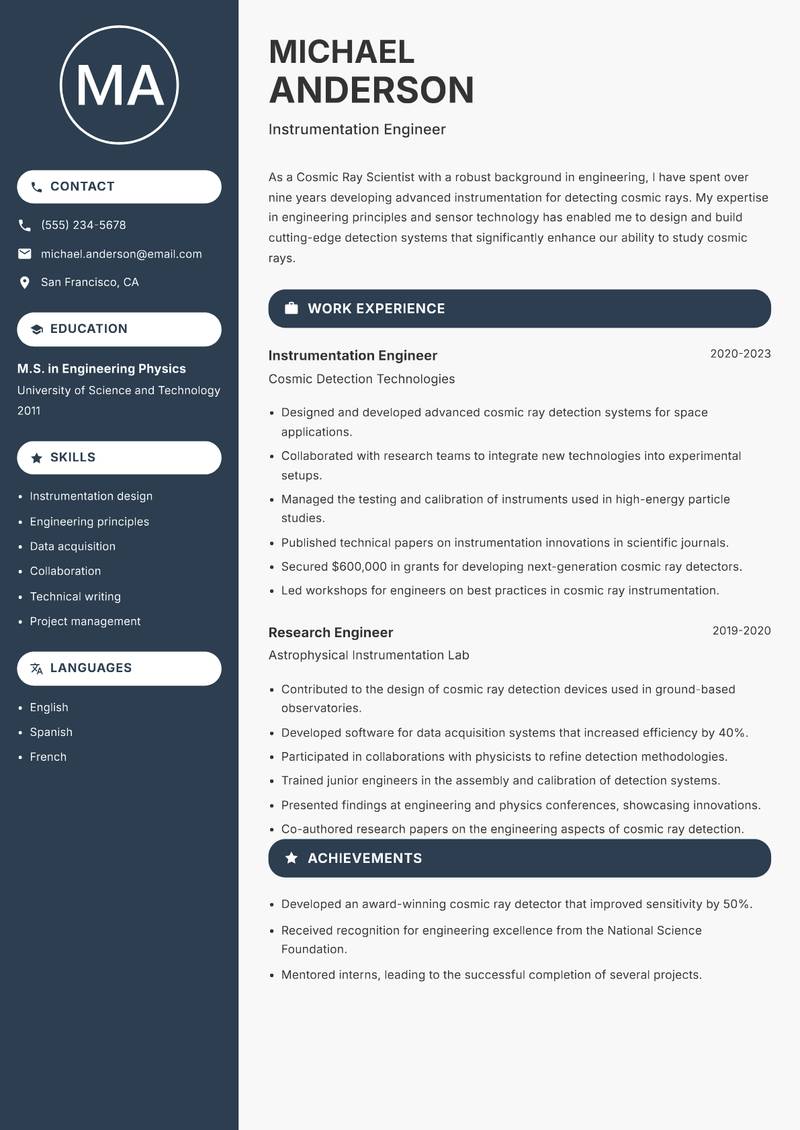
Compact
Use Template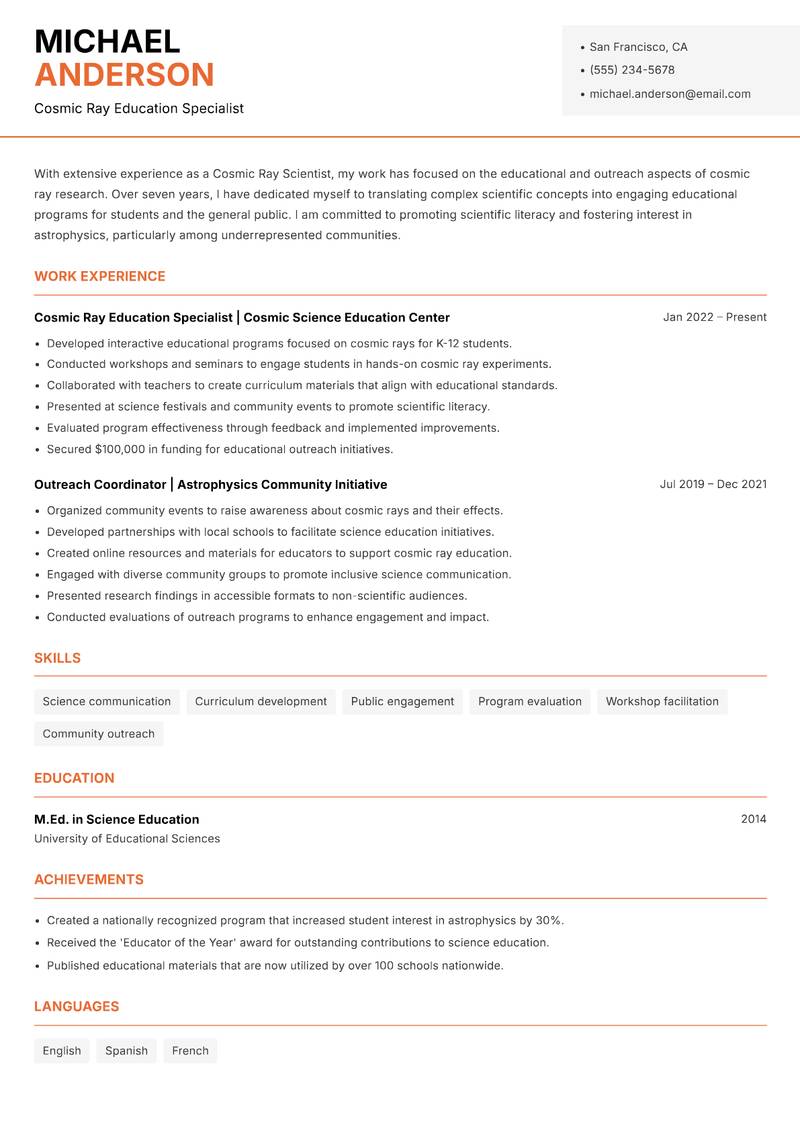
Modern Professional
Use Template7 Real Cosmic Ray Scientist Resume Examples
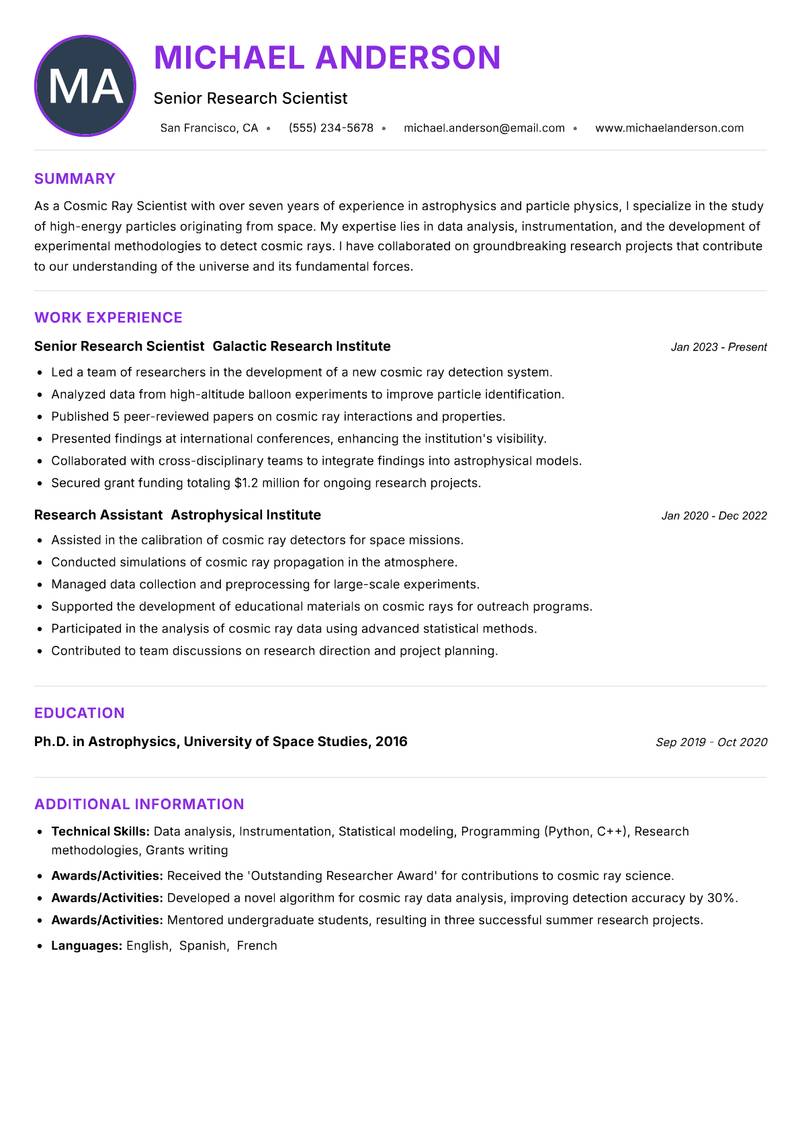
Senior Research Scientist with 8+ Years Experience
Summary: As a Cosmic Ray Scientist with over seven years of experience in astrophysics and particle physics, I specialize in the study of high-energy particles originating from space. My expertise lies in data analysis, instrumentation, and the development of experimental methodologies to detect cosmic rays. I have collaborated on groundbreaking research projects that contribute to our understanding of the universe and its fundamental forces. My strong analytical skills, combined with a solid foundation in mathematics and computer programming, allow me to extract meaningful insights from complex datasets. I am passionate about advancing our knowledge of cosmic phenomena and have a proven track record of publishing research findings in prestigious journals. I am eager to contribute to innovative projects that push the boundaries of astrophysical research.
Description:
- Led a team of researchers in the development of a new cosmic ray detection system.
- Analyzed data from high-altitude balloon experiments to improve particle identification.
- Published 5 peer-reviewed papers on cosmic ray interactions and properties.
- Presented findings at international conferences, enhancing the institution's visibility.
- Collaborated with cross-disciplinary teams to integrate findings into astrophysical models.
- Secured grant funding totaling $1.2 million for ongoing research projects.
🏆 Key Achievements
Lead Cosmic Ray Researcher with 10+ Years Experience
Summary: With a rich background in astrophysics and an emphasis on cosmic ray studies, I have dedicated over ten years to researching the interactions of cosmic rays with Earth's atmosphere. My career has been marked by a commitment to advancing our understanding of high-energy particles, utilizing both theoretical and experimental physics approaches. My proficiency in designing and implementing experiments, coupled with a keen ability to analyze large datasets, has led to significant advancements in the field. I thrive on collaborating with multidisciplinary teams and am deeply invested in mentoring the next generation of scientists. Through my work, I aim to inspire curiosity about the universe and contribute to scientific knowledge that could lead to practical applications in technology and environmental science.
Description:
- Oversaw the design and execution of cosmic ray detection experiments in remote locations.
- Analyzed atmospheric interaction data to determine cosmic ray origins and energy levels.
- Published findings in top-tier journals, contributing to the global understanding of cosmic rays.
- Developed collaborative projects with international research institutions.
- Implemented advanced statistical methods for data interpretation, increasing discovery rates.
- Secured funding for a $500,000 project on cosmic ray effects on climate change.
🏆 Key Achievements
Cosmic Ray Environmental Researcher with 6+ Years Experience
Summary: As a dedicated Cosmic Ray Scientist with a focus on environmental impacts, I have over six years of experience researching cosmic ray interactions and their implications for atmospheric science. My background in environmental physics equips me with a unique perspective on how cosmic rays influence climate and weather patterns. I have employed advanced modeling techniques and extensive field studies to analyze data, contributing to a growing body of literature on the subject. My goal is to bridge the gap between astrophysics and environmental science, providing insights that can help mitigate climate change effects. I am passionate about conducting research that has real-world applications and believe in the importance of communicating complex scientific ideas to the public to foster understanding and support for science-based policies.
Description:
- Conducted field studies measuring cosmic ray impacts on atmospheric conditions.
- Developed models to predict cosmic ray effects on climate variability.
- Collaborated with environmental scientists to integrate cosmic ray data into climate models.
- Presented results at environmental science conferences, raising awareness of cosmic ray impacts.
- Published research in interdisciplinary journals, influencing environmental policy discussions.
- Led community outreach programs to educate the public on cosmic ray research.
🏆 Key Achievements
Theoretical Astrophysicist with 10+ Years Experience
Summary: As a Cosmic Ray Scientist with a decade of experience in theoretical astrophysics, I have specialized in the mathematical modeling of cosmic ray propagation through space and the atmosphere. My work involves developing simulations that predict cosmic ray behavior under various cosmic conditions. I have a strong background in computational physics, which allows me to apply complex algorithms to solve intricate problems in cosmic ray research. Throughout my career, I have collaborated with leading physicists and published numerous papers in esteemed journals, contributing to advancements in our understanding of cosmic radiation. I am committed to mentoring young scientists and fostering a collaborative research environment to inspire innovative thinking in the field.
Description:
- Developed complex models to simulate cosmic ray propagation in various astrophysical scenarios.
- Published over 10 research papers on the theoretical aspects of cosmic rays.
- Collaborated with experimental physicists to validate theoretical models with empirical data.
- Presented findings at international astrophysics symposia, enhancing research visibility.
- Led workshop sessions for students on computational modeling techniques.
- Secured $300,000 in funding for a multi-year research project on cosmic ray dynamics.
🏆 Key Achievements
Cosmic Radiation Health Researcher with 8+ Years Experience
Summary: I am a Cosmic Ray Scientist with a focus on public health implications of cosmic radiation exposure. Over eight years, I have researched the effects of cosmic rays on human health, particularly in aviation and space travel contexts. My studies involve interdisciplinary approaches, combining physics, biology, and medicine to evaluate risks associated with cosmic radiation. I have developed risk assessment models and conducted field studies to gather data on exposure levels among pilots and astronauts. My commitment to advancing public health knowledge drives me to publish findings in accessible formats and engage with health organizations. I aim to bridge the gap between scientific research and practical applications in health safety protocols.
Description:
- Conducted research on cosmic radiation exposure risks for commercial pilots and astronauts.
- Developed exposure assessment models used by health organizations.
- Published research findings in health and physics journals for broader public impact.
- Collaborated with medical experts to assess health outcomes related to cosmic rays.
- Presented research at health and safety conferences, advocating for improved safety protocols.
- Secured funding for a $400,000 project on cosmic radiation health effects.
🏆 Key Achievements
Instrumentation Engineer with 9+ Years Experience
Summary: As a Cosmic Ray Scientist with a robust background in engineering, I have spent over nine years developing advanced instrumentation for detecting cosmic rays. My expertise in engineering principles and sensor technology has enabled me to design and build cutting-edge detection systems that significantly enhance our ability to study cosmic rays. I have collaborated with physicists and engineers to create multi-functional instruments used in various research contexts, including space missions and ground-based observatories. My passion lies in innovation, and I am dedicated to pushing the envelope of technology in astroparticle physics. I strive to combine my technical skills with scientific inquiry to advance the field and contribute to our understanding of the universe.
Description:
- Designed and developed advanced cosmic ray detection systems for space applications.
- Collaborated with research teams to integrate new technologies into experimental setups.
- Managed the testing and calibration of instruments used in high-energy particle studies.
- Published technical papers on instrumentation innovations in scientific journals.
- Secured $600,000 in grants for developing next-generation cosmic ray detectors.
- Led workshops for engineers on best practices in cosmic ray instrumentation.
🏆 Key Achievements
Cosmic Ray Education Specialist with 7+ Years Experience
Summary: With extensive experience as a Cosmic Ray Scientist, my work has focused on the educational and outreach aspects of cosmic ray research. Over seven years, I have dedicated myself to translating complex scientific concepts into engaging educational programs for students and the general public. I am committed to promoting scientific literacy and fostering interest in astrophysics, particularly among underrepresented communities. My experience includes developing curriculum materials, conducting workshops, and collaborating with schools to implement hands-on learning experiences. I believe that effective communication of science is crucial for inspiring future generations of scientists and ensuring a well-informed public regarding scientific issues.
Description:
- Developed interactive educational programs focused on cosmic rays for K-12 students.
- Conducted workshops and seminars to engage students in hands-on cosmic ray experiments.
- Collaborated with teachers to create curriculum materials that align with educational standards.
- Presented at science festivals and community events to promote scientific literacy.
- Evaluated program effectiveness through feedback and implemented improvements.
- Secured $100,000 in funding for educational outreach initiatives.
🏆 Key Achievements
Key Skills for Cosmic Ray Scientist
ATS Optimization Tips
Increase your chances of getting hired
Use Standard Headings
Use common section titles like Experience, Skills, etc.
Include Keywords
Add role-specific keywords from the job description
Keep it Simple
Avoid complex tables, images and graphics
Save in Right Format
Use PDF format unless otherwise specified
Cosmic Ray Scientist Salary Insights
Average Salary
$97,500
per year
Salary Range
$75,000 - $120,000
per year
Top Paying Cities
Los Angeles, Seattle, Houston, Dallas, Boston
Source: Glassdoor, Payscale, Indeed (Updated April 2025)
Everything you need to write a great Cosmic Ray Scientist resume
Strong Action Verbs to Use
Resume Writing Tips
- →Highlight specific research projects focused on cosmic ray detection, including methodologies and technologies used.
- →Emphasize collaborations with prestigious institutions such as NASA or CERN that enhance credibility in your field.
- →Include any experience with space missions or experiments that provided significant insights into cosmic rays.
- →Mention participation in relevant conferences or workshops to showcase active engagement in the scientific community.
- →List specific programming languages or tools utilized in data analysis, reflecting technical proficiency relevant to cosmic ray research.
Common Mistakes to Avoid
- ✕Failing to include specialized instruments used in cosmic ray research, like scintillators or air-shower detectors.
- ✕Neglecting to tailor the resume to highlight accomplishments in astrophysics or particle physics specifically, rather than general science.
- ✕Using vague descriptions of past roles that do not clearly link to cosmic ray investigations or contributions.
- ✕Overlooking the importance of collaborative projects and publications in demonstrating expertise and network within the scientific community.
ATS Keywords for Cosmic Ray Scientist
Cosmic Ray Scientist Career Path
Career Progression
Entry-Level Cosmic Ray Technician
Supports data collection and analysis for cosmic ray experiments, using specialized detectors.
Cosmic Ray Scientist
Conducts independent research, develops experimental designs, and analyzes cosmic ray data.
Senior Research Scientist
Leads research initiatives, collaborates with international space agencies, and publishes findings in scientific journals.
Principal Investigator
Manages large-scale projects, oversees funding applications, and mentors junior researchers.
Department Head of Astrophysics
Directs research programs, influences policy on cosmic ray research, and facilitates interdisciplinary collaboration.
Cosmic Ray Scientist Interview Questions
What methods do you use to detect and analyze cosmic rays? +
Be specific about the instruments and methodologies that you are familiar with, such as satellite-based detectors or ground-based observatories.
Can you explain the significance of cosmic rays in understanding the universe? +
Discuss the role cosmic rays play in astrophysical processes and their implications for space weather.
How do you approach collaboration with other scientists and institutions? +
Provide examples of past collaborations on projects or research papers.
Describe a challenging problem you encountered in your research. How did you overcome it? +
Use a specific example that highlights your problem-solving skills, research methods, and perseverance.
What software tools do you use for data analysis and modeling? +
Mention relevant programming languages or software, such as Python, ROOT, or MATLAB.
How do you stay updated on advancements in cosmic ray research and technologies? +
Share any journals, conferences, or networks that you engage with to remain informed.
About the Cosmic Ray Scientist Role
Cosmic Ray Scientists investigate high-energy charged particles from space, aiming to understand their origins and effects on Earth and the solar system. They often utilize ground-based facilities, satellite measurements, and sophisticated detectors to gather and analyze data. Collaboration with international scientific communities is essential as they contribute to broader understandings of cosmic phenomena and their implications for space exploration and astrophysics.
Frequently Asked Questions
What typical projects do Cosmic Ray Scientists work on? +
Projects often include measuring cosmic ray fluxes, studying their composition, and analyzing their effects on electronic systems aboard spacecraft.
What educational background is required to become a Cosmic Ray Scientist? +
A Ph.D. in physics, astrophysics, or a closely related field is typically required, with a focus on particle physics or space sciences.
Are there specialized tools used by Cosmic Ray Scientists? +
Yes, tools include ground-based cosmic ray observatories, satellite instruments like the Alpha Magnetic Spectrometer, and simulation software for data processing.
What type of organizations hire Cosmic Ray Scientists? +
Cosmic Ray Scientists are commonly employed by universities, government space agencies, research institutions, and private aerospace companies.
How important is fieldwork in this job? +
Fieldwork can be crucial, especially for ground-based observatories, where scientists must ensure the functionality of detectors and collect data in various environments.
Is networking vital for a career in cosmic ray research? +
Yes, networking is essential for collaboration opportunities, staying informed on advancements, and accessing funding for research projects.
More Resume Examples You Might Like
Related Career Paths
Other roles candidates for Cosmic Ray Scientist positions often also consider.
Will this Cosmic Ray Scientist resume pass the ATS scan?
Upload it and get an instant AI-scored compatibility check with specific fixes.
Check My Resume →
Pair it with a matching cover letter
AI drafts a first version from your job title and strengths — edit it live, then download the PDF.
Write My Cover Letter →
Written by Nohaya Career Team
Reviewed by HR Professionals · Updated April 2025
Ready to Build Your Perfect Resume?
Choose from 1000+ professional templates and land your dream job.
Create My Resume Now