Build an ATS-Friendly
Astronomer Resume
That Gets Interviews
Astronomers study celestial bodies, such as stars, planets, and galaxies, to understand their behavior and evolution. They utilize both ground-based and space telescopes to gather data, analyze patterns, and develop theoretical models. The role often involves extensive collaboration with interdisciplinary teams to…
Astronomer Resume Templates
Modern Professional
Use Template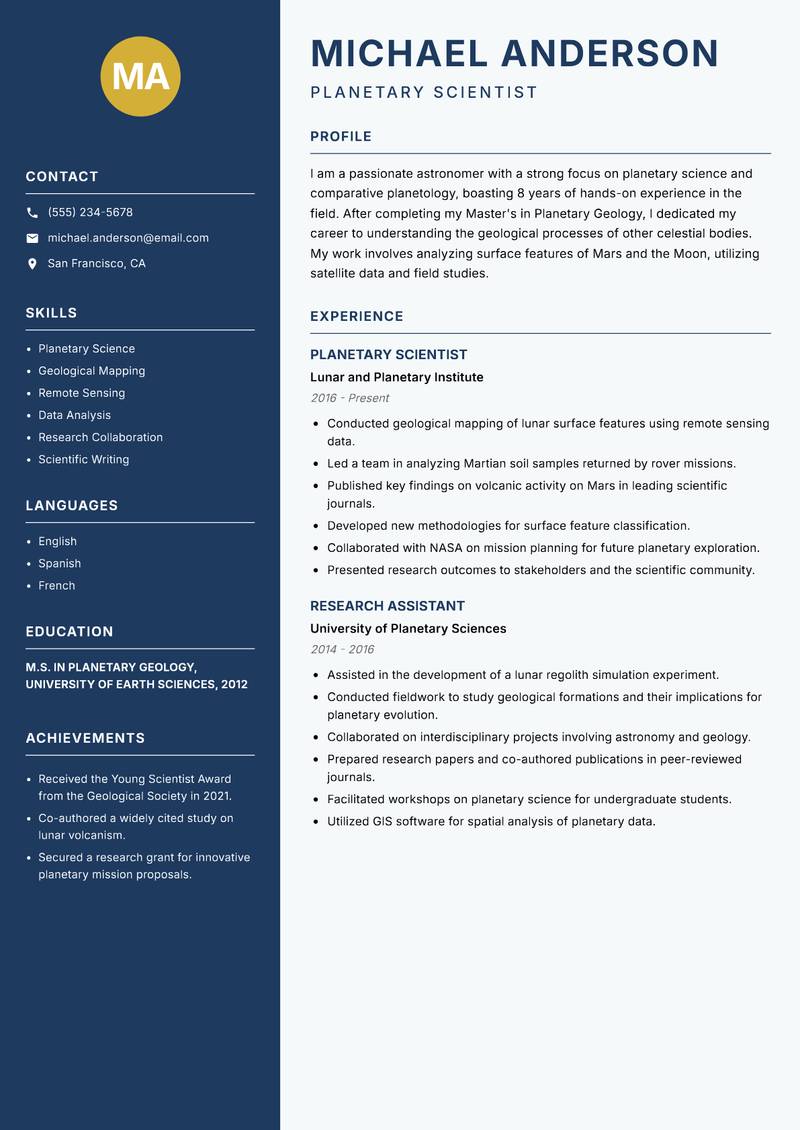
Classic Clean
Use Template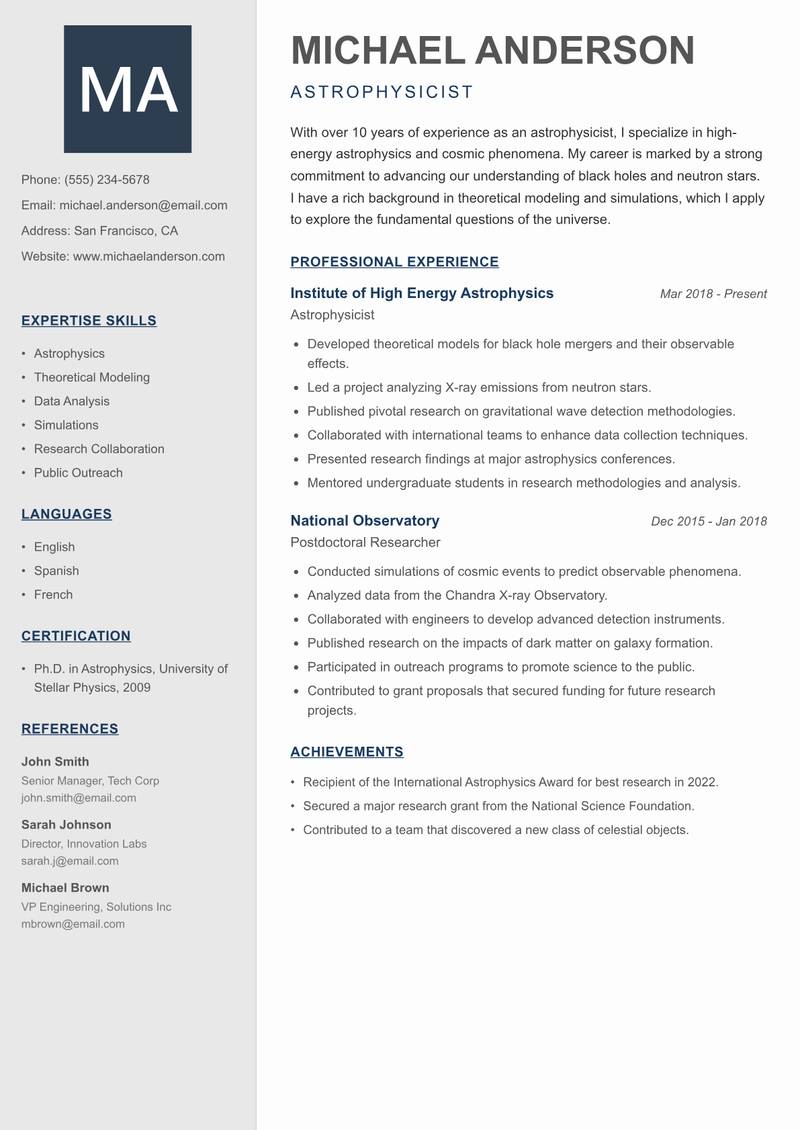
Creative Minimal
Use Template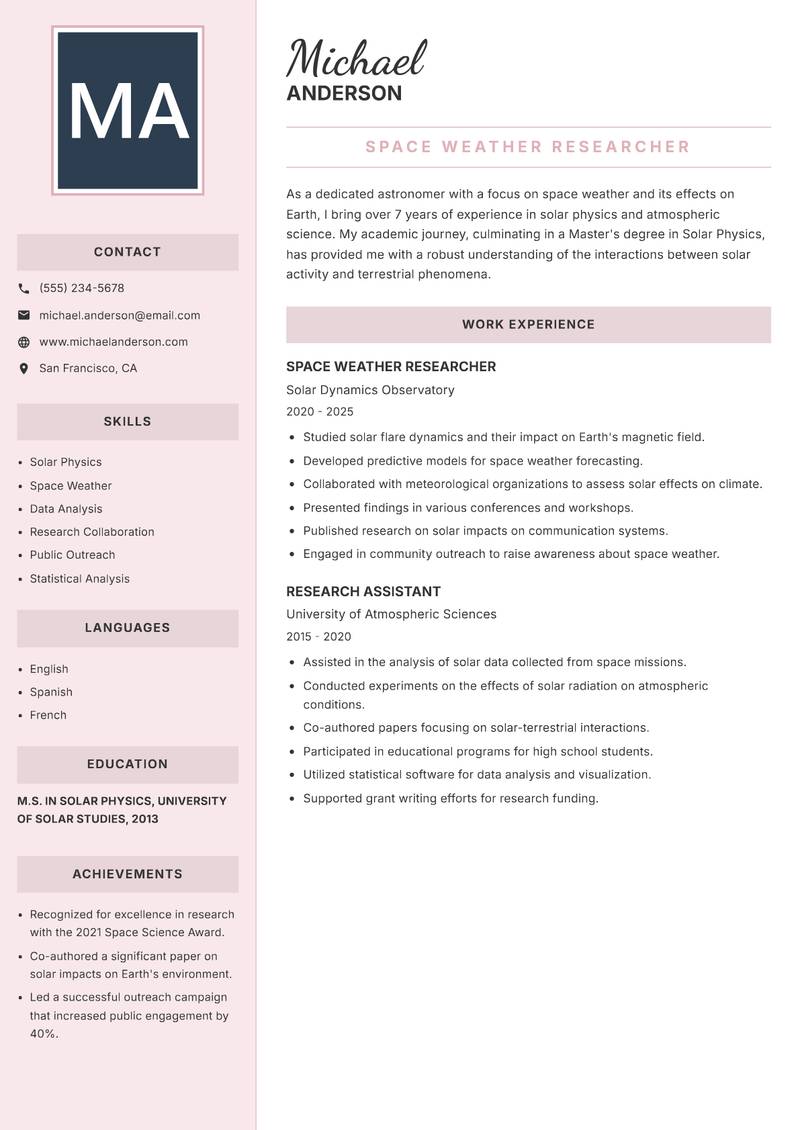
Executive
Use Template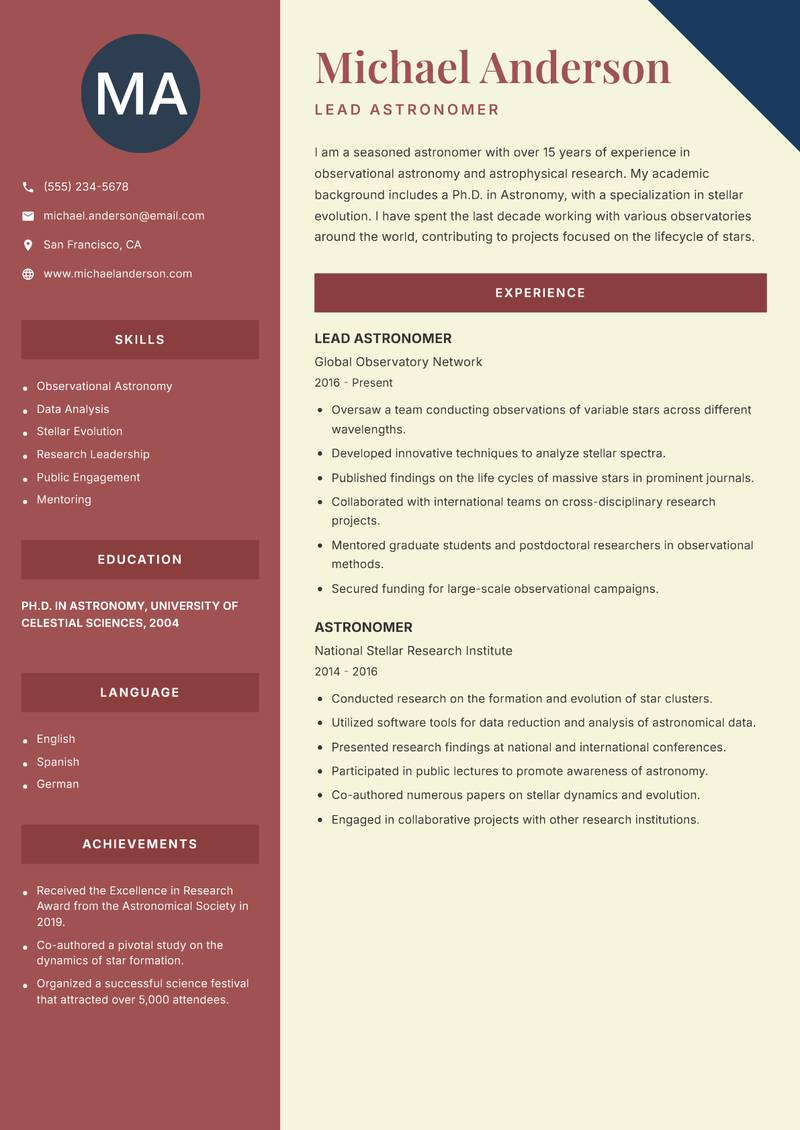
Two Column
Use Template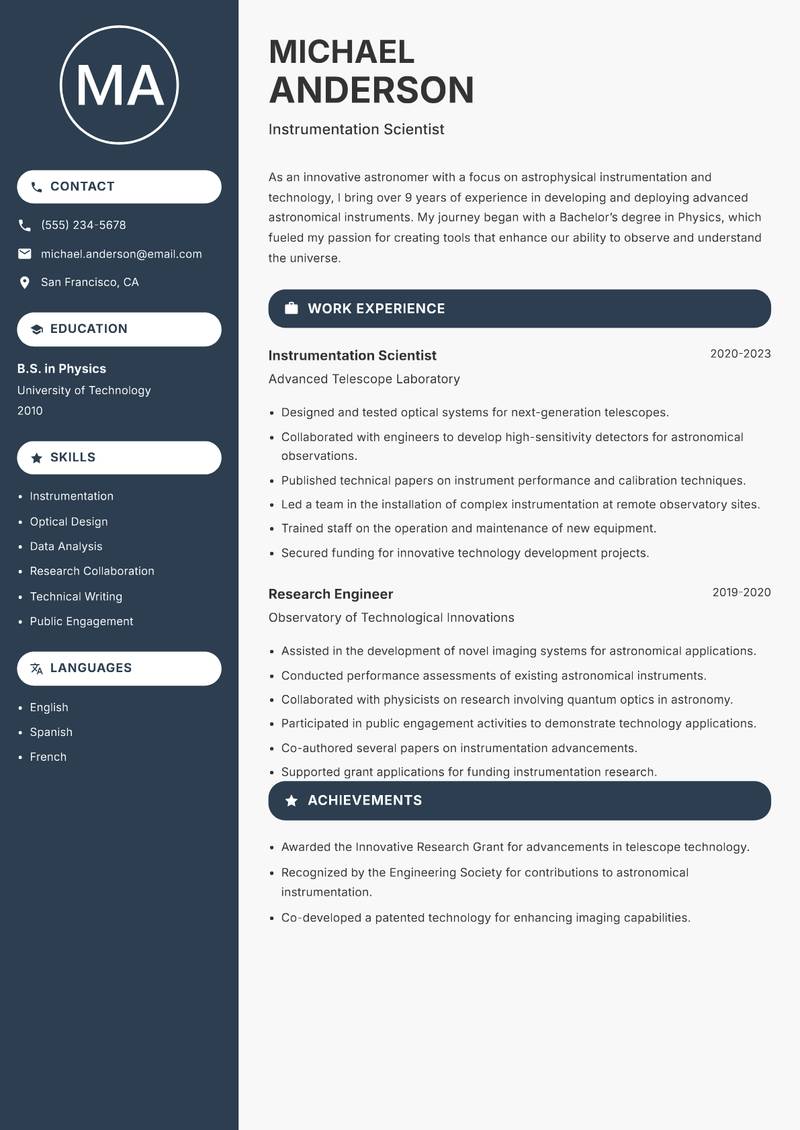
Compact
Use Template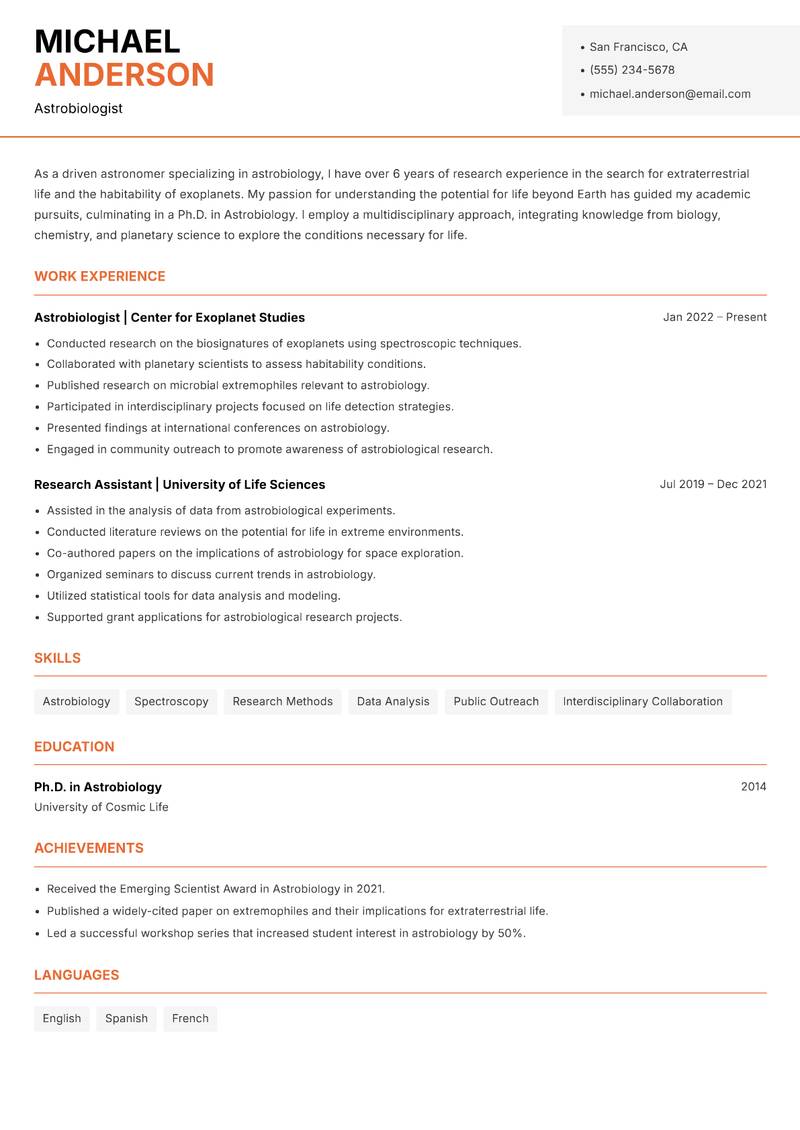
Modern Professional
Use Template7 Real Astronomer Resume Examples
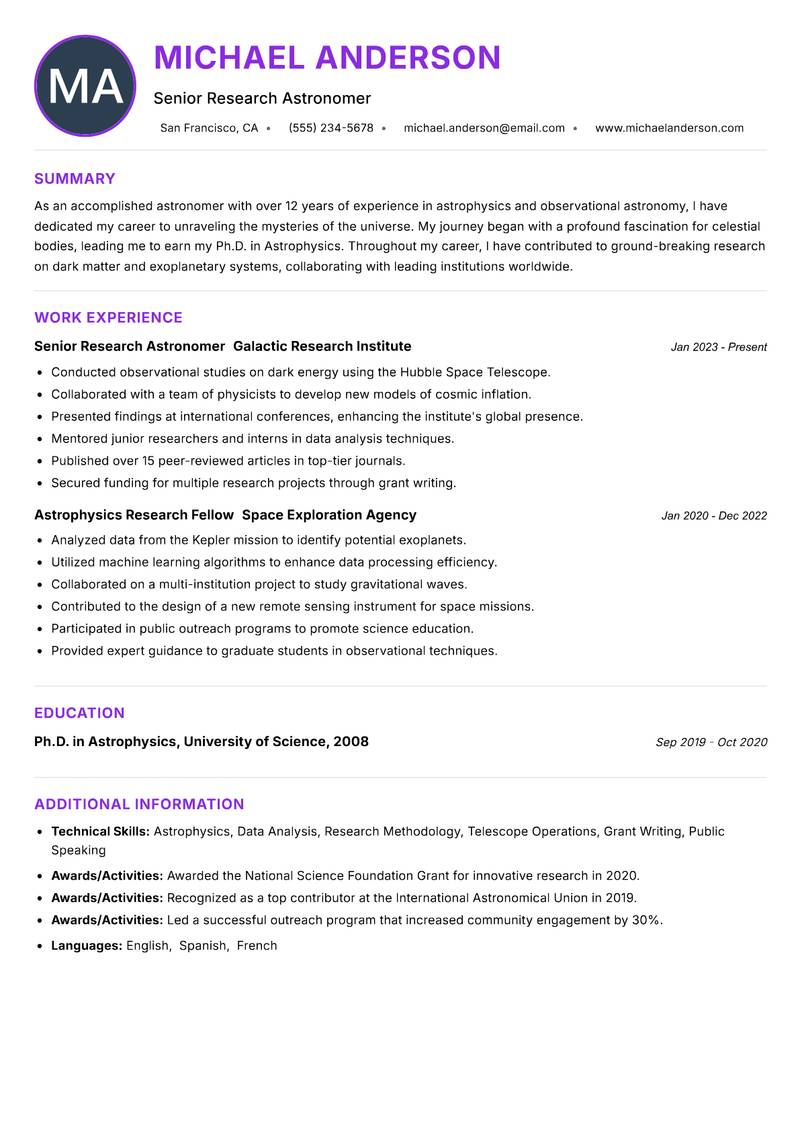
Senior Research Astronomer with 12+ Years Experience
Summary: As an accomplished astronomer with over 12 years of experience in astrophysics and observational astronomy, I have dedicated my career to unraveling the mysteries of the universe. My journey began with a profound fascination for celestial bodies, leading me to earn my Ph.D. in Astrophysics. Throughout my career, I have contributed to ground-breaking research on dark matter and exoplanetary systems, collaborating with leading institutions worldwide. My expertise in utilizing advanced telescopes and data analysis software has enabled me to publish numerous papers in reputable journals. Passionate about teaching and mentorship, I have also guided aspiring scientists through educational programs and workshops. I thrive in dynamic environments where innovative ideas can be explored, and I am committed to making significant contributions to our understanding of the cosmos.
Description:
- Conducted observational studies on dark energy using the Hubble Space Telescope.
- Collaborated with a team of physicists to develop new models of cosmic inflation.
- Presented findings at international conferences, enhancing the institute's global presence.
- Mentored junior researchers and interns in data analysis techniques.
- Published over 15 peer-reviewed articles in top-tier journals.
- Secured funding for multiple research projects through grant writing.
🏆 Key Achievements
Planetary Scientist with 8+ Years Experience
Summary: I am a passionate astronomer with a strong focus on planetary science and comparative planetology, boasting 8 years of hands-on experience in the field. After completing my Master's in Planetary Geology, I dedicated my career to understanding the geological processes of other celestial bodies. My work involves analyzing surface features of Mars and the Moon, utilizing satellite data and field studies. I thrive in collaborative research environments and have successfully led projects that uncover the geological history of our neighboring planets. I aim to enhance our understanding of planetary systems through innovative research techniques and interdisciplinary collaboration, contributing to both academic knowledge and practical applications in space exploration.
Description:
- Conducted geological mapping of lunar surface features using remote sensing data.
- Led a team in analyzing Martian soil samples returned by rover missions.
- Published key findings on volcanic activity on Mars in leading scientific journals.
- Developed new methodologies for surface feature classification.
- Collaborated with NASA on mission planning for future planetary exploration.
- Presented research outcomes to stakeholders and the scientific community.
🏆 Key Achievements
Astrophysicist with 10+ Years Experience
Summary: With over 10 years of experience as an astrophysicist, I specialize in high-energy astrophysics and cosmic phenomena. My career is marked by a strong commitment to advancing our understanding of black holes and neutron stars. I have a rich background in theoretical modeling and simulations, which I apply to explore the fundamental questions of the universe. I earned my Ph.D. in Astrophysics and have since been actively involved in several high-profile research projects. I thrive in fast-paced environments and enjoy collaborating with diverse teams to tackle challenging astrophysical problems. My goal is to contribute to groundbreaking discoveries that expand our knowledge of the cosmos and inspire the next generation of scientists.
Description:
- Developed theoretical models for black hole mergers and their observable effects.
- Led a project analyzing X-ray emissions from neutron stars.
- Published pivotal research on gravitational wave detection methodologies.
- Collaborated with international teams to enhance data collection techniques.
- Presented research findings at major astrophysics conferences.
- Mentored undergraduate students in research methodologies and analysis.
🏆 Key Achievements
Space Weather Researcher with 7+ Years Experience
Summary: As a dedicated astronomer with a focus on space weather and its effects on Earth, I bring over 7 years of experience in solar physics and atmospheric science. My academic journey, culminating in a Master's degree in Solar Physics, has provided me with a robust understanding of the interactions between solar activity and terrestrial phenomena. Throughout my career, I have conducted extensive research on solar flares and their implications for satellite communications and power grids. I am committed to advancing our understanding of space weather through innovative approaches and public outreach initiatives. My ability to communicate complex scientific concepts to diverse audiences sets me apart as an effective advocate for science education.
Description:
- Studied solar flare dynamics and their impact on Earth's magnetic field.
- Developed predictive models for space weather forecasting.
- Collaborated with meteorological organizations to assess solar effects on climate.
- Presented findings in various conferences and workshops.
- Published research on solar impacts on communication systems.
- Engaged in community outreach to raise awareness about space weather.
🏆 Key Achievements
Lead Astronomer with 15+ Years Experience
Summary: I am a seasoned astronomer with over 15 years of experience in observational astronomy and astrophysical research. My academic background includes a Ph.D. in Astronomy, with a specialization in stellar evolution. I have spent the last decade working with various observatories around the world, contributing to projects focused on the lifecycle of stars. My expertise lies in utilizing advanced telescopic technology and data analysis techniques to glean insights into stellar phenomena. I am passionate about mentoring the next generation of astronomers and have led numerous educational initiatives aimed at fostering interest in the sciences. My goal is to continue making significant contributions to our understanding of stellar dynamics while advocating for science education.
Description:
- Oversaw a team conducting observations of variable stars across different wavelengths.
- Developed innovative techniques to analyze stellar spectra.
- Published findings on the life cycles of massive stars in prominent journals.
- Collaborated with international teams on cross-disciplinary research projects.
- Mentored graduate students and postdoctoral researchers in observational methods.
- Secured funding for large-scale observational campaigns.
🏆 Key Achievements
Instrumentation Scientist with 9+ Years Experience
Summary: As an innovative astronomer with a focus on astrophysical instrumentation and technology, I bring over 9 years of experience in developing and deploying advanced astronomical instruments. My journey began with a Bachelor’s degree in Physics, which fueled my passion for creating tools that enhance our ability to observe and understand the universe. I have worked with leading research institutions, contributing to the design and implementation of state-of-the-art telescopes and detectors. My collaborative approach allows me to work effectively in multidisciplinary teams, ensuring the successful delivery of complex projects. I am dedicated to pushing the boundaries of astronomical research through technological advancements.
Description:
- Designed and tested optical systems for next-generation telescopes.
- Collaborated with engineers to develop high-sensitivity detectors for astronomical observations.
- Published technical papers on instrument performance and calibration techniques.
- Led a team in the installation of complex instrumentation at remote observatory sites.
- Trained staff on the operation and maintenance of new equipment.
- Secured funding for innovative technology development projects.
🏆 Key Achievements
Astrobiologist with 6+ Years Experience
Summary: As a driven astronomer specializing in astrobiology, I have over 6 years of research experience in the search for extraterrestrial life and the habitability of exoplanets. My passion for understanding the potential for life beyond Earth has guided my academic pursuits, culminating in a Ph.D. in Astrobiology. I employ a multidisciplinary approach, integrating knowledge from biology, chemistry, and planetary science to explore the conditions necessary for life. My research has led to significant findings regarding biosignatures and the implications of extreme environments. I am committed to advancing our understanding of life's potential across the universe through innovative research and collaboration.
Description:
- Conducted research on the biosignatures of exoplanets using spectroscopic techniques.
- Collaborated with planetary scientists to assess habitability conditions.
- Published research on microbial extremophiles relevant to astrobiology.
- Participated in interdisciplinary projects focused on life detection strategies.
- Presented findings at international conferences on astrobiology.
- Engaged in community outreach to promote awareness of astrobiological research.
🏆 Key Achievements
Key Skills for Astronomer
ATS Optimization Tips
Increase your chances of getting hired
Use Standard Headings
Use common section titles like Experience, Skills, etc.
Include Keywords
Add role-specific keywords from the job description
Keep it Simple
Avoid complex tables, images and graphics
Save in Right Format
Use PDF format unless otherwise specified
Astronomer Salary Insights
Average Salary
$95,000
per year
Salary Range
$70,000 - $120,000
per year
Top Paying Cities
Los Angeles, Seattle, Houston, Dallas, Boston
Source: Glassdoor, Payscale, Indeed (Updated April 2025)
Everything you need to write a great Astronomer resume
Strong Action Verbs to Use
Resume Writing Tips
- →Highlight specific software and programming languages you are proficient in, such as Python or R.
- →Illustrate your contributions to research publications clearly, including any metrics like citation counts or impact factors.
- →Consider listing any grants you’ve been awarded or research funding obtained to showcase your ability to secure project funding.
- →Include relevant fieldwork experience, especially if you’ve worked at observatories or during expeditions.
- →Tailor your resume to emphasize collaboration with physicists and engineers on multi-faceted projects.
Common Mistakes to Avoid
- ✕Focusing too much on undergraduate projects without mentioning recent research or experiences.
- ✕Listing technology skills that are not common in astronomy, like generic software not used in the field.
- ✕Neglecting to quantify the impact of your research contributions, such as citations and recognitions.
- ✕Being vague about your role in collaborative projects; specific contributions are critical.
- ✕Failing to highlight any public outreach efforts, which are valuable in academia and industry.
ATS Keywords for Astronomer
Astronomer Career Path
Relevant Certifications
Career Progression
Entry-Level Astronomer
Conduct preliminary research with focused studies on specific celestial bodies; often involves assistant roles in observational research.
Mid-Level Astronomer
Lead research projects, write scientific papers, and present findings at conferences; manage data from telescopes and collaborate with astrophysicists.
Senior Astronomer
Oversee research teams, contribute to revolutionary discoveries in cosmology or planetary science, and mentor junior astronomers.
Research Scientist
Design and execute large-scale observational and theoretical programs; may involve application for funding and grants.
Department Head/Director
Manage astronomical research departments, set strategic research priorities, and ensure alignment with institutional missions.
Astronomer Interview Questions
What methods do you use to analyze astronomical data? +
Discuss specific tools, software, or techniques that are commonly used in astronomy, such as Python for data analysis or specific astrophysical modeling programs.
Can you describe a significant research project you have been involved in? +
Highlight the project's objectives, your role, and the outcomes, while preparing to explain the relevance to current astronomical understanding.
How do you stay updated with recent developments in astronomy? +
Mention journals, conferences, or networks important in the field, emphasizing methods of continuous learning.
What challenges have you faced in your research and how did you overcome them? +
Share a specific challenge and detail the solution process, particularly in data collection or analysis.
Describe an experience working with interdisciplinary teams. How did you manage collaboration? +
Emphasize your communication skills and any leadership experience in projects involving varied expertise.
How do you approach writing and publishing scientific papers? +
Discuss your process for drafting, peer-review, and addressing reviewer comments, while citing a specific paper if possible.
What specific tools or telescopes have you used for your observations? +
Be prepared to discuss various observational equipment, including any hands-on experiences or technical expertise.
About the Astronomer Role
Astronomers study celestial bodies, such as stars, planets, and galaxies, to understand their behavior and evolution. They utilize both ground-based and space telescopes to gather data, analyze patterns, and develop theoretical models. The role often involves extensive collaboration with interdisciplinary teams to enhance the understanding of the universe and contribute to space exploration efforts.
Frequently Asked Questions
View all →What qualifications are necessary to become an astronomer? +
Typically, a PhD in astronomy, astrophysics, or a related field is required, along with strong analytical and programming skills.
What kind of work environment do astronomers typically have? +
Astronomers often work in research institutions, universities, or observatories, and may spend time at telescopes or in laboratories analyzing data.
Is it necessary to publish research work as an astronomer? +
Yes, publishing in peer-reviewed journals is crucial for academic advancement and collaboration opportunities.
What are the main tools used by astronomers? +
Common tools include telescopes, spectrometers, and various data analysis software, such as MATLAB or IDL.
Can astronomers work in the private sector? +
Absolutely, many work for aerospace companies, research firms, or governmental agencies like NASA, contributing to space missions and technology.
What are some emerging fields in astronomy? +
Astrobiology, gravitational wave astronomy, and the study of exoplanets are rapidly growing areas of research.
How crucial is networking in the field of astronomy? +
Networking is essential for collaboration, finding job opportunities, and getting publishing assistance in the scientific community.
More Resume Examples You Might Like
Related Career Paths
Other roles candidates for Astronomer positions often also consider.
Will this Astronomer resume pass the ATS scan?
Upload it and get an instant AI-scored compatibility check with specific fixes.
Check My Resume →
Pair it with a matching cover letter
AI drafts a first version from your job title and strengths — edit it live, then download the PDF.
Write My Cover Letter →
Written by Nohaya Career Team
Reviewed by HR Professionals · Updated April 2025
Ready to Build Your Perfect Resume?
Choose from 1000+ professional templates and land your dream job.
Create My Resume Now