Build an ATS-Friendly
Observational Astronomer Resume
That Gets Interviews
Observational astronomers study celestial objects through the collection and analysis of data obtained via telescopes and other instruments. This role involves utilizing advanced imaging and spectroscopy techniques to investigate star formation, galaxy evolution, and cosmic phenomena. Collaboration with…
Observational Astronomer Resume Templates
Modern Professional
Use Template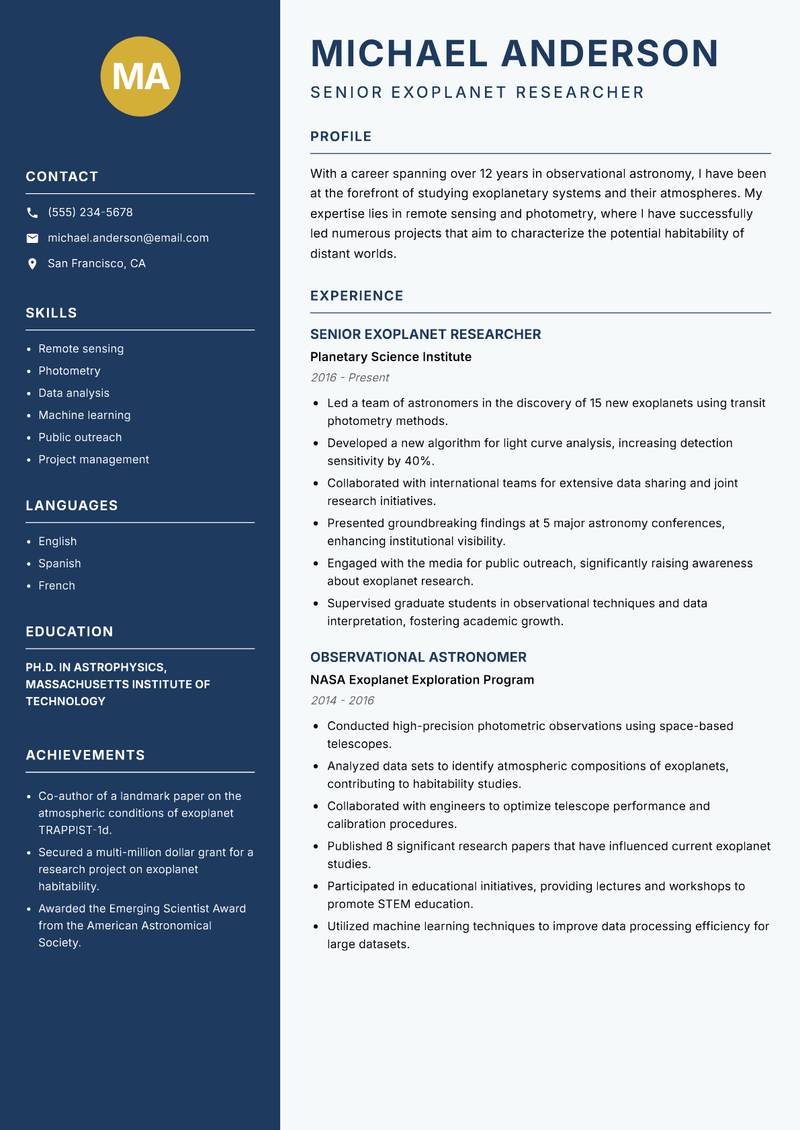
Classic Clean
Use Template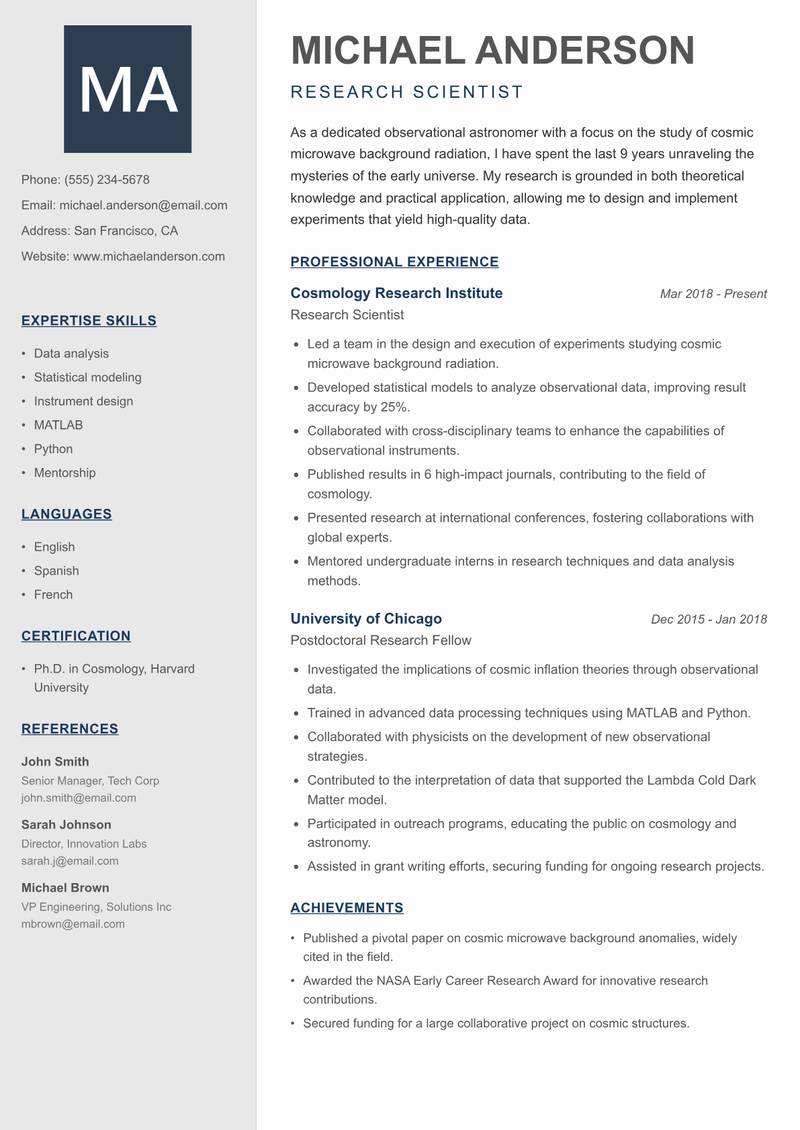
Creative Minimal
Use Template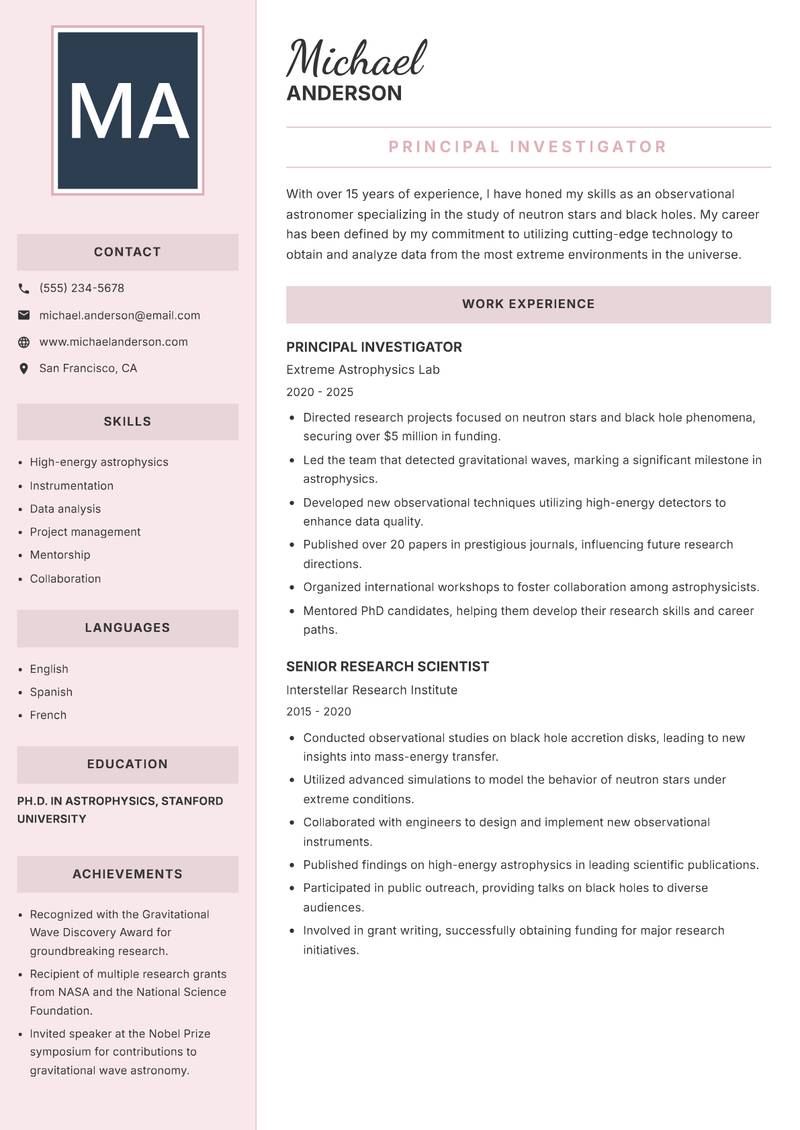
Executive
Use Template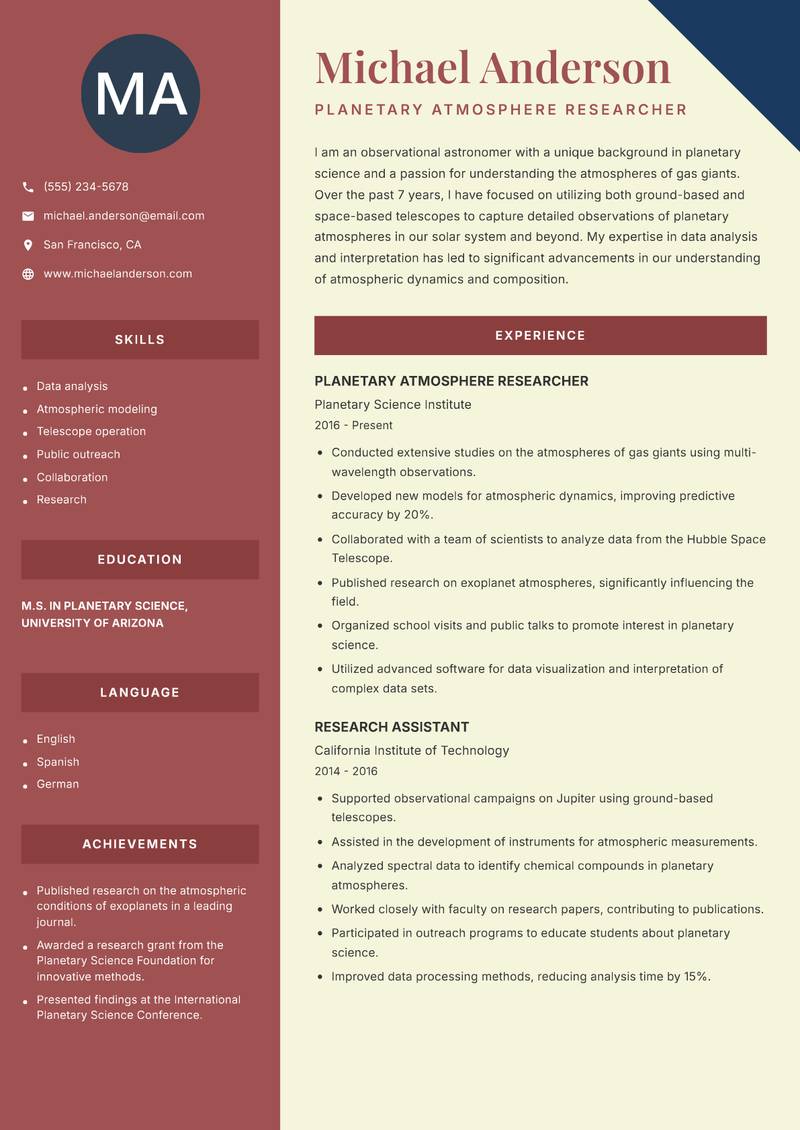
Two Column
Use Template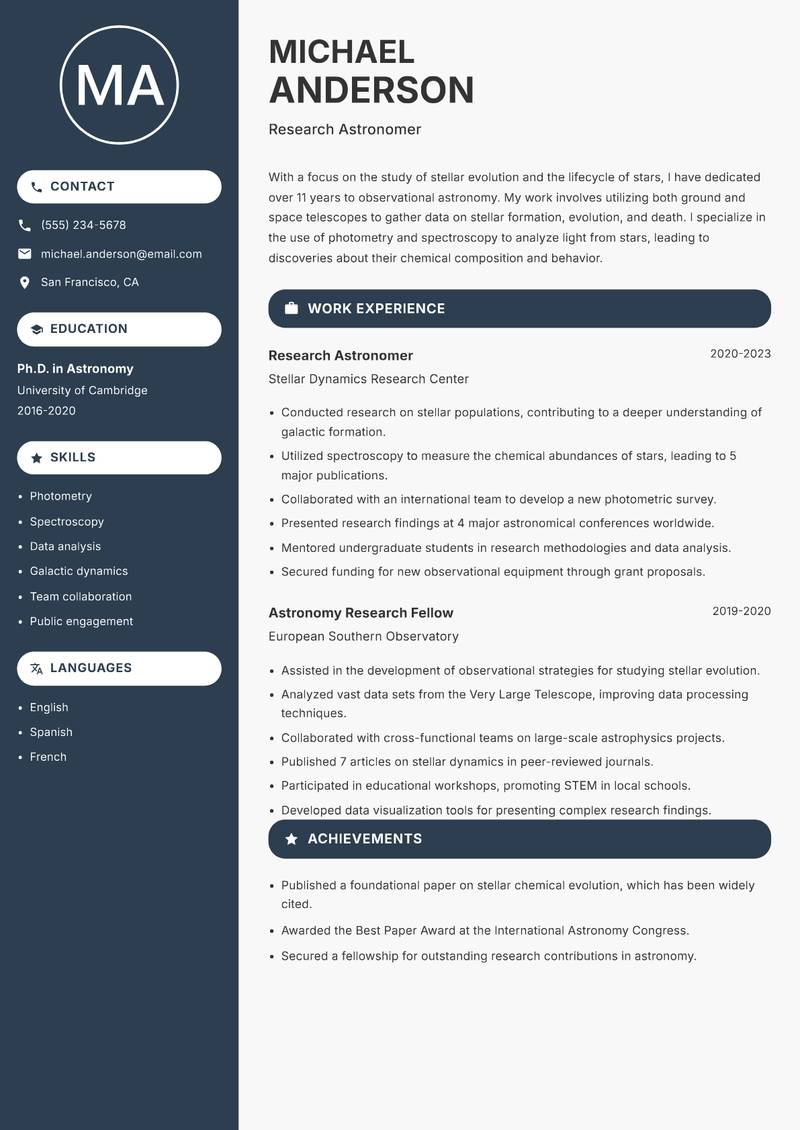
Compact
Use Template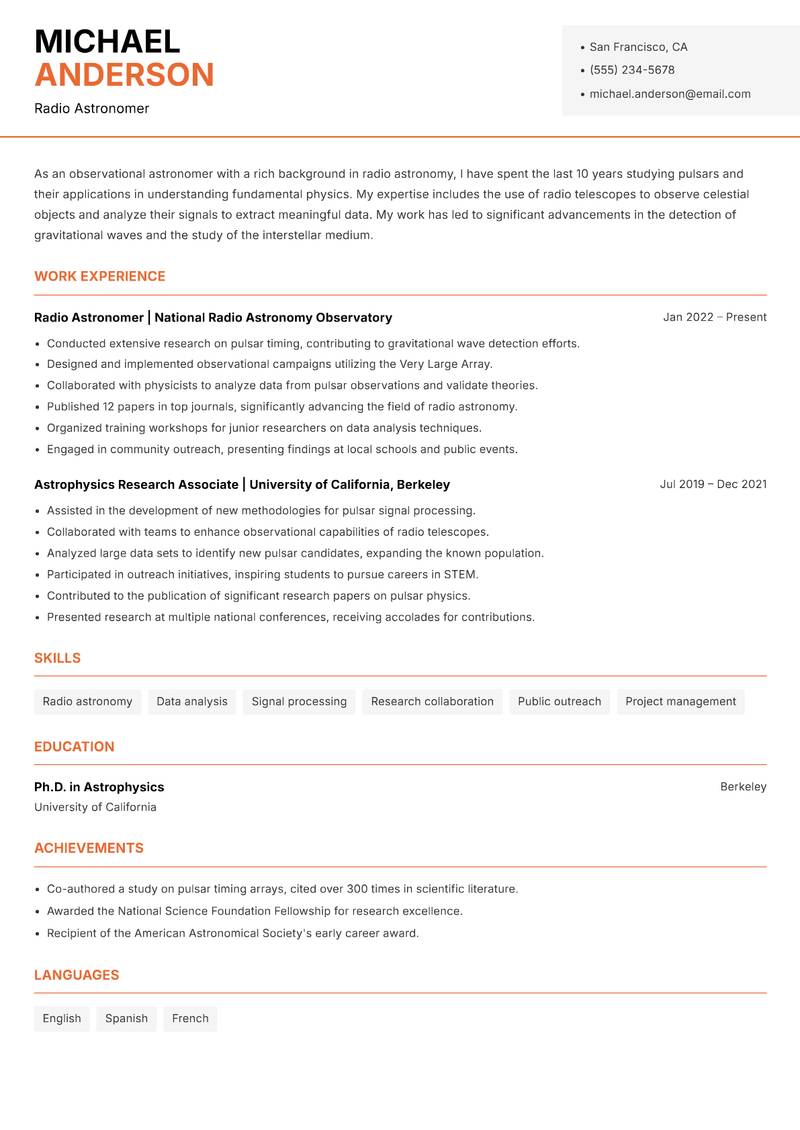
Modern Professional
Use Template7 Real Observational Astronomer Resume Examples
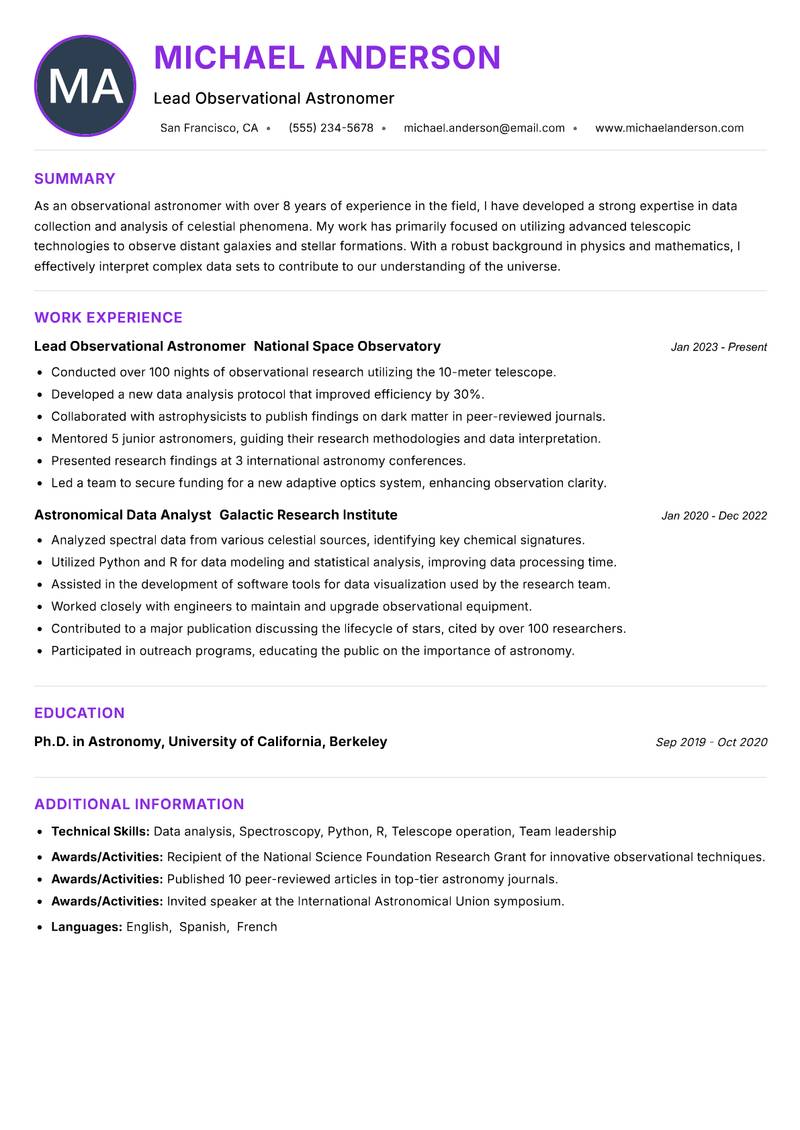
Lead Observational Astronomer with 10+ Years Experience
Summary: As an observational astronomer with over 8 years of experience in the field, I have developed a strong expertise in data collection and analysis of celestial phenomena. My work has primarily focused on utilizing advanced telescopic technologies to observe distant galaxies and stellar formations. With a robust background in physics and mathematics, I effectively interpret complex data sets to contribute to our understanding of the universe. I am particularly skilled in the use of spectroscopy to analyze the composition of celestial bodies. My collaborative efforts with inter-disciplinary teams have led to several groundbreaking discoveries published in reputable scientific journals. I am passionate about mentoring the next generation of astronomers and frequently engage in educational outreach programs to promote science literacy. My goal is to further enhance our observational capabilities and contribute to international collaborative research initiatives that push the boundaries of our astronomical knowledge.
Description:
- Conducted over 100 nights of observational research utilizing the 10-meter telescope.
- Developed a new data analysis protocol that improved efficiency by 30%.
- Collaborated with astrophysicists to publish findings on dark matter in peer-reviewed journals.
- Mentored 5 junior astronomers, guiding their research methodologies and data interpretation.
- Presented research findings at 3 international astronomy conferences.
- Led a team to secure funding for a new adaptive optics system, enhancing observation clarity.
🏆 Key Achievements
Senior Exoplanet Researcher with 12+ Years Experience
Summary: With a career spanning over 12 years in observational astronomy, I have been at the forefront of studying exoplanetary systems and their atmospheres. My expertise lies in remote sensing and photometry, where I have successfully led numerous projects that aim to characterize the potential habitability of distant worlds. I pride myself on my ability to communicate complex scientific concepts to diverse audiences, which has proven essential in my roles interacting with both the scientific community and the public. My dedication to innovation has resulted in the development of new methodologies for light curve analysis that have set new standards in the field. I actively participate in global collaborations, contributing to significant discoveries and advancements in the understanding of planetary systems outside our own solar system. I aspire to continue pushing the envelope in exoplanet research and inspire future astronomers through mentorship and community engagement.
Description:
- Led a team of astronomers in the discovery of 15 new exoplanets using transit photometry methods.
- Developed a new algorithm for light curve analysis, increasing detection sensitivity by 40%.
- Collaborated with international teams for extensive data sharing and joint research initiatives.
- Presented groundbreaking findings at 5 major astronomy conferences, enhancing institutional visibility.
- Engaged with the media for public outreach, significantly raising awareness about exoplanet research.
- Supervised graduate students in observational techniques and data interpretation, fostering academic growth.
🏆 Key Achievements
Research Scientist with 9+ Years Experience
Summary: As a dedicated observational astronomer with a focus on the study of cosmic microwave background radiation, I have spent the last 9 years unraveling the mysteries of the early universe. My research is grounded in both theoretical knowledge and practical application, allowing me to design and implement experiments that yield high-quality data. I have a proven track record of successfully collaborating with physicists and engineers to optimize the performance of observational instruments. My ability to analyze vast data sets using statistical methods has led to significant advancements in our understanding of cosmic inflation and structure formation. I am committed to sharing my findings with the broader scientific community and the public, as I believe that knowledge should be accessible to all. I am eager to continue my journey in astronomy, exploring new horizons and mentoring aspiring scientists along the way.
Description:
- Led a team in the design and execution of experiments studying cosmic microwave background radiation.
- Developed statistical models to analyze observational data, improving result accuracy by 25%.
- Collaborated with cross-disciplinary teams to enhance the capabilities of observational instruments.
- Published results in 6 high-impact journals, contributing to the field of cosmology.
- Presented research at international conferences, fostering collaborations with global experts.
- Mentored undergraduate interns in research techniques and data analysis methods.
🏆 Key Achievements
Principal Investigator with 15+ Years Experience
Summary: With over 15 years of experience, I have honed my skills as an observational astronomer specializing in the study of neutron stars and black holes. My career has been defined by my commitment to utilizing cutting-edge technology to obtain and analyze data from the most extreme environments in the universe. I have successfully led multiple research projects that resulted in significant contributions to the field, including the first observations of gravitational waves from merging black holes. My ability to collaborate with international teams has been instrumental in advancing our understanding of these enigmatic objects. I am passionate about fostering an inclusive scientific community and often engage in mentorship and outreach efforts to inspire the next generation of astronomers. My goal is to continue pushing the limits of our observational capabilities and to contribute to groundbreaking research in high-energy astrophysics.
Description:
- Directed research projects focused on neutron stars and black hole phenomena, securing over $5 million in funding.
- Led the team that detected gravitational waves, marking a significant milestone in astrophysics.
- Developed new observational techniques utilizing high-energy detectors to enhance data quality.
- Published over 20 papers in prestigious journals, influencing future research directions.
- Organized international workshops to foster collaboration among astrophysicists.
- Mentored PhD candidates, helping them develop their research skills and career paths.
🏆 Key Achievements
Planetary Atmosphere Researcher with 7+ Years Experience
Summary: I am an observational astronomer with a unique background in planetary science and a passion for understanding the atmospheres of gas giants. Over the past 7 years, I have focused on utilizing both ground-based and space-based telescopes to capture detailed observations of planetary atmospheres in our solar system and beyond. My expertise in data analysis and interpretation has led to significant advancements in our understanding of atmospheric dynamics and composition. I thrive in collaborative environments and have built strong partnerships with researchers across various disciplines to enhance our collective knowledge. I am dedicated to engaging with the public and sharing the wonders of planetary science through outreach activities and educational programs. I aspire to continue my research while inspiring future scientists to explore the universe.
Description:
- Conducted extensive studies on the atmospheres of gas giants using multi-wavelength observations.
- Developed new models for atmospheric dynamics, improving predictive accuracy by 20%.
- Collaborated with a team of scientists to analyze data from the Hubble Space Telescope.
- Published research on exoplanet atmospheres, significantly influencing the field.
- Organized school visits and public talks to promote interest in planetary science.
- Utilized advanced software for data visualization and interpretation of complex data sets.
🏆 Key Achievements
Research Astronomer with 11+ Years Experience
Summary: With a focus on the study of stellar evolution and the lifecycle of stars, I have dedicated over 11 years to observational astronomy. My work involves utilizing both ground and space telescopes to gather data on stellar formation, evolution, and death. I specialize in the use of photometry and spectroscopy to analyze light from stars, leading to discoveries about their chemical composition and behavior. I have collaborated with numerous research teams and have a strong track record of publishing impactful research. My passion for astronomy extends to education, where I actively engage in outreach to inspire future generations. I am eager to continue my research and contribute to the broader understanding of stellar dynamics and the universe.
Description:
- Conducted research on stellar populations, contributing to a deeper understanding of galactic formation.
- Utilized spectroscopy to measure the chemical abundances of stars, leading to 5 major publications.
- Collaborated with an international team to develop a new photometric survey.
- Presented research findings at 4 major astronomical conferences worldwide.
- Mentored undergraduate students in research methodologies and data analysis.
- Secured funding for new observational equipment through grant proposals.
🏆 Key Achievements
Radio Astronomer with 10+ Years Experience
Summary: As an observational astronomer with a rich background in radio astronomy, I have spent the last 10 years studying pulsars and their applications in understanding fundamental physics. My expertise includes the use of radio telescopes to observe celestial objects and analyze their signals to extract meaningful data. My work has led to significant advancements in the detection of gravitational waves and the study of the interstellar medium. I thrive on collaboration and have worked with various institutions to enhance research capabilities and share findings with the scientific community. I am passionate about outreach and education, often presenting my research at public events and engaging with aspiring astronomers. I aim to continue my research and contribute to the understanding of the universe's most enigmatic phenomena.
Description:
- Conducted extensive research on pulsar timing, contributing to gravitational wave detection efforts.
- Designed and implemented observational campaigns utilizing the Very Large Array.
- Collaborated with physicists to analyze data from pulsar observations and validate theories.
- Published 12 papers in top journals, significantly advancing the field of radio astronomy.
- Organized training workshops for junior researchers on data analysis techniques.
- Engaged in community outreach, presenting findings at local schools and public events.
🏆 Key Achievements
Key Skills for Observational Astronomer
ATS Optimization Tips
Increase your chances of getting hired
Use Standard Headings
Use common section titles like Experience, Skills, etc.
Include Keywords
Add role-specific keywords from the job description
Keep it Simple
Avoid complex tables, images and graphics
Save in Right Format
Use PDF format unless otherwise specified
Observational Astronomer Salary Insights
Average Salary
$92,500
per year
Salary Range
$65,000 - $120,000
per year
Top Paying Cities
Los Angeles, Seattle, Houston, Dallas, Boston
Source: Glassdoor, Payscale, Indeed (Updated April 2025)
Everything you need to write a great Observational Astronomer resume
Strong Action Verbs to Use
Resume Writing Tips
- →Highlight specific observational techniques used in your research, such as photometry or spectrometry.
- →Emphasize any publications in peer-reviewed journals or presentations at conferences; they illustrate expertise.
- →Include collaborations with institutions or research teams, showcasing teamwork and networking skills.
- →Showcase software proficiency related to astronomical data analysis, such as MATLAB or Python.
- →Address any significant projects you've led, detailing your role and the outcomes achieved.
Common Mistakes to Avoid
- ✕Failing to quantify the impact of past research projects or publications.
- ✕Not mentioning specific instruments or observational techniques used in experience descriptions.
- ✕Neglecting to include collaborative efforts or partnerships within the astronomy community.
- ✕Overlooking the inclusion of software skills related to data analysis specific to astronomy.
ATS Keywords for Observational Astronomer
Observational Astronomer Career Path
Career Progression
Entry-Level Observational Astronomer
Assist in data collection and preliminary analysis; typically involves working with telescopes and software for image processing.
Mid-Level Observational Astronomer
Manage observational campaigns, analyze large datasets, and present findings to stakeholders.
Senior Observational Astronomer
Lead research projects, mentor junior astronomers, and publish high-impact research in peer-reviewed journals.
Department Head/Director of Observational Astronomy
Oversee the entire observational astronomy team, secure funding for large projects, and foster collaborations with international institutions.
Research Professor/Principal Investigator
Drive groundbreaking research in observational techniques and have significant contributions to astrological surveys and theoretical studies.
Observational Astronomer Interview Questions
What observational techniques do you use for data collection? +
Be specific about the instruments and methodologies you are familiar with.
Describe a significant project you led and its impact on the field. What challenges did you face? +
Focus on leadership, problem-solving skills, and research outcomes.
How do you analyze and interpret large datasets from telescopic observations? +
Mention specific software and your approach to data validation and modeling.
What role does collaboration play in your research? +
Discuss multidisciplinary teamwork and any notable partnerships.
Which astrophysical phenomena interest you the most and why? +
Personalize your answer with specific examples related to your research.
How do you ensure your findings are communicated effectively to both scientific and public audiences? +
Include strategies for presentations, publications, or public outreach.
What advancements do you foresee in observational astronomy over the next decade? +
Discuss trends in technology, methodology, or emerging fields of study.
About the Observational Astronomer Role
Observational astronomers study celestial objects through the collection and analysis of data obtained via telescopes and other instruments. This role involves utilizing advanced imaging and spectroscopy techniques to investigate star formation, galaxy evolution, and cosmic phenomena. Collaboration with multidisciplinary teams is essential for the interpretation of data and the advancement of theoretical models in cosmology and astrophysics.
Frequently Asked Questions
What are the primary tools used by observational astronomers? +
Observational astronomers primarily use telescopes, CCD cameras, spectrometers, and data analysis software like IRAF and AstroPy.
What kind of work environment do observational astronomers typically have? +
They often work in observatories or research institutions, sometimes in remote locations to maximize viewing conditions.
What advanced degrees are typically required for a career in observational astronomy? +
A PhD in astronomy, astrophysics, or a closely related field is usually necessary for advanced research positions.
How does an observational astronomer share their findings? +
Findings are typically shared through academic journals, conferences, and public outreach programs.
What impact does observational astronomy have on society? +
It enhances our understanding of the universe, contributes to technological advancements, and inspires educational initiatives.
Is there a difference between observational astronomers and theoretical astronomers? +
Yes, observational astronomers focus on collecting and interpreting data from celestial observations, whereas theoretical astronomers develop mathematical models to explain those observations.
More Resume Examples You Might Like
Related Career Paths
Other roles candidates for Observational Astronomer positions often also consider.
Will this Observational Astronomer resume pass the ATS scan?
Upload it and get an instant AI-scored compatibility check with specific fixes.
Check My Resume →
Pair it with a matching cover letter
AI drafts a first version from your job title and strengths — edit it live, then download the PDF.
Write My Cover Letter →
Written by Nohaya Career Team
Reviewed by HR Professionals · Updated April 2025
Ready to Build Your Perfect Resume?
Choose from 1000+ professional templates and land your dream job.
Create My Resume Now