Build an ATS-Friendly
Space Telescope Scientist Resume
That Gets Interviews
Designing observation strategies for space telescopes requires a deep understanding of astronomical phenomena and the technical capabilities of the instruments involved. As a Space Telescope Scientist, the primary responsibility centers on analyzing data captured from various wavelengths to contribute to discoveries…
Space Telescope Scientist Resume Templates
Modern Professional
Use Template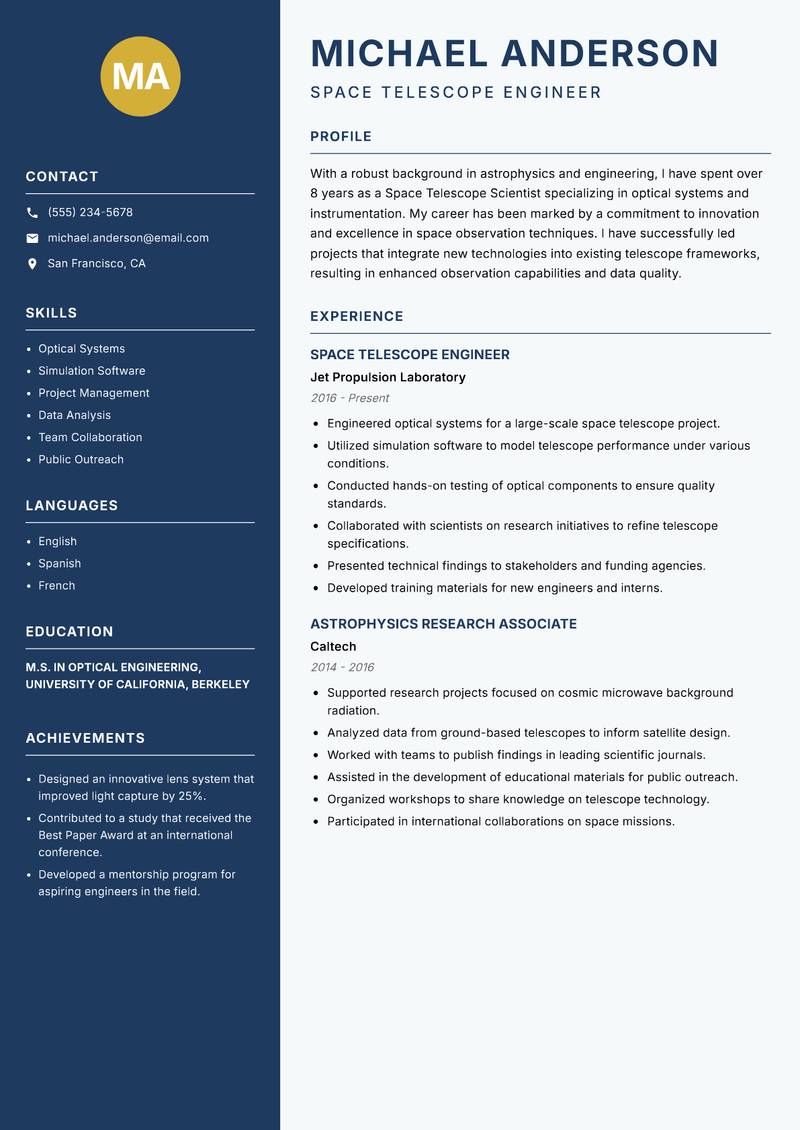
Classic Clean
Use Template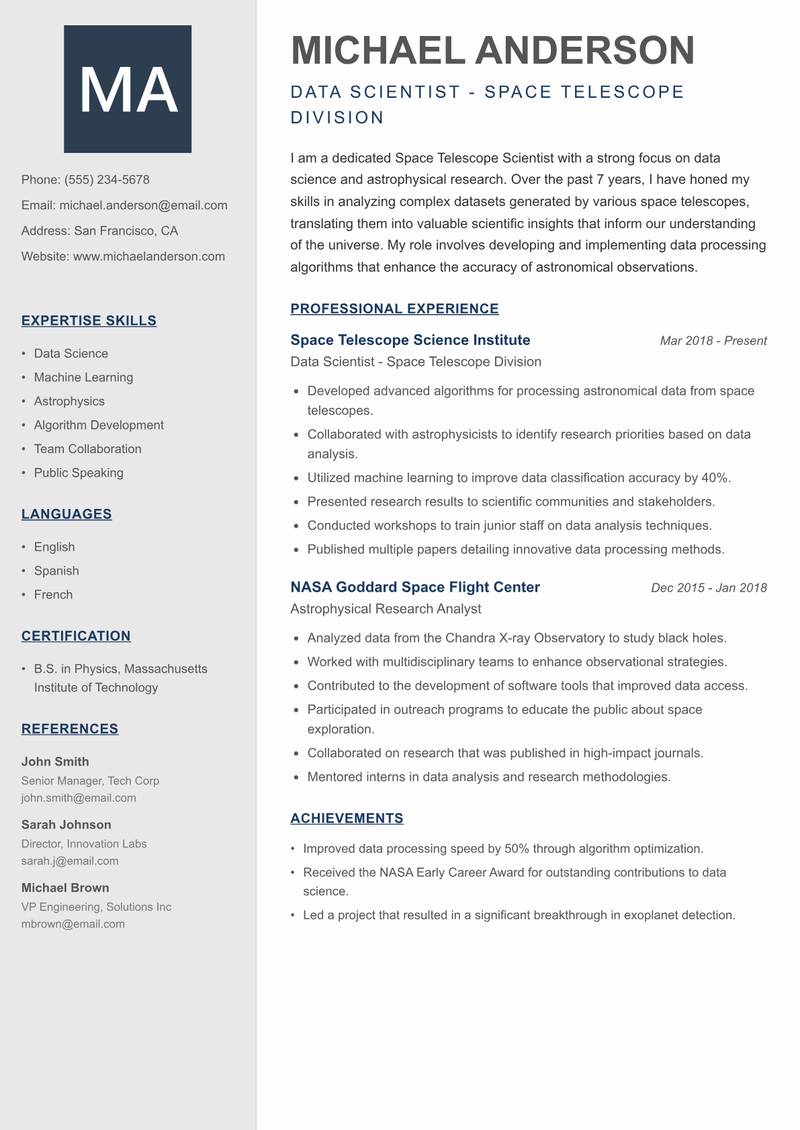
Creative Minimal
Use Template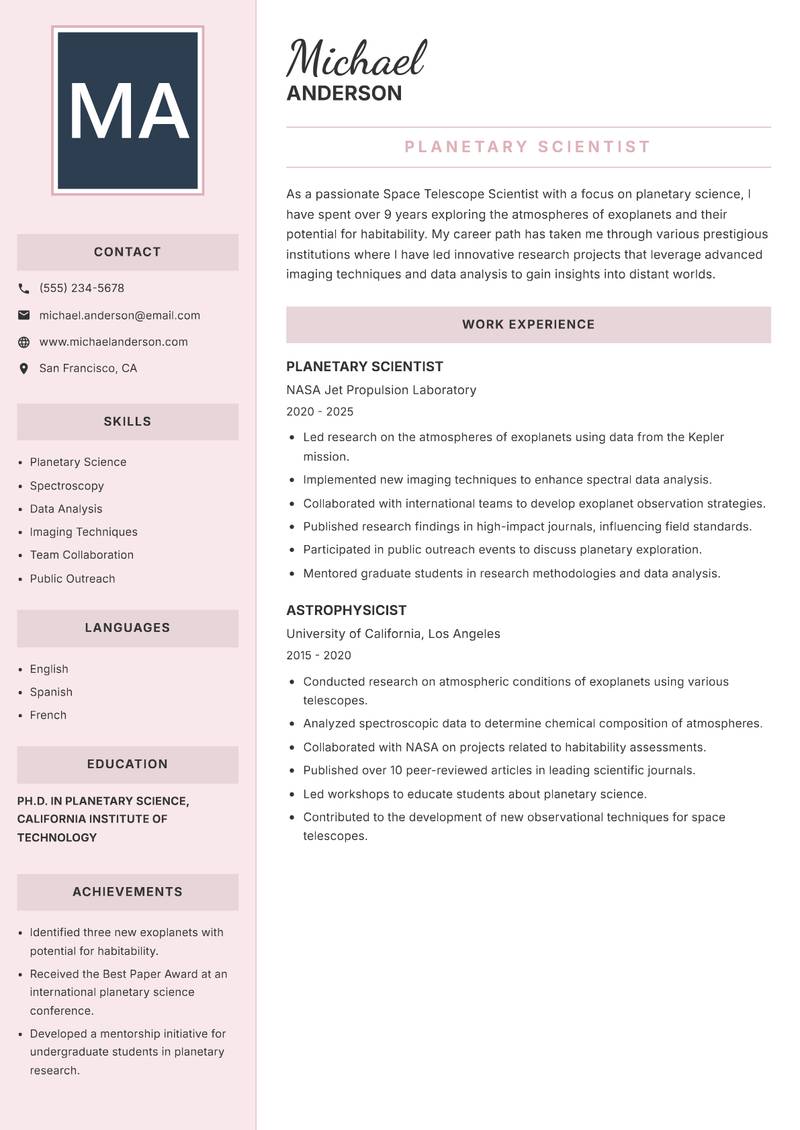
Executive
Use Template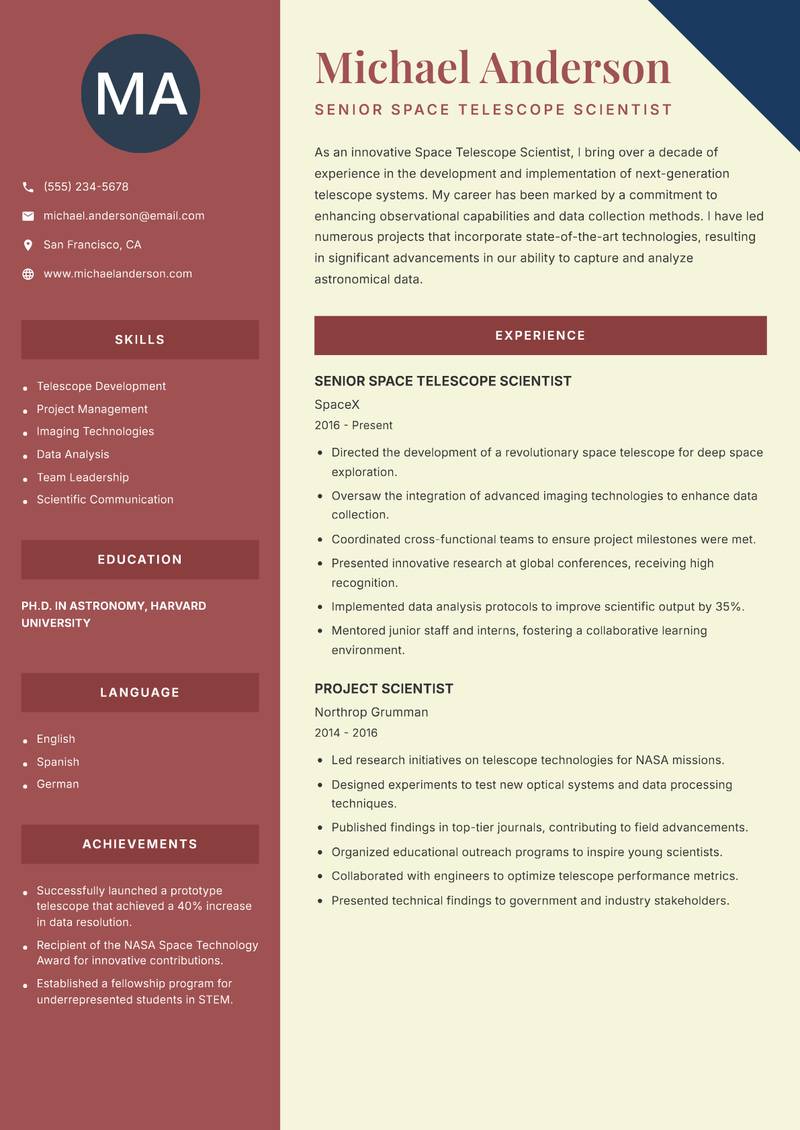
Two Column
Use Template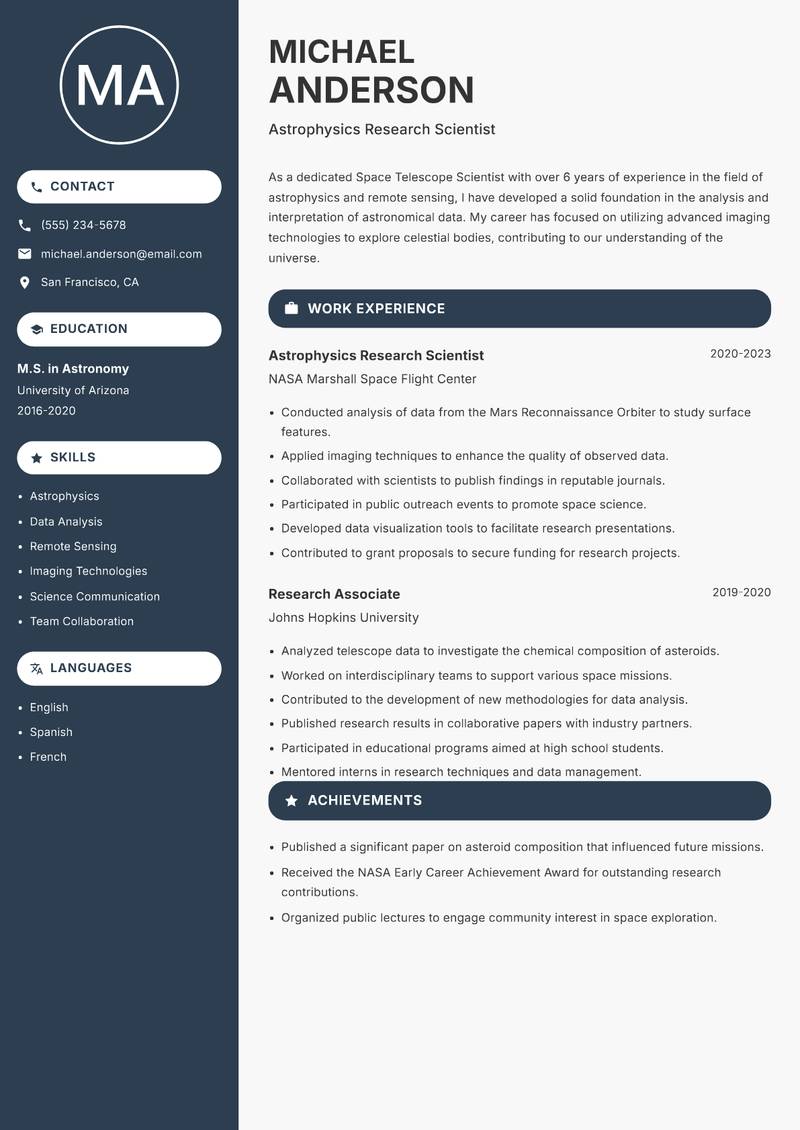
Compact
Use Template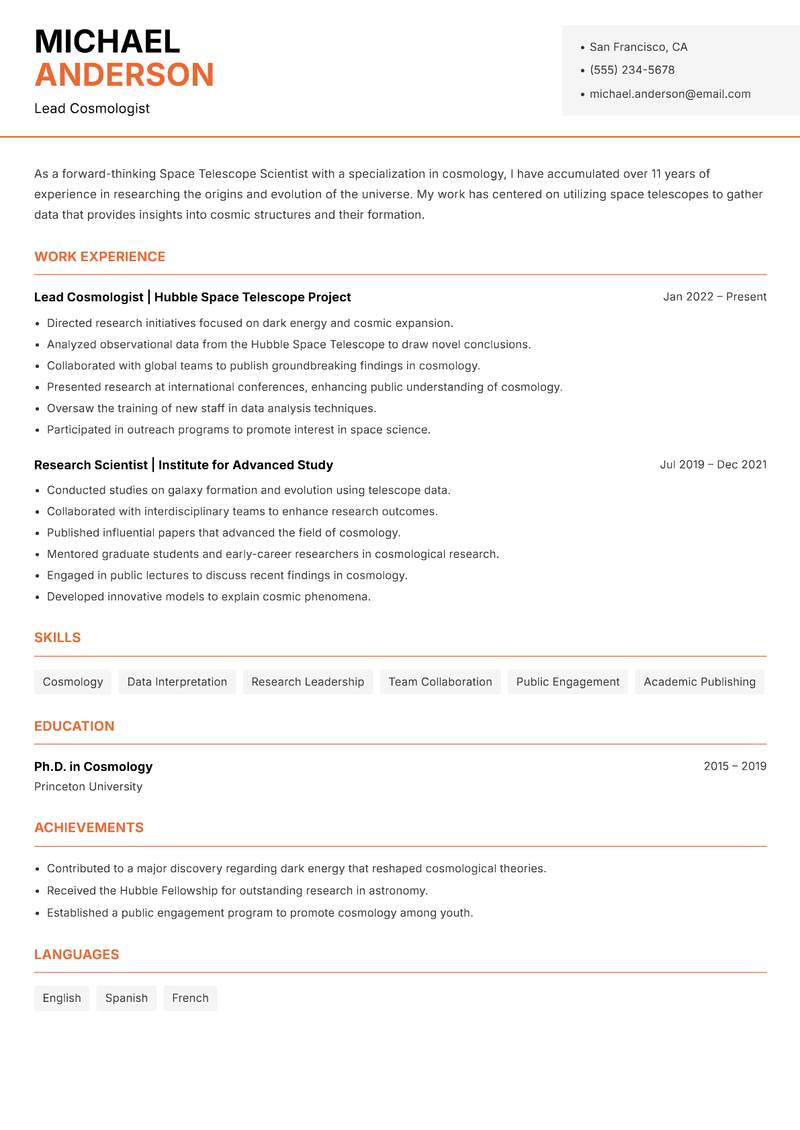
Modern Professional
Use Template7 Real Space Telescope Scientist Resume Examples
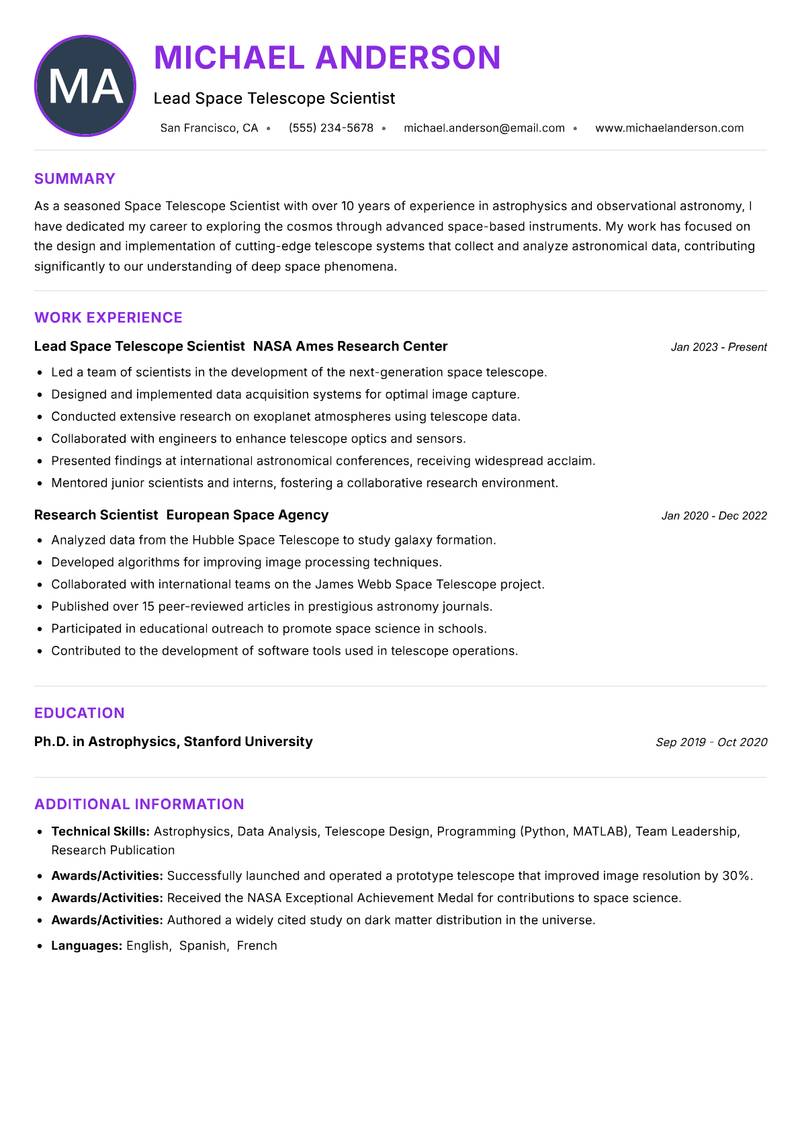
Lead Space Telescope Scientist with 11+ Years Experience
Summary: As a seasoned Space Telescope Scientist with over 10 years of experience in astrophysics and observational astronomy, I have dedicated my career to exploring the cosmos through advanced space-based instruments. My work has focused on the design and implementation of cutting-edge telescope systems that collect and analyze astronomical data, contributing significantly to our understanding of deep space phenomena. I have collaborated with multidisciplinary teams to develop innovative solutions that enhance telescope capabilities, leading to groundbreaking discoveries. My strong background in data analysis and interpretation allows me to translate complex data into meaningful insights, which have been published in leading scientific journals. I am passionate about mentoring the next generation of scientists and actively engage in outreach programs to promote STEM education. I thrive in high-pressure environments where precision and attention to detail are paramount and am committed to pushing the boundaries of space exploration.
Description:
- Led a team of scientists in the development of the next-generation space telescope.
- Designed and implemented data acquisition systems for optimal image capture.
- Conducted extensive research on exoplanet atmospheres using telescope data.
- Collaborated with engineers to enhance telescope optics and sensors.
- Presented findings at international astronomical conferences, receiving widespread acclaim.
- Mentored junior scientists and interns, fostering a collaborative research environment.
🏆 Key Achievements
Space Telescope Engineer with 8+ Years Experience
Summary: With a robust background in astrophysics and engineering, I have spent over 8 years as a Space Telescope Scientist specializing in optical systems and instrumentation. My career has been marked by a commitment to innovation and excellence in space observation techniques. I have successfully led projects that integrate new technologies into existing telescope frameworks, resulting in enhanced observation capabilities and data quality. My experience includes collaborating with cross-functional teams to conduct experiments that yield critical insights into cosmic phenomena. I am adept at utilizing advanced simulation software to predict telescope performance and troubleshoot issues, ensuring successful mission outcomes. Passionate about education and outreach, I strive to inspire future scientists through mentorship programs and public lectures. My goal is to continue advancing the frontiers of astronomical research by leveraging my technical expertise and collaborative spirit.
Description:
- Engineered optical systems for a large-scale space telescope project.
- Utilized simulation software to model telescope performance under various conditions.
- Conducted hands-on testing of optical components to ensure quality standards.
- Collaborated with scientists on research initiatives to refine telescope specifications.
- Presented technical findings to stakeholders and funding agencies.
- Developed training materials for new engineers and interns.
🏆 Key Achievements
Data Scientist - Space Telescope Division with 7+ Years Experience
Summary: I am a dedicated Space Telescope Scientist with a strong focus on data science and astrophysical research. Over the past 7 years, I have honed my skills in analyzing complex datasets generated by various space telescopes, translating them into valuable scientific insights that inform our understanding of the universe. My role involves developing and implementing data processing algorithms that enhance the accuracy of astronomical observations. I work closely with researchers to identify key areas of investigation, ensuring our findings are impactful and relevant. I am proficient in machine learning techniques, which I apply to extract patterns from large volumes of celestial data. Recognized for my problem-solving abilities, I consistently strive to innovate within my field, contributing to projects that push the boundaries of what we know about space. I am passionate about sharing my knowledge through workshops and mentoring, fostering a collaborative environment for learning and discovery.
Description:
- Developed advanced algorithms for processing astronomical data from space telescopes.
- Collaborated with astrophysicists to identify research priorities based on data analysis.
- Utilized machine learning to improve data classification accuracy by 40%.
- Presented research results to scientific communities and stakeholders.
- Conducted workshops to train junior staff on data analysis techniques.
- Published multiple papers detailing innovative data processing methods.
🏆 Key Achievements
Planetary Scientist with 9+ Years Experience
Summary: As a passionate Space Telescope Scientist with a focus on planetary science, I have spent over 9 years exploring the atmospheres of exoplanets and their potential for habitability. My career path has taken me through various prestigious institutions where I have led innovative research projects that leverage advanced imaging techniques and data analysis to gain insights into distant worlds. I am skilled in utilizing both ground-based and space-based telescopes, and my expertise lies in interpreting spectroscopic data to assess the chemical compositions of planetary atmospheres. My work has contributed to the identification of potentially habitable exoplanets, and I have been recognized for my contributions to the field through various awards. I am committed to advancing our understanding of planetary systems and actively engage in educational outreach to inspire future scientists.
Description:
- Led research on the atmospheres of exoplanets using data from the Kepler mission.
- Implemented new imaging techniques to enhance spectral data analysis.
- Collaborated with international teams to develop exoplanet observation strategies.
- Published research findings in high-impact journals, influencing field standards.
- Participated in public outreach events to discuss planetary exploration.
- Mentored graduate students in research methodologies and data analysis.
🏆 Key Achievements
Senior Space Telescope Scientist with 10+ Years Experience
Summary: As an innovative Space Telescope Scientist, I bring over a decade of experience in the development and implementation of next-generation telescope systems. My career has been marked by a commitment to enhancing observational capabilities and data collection methods. I have led numerous projects that incorporate state-of-the-art technologies, resulting in significant advancements in our ability to capture and analyze astronomical data. My expertise extends to project management, where I have successfully overseen teams of scientists and engineers to deliver projects on time and within budget. I am passionate about sharing my knowledge and experiences with aspiring scientists and engineers through mentorship and outreach initiatives. My dedication to the field is reflected in my numerous publications and presentations at international conferences, where I discuss innovative findings and methodologies.
Description:
- Directed the development of a revolutionary space telescope for deep space exploration.
- Oversaw the integration of advanced imaging technologies to enhance data collection.
- Coordinated cross-functional teams to ensure project milestones were met.
- Presented innovative research at global conferences, receiving high recognition.
- Implemented data analysis protocols to improve scientific output by 35%.
- Mentored junior staff and interns, fostering a collaborative learning environment.
🏆 Key Achievements
Astrophysics Research Scientist with 6+ Years Experience
Summary: As a dedicated Space Telescope Scientist with over 6 years of experience in the field of astrophysics and remote sensing, I have developed a solid foundation in the analysis and interpretation of astronomical data. My career has focused on utilizing advanced imaging technologies to explore celestial bodies, contributing to our understanding of the universe. I have collaborated with research teams on various projects, analyzing data from space missions to derive critical insights into the composition and behavior of astronomical objects. My strong analytical skills and attention to detail enable me to provide accurate interpretations that guide future research directions. Passionate about science communication, I actively participate in outreach activities aimed at engaging the public in astronomy and space exploration. My goal is to continue advancing my expertise while contributing to significant discoveries in the field.
Description:
- Conducted analysis of data from the Mars Reconnaissance Orbiter to study surface features.
- Applied imaging techniques to enhance the quality of observed data.
- Collaborated with scientists to publish findings in reputable journals.
- Participated in public outreach events to promote space science.
- Developed data visualization tools to facilitate research presentations.
- Contributed to grant proposals to secure funding for research projects.
🏆 Key Achievements
Lead Cosmologist with 11+ Years Experience
Summary: As a forward-thinking Space Telescope Scientist with a specialization in cosmology, I have accumulated over 11 years of experience in researching the origins and evolution of the universe. My work has centered on utilizing space telescopes to gather data that provides insights into cosmic structures and their formation. I possess a strong analytical background, enabling me to interpret complex data and draw meaningful conclusions that contribute to academic discourse in the field. I have been involved in several high-profile projects that have resulted in significant advancements in our understanding of dark energy and the expansion of the universe. My commitment to science extends beyond research, as I actively engage in mentorship and educational initiatives to inspire the next generation of scientists. I am driven by a passion for discovery and a desire to share my findings with both the scientific community and the public.
Description:
- Directed research initiatives focused on dark energy and cosmic expansion.
- Analyzed observational data from the Hubble Space Telescope to draw novel conclusions.
- Collaborated with global teams to publish groundbreaking findings in cosmology.
- Presented research at international conferences, enhancing public understanding of cosmology.
- Oversaw the training of new staff in data analysis techniques.
- Participated in outreach programs to promote interest in space science.
🏆 Key Achievements
Key Skills for Space Telescope Scientist
ATS Optimization Tips
Increase your chances of getting hired
Use Standard Headings
Use common section titles like Experience, Skills, etc.
Include Keywords
Add role-specific keywords from the job description
Keep it Simple
Avoid complex tables, images and graphics
Save in Right Format
Use PDF format unless otherwise specified
Space Telescope Scientist Salary Insights
Average Salary
$107,500
per year
Salary Range
$85,000 - $130,000
per year
Top Paying Cities
Los Angeles, Seattle, Houston, Dallas, Boston
Source: Glassdoor, Payscale, Indeed (Updated April 2025)
Everything you need to write a great Space Telescope Scientist resume
Strong Action Verbs to Use
Resume Writing Tips
- →Highlight your experience with specific telescopes and instruments, including any hands-on work performed.
- →Include detailed examples of data analysis projects—mention software and statistical methods employed.
- →Showcase collaboration with other scientists, emphasizing roles in team-based projects and successful outcomes.
- →List any specialized knowledge such as image processing tools relevant to astronomical data.
- →Document contributions to published papers or conferences to underline your engagement in the field.
Common Mistakes to Avoid
- ✕Failing to quantify achievements—make sure to mention specific observations or data sets you worked with.
- ✕Not showcasing specific technical skills; always mention programming languages like Python or MATLAB used in analysis.
- ✕Using vague descriptors like 'conducted research' without detailing methodologies or results achieved.
- ✕Overlooking the importance of teamwork; not attributing collaborative efforts and contributions made to larger missions.
ATS Keywords for Space Telescope Scientist
Space Telescope Scientist Career Path
Career Progression
Junior Space Telescope Scientist
Focuses on data collection and preliminary analysis, typically involved in assisting with observational campaigns.
Mid-Level Space Telescope Scientist
Develops algorithms for image processing, contributing to science release papers and leading small projects.
Senior Space Telescope Scientist
Oversees major research initiatives, coordinates with interdisciplinary teams, and leads telescope observation planning.
Principal Investigator
Directs significant research programs, secures funding, and publishes groundbreaking findings in peer-reviewed journals.
Director of Telescope Operations
Manages all aspects of telescope missions, including technical infrastructure and scientific output.
Space Telescope Scientist Interview Questions
What methodologies do you use for data analysis from space telescopes? +
Detail specific tools and techniques for processing astronomical data.
Can you describe a challenging project you worked on involving telescope data? +
Highlight problem-solving strategies and outcomes.
How do you ensure data integrity when analyzing observational data? +
Discuss your approach to verifying the precision and accuracy of results.
What role do you see emerging technologies playing in your work as a Space Telescope Scientist? +
Consider discussing advancements like AI and machine learning in astronomy.
Explain your experience in writing and publishing scientific papers. What steps do you follow? +
Include your process for collaboration, drafting, peer-review, and publication.
Describe a situation where you collaborated with other scientists on a space mission. What was your contribution? +
Focus on teamwork, interdisciplinary approaches, and defining your role in the collaboration.
What are the main challenges that Space Telescope Scientists face in current space missions? +
Discuss logistical, technical, or scientific challenges.
About the Space Telescope Scientist Role
Designing observation strategies for space telescopes requires a deep understanding of astronomical phenomena and the technical capabilities of the instruments involved. As a Space Telescope Scientist, the primary responsibility centers on analyzing data captured from various wavelengths to contribute to discoveries about the cosmos. Collaborating with multidisciplinary teams, these scientists transform complex signals into interpretable scientific insights, refining techniques for future observations and publications.
Frequently Asked Questions
What educational background is necessary to become a Space Telescope Scientist? +
Typically, a PhD in astrophysics, astronomy, or a related field is required, along with research experience.
What scientific software is commonly used in this role? +
Astropy, IDL, or proprietary software specific to the telescope, as well as general-purpose programming languages like Python.
How does one become involved with major projects like the James Webb Space Telescope? +
Involvement generally comes through academic connections, grants, collaborations, or dedicated application processes from organizations leading the projects.
What role does public outreach play in the job of a Space Telescope Scientist? +
Scientists often participate in public outreach by communicating findings through lectures, articles, and educational initiatives.
Are certifications or additional training beneficial for Space Telescope Scientists? +
While not always required, courses in data science or additional workshops in specialized software can provide a competitive edge.
What career advancements can one expect as a Space Telescope Scientist? +
Opportunities exist to advance to leadership positions in project management or academia, directing major research initiatives.
More Resume Examples You Might Like
Related Career Paths
Other roles candidates for Space Telescope Scientist positions often also consider.
Will this Space Telescope Scientist resume pass the ATS scan?
Upload it and get an instant AI-scored compatibility check with specific fixes.
Check My Resume →
Pair it with a matching cover letter
AI drafts a first version from your job title and strengths — edit it live, then download the PDF.
Write My Cover Letter →
Written by Nohaya Career Team
Reviewed by HR Professionals · Updated April 2025
Ready to Build Your Perfect Resume?
Choose from 1000+ professional templates and land your dream job.
Create My Resume Now