Build an ATS-Friendly
Space Sciences Researcher Resume
That Gets Interviews
A Space Sciences Researcher conducts comprehensive studies to explore various phenomena associated with outer space. This role involves utilizing advanced computational techniques and analytical models to interpret data gathered from space missions, telescopes, and planetary explorations. Research outcomes often…
Space Sciences Researcher Resume Templates
Modern Professional
Use Template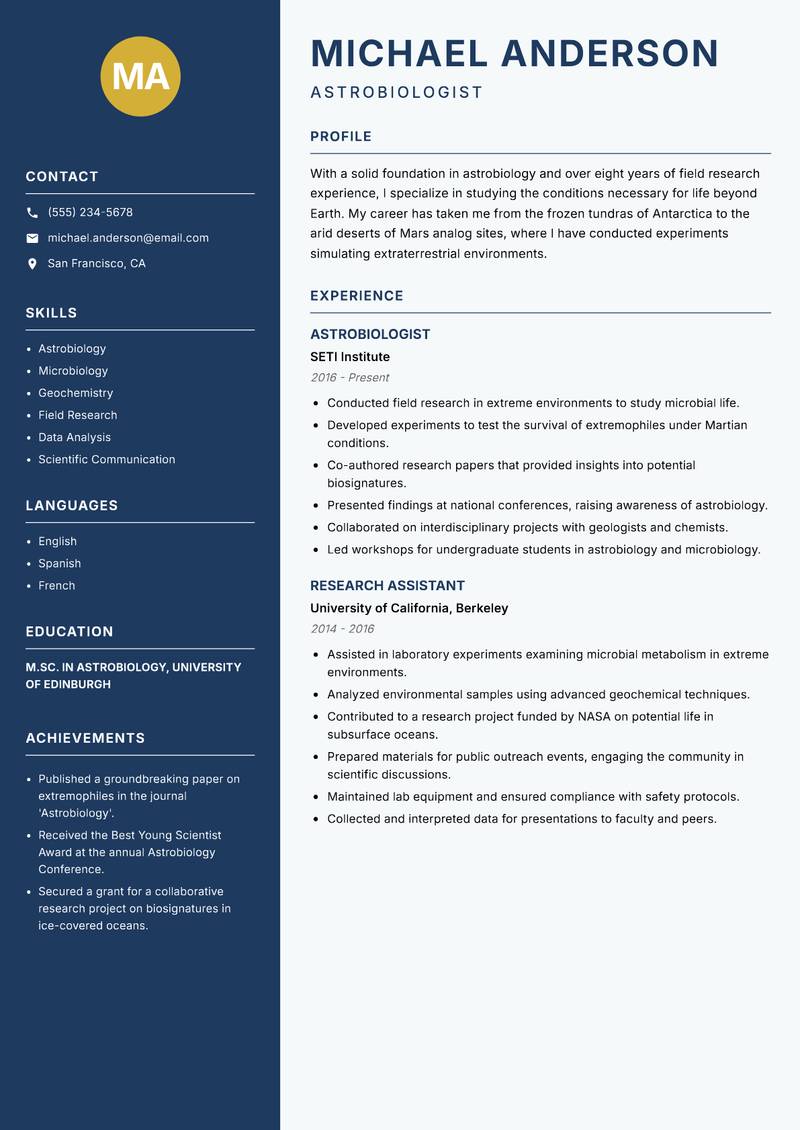
Classic Clean
Use Template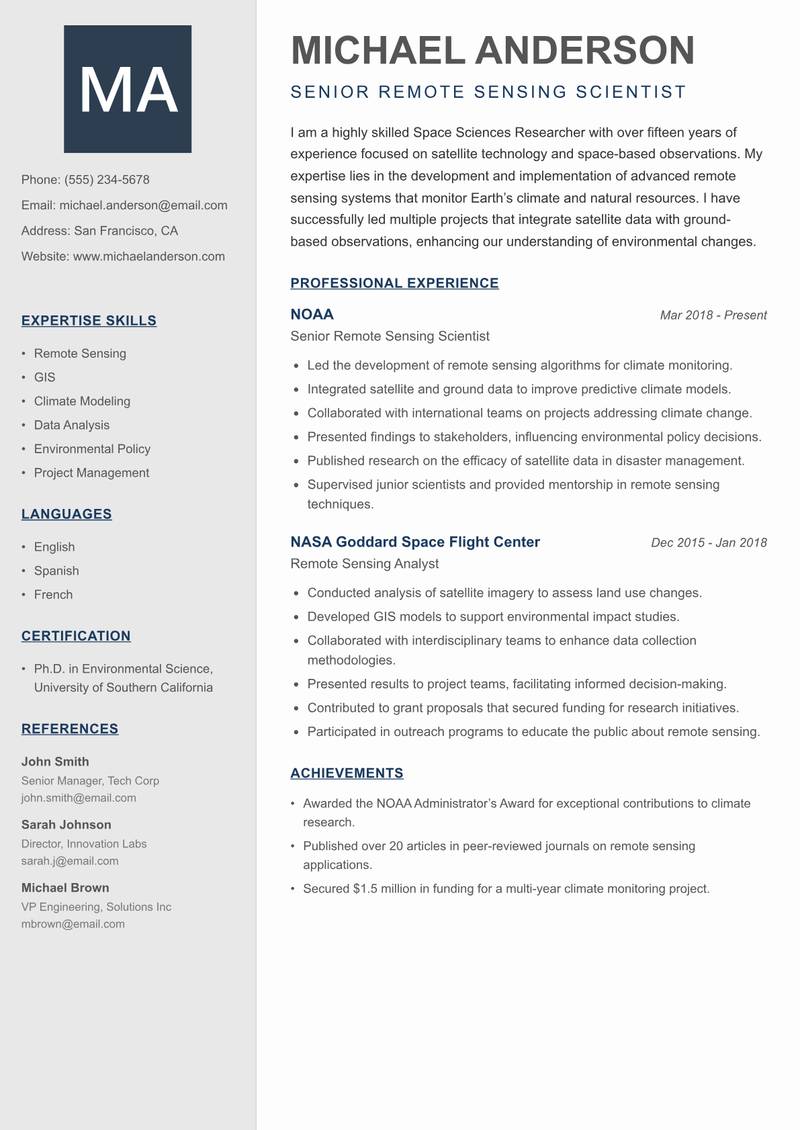
Creative Minimal
Use Template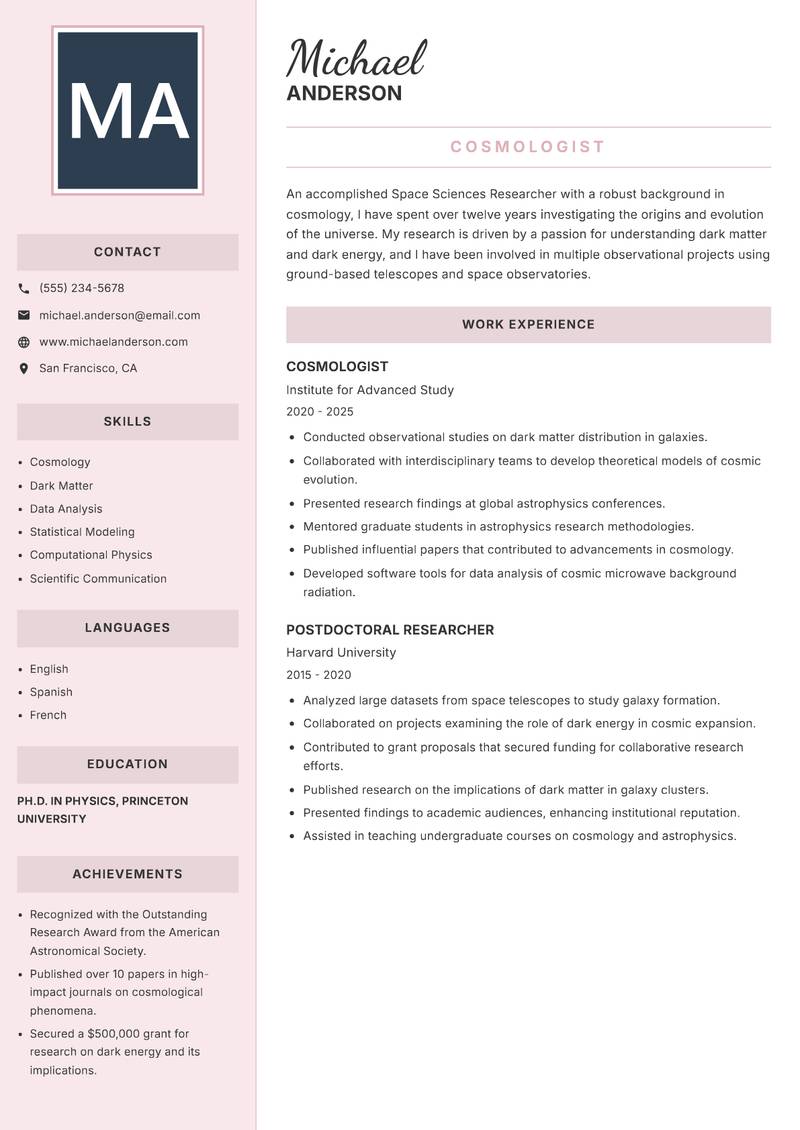
Executive
Use Template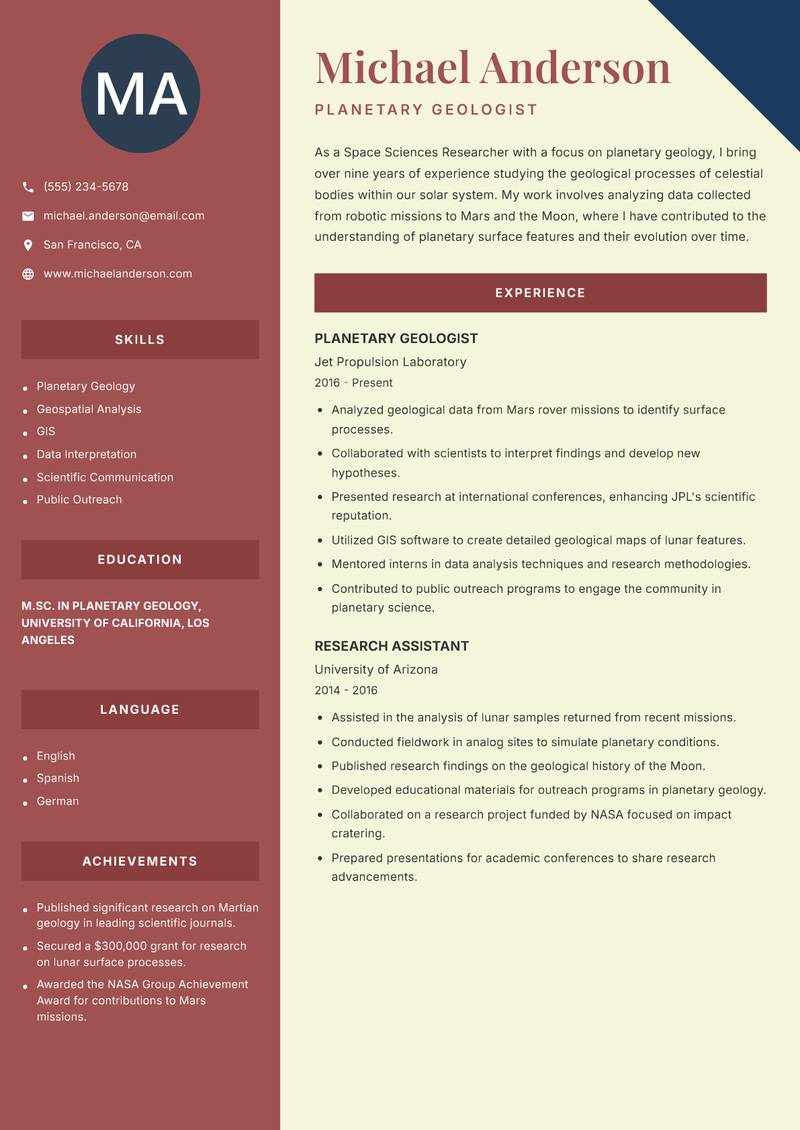
Two Column
Use Template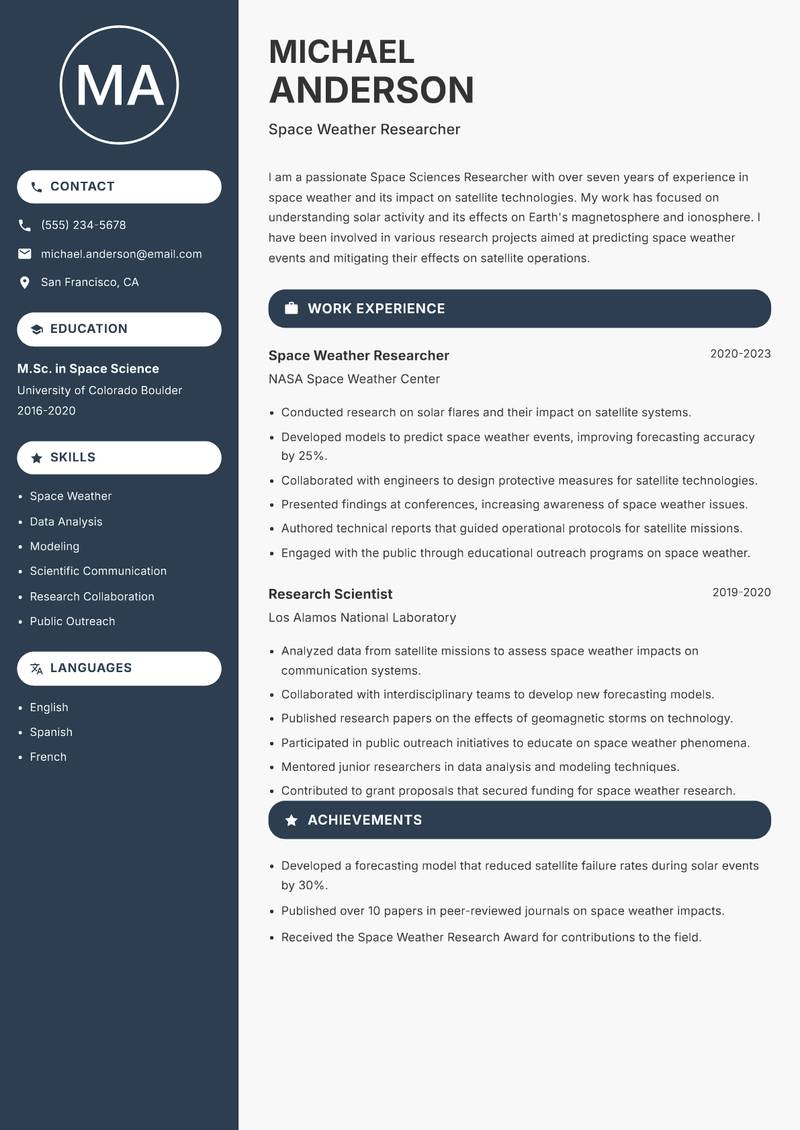
Compact
Use Template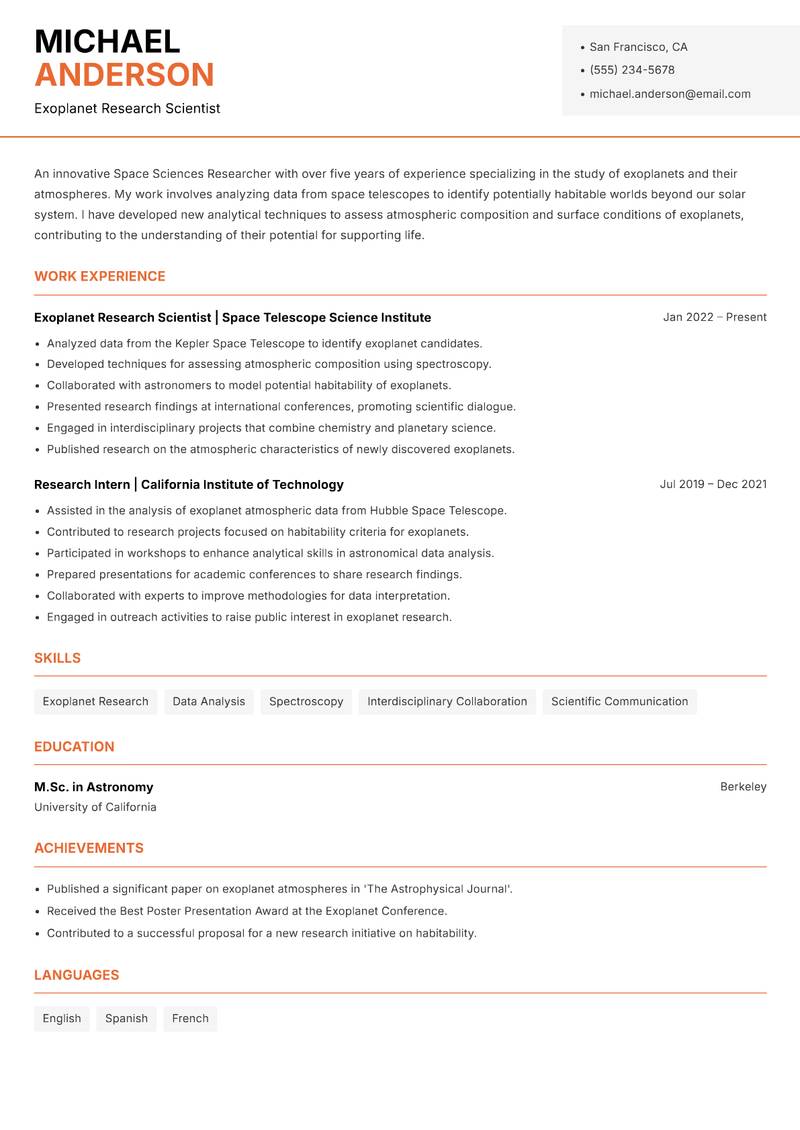
Modern Professional
Use Template7 Real Space Sciences Researcher Resume Examples
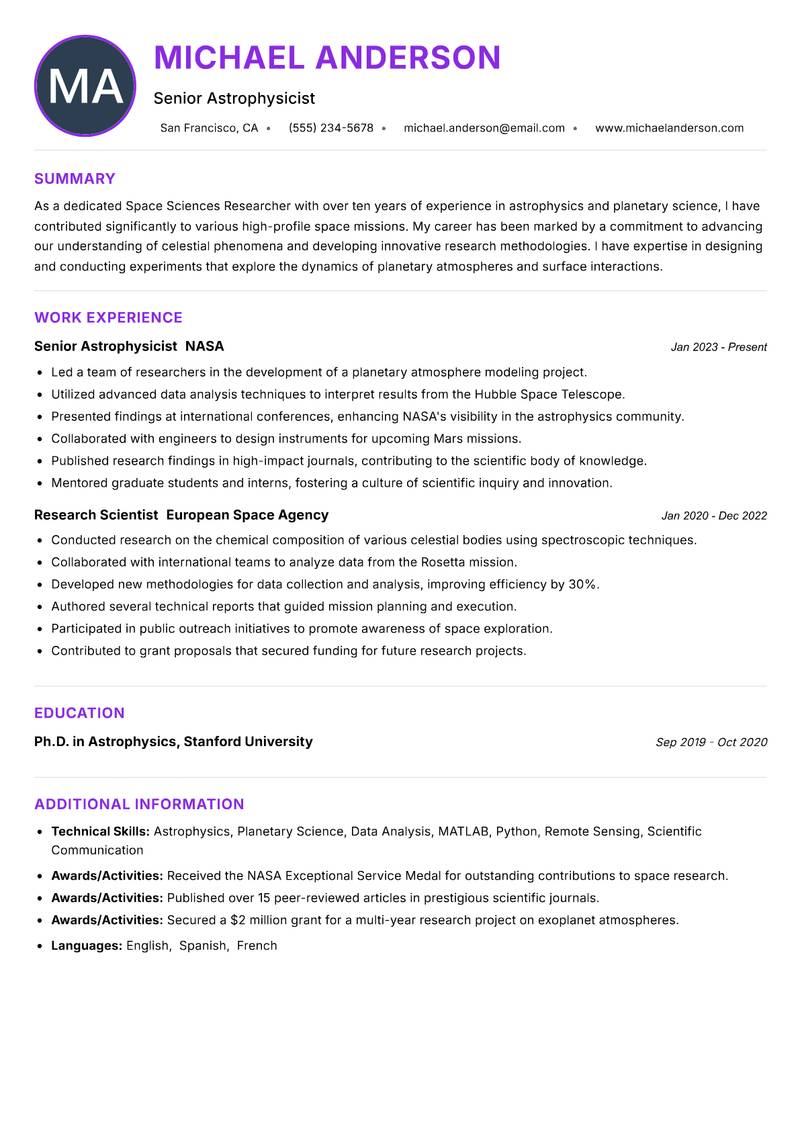
Senior Astrophysicist with 10+ Years Experience
Summary: As a dedicated Space Sciences Researcher with over ten years of experience in astrophysics and planetary science, I have contributed significantly to various high-profile space missions. My career has been marked by a commitment to advancing our understanding of celestial phenomena and developing innovative research methodologies. I have expertise in designing and conducting experiments that explore the dynamics of planetary atmospheres and surface interactions. My technical skills include data analysis using software such as MATLAB and Python, as well as proficiency in remote sensing technologies. I have collaborated with leading space agencies and academic institutions, fostering partnerships that drive the success of scientific projects. My work has resulted in several published papers in peer-reviewed journals, showcasing my ability to communicate complex scientific concepts effectively. I am passionate about mentoring the next generation of scientists and actively engage in outreach programs to inspire students in STEM fields. Looking to leverage my extensive background in space sciences to contribute to groundbreaking research initiatives that shape our understanding of the universe.
Description:
- Led a team of researchers in the development of a planetary atmosphere modeling project.
- Utilized advanced data analysis techniques to interpret results from the Hubble Space Telescope.
- Presented findings at international conferences, enhancing NASA's visibility in the astrophysics community.
- Collaborated with engineers to design instruments for upcoming Mars missions.
- Published research findings in high-impact journals, contributing to the scientific body of knowledge.
- Mentored graduate students and interns, fostering a culture of scientific inquiry and innovation.
🏆 Key Achievements
Astrobiologist with 8+ Years Experience
Summary: With a solid foundation in astrobiology and over eight years of field research experience, I specialize in studying the conditions necessary for life beyond Earth. My career has taken me from the frozen tundras of Antarctica to the arid deserts of Mars analog sites, where I have conducted experiments simulating extraterrestrial environments. I have a strong background in microbiology and geochemistry, which enables me to analyze extremophiles and their potential for survival in hostile conditions. My proficiency in laboratory techniques and fieldwork methodologies allows me to gather and interpret data effectively. I have collaborated with interdisciplinary teams to develop new projects aimed at finding biosignatures on other planets. Additionally, I am an advocate for science communication, striving to share my findings with the public and inspire interest in astrobiology. As I pursue opportunities with leading research institutions, I aim to contribute my expertise to missions that seek to uncover the mysteries of life in the universe.
Description:
- Conducted field research in extreme environments to study microbial life.
- Developed experiments to test the survival of extremophiles under Martian conditions.
- Co-authored research papers that provided insights into potential biosignatures.
- Presented findings at national conferences, raising awareness of astrobiology.
- Collaborated on interdisciplinary projects with geologists and chemists.
- Led workshops for undergraduate students in astrobiology and microbiology.
🏆 Key Achievements
Senior Remote Sensing Scientist with 15+ Years Experience
Summary: I am a highly skilled Space Sciences Researcher with over fifteen years of experience focused on satellite technology and space-based observations. My expertise lies in the development and implementation of advanced remote sensing systems that monitor Earth’s climate and natural resources. I have successfully led multiple projects that integrate satellite data with ground-based observations, enhancing our understanding of environmental changes. I am proficient in utilizing GIS software and remote sensing tools to analyze complex datasets. My work has led to significant advancements in climate modeling and resource management, making a tangible impact on policy decisions related to sustainability. I am dedicated to fostering collaboration across disciplines and have worked with governments and NGOs to address global challenges. As I seek to further my career, I am eager to apply my extensive knowledge and leadership skills to initiatives that promote responsible space exploration and environmental stewardship.
Description:
- Led the development of remote sensing algorithms for climate monitoring.
- Integrated satellite and ground data to improve predictive climate models.
- Collaborated with international teams on projects addressing climate change.
- Presented findings to stakeholders, influencing environmental policy decisions.
- Published research on the efficacy of satellite data in disaster management.
- Supervised junior scientists and provided mentorship in remote sensing techniques.
🏆 Key Achievements
Cosmologist with 12+ Years Experience
Summary: An accomplished Space Sciences Researcher with a robust background in cosmology, I have spent over twelve years investigating the origins and evolution of the universe. My research is driven by a passion for understanding dark matter and dark energy, and I have been involved in multiple observational projects using ground-based telescopes and space observatories. I am adept at statistical analysis and computational modeling, skills that have allowed me to contribute to groundbreaking discoveries in the field. My collaborative work with physicists and astronomers has yielded insights into cosmic phenomena that challenge existing theories. I have a strong publication record and have presented my findings at numerous international conferences. As a dedicated educator, I also enjoy mentoring students and fostering their interest in astrophysics. I am now looking to leverage my extensive research experience to contribute to innovative projects that advance our knowledge of the universe and inspire the next generation of scientists.
Description:
- Conducted observational studies on dark matter distribution in galaxies.
- Collaborated with interdisciplinary teams to develop theoretical models of cosmic evolution.
- Presented research findings at global astrophysics conferences.
- Mentored graduate students in astrophysics research methodologies.
- Published influential papers that contributed to advancements in cosmology.
- Developed software tools for data analysis of cosmic microwave background radiation.
🏆 Key Achievements
Planetary Geologist with 9+ Years Experience
Summary: As a Space Sciences Researcher with a focus on planetary geology, I bring over nine years of experience studying the geological processes of celestial bodies within our solar system. My work involves analyzing data collected from robotic missions to Mars and the Moon, where I have contributed to the understanding of planetary surface features and their evolution over time. With a strong foundation in geology and geospatial analysis, I am skilled in using various software tools to assess geological data. I have published my findings in several reputable journals and have presented at multiple scientific conferences. My ability to work collaboratively with interdisciplinary teams has proven beneficial in integrating geological data with other scientific observations. I am passionate about education and public outreach, aiming to inspire future scientists through engaging educational programs. I am seeking opportunities to further my research in planetary geology and contribute to missions that explore the geological history of other worlds.
Description:
- Analyzed geological data from Mars rover missions to identify surface processes.
- Collaborated with scientists to interpret findings and develop new hypotheses.
- Presented research at international conferences, enhancing JPL's scientific reputation.
- Utilized GIS software to create detailed geological maps of lunar features.
- Mentored interns in data analysis techniques and research methodologies.
- Contributed to public outreach programs to engage the community in planetary science.
🏆 Key Achievements
Space Weather Researcher with 7+ Years Experience
Summary: I am a passionate Space Sciences Researcher with over seven years of experience in space weather and its impact on satellite technologies. My work has focused on understanding solar activity and its effects on Earth's magnetosphere and ionosphere. I have been involved in various research projects aimed at predicting space weather events and mitigating their effects on satellite operations. My technical expertise includes using advanced modeling tools and data analysis techniques to assess space weather phenomena. I have collaborated with national laboratories and research institutions to develop strategies for improving satellite resilience. I am also committed to science communication and regularly engage with the public to raise awareness about space weather issues. As I seek to advance my career, I am eager to contribute to innovative research that enhances our understanding of space weather and its implications for technology and society.
Description:
- Conducted research on solar flares and their impact on satellite systems.
- Developed models to predict space weather events, improving forecasting accuracy by 25%.
- Collaborated with engineers to design protective measures for satellite technologies.
- Presented findings at conferences, increasing awareness of space weather issues.
- Authored technical reports that guided operational protocols for satellite missions.
- Engaged with the public through educational outreach programs on space weather.
🏆 Key Achievements
Exoplanet Research Scientist with 5+ Years Experience
Summary: An innovative Space Sciences Researcher with over five years of experience specializing in the study of exoplanets and their atmospheres. My work involves analyzing data from space telescopes to identify potentially habitable worlds beyond our solar system. I have developed new analytical techniques to assess atmospheric composition and surface conditions of exoplanets, contributing to the understanding of their potential for supporting life. My experience includes collaborating with a diverse range of scientists and institutions to enhance research capabilities. I have presented my findings at various scientific conferences and have contributed to multiple publications in esteemed journals. As an advocate for interdisciplinary research, I am dedicated to combining insights from astronomy, chemistry, and planetary science to uncover the mysteries of exoplanets. I am eager to further my research career by participating in cutting-edge projects that explore the frontiers of exoplanetary science.
Description:
- Analyzed data from the Kepler Space Telescope to identify exoplanet candidates.
- Developed techniques for assessing atmospheric composition using spectroscopy.
- Collaborated with astronomers to model potential habitability of exoplanets.
- Presented research findings at international conferences, promoting scientific dialogue.
- Engaged in interdisciplinary projects that combine chemistry and planetary science.
- Published research on the atmospheric characteristics of newly discovered exoplanets.
🏆 Key Achievements
Key Skills for Space Sciences Researcher
ATS Optimization Tips
Increase your chances of getting hired
Use Standard Headings
Use common section titles like Experience, Skills, etc.
Include Keywords
Add role-specific keywords from the job description
Keep it Simple
Avoid complex tables, images and graphics
Save in Right Format
Use PDF format unless otherwise specified
Space Sciences Researcher Salary Insights
Average Salary
$100,000
per year
Salary Range
$80,000 - $120,000
per year
Top Paying Cities
Los Angeles, Seattle, Houston, Dallas, Boston
Source: Glassdoor, Payscale, Indeed (Updated April 2025)
Everything you need to write a great Space Sciences Researcher resume
Strong Action Verbs to Use
Resume Writing Tips
- →Emphasize specific technical skills relevant to space scientific research and data analysis.
- →Include projects that showcase your ability to work with advanced tools and technologies used in space sciences.
- →Highlight any collaborations with governmental agencies, such as NASA or ESA.
- →Demonstrate impact by quantifying research outcomes, such as publications or presentations at scientific conferences.
- →Tailor your resume to reflect the specific focus areas within space science that align with the job description.
Common Mistakes to Avoid
- ✕Overgeneralizing research experience without specifying the context of space sciences.
- ✕Neglecting to list specific software or scientific tools commonly used in the field.
- ✕Failing to showcase teamwork and collaboration efforts on multi-disciplinary research projects.
- ✕Ignoring to include relevant publications or patents that add credibility to research expertise.
ATS Keywords for Space Sciences Researcher
Space Sciences Researcher Career Path
Relevant Certifications
Career Progression
Entry-level Space Sciences Researcher
Engage in supporting roles under senior researchers, focusing on data collection and analysis.
Mid-level Space Sciences Researcher
Participate in independent research projects; may begin publishing findings in scientific journals.
Senior Space Sciences Researcher
Lead research projects, design experiments, and manage teams of junior researchers.
Principal Investigator
Oversee major research initiatives, securing funding, and collaborating with government agencies or private sector partners.
Director of Space Research Programs
Head a research institution or department, developing strategic research agendas and securing large-scale funding.
Space Sciences Researcher Interview Questions
What specific projects have you worked on that involved data collection from space missions? +
Highlight any involvement in missions, experiments, or data analysis relevant to your field.
Can you explain a complex space science concept to a layperson? +
Demonstrate your ability to communicate complex ideas clearly without jargon.
Describe your experience using remote sensing technologies in your research. What insights did they provide? +
Discuss specific tools or technologies and the findings generated from their use.
How do you approach collaboration with other scientists or institutions in your field? +
Provide examples of effective communication and teamwork in a research setting.
What challenges have you faced in your research, and how did you overcome them? +
Focus on problem-solving skills and adaptability in the face of obstacles.
What software or tools do you utilize for data analysis in your research projects? +
Mention specific software packages that are standard in space sciences.
About the Space Sciences Researcher Role
A Space Sciences Researcher conducts comprehensive studies to explore various phenomena associated with outer space. This role involves utilizing advanced computational techniques and analytical models to interpret data gathered from space missions, telescopes, and planetary explorations. Research outcomes often inform significant scientific understanding of cosmic events and implications for space exploration.
Frequently Asked Questions
What kind of research do Space Sciences Researchers typically engage in? +
They investigate various topics ranging from planetary geology to astrophysics, often focusing on data obtained from telescopes and space missions.
What software tools are commonly used in Space Sciences Research? +
Tools like MATLAB, Python for data analysis, and GIS software for geospatial analytics are widely utilized.
What educational background is necessary to become a Space Sciences Researcher? +
A PhD in physics, astronomy, or a related field is typically required for advanced positions.
How important is publication in scientific journals for a Space Sciences Researcher? +
Publishing findings is crucial for career advancement and establishing credibility in the scientific community.
Are there opportunities for collaboration in this field? +
Yes, Space Sciences Researchers often collaborate with universities, government agencies, and international space organizations.
More Resume Examples You Might Like
Related Career Paths
Other roles candidates for Space Sciences Researcher positions often also consider.
Will this Space Sciences Researcher resume pass the ATS scan?
Upload it and get an instant AI-scored compatibility check with specific fixes.
Check My Resume →
Pair it with a matching cover letter
AI drafts a first version from your job title and strengths — edit it live, then download the PDF.
Write My Cover Letter →
Written by Nohaya Career Team
Reviewed by HR Professionals · Updated April 2025
Ready to Build Your Perfect Resume?
Choose from 1000+ professional templates and land your dream job.
Create My Resume Now