Build an ATS-Friendly
Radio Astronomer Resume
That Gets Interviews
Radio astronomers study celestial phenomena by analyzing radio wave emissions from space. Using advanced radio telescopes and interferometric techniques, they examine objects such as galaxies, quasars, and cosmic microwave background radiation. Collaborating closely with physicists and engineers, they develop and…
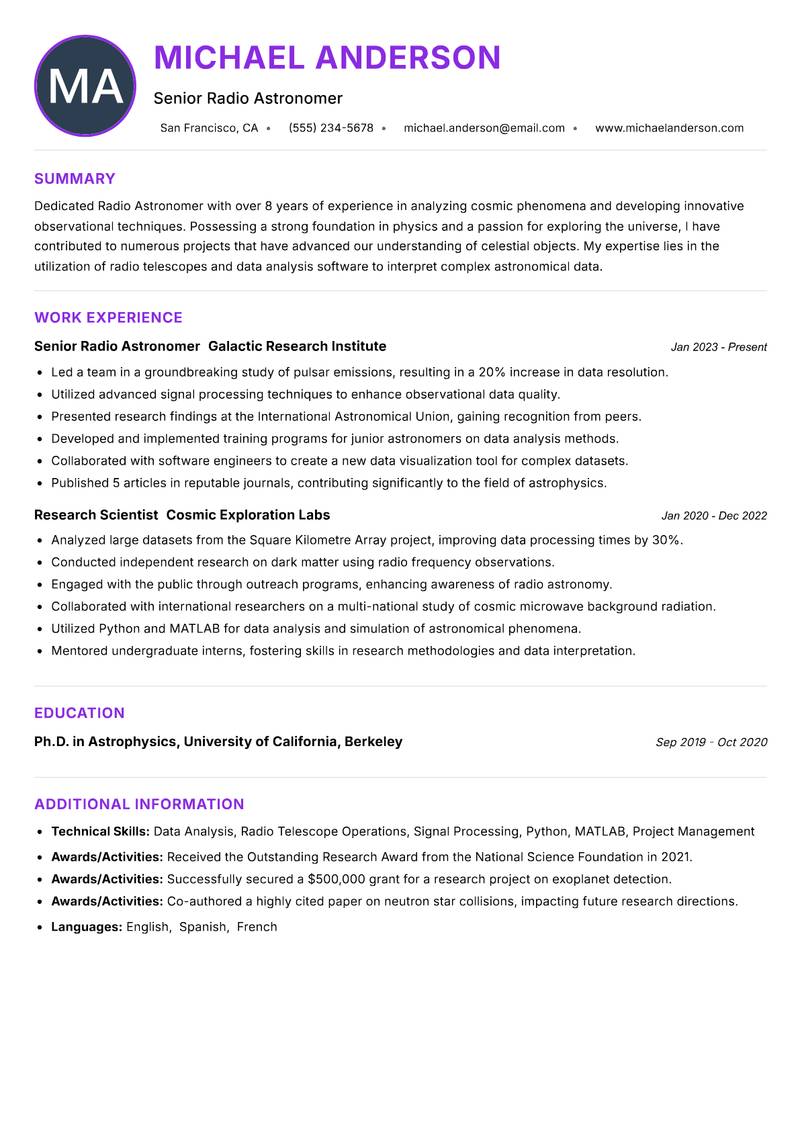
Radio Astronomer Resume Templates
Modern Professional
Use Template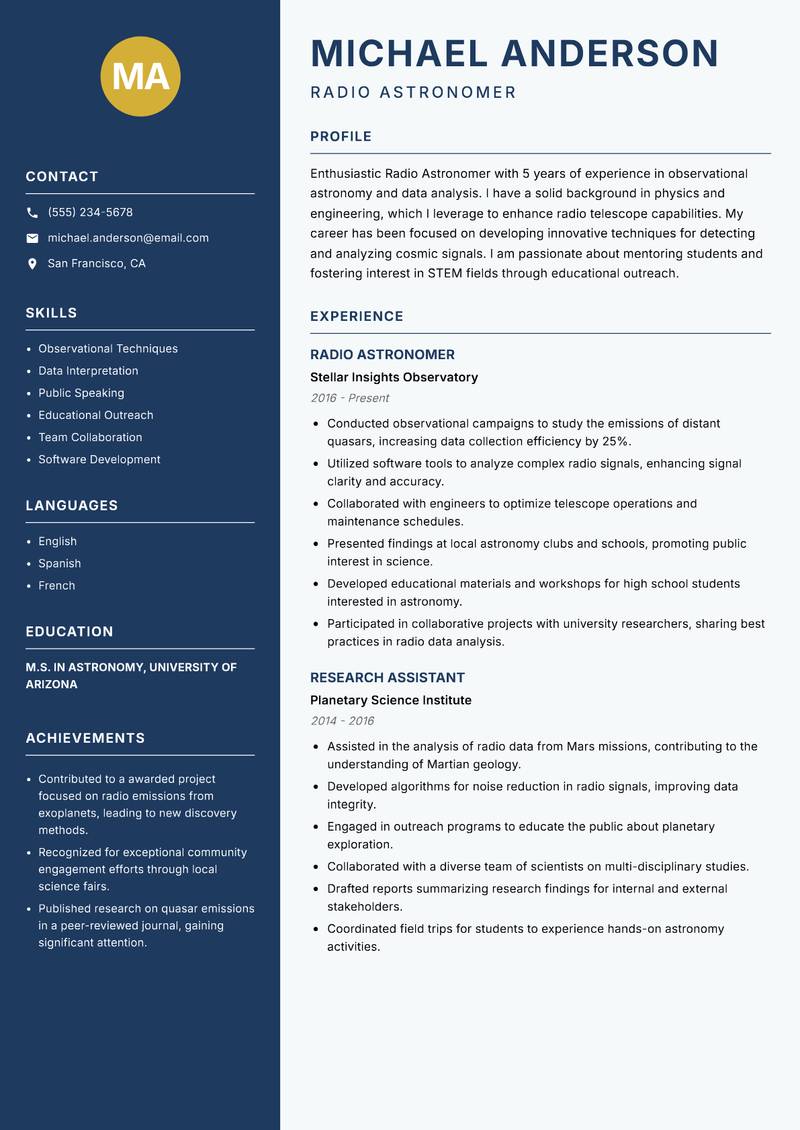
Classic Clean
Use Template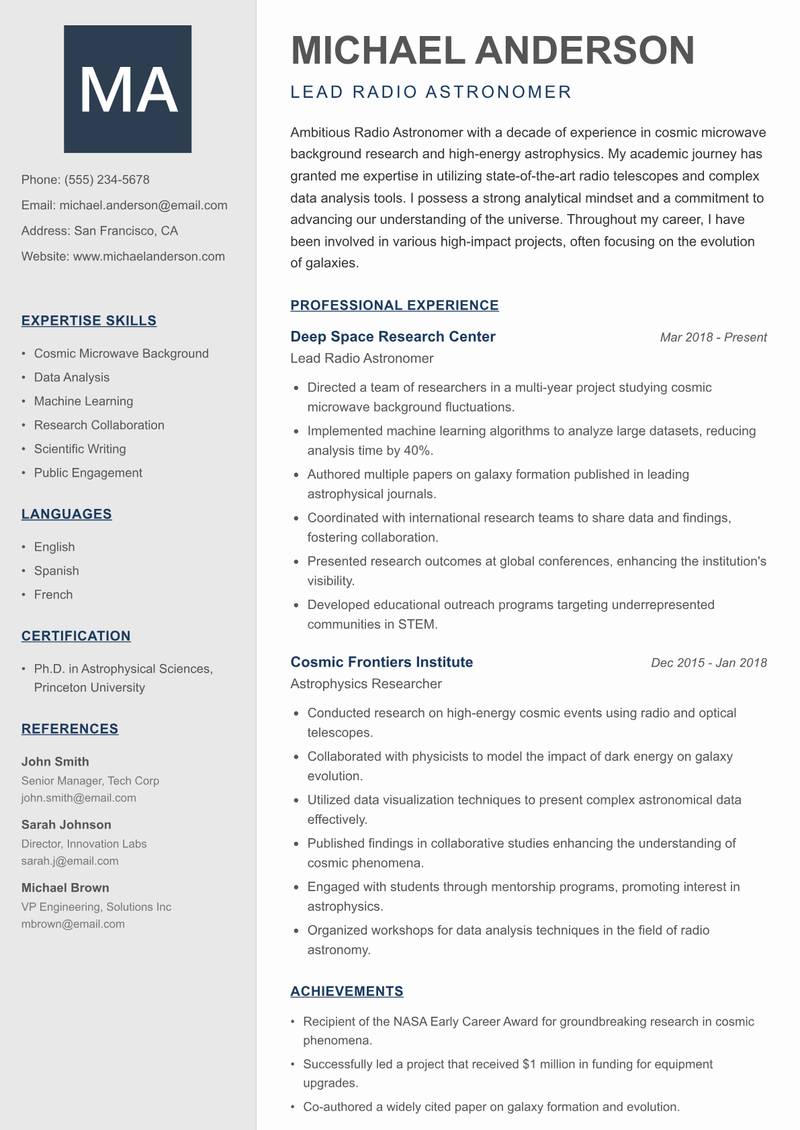
Creative Minimal
Use Template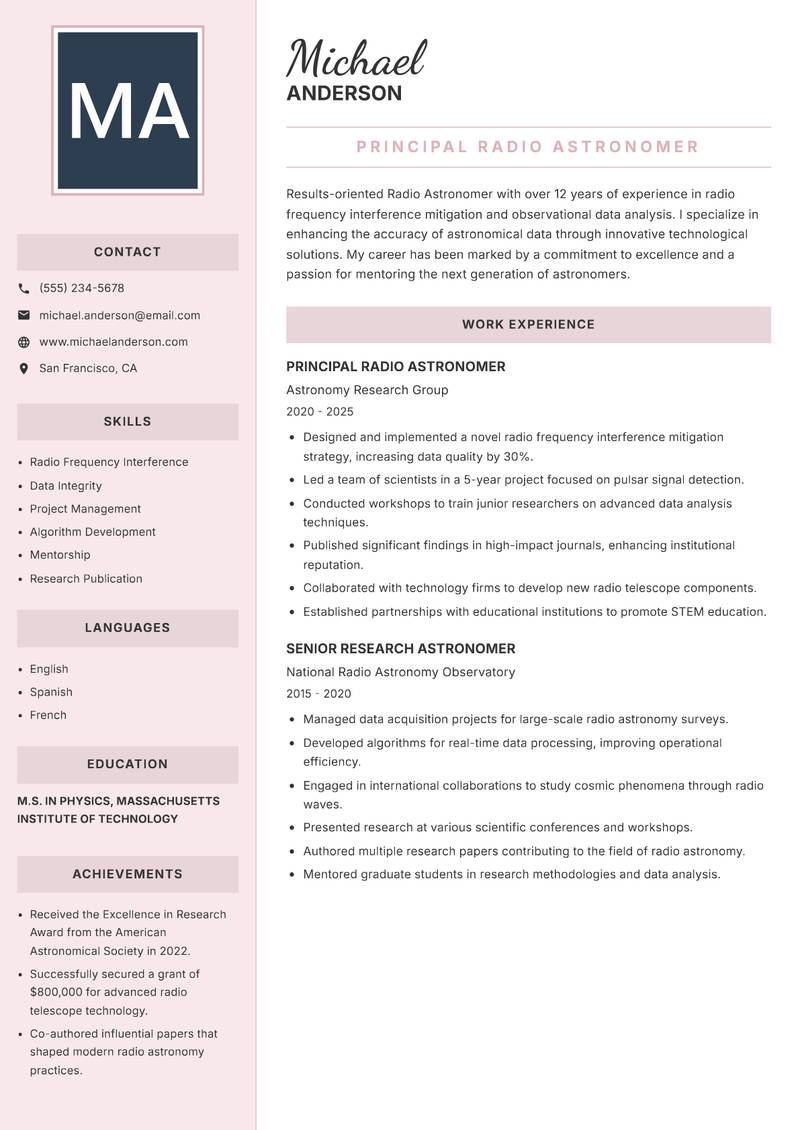
Executive
Use Template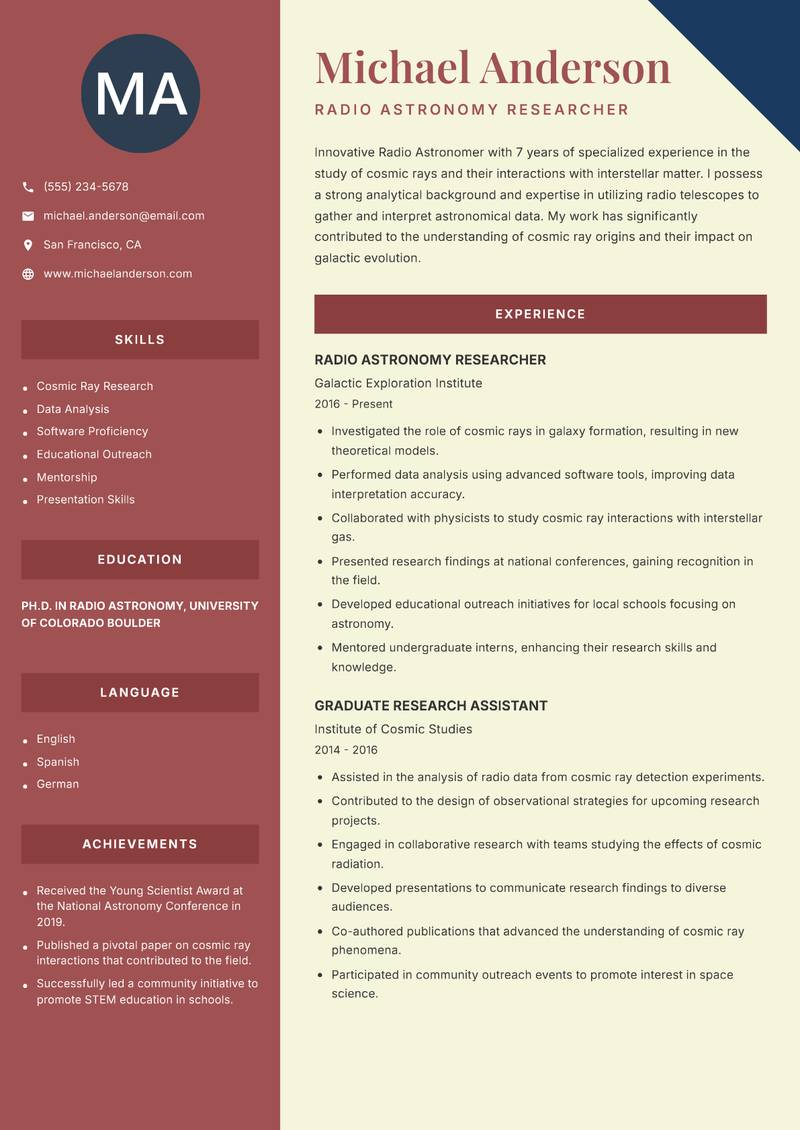
Two Column
Use Template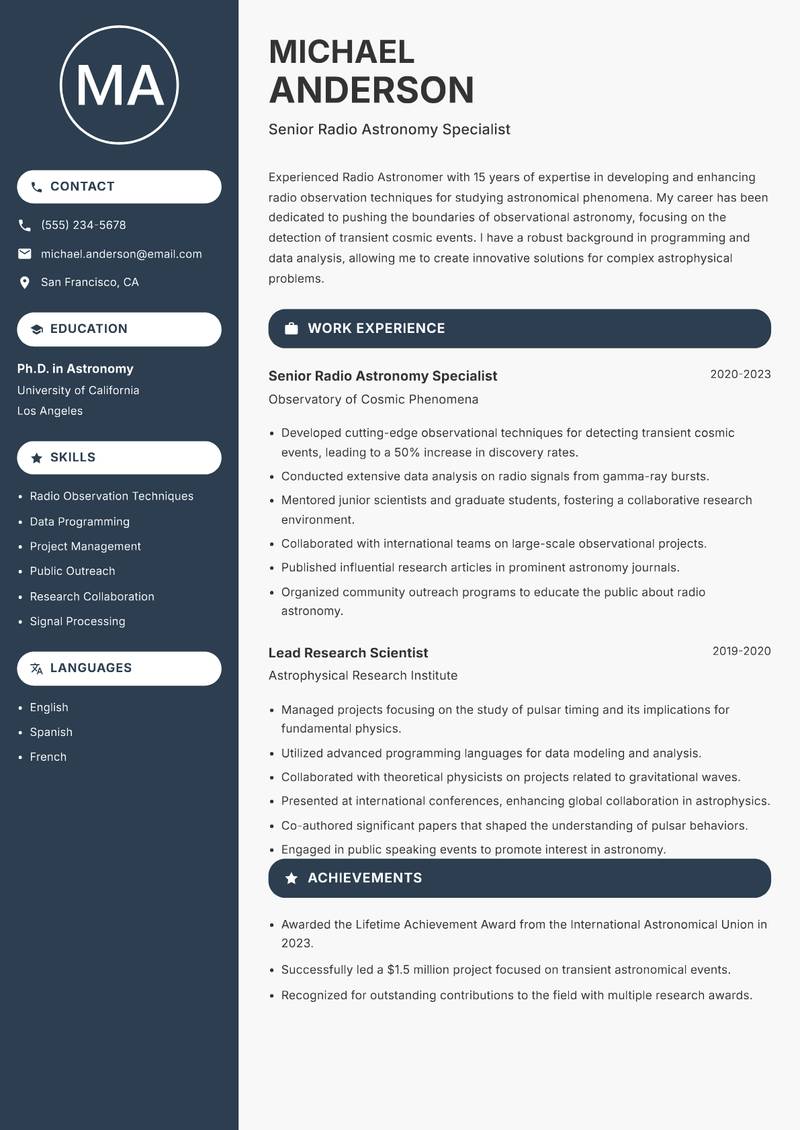
Compact
Use Template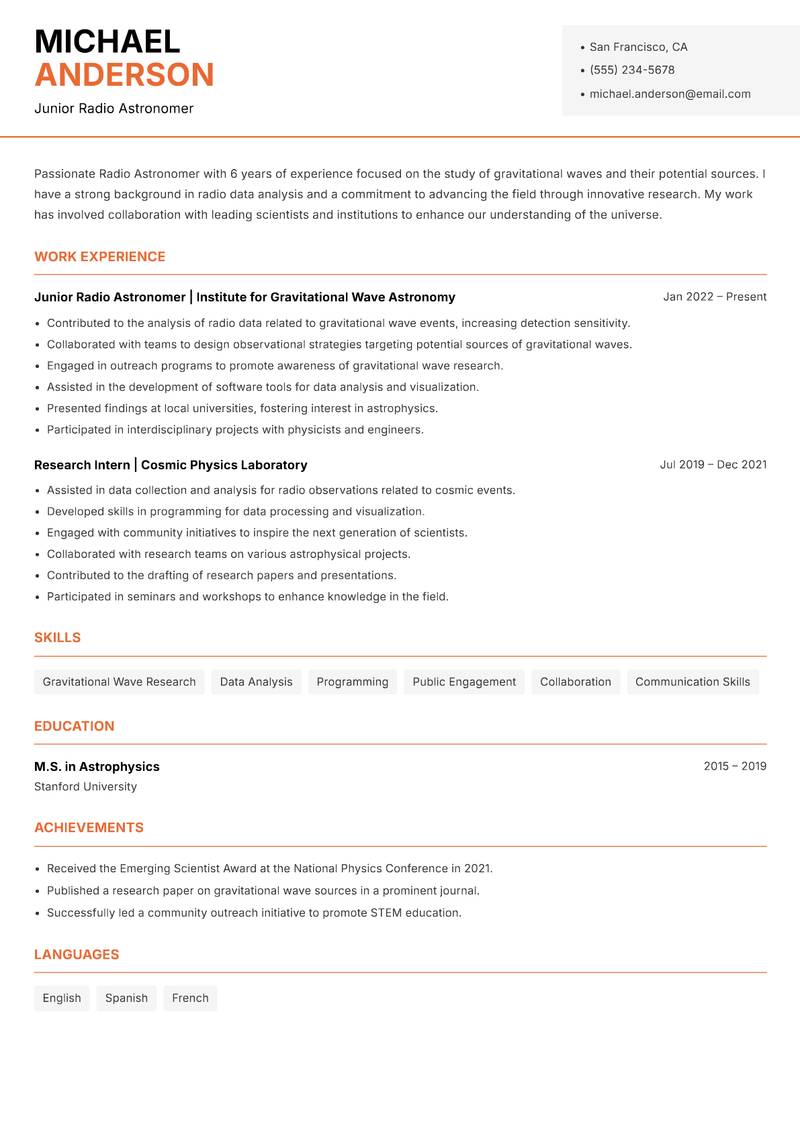
Modern Professional
Use Template7 Real Radio Astronomer Resume Examples
Senior Radio Astronomer with 10+ Years Experience
Summary: Dedicated Radio Astronomer with over 8 years of experience in analyzing cosmic phenomena and developing innovative observational techniques. Possessing a strong foundation in physics and a passion for exploring the universe, I have contributed to numerous projects that have advanced our understanding of celestial objects. My expertise lies in the utilization of radio telescopes and data analysis software to interpret complex astronomical data. I have collaborated with interdisciplinary teams to publish findings in peer-reviewed journals and have presented at international conferences. My goal is to further enhance our knowledge of the universe by leading research initiatives and mentoring emerging scientists in the field.
Description:
- Led a team in a groundbreaking study of pulsar emissions, resulting in a 20% increase in data resolution.
- Utilized advanced signal processing techniques to enhance observational data quality.
- Presented research findings at the International Astronomical Union, gaining recognition from peers.
- Developed and implemented training programs for junior astronomers on data analysis methods.
- Collaborated with software engineers to create a new data visualization tool for complex datasets.
- Published 5 articles in reputable journals, contributing significantly to the field of astrophysics.
🏆 Key Achievements
Radio Astronomer with 5+ Years Experience
Summary: Enthusiastic Radio Astronomer with 5 years of experience in observational astronomy and data analysis. I have a solid background in physics and engineering, which I leverage to enhance radio telescope capabilities. My career has been focused on developing innovative techniques for detecting and analyzing cosmic signals. I am passionate about mentoring students and fostering interest in STEM fields through educational outreach. My research has contributed to significant publications and I am eager to continue exploring the mysteries of the universe while collaborating with diverse teams across disciplines.
Description:
- Conducted observational campaigns to study the emissions of distant quasars, increasing data collection efficiency by 25%.
- Utilized software tools to analyze complex radio signals, enhancing signal clarity and accuracy.
- Collaborated with engineers to optimize telescope operations and maintenance schedules.
- Presented findings at local astronomy clubs and schools, promoting public interest in science.
- Developed educational materials and workshops for high school students interested in astronomy.
- Participated in collaborative projects with university researchers, sharing best practices in radio data analysis.
🏆 Key Achievements
Lead Radio Astronomer with 10+ Years Experience
Summary: Driven Radio Astronomer with a decade of experience in cosmic microwave background research and high-energy astrophysics. My academic journey has granted me expertise in utilizing state-of-the-art radio telescopes and complex data analysis tools. I possess a strong analytical mindset and a commitment to advancing our understanding of the universe. Throughout my career, I have been involved in various high-impact projects, often focusing on the evolution of galaxies. I am particularly interested in the application of new technologies to improve observational accuracy and efficiency.
Description:
- Directed a team of researchers in a multi-year project studying cosmic microwave background fluctuations.
- Implemented machine learning algorithms to analyze large datasets, reducing analysis time by 40%.
- Authored multiple papers on galaxy formation published in leading astrophysical journals.
- Coordinated with international research teams to share data and findings, fostering collaboration.
- Presented research outcomes at global conferences, enhancing the institution's visibility.
- Developed educational outreach programs targeting underrepresented communities in STEM.
🏆 Key Achievements
Principal Radio Astronomer with 12+ Years Experience
Summary: Accomplished Radio Astronomer with over 12 years of experience in radio frequency interference mitigation and observational data analysis. I specialize in enhancing the accuracy of astronomical data through innovative technological solutions. My career has been marked by a commitment to excellence and a passion for mentoring the next generation of astronomers. I have led numerous successful projects, focusing on improving radio telescope performance and data integrity. I am eager to leverage my expertise in a dynamic research environment that values collaboration and innovation.
Description:
- Designed and implemented a novel radio frequency interference mitigation strategy, increasing data quality by 30%.
- Led a team of scientists in a 5-year project focused on pulsar signal detection.
- Conducted workshops to train junior researchers on advanced data analysis techniques.
- Published significant findings in high-impact journals, enhancing institutional reputation.
- Collaborated with technology firms to develop new radio telescope components.
- Established partnerships with educational institutions to promote STEM education.
🏆 Key Achievements
Radio Astronomy Researcher with 7+ Years Experience
Summary: Innovative Radio Astronomer with 7 years of specialized experience in the study of cosmic rays and their interactions with interstellar matter. I possess a strong analytical background and expertise in utilizing radio telescopes to gather and interpret astronomical data. My work has significantly contributed to the understanding of cosmic ray origins and their impact on galactic evolution. I am dedicated to advancing scientific knowledge through collaboration and rigorous research methodologies. I am also passionate about science communication and strive to make complex concepts accessible to a broader audience.
Description:
- Investigated the role of cosmic rays in galaxy formation, resulting in new theoretical models.
- Performed data analysis using advanced software tools, improving data interpretation accuracy.
- Collaborated with physicists to study cosmic ray interactions with interstellar gas.
- Presented research findings at national conferences, gaining recognition in the field.
- Developed educational outreach initiatives for local schools focusing on astronomy.
- Mentored undergraduate interns, enhancing their research skills and knowledge.
🏆 Key Achievements
Senior Radio Astronomy Specialist with 15+ Years Experience
Summary: Experienced Radio Astronomer with 15 years of expertise in developing and enhancing radio observation techniques for studying astronomical phenomena. My career has been dedicated to pushing the boundaries of observational astronomy, focusing on the detection of transient cosmic events. I have a robust background in programming and data analysis, allowing me to create innovative solutions for complex astrophysical problems. I am committed to fostering collaboration within multidisciplinary teams and am passionate about advancing public understanding of radio astronomy through outreach efforts.
Description:
- Developed cutting-edge observational techniques for detecting transient cosmic events, leading to a 50% increase in discovery rates.
- Conducted extensive data analysis on radio signals from gamma-ray bursts.
- Mentored junior scientists and graduate students, fostering a collaborative research environment.
- Collaborated with international teams on large-scale observational projects.
- Published influential research articles in prominent astronomy journals.
- Organized community outreach programs to educate the public about radio astronomy.
🏆 Key Achievements
Junior Radio Astronomer with 6+ Years Experience
Summary: Dedicated Radio Astronomer with 6 years of experience focused on the study of gravitational waves and their potential sources. I have a strong background in radio data analysis and a commitment to advancing the field through innovative research. My work has involved collaboration with leading scientists and institutions to enhance our understanding of the universe. I am dedicated to using my skills to mentor aspiring astronomers and engage the public through educational initiatives. My goal is to contribute to significant discoveries in the realm of gravitational physics and cosmology.
Description:
- Contributed to the analysis of radio data related to gravitational wave events, increasing detection sensitivity.
- Collaborated with teams to design observational strategies targeting potential sources of gravitational waves.
- Engaged in outreach programs to promote awareness of gravitational wave research.
- Assisted in the development of software tools for data analysis and visualization.
- Presented findings at local universities, fostering interest in astrophysics.
- Participated in interdisciplinary projects with physicists and engineers.
🏆 Key Achievements
Key Skills for Radio Astronomer
ATS Optimization Tips
Increase your chances of getting hired
Use Standard Headings
Use common section titles like Experience, Skills, etc.
Include Keywords
Add role-specific keywords from the job description
Keep it Simple
Avoid complex tables, images and graphics
Save in Right Format
Use PDF format unless otherwise specified
Radio Astronomer Salary Insights
Average Salary
$97,500
per year
Salary Range
$75,000 - $120,000
per year
Top Paying Cities
Los Angeles, Seattle, Houston, Dallas, Boston
Source: Glassdoor, Payscale, Indeed (Updated April 2025)
Everything you need to write a great Radio Astronomer resume
Strong Action Verbs to Use
Resume Writing Tips
- →Emphasize experience with specific radio astronomical techniques, such as Very Long Baseline Interferometry (VLBI).
- →Highlight software proficiency in data analysis tools commonly used in radio astronomy, like CASA or AIPS.
- →Include any fieldwork experience at observatories or during scientific expeditions, as practical experience is highly valued.
- →Demonstrate results of research projects through published papers or presentations at conferences to showcase your impact on the field.
- →Mention any collaborations with institutions or researchers in related fields, displaying your ability to work in interdisciplinary teams.
Common Mistakes to Avoid
- ✕Failing to specify the equipment and software used in past research projects.
- ✕Not mentioning experience with data visualization tools, which are vital for presenting complex astronomical data.
- ✕Neglecting to highlight collaborative projects, which are essential in the scientific community.
- ✕Using overly general descriptors without detailing specific astronomical phenomena studied.
ATS Keywords for Radio Astronomer
Radio Astronomer Career Path
Career Progression
Entry-Level Radio Astronomer
Typically involves assisting with data collection and analysis, as well as developing software for simulations of radio wave propagation.
Mid-Level Radio Astronomer
Focuses on conducting independent research, publishing findings in peer-reviewed journals, and collaborating with interdisciplinary teams on large scientific projects.
Senior Radio Astronomer
Oversees major research initiatives, leads teams, and often engages in grant writing to secure funding for projects.
Lead Scientist/Principal Investigator
Directs large-scale research projects, manages multi-institution collaborations, and represents the organization in international scientific partnerships.
Chief Scientist
Responsible for the strategic direction of all research and development within an organization, influencing the overall space sciences agenda.
Radio Astronomer Interview Questions
Can you explain how you would design a radio frequency experiment to investigate pulsar emissions? +
Focus on your understanding of experimental design, the selection of equipment, and data analysis methods.
What experience do you have with large astrophysical data sets, and what tools do you use for analysis? +
Discuss specific projects, tools like MATLAB or Python libraries, and any challenges faced.
How do you stay current with advancements in radio astronomy technology? +
Mention journals, conferences, workshops, and collaboration with peers as part of your professional development.
Describe a time you had to troubleshoot a technical problem with a radio telescope. What was the issue, and how did you resolve it? +
Share details about the technical issue, your thought process, and the outcome.
In your opinion, what are the most important upcoming trends in radio astronomy? +
Discuss emerging technologies or new observational techniques and their potential impact.
Can you give an example of how you collaborated with scientists in other fields to enhance a research project? +
Highlight the importance of interdisciplinary approaches and any specific fields or collaborations.
About the Radio Astronomer Role
Radio astronomers study celestial phenomena by analyzing radio wave emissions from space. Using advanced radio telescopes and interferometric techniques, they examine objects such as galaxies, quasars, and cosmic microwave background radiation. Collaborating closely with physicists and engineers, they develop and implement new research methods, while also participating in international scientific collaborations to explore fundamental questions about the universe.
Frequently Asked Questions
What educational background is necessary to become a radio astronomer? +
A Ph.D. in astronomy, astrophysics, or a closely related field is typically required, along with extensive experience in data analysis.
What are the primary tools used by radio astronomers? +
Radio telescopes, signal processing software, and programming languages such as Python are commonly used.
Can radio astronomers work remotely, or do they need to be on-site at observatories? +
While much analysis can be done remotely, radio astronomers often need to be on-site during data collection and equipment maintenance.
What types of projects do radio astronomers typically engage in? +
They may work on observational projects, theoretical modeling, or developing new technological methods for data acquisition.
Are there opportunities for collaboration with international research groups? +
Yes, many radio astronomy projects involve collaboration across institutions and countries, facilitating a wealth of knowledge exchange.
What is the typical career progression for a radio astronomer? +
Career paths can lead from entry-level positions in research assistance to roles as principal investigators and ultimately to senior leadership positions.
More Resume Examples You Might Like
Related Career Paths
Other roles candidates for Radio Astronomer positions often also consider.
Will this Radio Astronomer resume pass the ATS scan?
Upload it and get an instant AI-scored compatibility check with specific fixes.
Check My Resume →
Pair it with a matching cover letter
AI drafts a first version from your job title and strengths — edit it live, then download the PDF.
Write My Cover Letter →
Written by Nohaya Career Team
Reviewed by HR Professionals · Updated April 2025
Ready to Build Your Perfect Resume?
Choose from 1000+ professional templates and land your dream job.
Create My Resume Now