Build an ATS-Friendly
Orbital Dynamics Scientist Resume
That Gets Interviews
Utilizing advanced modeling techniques, Orbital Dynamics Scientists analyze the pathways of spacecraft, ensuring alignment with mission parameters and safety protocols. By simulating various orbital scenarios, they evaluate risks and provide key insights for spacecraft launch and deployment. This role often requires…
Orbital Dynamics Scientist Resume Templates
Modern Professional
Use Template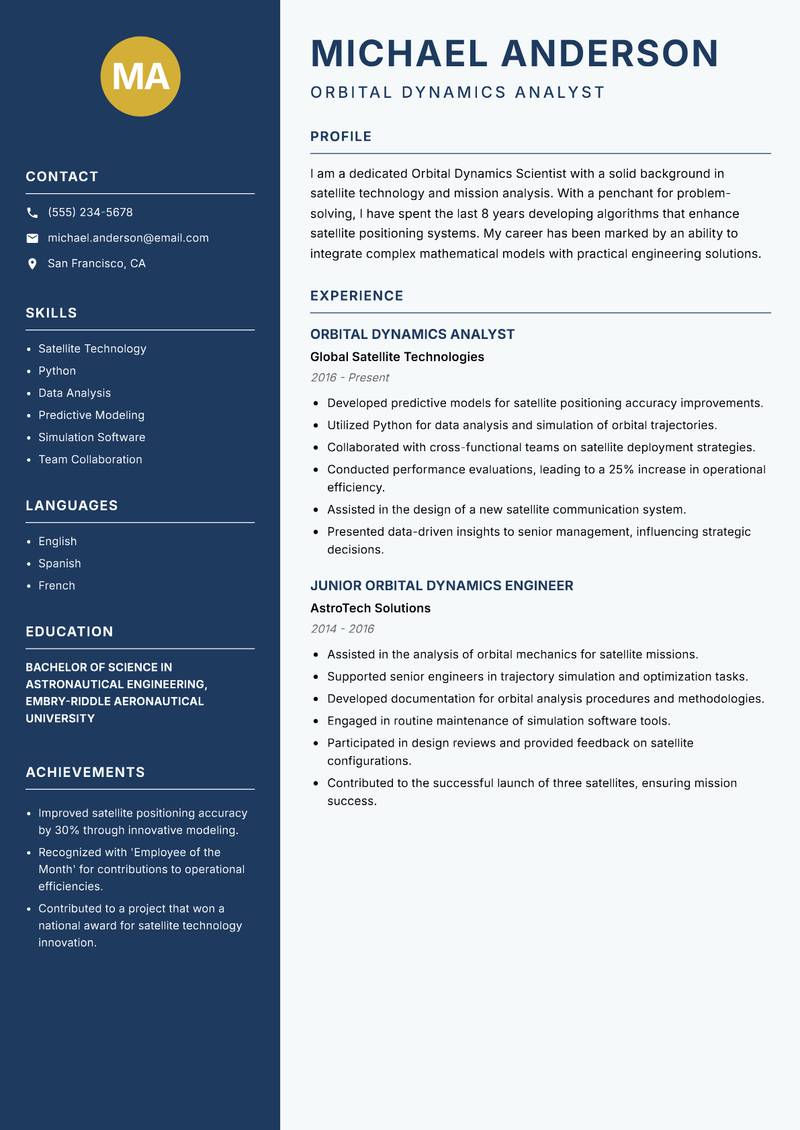
Classic Clean
Use Template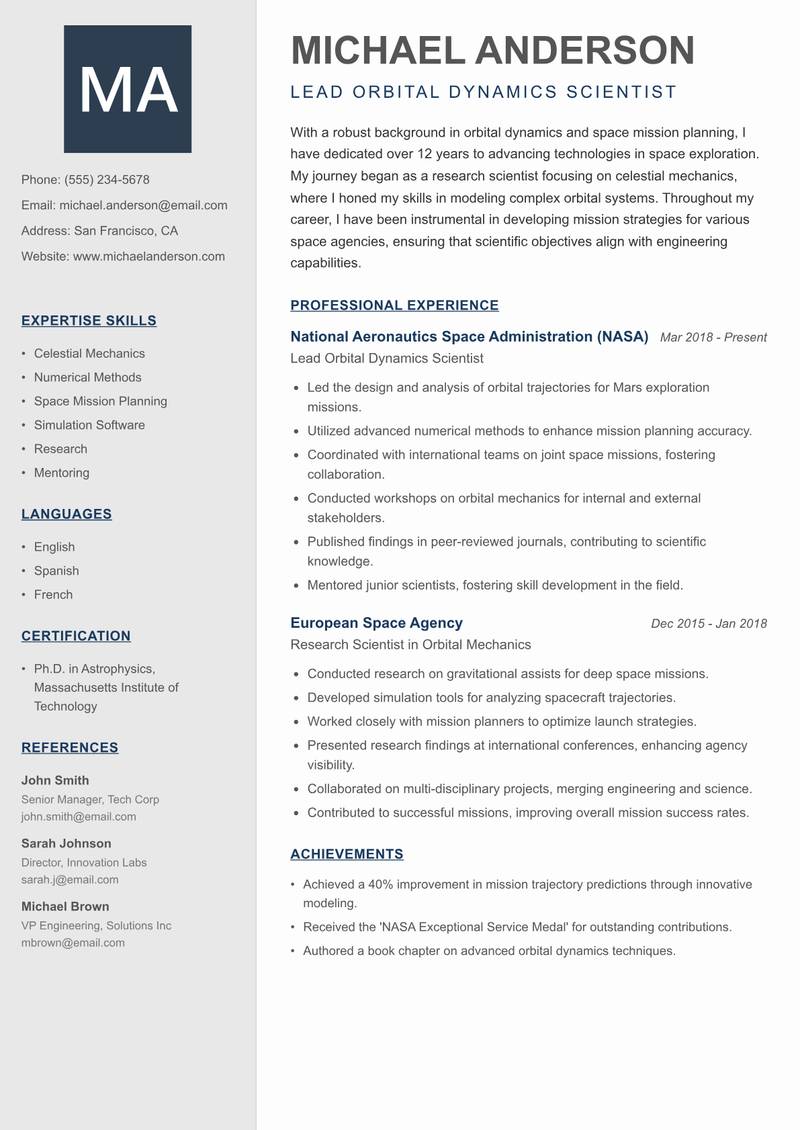
Creative Minimal
Use Template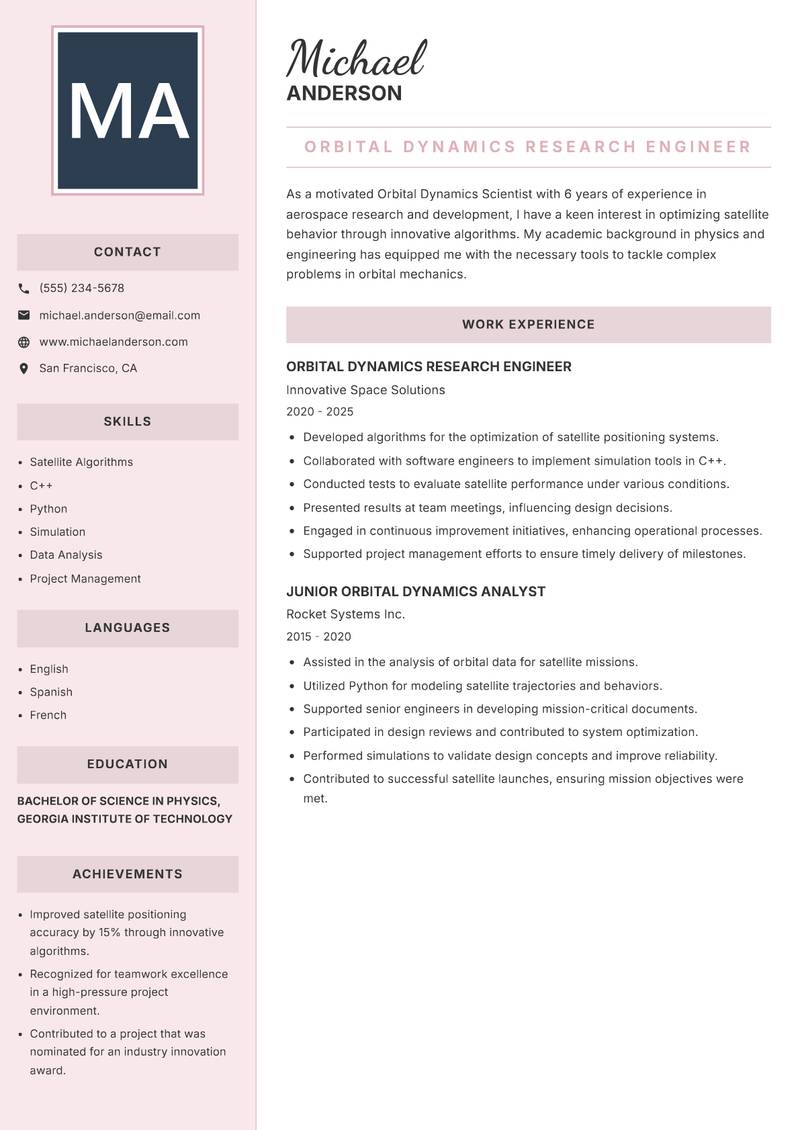
Executive
Use Template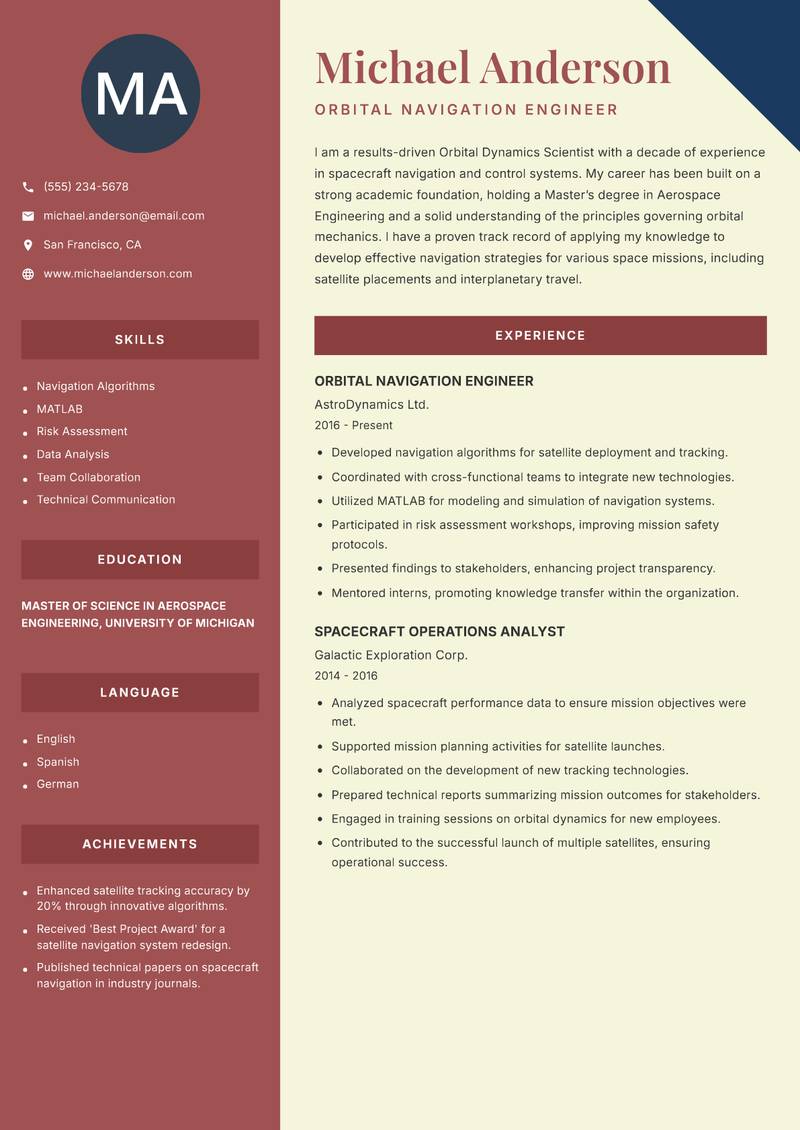
Two Column
Use Template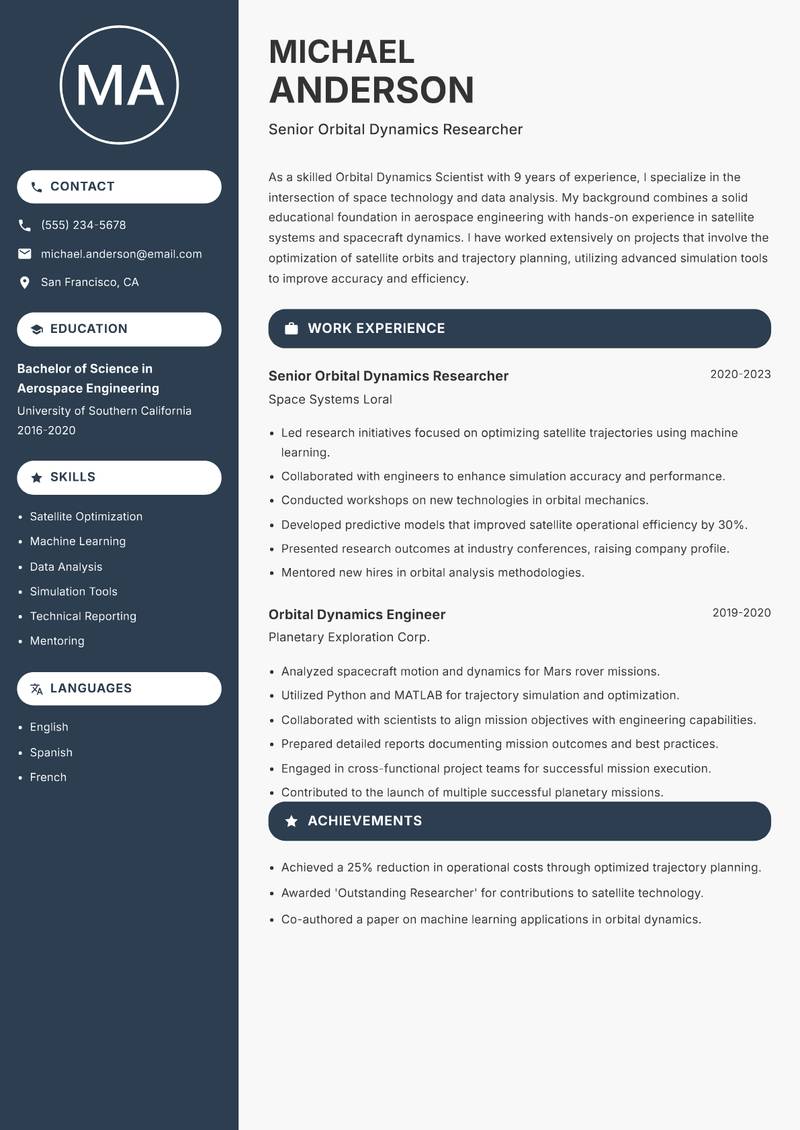
Compact
Use Template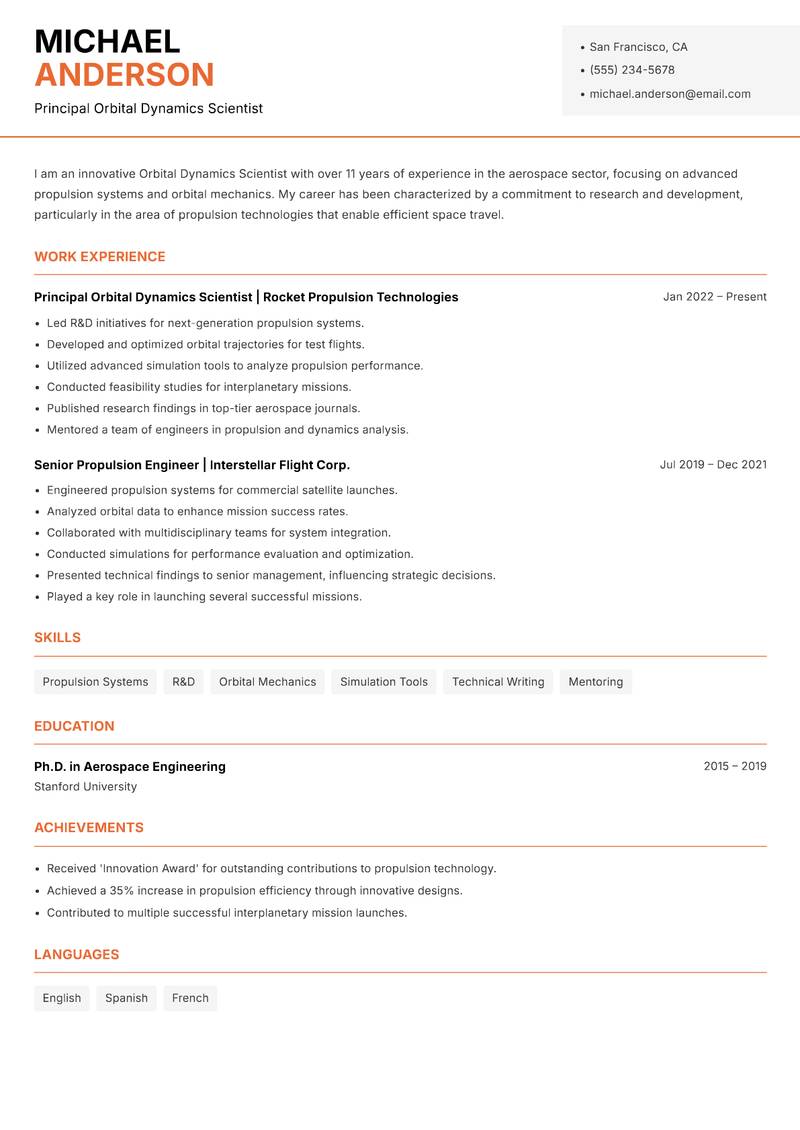
Modern Professional
Use Template7 Real Orbital Dynamics Scientist Resume Examples
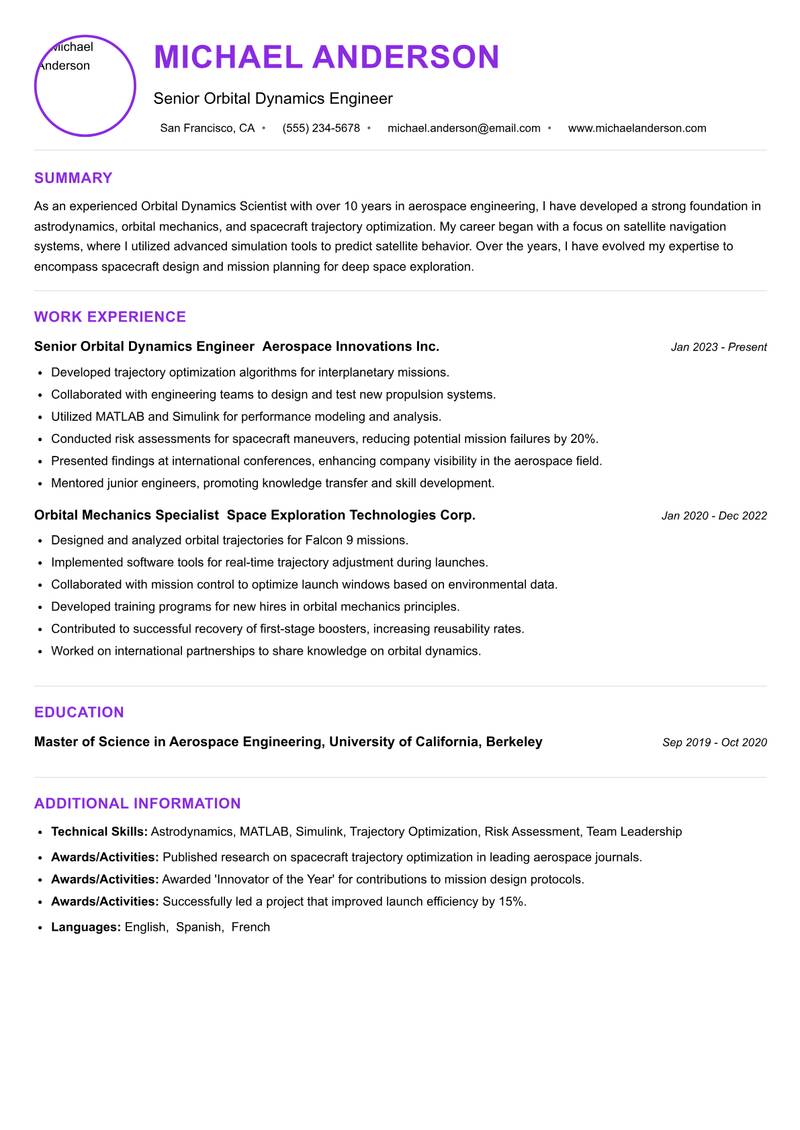
Senior Orbital Dynamics Engineer with 9+ Years Experience
Summary: As an experienced Orbital Dynamics Scientist with over 10 years in aerospace engineering, I have developed a strong foundation in astrodynamics, orbital mechanics, and spacecraft trajectory optimization. My career began with a focus on satellite navigation systems, where I utilized advanced simulation tools to predict satellite behavior. Over the years, I have evolved my expertise to encompass spacecraft design and mission planning for deep space exploration. I have successfully led projects that required coordination between cross-functional teams, ensuring the seamless integration of various engineering domains. My analytical skills allow me to interpret complex data sets and apply them to real-world problems, while my strong communication abilities enable me to present findings to stakeholders effectively. I am passionate about leveraging cutting-edge technology to advance space missions and contribute to humanity's understanding of the universe. My goal is to continue pushing the boundaries of space exploration through innovative solutions and collaborative efforts within the aerospace community.
Description:
- Developed trajectory optimization algorithms for interplanetary missions.
- Collaborated with engineering teams to design and test new propulsion systems.
- Utilized MATLAB and Simulink for performance modeling and analysis.
- Conducted risk assessments for spacecraft maneuvers, reducing potential mission failures by 20%.
- Presented findings at international conferences, enhancing company visibility in the aerospace field.
- Mentored junior engineers, promoting knowledge transfer and skill development.
🏆 Key Achievements
Orbital Dynamics Analyst with 7+ Years Experience
Summary: I am a dedicated Orbital Dynamics Scientist with a solid background in satellite technology and mission analysis. With a penchant for problem-solving, I have spent the last 8 years developing algorithms that enhance satellite positioning systems. My career has been marked by an ability to integrate complex mathematical models with practical engineering solutions. I have a strong grasp of both the theoretical and practical aspects of orbital mechanics, which enables me to contribute effectively to multidisciplinary teams. I strive to remain at the forefront of innovations in the aerospace industry by continuously updating my skills and knowledge. I am particularly passionate about the application of machine learning techniques to optimize satellite operations and increase data accuracy. Through collaboration and a commitment to excellence, I aim to contribute to impactful projects that advance our capabilities in space exploration and satellite communications.
Description:
- Developed predictive models for satellite positioning accuracy improvements.
- Utilized Python for data analysis and simulation of orbital trajectories.
- Collaborated with cross-functional teams on satellite deployment strategies.
- Conducted performance evaluations, leading to a 25% increase in operational efficiency.
- Assisted in the design of a new satellite communication system.
- Presented data-driven insights to senior management, influencing strategic decisions.
🏆 Key Achievements
Lead Orbital Dynamics Scientist with 12+ Years Experience
Summary: With a robust background in orbital dynamics and space mission planning, I have dedicated over 12 years to advancing technologies in space exploration. My journey began as a research scientist focusing on celestial mechanics, where I honed my skills in modeling complex orbital systems. Throughout my career, I have been instrumental in developing mission strategies for various space agencies, ensuring that scientific objectives align with engineering capabilities. My expertise lies in translating theoretical concepts into practical applications, significantly improving mission outcomes. I am particularly experienced in using numerical methods and simulation software to predict spacecraft behavior under various conditions. Beyond my technical skills, I am a strong advocate for collaboration and knowledge sharing, having led numerous workshops and training sessions for aspiring engineers. I am eager to continue contributing to groundbreaking space missions that expand our understanding of the universe while mentoring the next generation of scientists.
Description:
- Led the design and analysis of orbital trajectories for Mars exploration missions.
- Utilized advanced numerical methods to enhance mission planning accuracy.
- Coordinated with international teams on joint space missions, fostering collaboration.
- Conducted workshops on orbital mechanics for internal and external stakeholders.
- Published findings in peer-reviewed journals, contributing to scientific knowledge.
- Mentored junior scientists, fostering skill development in the field.
🏆 Key Achievements
Orbital Dynamics Research Engineer with 6+ Years Experience
Summary: As a motivated Orbital Dynamics Scientist with 6 years of experience in aerospace research and development, I have a keen interest in optimizing satellite behavior through innovative algorithms. My academic background in physics and engineering has equipped me with the necessary tools to tackle complex problems in orbital mechanics. I have successfully collaborated on various projects, focusing on enhancing the performance of satellite systems and ensuring their reliability in different environmental conditions. My problem-solving skills are complemented by my proficiency in programming languages such as C++ and Python, which I utilize for simulations and modeling. I am passionate about contributing to projects that push the boundaries of space technology and improve satellite functionality. I thrive in fast-paced environments and am eager to work with teams that prioritize innovation and excellence in space exploration.
Description:
- Developed algorithms for the optimization of satellite positioning systems.
- Collaborated with software engineers to implement simulation tools in C++.
- Conducted tests to evaluate satellite performance under various conditions.
- Presented results at team meetings, influencing design decisions.
- Engaged in continuous improvement initiatives, enhancing operational processes.
- Supported project management efforts to ensure timely delivery of milestones.
🏆 Key Achievements
Orbital Navigation Engineer with 10+ Years Experience
Summary: I am a results-driven Orbital Dynamics Scientist with a decade of experience in spacecraft navigation and control systems. My career has been built on a strong academic foundation, holding a Master’s degree in Aerospace Engineering and a solid understanding of the principles governing orbital mechanics. I have a proven track record of applying my knowledge to develop effective navigation strategies for various space missions, including satellite placements and interplanetary travel. My technical skills are complemented by a deep understanding of the regulatory frameworks governing space activities, which enables me to navigate complex project requirements. I possess excellent analytical skills that allow me to dissect complicated data sets and derive actionable insights. My ability to communicate complex concepts in an understandable manner has been key in fostering collaborative efforts within multidisciplinary teams. I am committed to advancing space exploration and developing innovative solutions that enhance mission success and sustainability in the industry.
Description:
- Developed navigation algorithms for satellite deployment and tracking.
- Coordinated with cross-functional teams to integrate new technologies.
- Utilized MATLAB for modeling and simulation of navigation systems.
- Participated in risk assessment workshops, improving mission safety protocols.
- Presented findings to stakeholders, enhancing project transparency.
- Mentored interns, promoting knowledge transfer within the organization.
🏆 Key Achievements
Senior Orbital Dynamics Researcher with 9+ Years Experience
Summary: As a skilled Orbital Dynamics Scientist with 9 years of experience, I specialize in the intersection of space technology and data analysis. My background combines a solid educational foundation in aerospace engineering with hands-on experience in satellite systems and spacecraft dynamics. I have worked extensively on projects that involve the optimization of satellite orbits and trajectory planning, utilizing advanced simulation tools to improve accuracy and efficiency. My research has led to significant contributions in the field, particularly in developing new methodologies for analyzing orbital data. I am adept at working in collaborative environments and enjoy the challenge of solving complex problems. My communication skills enable me to articulate technical concepts clearly to both technical and non-technical audiences. I aim to leverage my expertise to enhance the capabilities of future space missions and contribute to innovations that drive the aerospace industry forward.
Description:
- Led research initiatives focused on optimizing satellite trajectories using machine learning.
- Collaborated with engineers to enhance simulation accuracy and performance.
- Conducted workshops on new technologies in orbital mechanics.
- Developed predictive models that improved satellite operational efficiency by 30%.
- Presented research outcomes at industry conferences, raising company profile.
- Mentored new hires in orbital analysis methodologies.
🏆 Key Achievements
Principal Orbital Dynamics Scientist with 11+ Years Experience
Summary: I am an innovative Orbital Dynamics Scientist with over 11 years of experience in the aerospace sector, focusing on advanced propulsion systems and orbital mechanics. My career has been characterized by a commitment to research and development, particularly in the area of propulsion technologies that enable efficient space travel. I possess a deep understanding of the physical principles underlying spacecraft dynamics and have applied this knowledge to real-world projects involving satellite launches and interplanetary missions. My expertise extends to the use of cutting-edge simulation software and analytical tools that facilitate precise modeling of orbital phenomena. I am passionate about mentoring budding engineers and fostering an environment of knowledge sharing within teams. I believe that collaboration is key to achieving groundbreaking advancements in space exploration. I am eager to apply my skills to projects that aim to push the envelope in space travel technology and contribute to humanity's exploration of the cosmos.
Description:
- Led R&D initiatives for next-generation propulsion systems.
- Developed and optimized orbital trajectories for test flights.
- Utilized advanced simulation tools to analyze propulsion performance.
- Conducted feasibility studies for interplanetary missions.
- Published research findings in top-tier aerospace journals.
- Mentored a team of engineers in propulsion and dynamics analysis.
🏆 Key Achievements
Key Skills for Orbital Dynamics Scientist
ATS Optimization Tips
Increase your chances of getting hired
Use Standard Headings
Use common section titles like Experience, Skills, etc.
Include Keywords
Add role-specific keywords from the job description
Keep it Simple
Avoid complex tables, images and graphics
Save in Right Format
Use PDF format unless otherwise specified
Orbital Dynamics Scientist Salary Insights
Average Salary
$112,500
per year
Salary Range
$85,000 - $140,000
per year
Top Paying Cities
Los Angeles, Seattle, Houston, Dallas, Boston
Source: Glassdoor, Payscale, Indeed (Updated April 2025)
Everything you need to write a great Orbital Dynamics Scientist resume
Strong Action Verbs to Use
Resume Writing Tips
- →Highlight specific software proficiencies like STK and MATLAB with examples of how you've used them
- →Include quantitative outcomes from your projects to demonstrate impact and problem-solving abilities
- →Emphasize interdisciplinary collaboration, showcasing your ability to communicate complex ideas to non-specialists
- →Tailor your resume to reflect on-specific orbital mechanics projects, detailing your specific contributions
- →List publications or conference presentations to validate your expertise and commitment to the field
Common Mistakes to Avoid
- ✕Using generic language that doesn’t specify orbital mechanics applications
- ✕Neglecting to quantify achievements, such as improvements in simulation accuracy
- ✕Not explaining the relevance of past projects to potential future work
- ✕Overlooking key certifications relevant specifically to orbital dynamics
ATS Keywords for Orbital Dynamics Scientist
Orbital Dynamics Scientist Career Path
Relevant Certifications
Career Progression
Entry-Level Orbital Dynamics Analyst
Contribute to data analysis and modeling under senior scientists, focusing on trajectory optimization and satellite deployment.
Orbital Dynamics Scientist
Lead projects to develop predictive models for spacecraft trajectories, while collaborating with engineering teams and stakeholders on mission plans.
Senior Orbital Mechanics Engineer
Oversee complex projects involving advanced orbital simulations, mentoring junior scientists and facilitating interdisciplinary workshops.
Research Scientist in Astrodynamics
Pursue cutting-edge research in orbital perturbations and celestial mechanics, publishing findings in scientific journals and conferences.
Director of Orbital Dynamics Research
Set strategic goals for research programs, attract funding, and collaborate with industry partners to advance national space capabilities.
Orbital Dynamics Scientist Interview Questions
Can you explain how you would approach modeling a new spacecraft trajectory? +
Discuss specific software you would use, like STK or MATLAB, and the data inputs required.
What are some essential factors to consider when predicting orbital decay? +
Mention atmospheric drag, gravitational perturbations, and solar radiation pressure.
Describe a challenging problem you faced in orbital dynamics and how you solved it. +
Use a specific instance from your work, detailing the methods and outcomes.
How do you keep up with recent advancements in space technology and orbital dynamics research? +
Mention specific journals, conferences, or online platforms you follow.
What is the significance of perturbation theory in your work? +
Provide a brief overview of how it applies to trajectory analysis.
Have you worked on multi-body simulations? What challenges did you encounter? +
References specific projects and techniques used.
Can you discuss an experience where you collaborated with different engineering disciplines? +
Highlight teamwork aspects and how you communicated across fields.
About the Orbital Dynamics Scientist Role
Utilizing advanced modeling techniques, Orbital Dynamics Scientists analyze the pathways of spacecraft, ensuring alignment with mission parameters and safety protocols. By simulating various orbital scenarios, they evaluate risks and provide key insights for spacecraft launch and deployment. This role often requires collaboration with engineers, project managers, and scientists to refine predictive algorithms and integrate them into broader aerospace mission objectives.
Frequently Asked Questions
View all →What software tools are commonly used by Orbital Dynamics Scientists? +
Common tools include MATLAB for simulations, STK for mission planning, and Python for data analysis.
What kind of projects do Orbital Dynamics Scientists typically work on? +
Projects often include satellite trajectory planning, space mission feasibility studies, and analysis of orbital debris.
What academic background is usually preferred for this role? +
A degree in aerospace engineering, mathematics, physics, or a closely related field is typically required.
Is experience in programming essential for an Orbital Dynamics Scientist? +
Yes, proficiency in programming languages such as Python, C++, or MATLAB is highly valued.
What are the typical industries employing Orbital Dynamics Scientists? +
Industries include aerospace companies, government space agencies like NASA, and research institutions.
What is the most rewarding aspect of being an Orbital Dynamics Scientist? +
Many find satisfaction in contributing to groundbreaking missions and expanding human presence in space.
Are there opportunities for Orbital Dynamics Scientists to work internationally? +
Yes, many projects involve international collaboration, especially with agencies like ESA or through global space missions.
More Resume Examples You Might Like
Related Career Paths
Other roles candidates for Orbital Dynamics Scientist positions often also consider.
Will this Orbital Dynamics Scientist resume pass the ATS scan?
Upload it and get an instant AI-scored compatibility check with specific fixes.
Check My Resume →
Pair it with a matching cover letter
AI drafts a first version from your job title and strengths — edit it live, then download the PDF.
Write My Cover Letter →
Written by Nohaya Career Team
Reviewed by HR Professionals · Updated April 2025
Ready to Build Your Perfect Resume?
Choose from 1000+ professional templates and land your dream job.
Create My Resume Now