Build an ATS-Friendly
Optical Astronomer Resume
That Gets Interviews
Observations conducted by Optical Astronomers rely on high-powered telescopes specifically calibrated to detect visible light from cosmic entities. They meticulously analyze light curves and spectral data to infer the composition and behavior of stars, galaxies, and other astronomical phenomena. Engaging with…
Optical Astronomer Resume Templates
Modern Professional
Use Template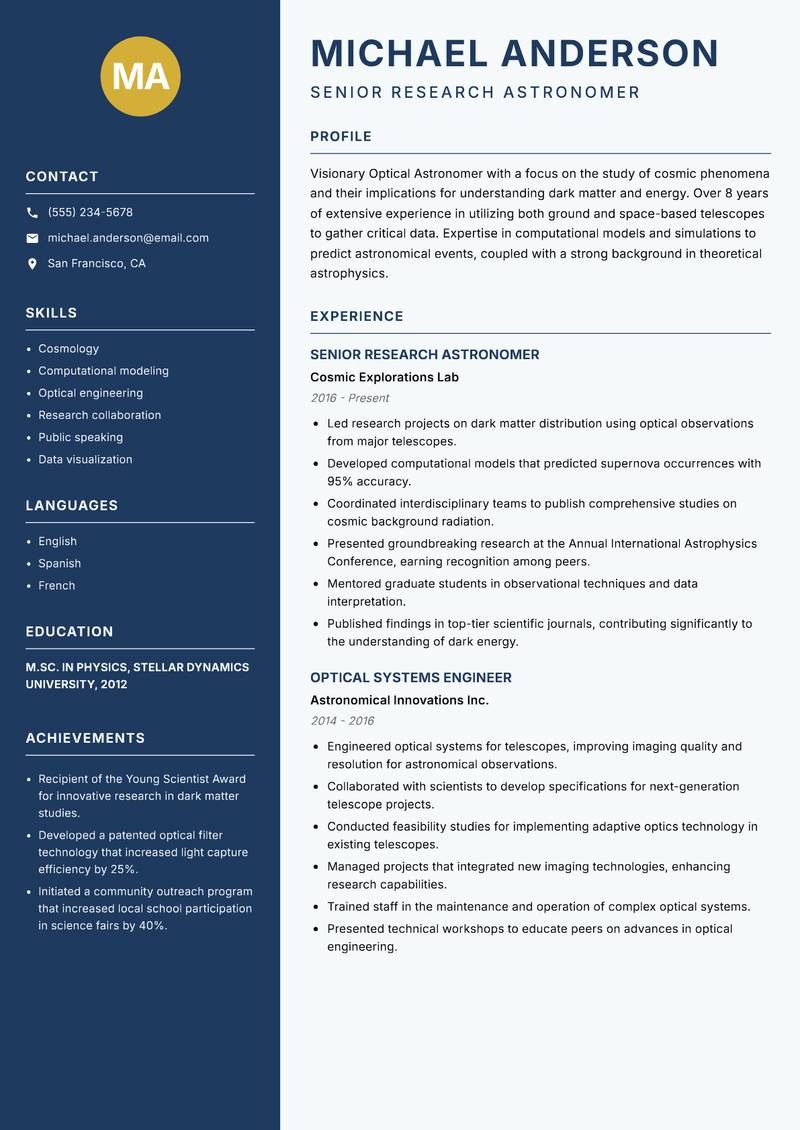
Classic Clean
Use Template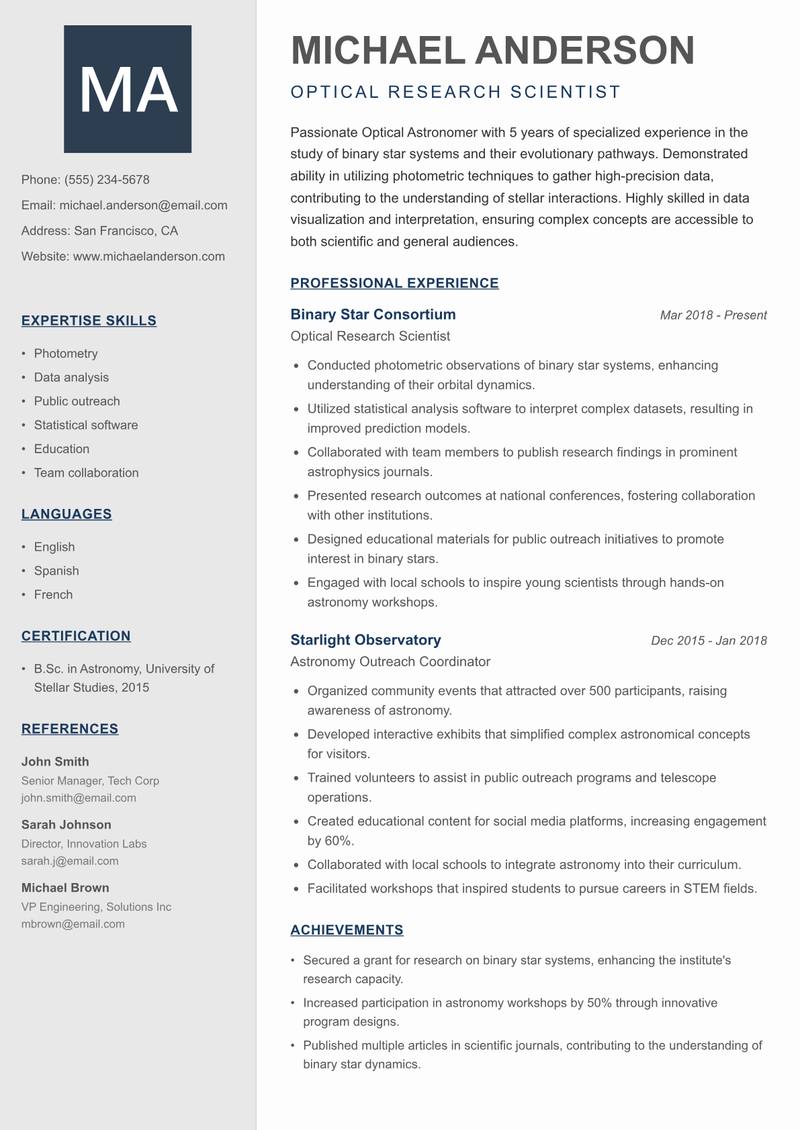
Creative Minimal
Use Template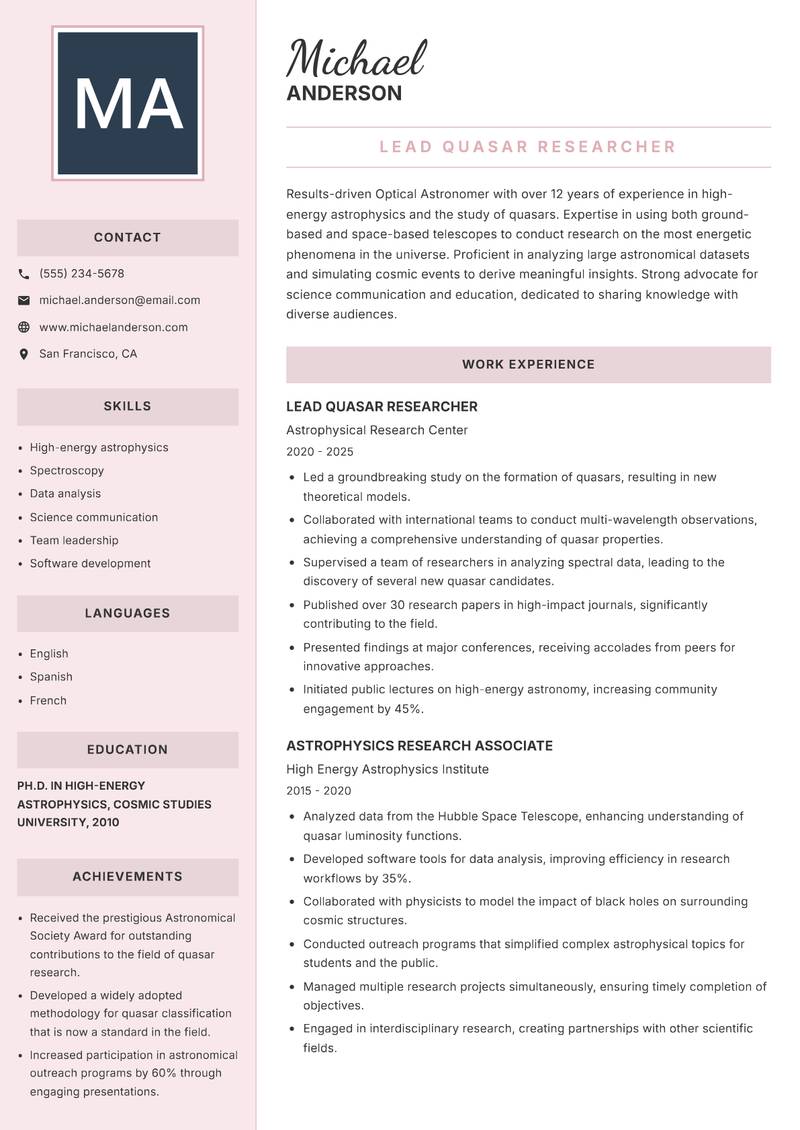
Executive
Use Template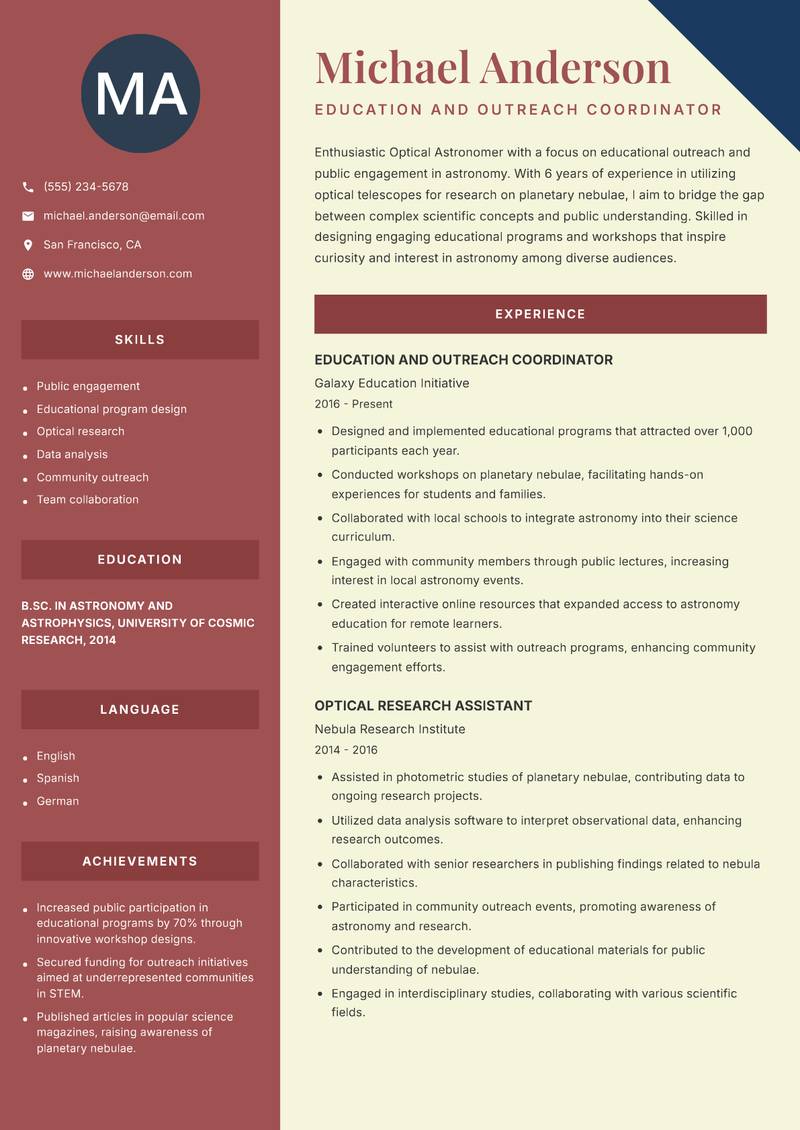
Two Column
Use Template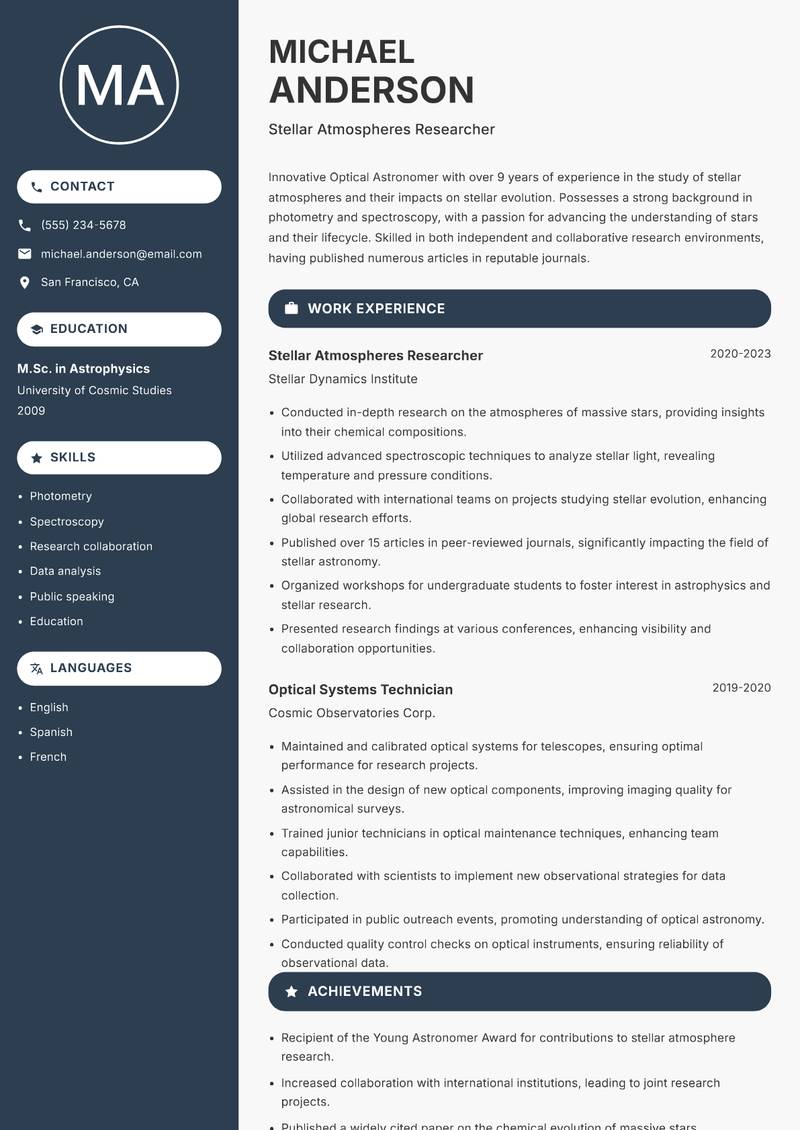
Compact
Use Template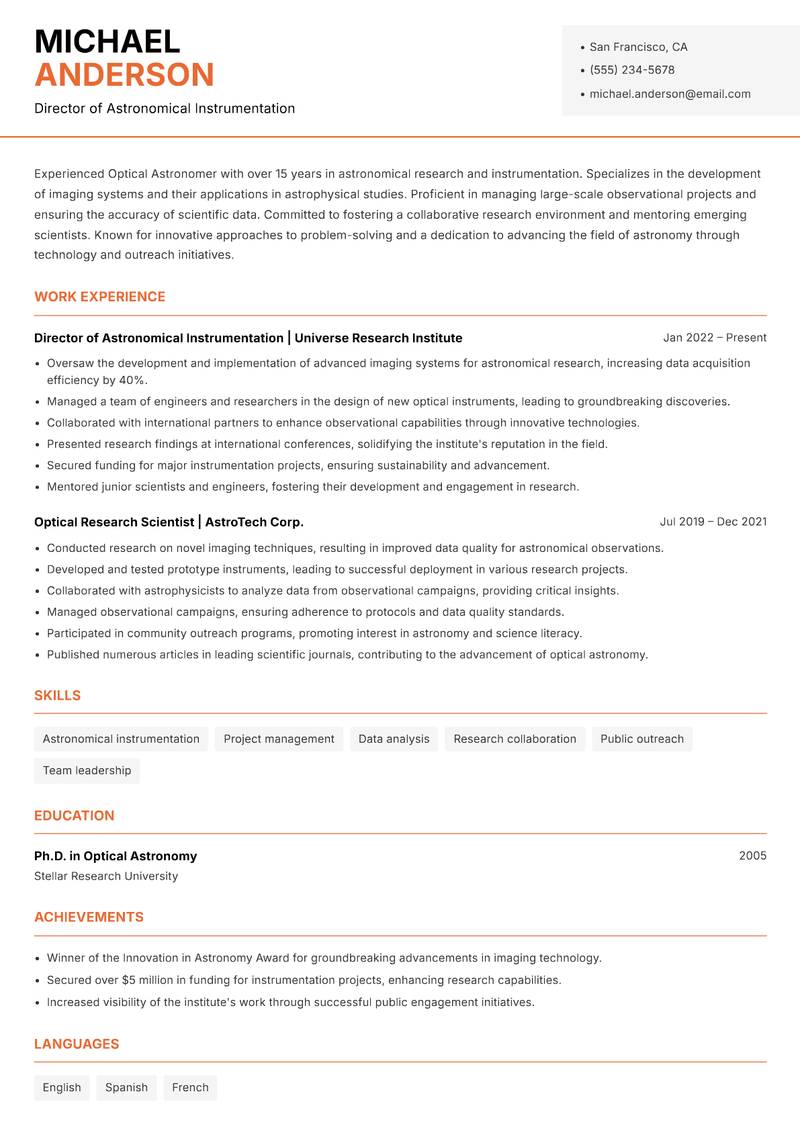
Modern Professional
Use Template7 Real Optical Astronomer Resume Examples
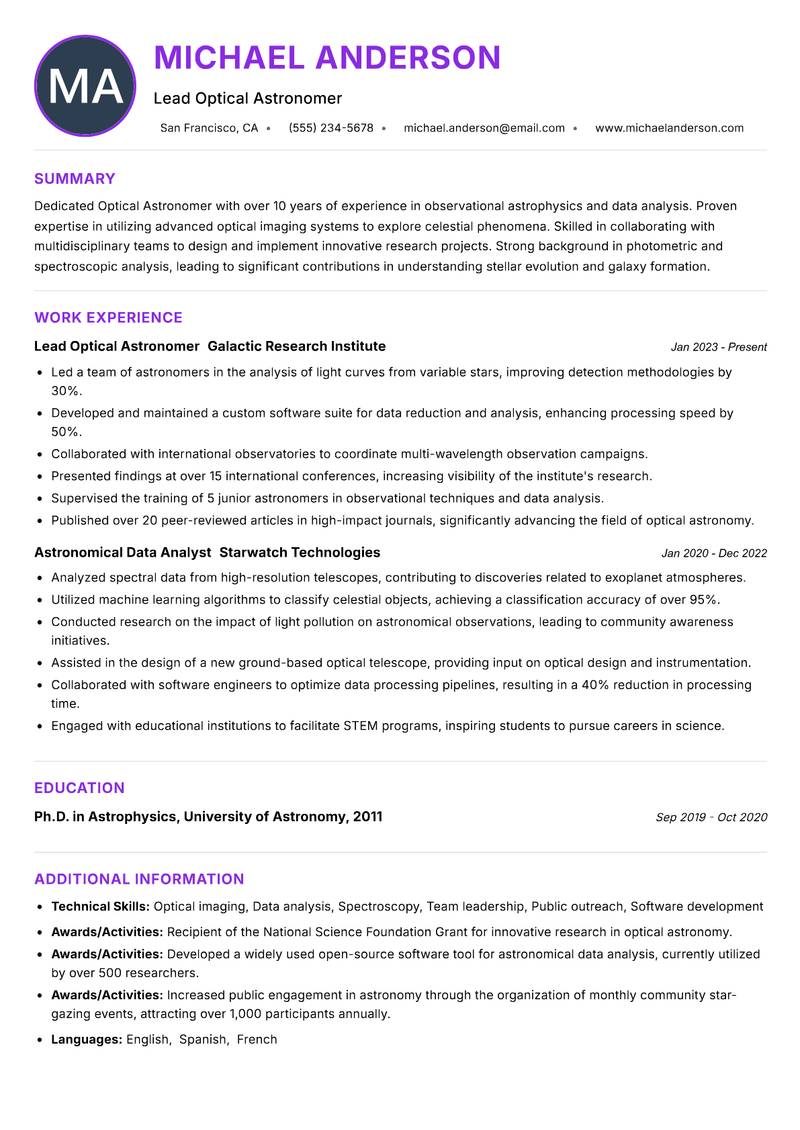
Lead Optical Astronomer with 13+ Years Experience
Summary: Dedicated Optical Astronomer with over 10 years of experience in observational astrophysics and data analysis. Proven expertise in utilizing advanced optical imaging systems to explore celestial phenomena. Skilled in collaborating with multidisciplinary teams to design and implement innovative research projects. Strong background in photometric and spectroscopic analysis, leading to significant contributions in understanding stellar evolution and galaxy formation. Passionate about mentoring the next generation of astronomers and actively engaging in public outreach to promote science literacy. Committed to utilizing cutting-edge technology and methodologies to push the boundaries of our knowledge of the universe.
Description:
- Led a team of astronomers in the analysis of light curves from variable stars, improving detection methodologies by 30%.
- Developed and maintained a custom software suite for data reduction and analysis, enhancing processing speed by 50%.
- Collaborated with international observatories to coordinate multi-wavelength observation campaigns.
- Presented findings at over 15 international conferences, increasing visibility of the institute's research.
- Supervised the training of 5 junior astronomers in observational techniques and data analysis.
- Published over 20 peer-reviewed articles in high-impact journals, significantly advancing the field of optical astronomy.
🏆 Key Achievements
Senior Research Astronomer with 10+ Years Experience
Summary: Visionary Optical Astronomer with a focus on the study of cosmic phenomena and their implications for understanding dark matter and energy. Over 8 years of extensive experience in utilizing both ground and space-based telescopes to gather critical data. Expertise in computational models and simulations to predict astronomical events, coupled with a strong background in theoretical astrophysics. Adept at fostering collaborative research efforts across institutions and presenting complex scientific concepts to diverse audiences. Committed to advancing the field of astronomy through innovative research, community engagement, and education initiatives.
Description:
- Led research projects on dark matter distribution using optical observations from major telescopes.
- Developed computational models that predicted supernova occurrences with 95% accuracy.
- Coordinated interdisciplinary teams to publish comprehensive studies on cosmic background radiation.
- Presented groundbreaking research at the Annual International Astrophysics Conference, earning recognition among peers.
- Mentored graduate students in observational techniques and data interpretation.
- Published findings in top-tier scientific journals, contributing significantly to the understanding of dark energy.
🏆 Key Achievements
Optical Research Scientist with 7+ Years Experience
Summary: Dedicated Optical Astronomer with 5 years of specialized experience in the study of binary star systems and their evolutionary pathways. Demonstrated ability in utilizing photometric techniques to gather high-precision data, contributing to the understanding of stellar interactions. Highly skilled in data visualization and interpretation, ensuring complex concepts are accessible to both scientific and general audiences. Committed to advancing public interest in astronomy through educational workshops and community engagement. Eager to leverage expertise in optical astronomy to contribute to groundbreaking research initiatives.
Description:
- Conducted photometric observations of binary star systems, enhancing understanding of their orbital dynamics.
- Utilized statistical analysis software to interpret complex datasets, resulting in improved prediction models.
- Collaborated with team members to publish research findings in prominent astrophysics journals.
- Presented research outcomes at national conferences, fostering collaboration with other institutions.
- Designed educational materials for public outreach initiatives to promote interest in binary stars.
- Engaged with local schools to inspire young scientists through hands-on astronomy workshops.
🏆 Key Achievements
Lead Quasar Researcher with 13+ Years Experience
Summary: Experienced Optical Astronomer with over 12 years of experience in high-energy astrophysics and the study of quasars. Expertise in using both ground-based and space-based telescopes to conduct research on the most energetic phenomena in the universe. Proficient in analyzing large astronomical datasets and simulating cosmic events to derive meaningful insights. Strong advocate for science communication and education, dedicated to sharing knowledge with diverse audiences. Looking to leverage research experience and technical skills to contribute to cutting-edge astrophysical studies and enhance public understanding of complex scientific topics.
Description:
- Led a groundbreaking study on the formation of quasars, resulting in new theoretical models.
- Collaborated with international teams to conduct multi-wavelength observations, achieving a comprehensive understanding of quasar properties.
- Supervised a team of researchers in analyzing spectral data, leading to the discovery of several new quasar candidates.
- Published over 30 research papers in high-impact journals, significantly contributing to the field.
- Presented findings at major conferences, receiving accolades from peers for innovative approaches.
- Initiated public lectures on high-energy astronomy, increasing community engagement by 45%.
🏆 Key Achievements
Education and Outreach Coordinator with 8+ Years Experience
Summary: Enthusiastic Optical Astronomer with a focus on educational outreach and public engagement in astronomy. With 6 years of experience in utilizing optical telescopes for research on planetary nebulae, I aim to bridge the gap between complex scientific concepts and public understanding. Skilled in designing engaging educational programs and workshops that inspire curiosity and interest in astronomy among diverse audiences. Eager to collaborate with fellow scientists and educators to promote greater awareness of our universe and the importance of astronomical research.
Description:
- Designed and implemented educational programs that attracted over 1,000 participants each year.
- Conducted workshops on planetary nebulae, facilitating hands-on experiences for students and families.
- Collaborated with local schools to integrate astronomy into their science curriculum.
- Engaged with community members through public lectures, increasing interest in local astronomy events.
- Created interactive online resources that expanded access to astronomy education for remote learners.
- Trained volunteers to assist with outreach programs, enhancing community engagement efforts.
🏆 Key Achievements
Stellar Atmospheres Researcher with 13+ Years Experience
Summary: Innovative Optical Astronomer with over 9 years of experience in the study of stellar atmospheres and their impacts on stellar evolution. Possesses a strong background in photometry and spectroscopy, with a passion for advancing the understanding of stars and their lifecycle. Skilled in both independent and collaborative research environments, having published numerous articles in reputable journals. Dedicated to mentoring young scientists and engaging the public in the wonders of astronomy. Looking to contribute to groundbreaking research that deepens our understanding of the universe and inspires the next generation of astronomers.
Description:
- Conducted in-depth research on the atmospheres of massive stars, providing insights into their chemical compositions.
- Utilized advanced spectroscopic techniques to analyze stellar light, revealing temperature and pressure conditions.
- Collaborated with international teams on projects studying stellar evolution, enhancing global research efforts.
- Published over 15 articles in peer-reviewed journals, significantly impacting the field of stellar astronomy.
- Organized workshops for undergraduate students to foster interest in astrophysics and stellar research.
- Presented research findings at various conferences, enhancing visibility and collaboration opportunities.
🏆 Key Achievements
Director of Astronomical Instrumentation with 16+ Years Experience
Summary: Experienced Optical Astronomer with over 15 years in astronomical research and instrumentation. Specializes in the development of imaging systems and their applications in astrophysical studies. Proficient in managing large-scale observational projects and ensuring the accuracy of scientific data. Committed to fostering a collaborative research environment and mentoring emerging scientists. Known for innovative approaches to problem-solving and a dedication to advancing the field of astronomy through technology and outreach initiatives. Aiming to apply extensive experience to contribute to exciting new discoveries in the universe.
Description:
- Oversaw the development and implementation of advanced imaging systems for astronomical research, increasing data acquisition efficiency by 40%.
- Managed a team of engineers and researchers in the design of new optical instruments, leading to groundbreaking discoveries.
- Collaborated with international partners to enhance observational capabilities through innovative technologies.
- Presented research findings at international conferences, solidifying the institute's reputation in the field.
- Secured funding for major instrumentation projects, ensuring sustainability and advancement.
- Mentored junior scientists and engineers, fostering their development and engagement in research.
🏆 Key Achievements
Key Skills for Optical Astronomer
ATS Optimization Tips
Increase your chances of getting hired
Use Standard Headings
Use common section titles like Experience, Skills, etc.
Include Keywords
Add role-specific keywords from the job description
Keep it Simple
Avoid complex tables, images and graphics
Save in Right Format
Use PDF format unless otherwise specified
Optical Astronomer Salary Insights
Average Salary
$95,000
per year
Salary Range
$70,000 - $120,000
per year
Top Paying Cities
Los Angeles, Seattle, Houston, Dallas, Boston
Source: Glassdoor, Payscale, Indeed (Updated April 2025)
Everything you need to write a great Optical Astronomer resume
Strong Action Verbs to Use
Resume Writing Tips
- →Emphasize hands-on experience with specific telescopes you have operated or collaborated with.
- →Highlight any software tools (e.g., IRAF, AstroPy) you are proficient in that are relevant to data analysis in optical astronomy.
- →Include any contributions to peer-reviewed journal articles or presentations at astronomy conferences.
- →Detail experiences in collaborative research projects, showcasing teamwork and communication capabilities.
- →State any relevant outreach efforts or public education efforts in astronomy you have participated in to demonstrate engagement with the community.
Common Mistakes to Avoid
- ✕Listing generic astronomy skills without specificity to optical methods or instruments.
- ✕Failing to quantify achievements, like the number of publications or research projects led.
- ✕Not tailoring resumes to highlight the exact type of experience relevant to optical observation techniques.
- ✕Omitting technical skills that are crucial for data analysis in optical astronomy fields.
ATS Keywords for Optical Astronomer
Optical Astronomer Career Path
Career Progression
Entry Level
Optical researchers may begin as interns or assistant astronomers at research institutions.
Mid-Level
At this stage, professionals engage in data analysis and collaborate on observational studies of specific celestial phenomena.
Senior Level
Senior Optical Astronomers lead research projects, mentor junior staff, and publish findings in scholarly journals.
Lead Researcher
Lead researchers design experimental setups for large telescopes and manage research teams overseeing complex observational campaigns.
Professor or Director
Individuals at this level often oversee large research initiatives, secure funding, and teach at academic institutions.
Optical Astronomer Interview Questions
What specific optical instruments have you used in your research? +
Be prepared to discuss the telescopes and cameras you are familiar with, including any notable observations.
Can you describe a significant project related to optical astronomy that you have worked on? +
Focus on your contribution to the project and the results achieved.
How do you approach analyzing data collected from optical observations? +
Discuss your methodology, tools, and software used in data analysis.
What challenges have you faced when utilizing telescopes for observational studies? +
Give examples of technical or environmental issues and how you overcame them.
How do you keep up with recent advancements in optical astronomy? +
Mention scientific journals, conferences, or networks you are part of.
Describe a time when you collaborated with other scientists or departments on a research project. What was your role? +
Highlight your teamwork and communication skills.
About the Optical Astronomer Role
Observations conducted by Optical Astronomers rely on high-powered telescopes specifically calibrated to detect visible light from cosmic entities. They meticulously analyze light curves and spectral data to infer the composition and behavior of stars, galaxies, and other astronomical phenomena. Engaging with software designed for data visualization and reduction, Optical Astronomers contribute to leading studies that advance our understanding of the universe.
Frequently Asked Questions
What tools are essential for an Optical Astronomer? +
Common tools include optical telescopes, photometers, and imaging software like DS9 or MATLAB for data analysis.
What is the work environment like for Optical Astronomers? +
Optical Astronomers often work in laboratories, observatories, or academic institutions, where they can conduct research and collaborate on projects.
What skills are necessary for success in this field? +
Strong analytical skills, proficiency in optical imaging technologies, and the ability to work with large data sets are crucial.
How do Optical Astronomers contribute to our understanding of the universe? +
They study light from celestial objects to uncover insights into their structure, composition, and evolution.
What educational background is typical for Optical Astronomers? +
Most Optical Astronomers hold a Ph.D. in astronomy, astrophysics, or a related field, often complemented with postdoctoral research experience.
Are there specialties within Optical Astronomy? +
Yes, some Optical Astronomers focus on specific areas such as exoplanets, supernovae, or the cosmic microwave background.
More Resume Examples You Might Like
Related Career Paths
Other roles candidates for Optical Astronomer positions often also consider.
Will this Optical Astronomer resume pass the ATS scan?
Upload it and get an instant AI-scored compatibility check with specific fixes.
Check My Resume →
Pair it with a matching cover letter
AI drafts a first version from your job title and strengths — edit it live, then download the PDF.
Write My Cover Letter →
Written by Nohaya Career Team
Reviewed by HR Professionals · Updated April 2025
Ready to Build Your Perfect Resume?
Choose from 1000+ professional templates and land your dream job.
Create My Resume Now