Build an ATS-Friendly
Mission Operations Scientist Resume
That Gets Interviews
Mission Operations Scientists combine their expertise in space sciences and engineering to manage the execution of high-stakes missions. They collaborate with cross-functional teams, employing advanced data analysis techniques to monitor spacecraft systems and ensure the alignment of mission goals with scientific…
Mission Operations Scientist Resume Templates
Modern Professional
Use Template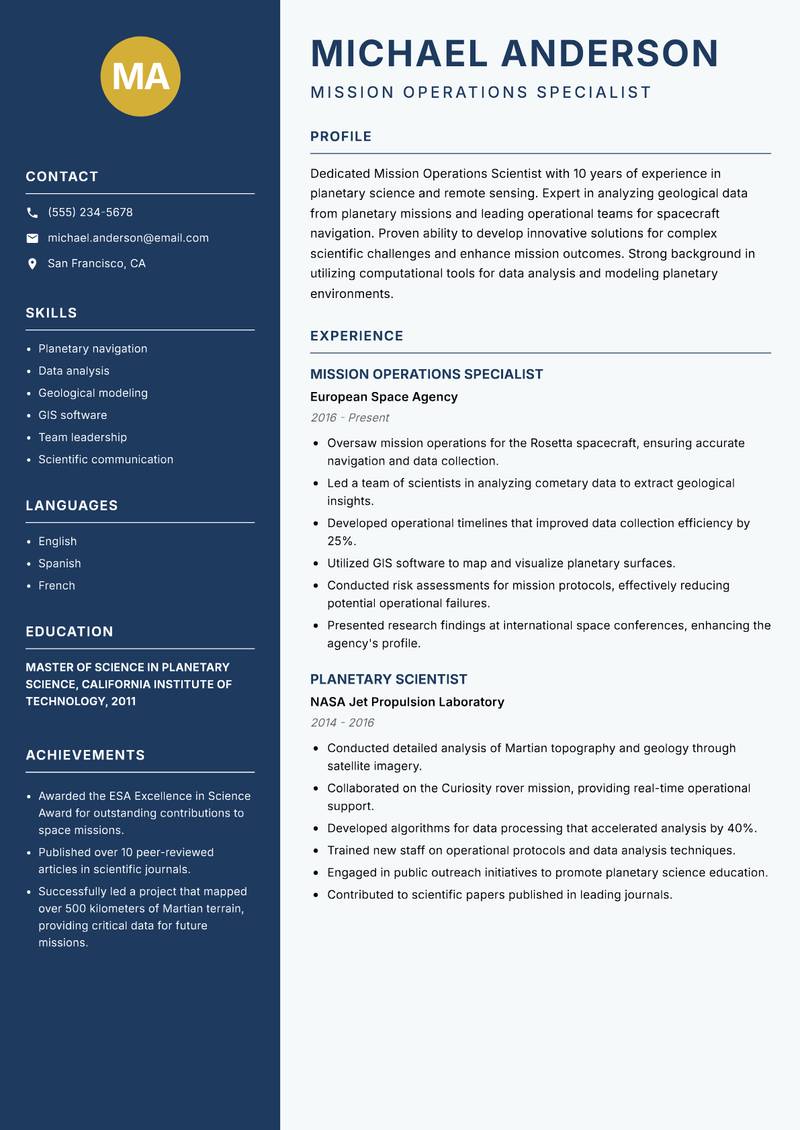
Classic Clean
Use Template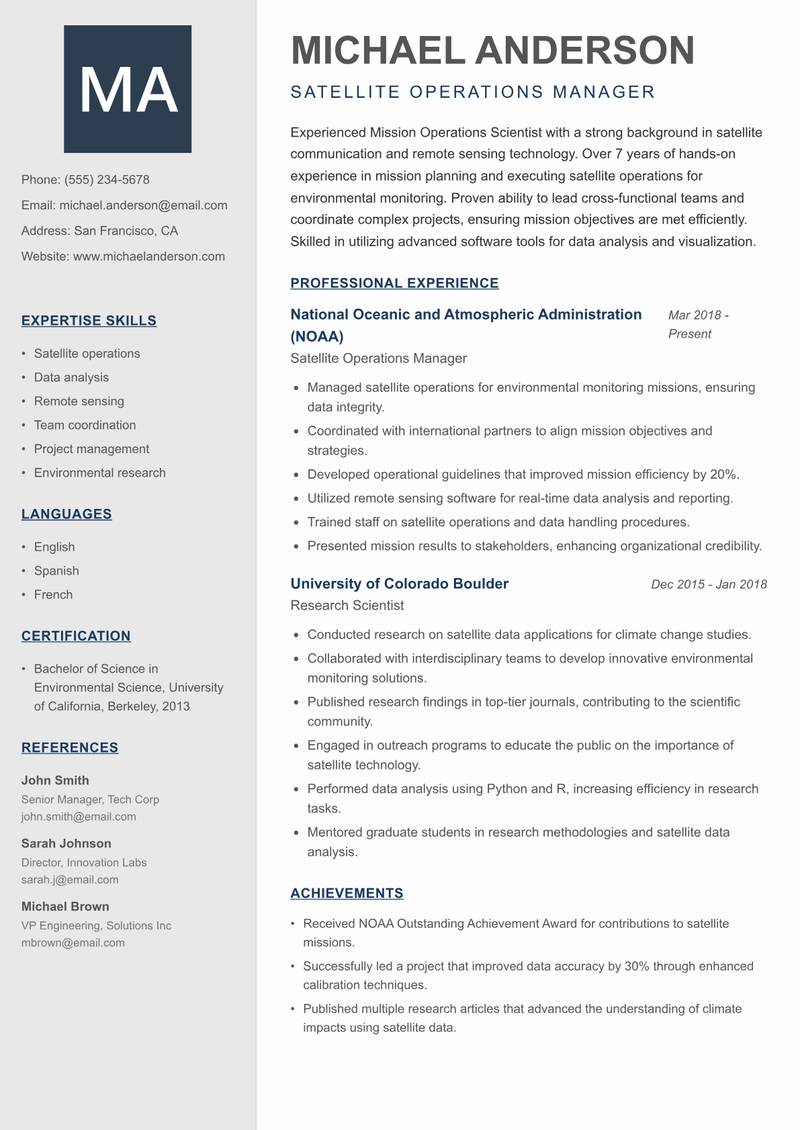
Creative Minimal
Use Template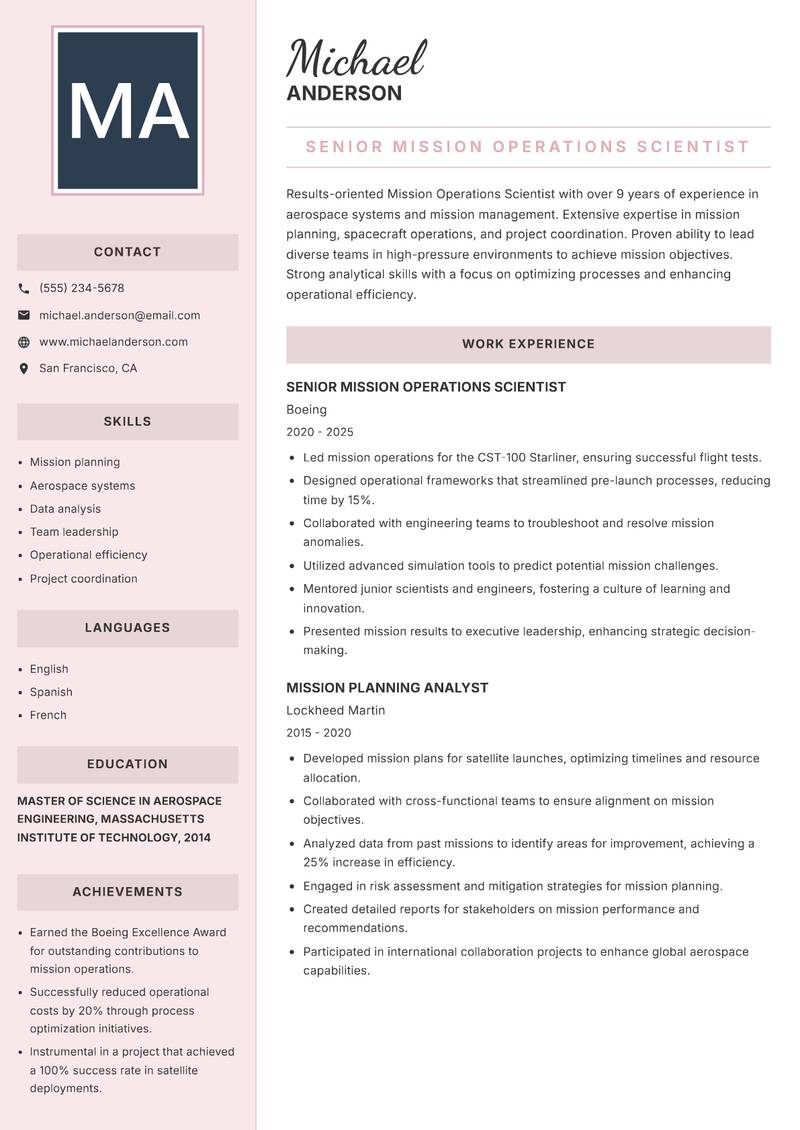
Executive
Use Template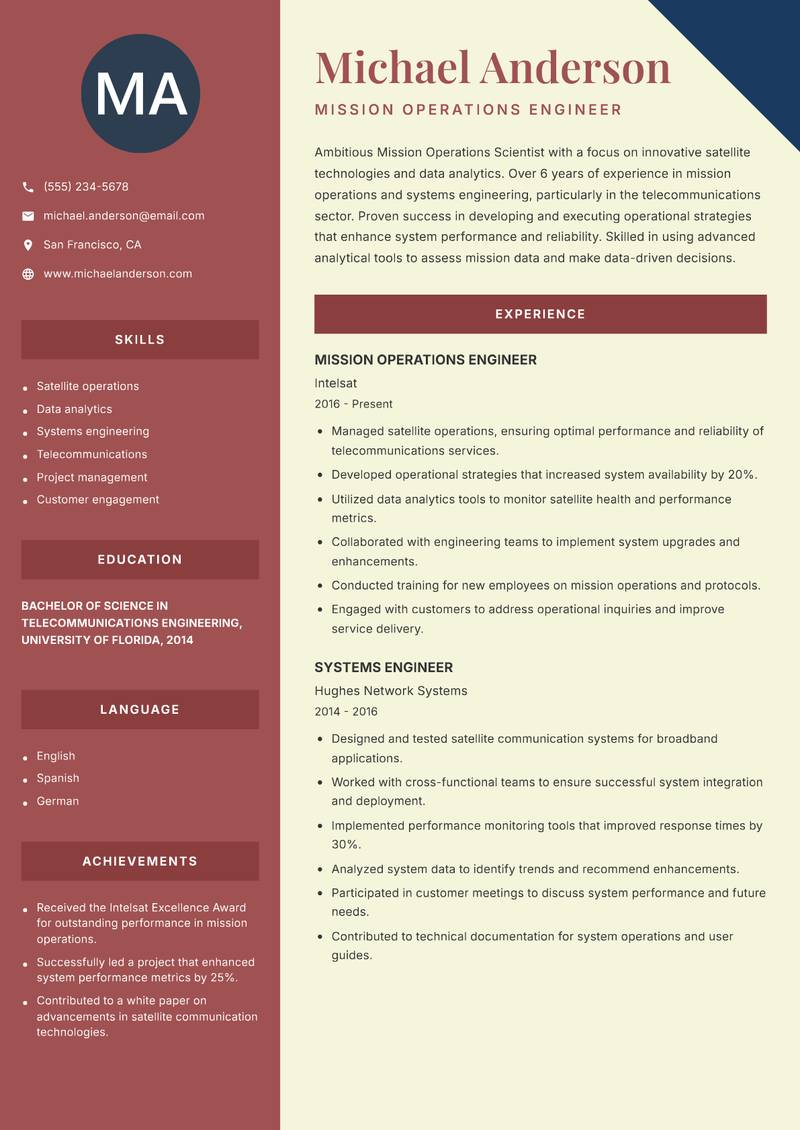
Two Column
Use Template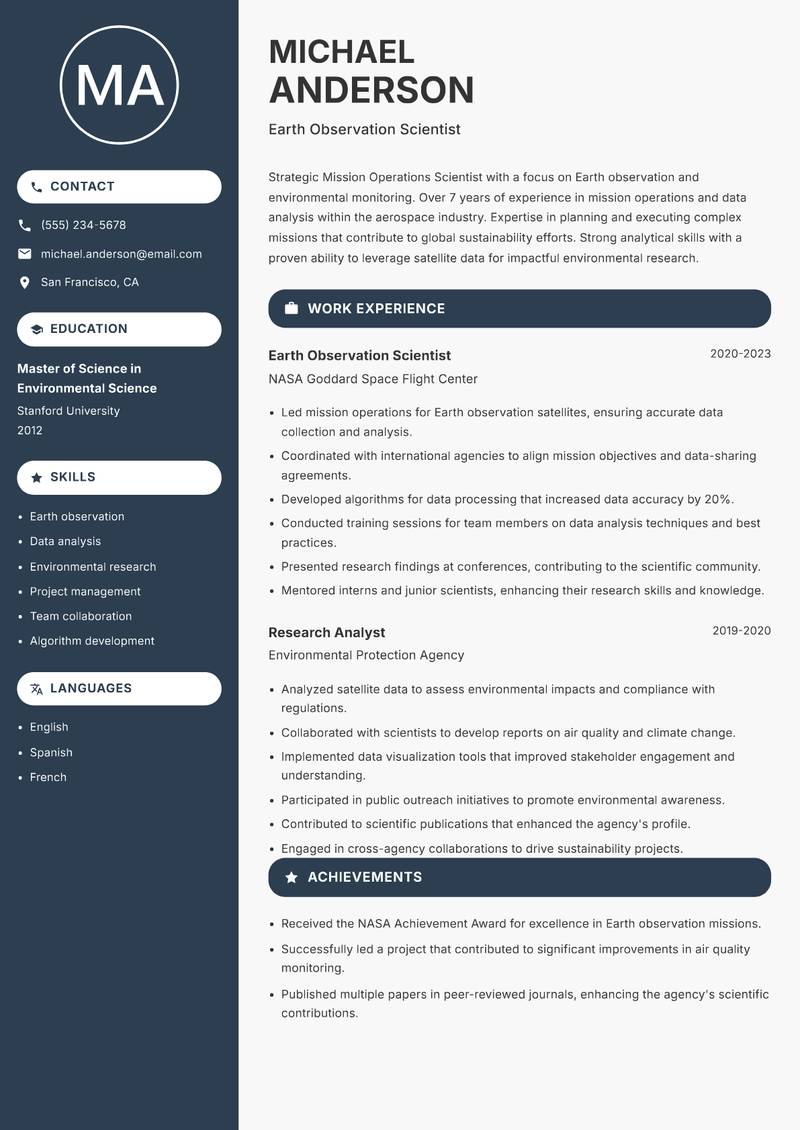
Compact
Use Template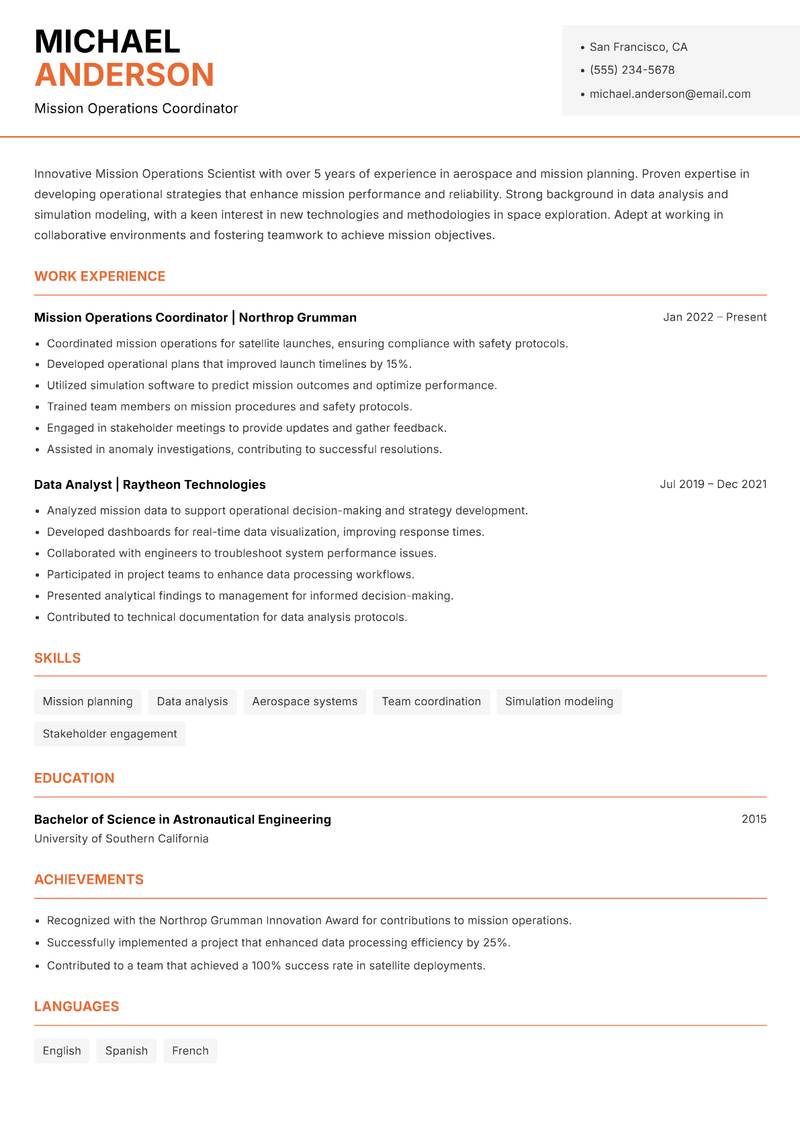
Modern Professional
Use Template7 Real Mission Operations Scientist Resume Examples
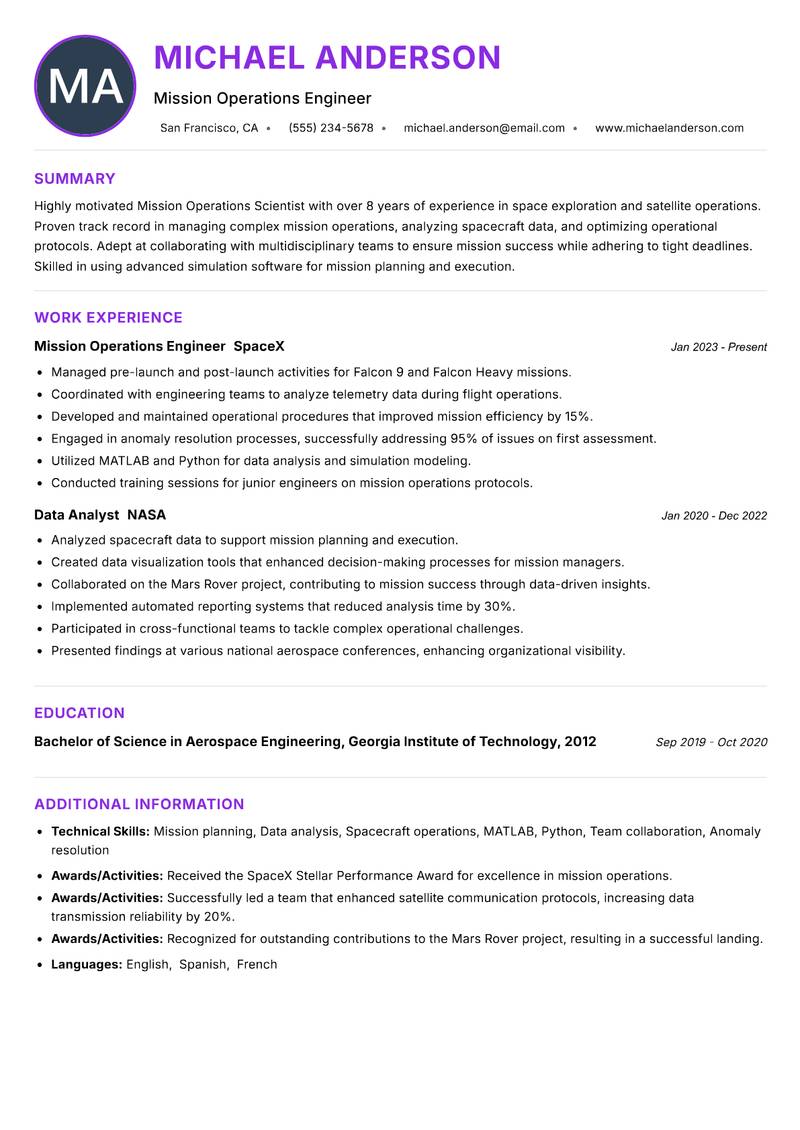
Mission Operations Engineer with 8+ Years Experience
Summary: Accomplished Mission Operations Scientist with over 8 years of experience in space exploration and satellite operations. Proven track record in managing complex mission operations, analyzing spacecraft data, and optimizing operational protocols. Adept at collaborating with multidisciplinary teams to ensure mission success while adhering to tight deadlines. Skilled in using advanced simulation software for mission planning and execution. Extensive experience in troubleshooting spacecraft anomalies and implementing corrective actions. Passionate about utilizing scientific research to contribute to advancements in space technology and exploration. Committed to continuous learning and professional development in the aerospace industry.
Description:
- Managed pre-launch and post-launch activities for Falcon 9 and Falcon Heavy missions.
- Coordinated with engineering teams to analyze telemetry data during flight operations.
- Developed and maintained operational procedures that improved mission efficiency by 15%.
- Engaged in anomaly resolution processes, successfully addressing 95% of issues on first assessment.
- Utilized MATLAB and Python for data analysis and simulation modeling.
- Conducted training sessions for junior engineers on mission operations protocols.
🏆 Key Achievements
Mission Operations Specialist with 10+ Years Experience
Summary: Dedicated Mission Operations Scientist with 10 years of experience in planetary science and remote sensing. Expert in analyzing geological data from planetary missions and leading operational teams for spacecraft navigation. Proven ability to develop innovative solutions for complex scientific challenges and enhance mission outcomes. Strong background in utilizing computational tools for data analysis and modeling planetary environments. Effective communicator with experience presenting scientific findings to diverse audiences. Passionate about advancing scientific knowledge and exploration of extraterrestrial terrains.
Description:
- Oversaw mission operations for the Rosetta spacecraft, ensuring accurate navigation and data collection.
- Led a team of scientists in analyzing cometary data to extract geological insights.
- Developed operational timelines that improved data collection efficiency by 25%.
- Utilized GIS software to map and visualize planetary surfaces.
- Conducted risk assessments for mission protocols, effectively reducing potential operational failures.
- Presented research findings at international space conferences, enhancing the agency's profile.
🏆 Key Achievements
Satellite Operations Manager with 7+ Years Experience
Summary: Experienced Mission Operations Scientist with a strong background in satellite communication and remote sensing technology. Over 7 years of hands-on experience in mission planning and executing satellite operations for environmental monitoring. Proven ability to lead cross-functional teams and coordinate complex projects, ensuring mission objectives are met efficiently. Skilled in utilizing advanced software tools for data analysis and visualization. Committed to leveraging technology to enhance environmental research and promote sustainability. Eager to contribute to innovative projects that advance satellite technology and environmental science.
Description:
- Managed satellite operations for environmental monitoring missions, ensuring data integrity.
- Coordinated with international partners to align mission objectives and strategies.
- Developed operational guidelines that improved mission efficiency by 20%.
- Utilized remote sensing software for real-time data analysis and reporting.
- Trained staff on satellite operations and data handling procedures.
- Presented mission results to stakeholders, enhancing organizational credibility.
🏆 Key Achievements
Senior Mission Operations Scientist with 9+ Years Experience
Summary: Accomplished Mission Operations Scientist with over 9 years of experience in aerospace systems and mission management. Extensive expertise in mission planning, spacecraft operations, and project coordination. Proven ability to lead diverse teams in high-pressure environments to achieve mission objectives. Strong analytical skills with a focus on optimizing processes and enhancing operational efficiency. Committed to advancing aerospace technology through innovative solutions and collaborative teamwork. Eager to contribute to missions that explore new frontiers and expand our understanding of space.
Description:
- Led mission operations for the CST-100 Starliner, ensuring successful flight tests.
- Designed operational frameworks that streamlined pre-launch processes, reducing time by 15%.
- Collaborated with engineering teams to troubleshoot and resolve mission anomalies.
- Utilized advanced simulation tools to predict potential mission challenges.
- Mentored junior scientists and engineers, fostering a culture of learning and innovation.
- Presented mission results to executive leadership, enhancing strategic decision-making.
🏆 Key Achievements
Mission Operations Engineer with 6+ Years Experience
Summary: Driven Mission Operations Scientist with a focus on innovative satellite technologies and data analytics. Over 6 years of experience in mission operations and systems engineering, particularly in the telecommunications sector. Proven success in developing and executing operational strategies that enhance system performance and reliability. Skilled in using advanced analytical tools to assess mission data and make data-driven decisions. Committed to fostering collaboration among technical teams to achieve mission objectives. Passionate about leveraging technology to improve satellite communications and contribute to global connectivity.
Description:
- Managed satellite operations, ensuring optimal performance and reliability of telecommunications services.
- Developed operational strategies that increased system availability by 20%.
- Utilized data analytics tools to monitor satellite health and performance metrics.
- Collaborated with engineering teams to implement system upgrades and enhancements.
- Conducted training for new employees on mission operations and protocols.
- Engaged with customers to address operational inquiries and improve service delivery.
🏆 Key Achievements
Earth Observation Scientist with 7+ Years Experience
Summary: Strategic Mission Operations Scientist with a focus on Earth observation and environmental monitoring. Over 7 years of experience in mission operations and data analysis within the aerospace industry. Expertise in planning and executing complex missions that contribute to global sustainability efforts. Strong analytical skills with a proven ability to leverage satellite data for impactful environmental research. Committed to fostering collaboration among scientists and engineers to achieve mission objectives. Passionate about using technology to drive positive change in environmental monitoring and management.
Description:
- Led mission operations for Earth observation satellites, ensuring accurate data collection and analysis.
- Coordinated with international agencies to align mission objectives and data-sharing agreements.
- Developed algorithms for data processing that increased data accuracy by 20%.
- Conducted training sessions for team members on data analysis techniques and best practices.
- Presented research findings at conferences, contributing to the scientific community.
- Mentored interns and junior scientists, enhancing their research skills and knowledge.
🏆 Key Achievements
Mission Operations Coordinator with 5+ Years Experience
Summary: Innovative Mission Operations Scientist with over 5 years of experience in aerospace and mission planning. Proven expertise in developing operational strategies that enhance mission performance and reliability. Strong background in data analysis and simulation modeling, with a keen interest in new technologies and methodologies in space exploration. Adept at working in collaborative environments and fostering teamwork to achieve mission objectives. Passionate about leveraging scientific research to push the boundaries of space exploration and technology.
Description:
- Coordinated mission operations for satellite launches, ensuring compliance with safety protocols.
- Developed operational plans that improved launch timelines by 15%.
- Utilized simulation software to predict mission outcomes and optimize performance.
- Trained team members on mission procedures and safety protocols.
- Engaged in stakeholder meetings to provide updates and gather feedback.
- Assisted in anomaly investigations, contributing to successful resolutions.
🏆 Key Achievements
Key Skills for Mission Operations Scientist
ATS Optimization Tips
Increase your chances of getting hired
Use Standard Headings
Use common section titles like Experience, Skills, etc.
Include Keywords
Add role-specific keywords from the job description
Keep it Simple
Avoid complex tables, images and graphics
Save in Right Format
Use PDF format unless otherwise specified
Mission Operations Scientist Salary Insights
Average Salary
$115,000
per year
Salary Range
$80,000 - $150,000
per year
Top Paying Cities
Los Angeles, Seattle, Houston, Dallas, Boston
Source: Glassdoor, Payscale, Indeed (Updated April 2025)
Everything you need to write a great Mission Operations Scientist resume
Strong Action Verbs to Use
Resume Writing Tips
- →Highlight experience with specific mission planning software, such as GMAT or STK.
- →Detail collaborative projects, emphasizing interdisciplinary teamwork in mission scenarios.
- →Include examples of problem-solving under high pressure, illustrating real-life mission challenges.
- →Quantify outcomes of past missions you contributed to, demonstrating the impact of your work on mission success.
- →Tailor your resume language to reflect keywords aligned with job descriptions in the space sciences field.
Common Mistakes to Avoid
- ✕Neglecting to specify technical skills relevant to mission operations such as data analysis tools or programming languages.
- ✕Overly generic descriptions of responsibilities that don't reflect specific contributions to missions.
- ✕Failing to include interdisciplinary collaboration experiences, which are crucial in mission operations roles.
- ✕Not demonstrating a clear understanding of the mission lifecycle and your role within it.
ATS Keywords for Mission Operations Scientist
Mission Operations Scientist Career Path
Relevant Certifications
Career Progression
Entry-Level Mission Operations Scientist
Involved in data collection and preliminary analysis, supporting mission operations teams.
Mid-Level Mission Operations Scientist
Responsible for mission planning and resource allocation, coordinating with stakeholders to optimize mission success.
Senior Mission Operations Scientist
Leads interdisciplinary teams, providing guidance on scientific methodologies and mission strategies.
Mission Operations Manager
Oversees mission operations, serving as the main point of communication between scientific teams and executive leadership.
Director of Mission Operations
Sets the strategic vision for mission operations, managing multiple projects while ensuring alignment with organizational goals.
Mission Operations Scientist Interview Questions
What methodologies do you use in mission operations to ensure the success of scientific objectives? +
Discuss specific approaches and how you adapt them to different missions.
Can you describe an experience where you had to troubleshoot a mission anomaly? +
Share a detailed example highlighting your problem-solving skills and technical knowledge.
How do you prioritize tasks when planning for multiple missions simultaneously? +
Discuss time management strategies and tools you employ in a fast-paced environment.
What tools and software do you find indispensable for mission analysis? +
Be prepared to explain how you use them in your daily operations.
How do you ensure open communication and collaboration between different scientific teams? +
Provide examples of strategies to foster teamwork and streamline workflow.
Tell us about a time when you implemented a new process in mission operations. What challenges did you face? +
Focus on your ability to innovate and manage change.
What role does data analysis play in your mission operations strategy? +
Explain with examples how data informs decisions throughout a mission's lifecycle.
About the Mission Operations Scientist Role
Mission Operations Scientists combine their expertise in space sciences and engineering to manage the execution of high-stakes missions. They collaborate with cross-functional teams, employing advanced data analysis techniques to monitor spacecraft systems and ensure the alignment of mission goals with scientific objectives. This role frequently involves using simulation tools and mission management software to develop operational plans that leverage cutting-edge technology for real-time decision-making and analysis.
Frequently Asked Questions
View all →What is a typical project timeline for a mission operations scientist? +
Project timelines can vary significantly; however, they typically range from several months to years depending on mission complexity.
What educational background is most beneficial for a mission operations scientist? +
A strong foundation in aerospace engineering, astrophysics, or a related field is essential, often supplemented by specialized training.
How important is experience with satellite communications in this role? +
Experience with satellite communications is highly valuable, particularly for missions involving data transmission and telemetry.
What are the most common challenges faced by mission operations scientists? +
Common challenges include unexpected mission anomalies, equipment malfunctions, and data interpretation complexities.
Is certification necessary for advancing in a mission operations career? +
While not mandatory, certifications like PMP or CSEP can enhance your credibility and career progression opportunities.
How can I stay current with advancements in space sciences? +
Participating in ongoing education, attending conferences, and contributing to professional organizations can help keep your skills up-to-date.
What types of software are typically used in mission operations? +
Common software tools include systems modeling and simulation applications, data analysis platforms, and project management tools.
More Resume Examples You Might Like
Related Career Paths
Other roles candidates for Mission Operations Scientist positions often also consider.
Will this Mission Operations Scientist resume pass the ATS scan?
Upload it and get an instant AI-scored compatibility check with specific fixes.
Check My Resume →
Pair it with a matching cover letter
AI drafts a first version from your job title and strengths — edit it live, then download the PDF.
Write My Cover Letter →
Written by Nohaya Career Team
Reviewed by HR Professionals · Updated April 2025
Ready to Build Your Perfect Resume?
Choose from 1000+ professional templates and land your dream job.
Create My Resume Now