Build an ATS-Friendly
Exobiologist Resume
That Gets Interviews
Exobiologists investigate the potential forms of life beyond Earth, conducting experiments that mimic extraterrestrial environments to explore biological possibilities. They meticulously devise research proposals, analyze data from robotic missions, and participate in the planning of future space missions aimed at…
Exobiologist Resume Templates
Modern Professional
Use Template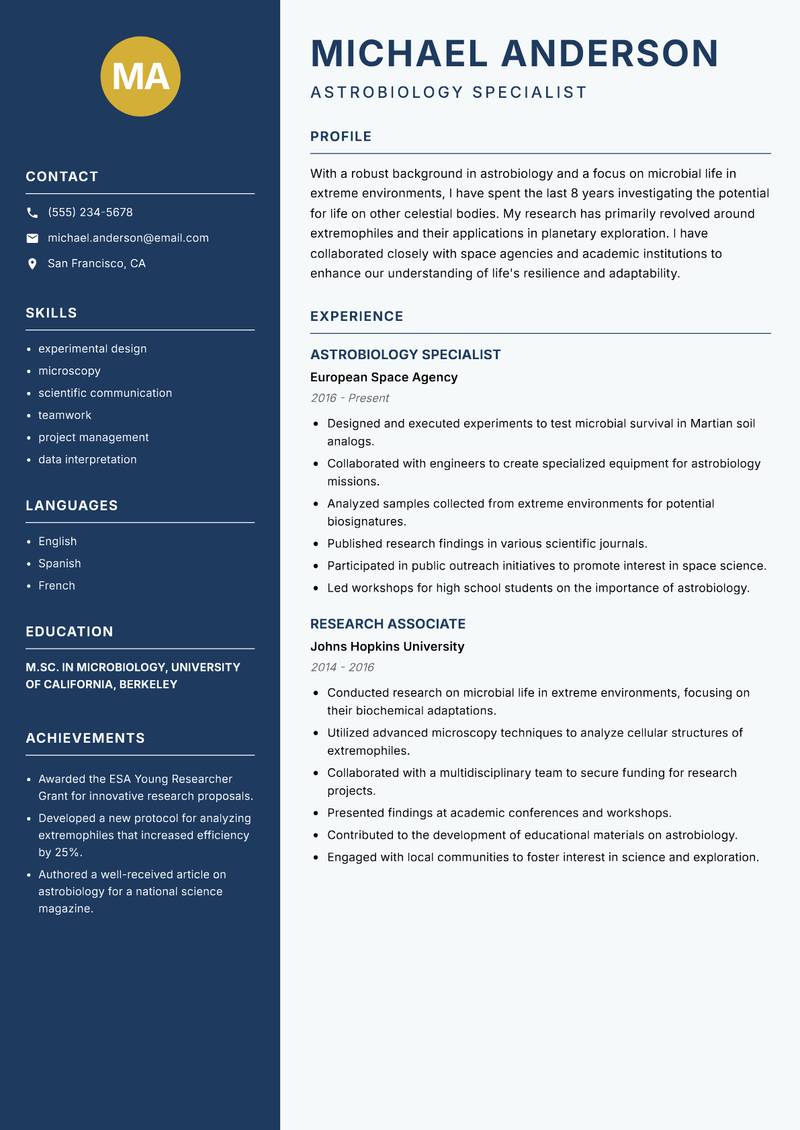
Classic Clean
Use Template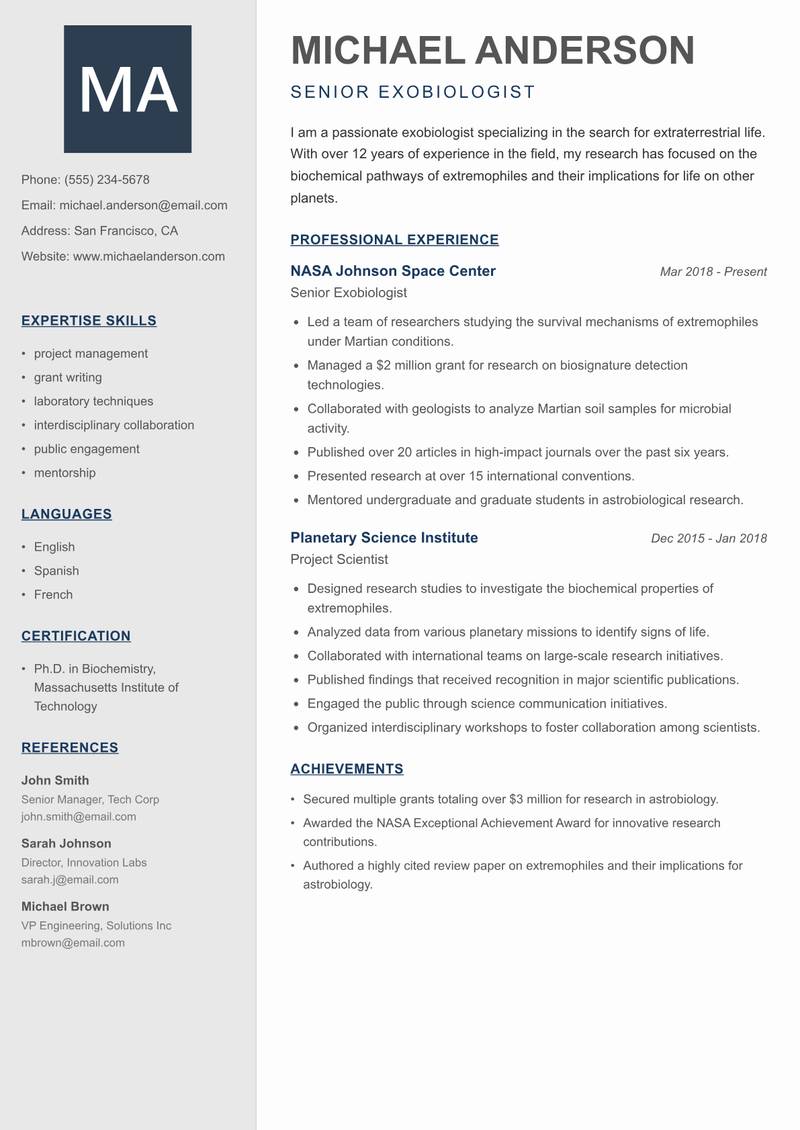
Creative Minimal
Use Template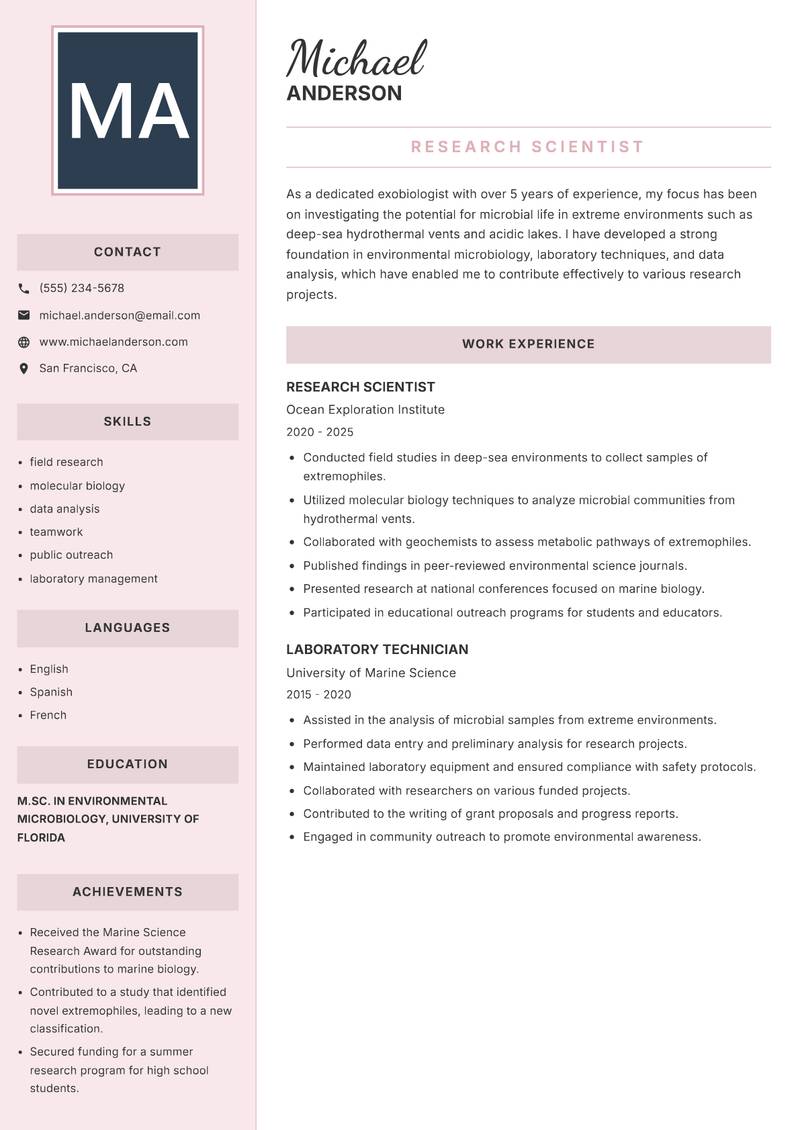
Executive
Use Template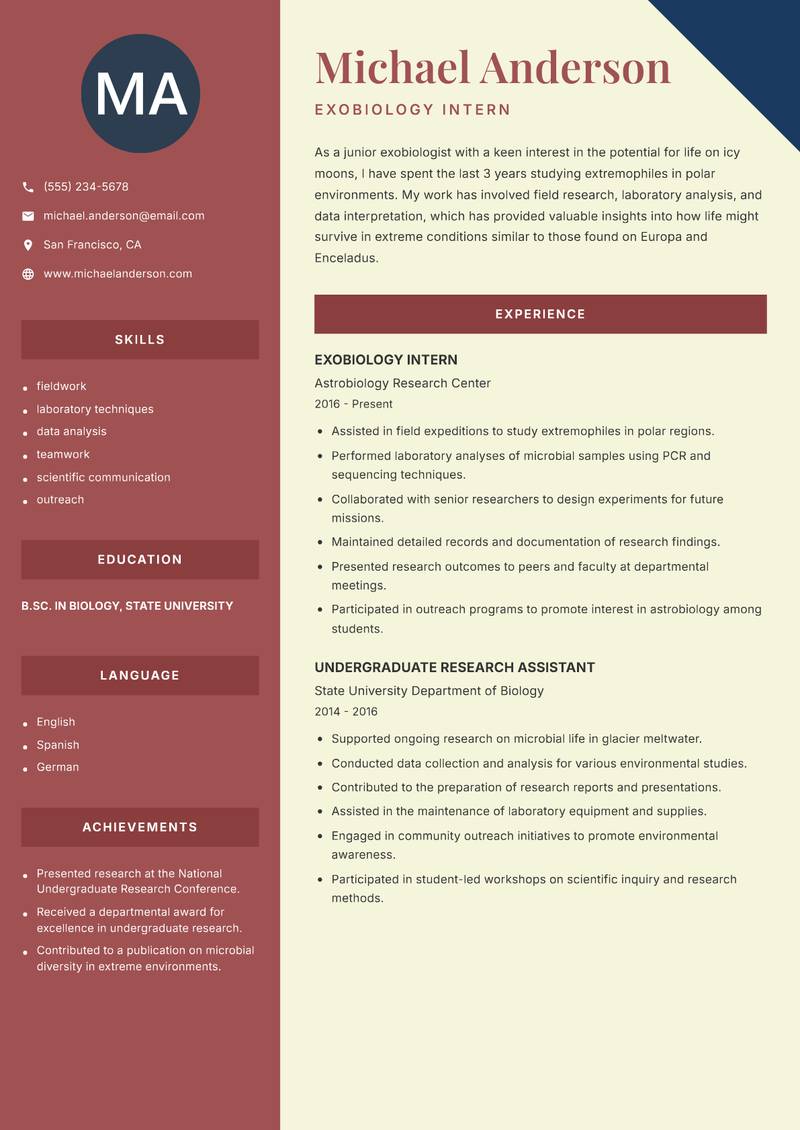
Two Column
Use Template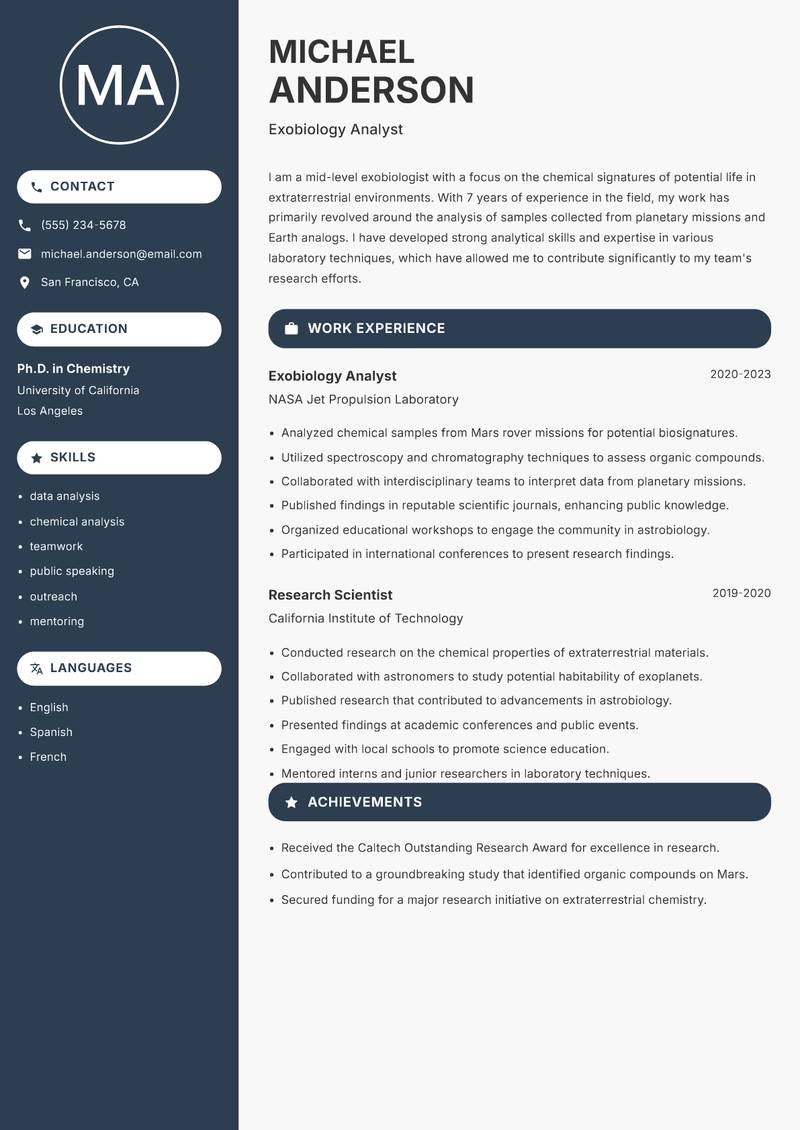
Compact
Use Template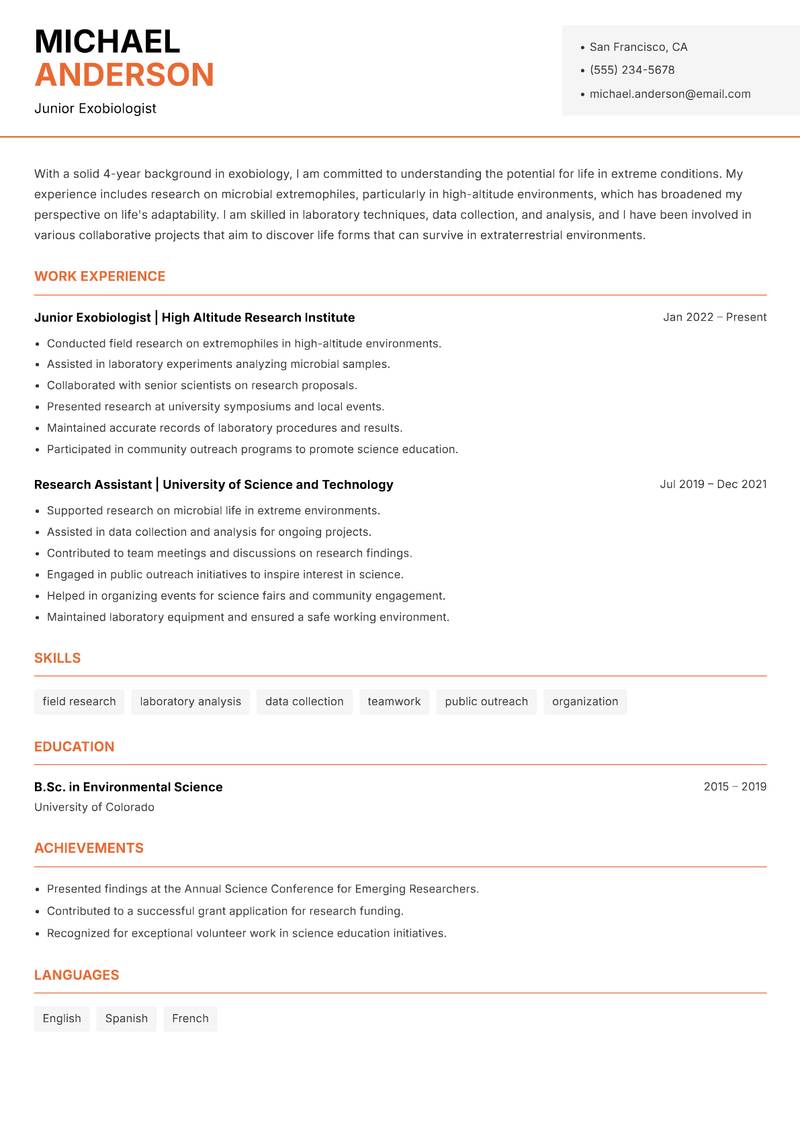
Modern Professional
Use Template7 Real Exobiologist Resume Examples
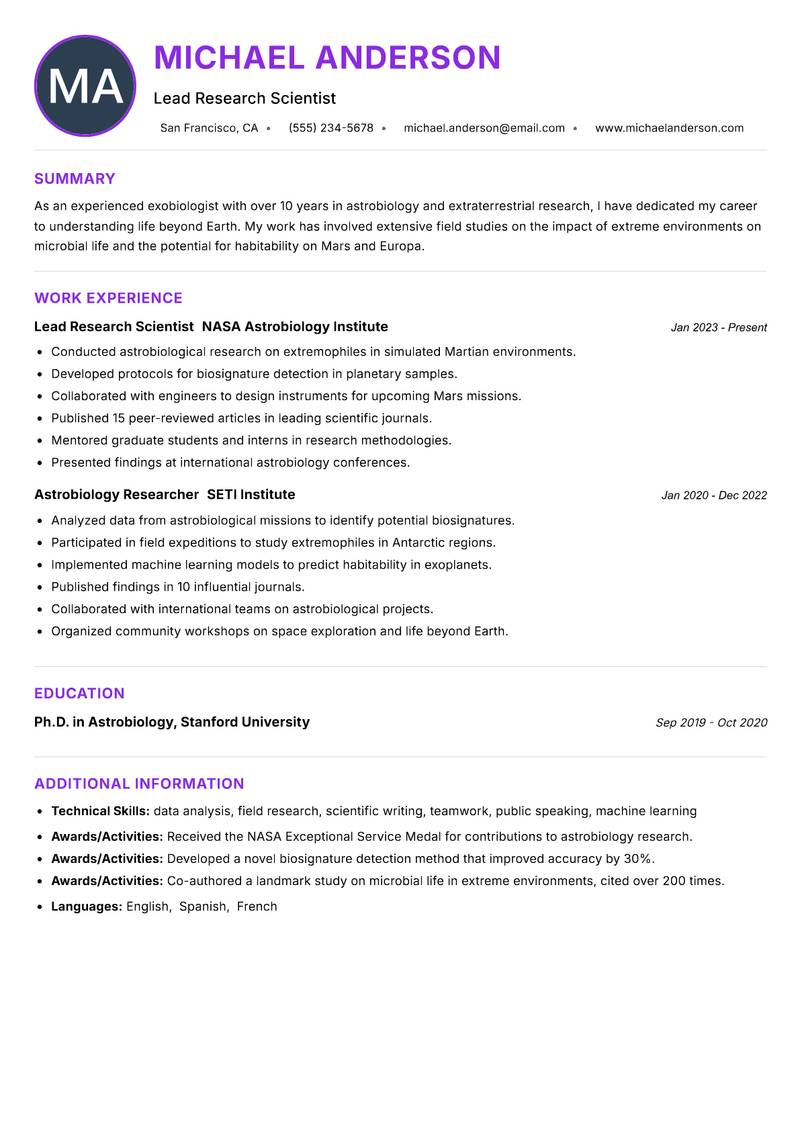
Lead Research Scientist with 10+ Years Experience
Summary: As an experienced exobiologist with over 10 years in astrobiology and extraterrestrial research, I have dedicated my career to understanding life beyond Earth. My work has involved extensive field studies on the impact of extreme environments on microbial life and the potential for habitability on Mars and Europa. I possess a strong background in experimentation and data analysis, which has led to a number of significant publications in reputable scientific journals. My collaboration with multidisciplinary teams has enhanced our approach to identifying biosignatures and developing technologies for future interplanetary exploration. I am passionate about educating the next generation of scientists and actively participate in outreach programs that inspire young minds to explore the mysteries of the universe. My goal is to contribute to groundbreaking discoveries that expand our understanding of life's potential and its origins in the cosmos.
Description:
- Conducted astrobiological research on extremophiles in simulated Martian environments.
- Developed protocols for biosignature detection in planetary samples.
- Collaborated with engineers to design instruments for upcoming Mars missions.
- Published 15 peer-reviewed articles in leading scientific journals.
- Mentored graduate students and interns in research methodologies.
- Presented findings at international astrobiology conferences.
🏆 Key Achievements
Astrobiology Specialist with 8+ Years Experience
Summary: With a robust background in astrobiology and a focus on microbial life in extreme environments, I have spent the last 8 years investigating the potential for life on other celestial bodies. My research has primarily revolved around extremophiles and their applications in planetary exploration. I have collaborated closely with space agencies and academic institutions to enhance our understanding of life's resilience and adaptability. My role has often included designing and conducting experiments to simulate extraterrestrial conditions, utilizing advanced laboratory techniques and instrumentation. I am committed to public science communication, aiming to bridge the gap between scientific research and public understanding of astrobiology. My objective is to further explore the possibilities of life beyond Earth and contribute to mission planning for future explorations.
Description:
- Designed and executed experiments to test microbial survival in Martian soil analogs.
- Collaborated with engineers to create specialized equipment for astrobiology missions.
- Analyzed samples collected from extreme environments for potential biosignatures.
- Published research findings in various scientific journals.
- Participated in public outreach initiatives to promote interest in space science.
- Led workshops for high school students on the importance of astrobiology.
🏆 Key Achievements
Senior Exobiologist with 12+ Years Experience
Summary: I am a passionate exobiologist specializing in the search for extraterrestrial life. With over 12 years of experience in the field, my research has focused on the biochemical pathways of extremophiles and their implications for life on other planets. I have a proven track record of securing research funding and managing large-scale projects, which has allowed me to lead innovative studies that push the boundaries of our understanding of life's potential in the universe. My work involves close collaboration with scientists across various disciplines, including geology, chemistry, and planetary science. In addition to my research, I am dedicated to mentoring young scientists and promoting diversity in STEM fields. My long-term goal is to contribute significantly to upcoming interplanetary missions and the exploration of Mars and beyond.
Description:
- Led a team of researchers studying the survival mechanisms of extremophiles under Martian conditions.
- Managed a $2 million grant for research on biosignature detection technologies.
- Collaborated with geologists to analyze Martian soil samples for microbial activity.
- Published over 20 articles in high-impact journals over the past six years.
- Presented research at over 15 international conventions.
- Mentored undergraduate and graduate students in astrobiological research.
🏆 Key Achievements
Research Scientist with 5+ Years Experience
Summary: As a dedicated exobiologist with over 5 years of experience, my focus has been on investigating the potential for microbial life in extreme environments such as deep-sea hydrothermal vents and acidic lakes. I have developed a strong foundation in environmental microbiology, laboratory techniques, and data analysis, which have enabled me to contribute effectively to various research projects. My work has involved collaboration with interdisciplinary teams, enhancing our understanding of life's adaptability in extreme conditions. I am particularly interested in how these studies can inform our search for extraterrestrial life. My goal is to continue advancing our knowledge of extremophiles while actively engaging in public outreach to promote interest in astrobiology and planetary science.
Description:
- Conducted field studies in deep-sea environments to collect samples of extremophiles.
- Utilized molecular biology techniques to analyze microbial communities from hydrothermal vents.
- Collaborated with geochemists to assess metabolic pathways of extremophiles.
- Published findings in peer-reviewed environmental science journals.
- Presented research at national conferences focused on marine biology.
- Participated in educational outreach programs for students and educators.
🏆 Key Achievements
Exobiology Intern with 3+ Years Experience
Summary: As a junior exobiologist with a keen interest in the potential for life on icy moons, I have spent the last 3 years studying extremophiles in polar environments. My work has involved field research, laboratory analysis, and data interpretation, which has provided valuable insights into how life might survive in extreme conditions similar to those found on Europa and Enceladus. I am proficient in using various scientific instruments and techniques to analyze microbial samples, and I am eager to contribute to the growing body of knowledge in astrobiology. My goal is to expand my expertise and collaborate on projects that explore the possibility of life beyond our planet. I am also committed to science communication and education, aiming to inspire others to engage with the field of astrobiology.
Description:
- Assisted in field expeditions to study extremophiles in polar regions.
- Performed laboratory analyses of microbial samples using PCR and sequencing techniques.
- Collaborated with senior researchers to design experiments for future missions.
- Maintained detailed records and documentation of research findings.
- Presented research outcomes to peers and faculty at departmental meetings.
- Participated in outreach programs to promote interest in astrobiology among students.
🏆 Key Achievements
Exobiology Analyst with 7+ Years Experience
Summary: I am a mid-level exobiologist with a focus on the chemical signatures of potential life in extraterrestrial environments. With 7 years of experience in the field, my work has primarily revolved around the analysis of samples collected from planetary missions and Earth analogs. I have developed strong analytical skills and expertise in various laboratory techniques, which have allowed me to contribute significantly to my team's research efforts. I am passionate about the search for extraterrestrial life and have participated in several public outreach initiatives to raise awareness about astrobiology. My goal is to further my research through collaboration with international space agencies and contribute to upcoming exploratory missions.
Description:
- Analyzed chemical samples from Mars rover missions for potential biosignatures.
- Utilized spectroscopy and chromatography techniques to assess organic compounds.
- Collaborated with interdisciplinary teams to interpret data from planetary missions.
- Published findings in reputable scientific journals, enhancing public knowledge.
- Organized educational workshops to engage the community in astrobiology.
- Participated in international conferences to present research findings.
🏆 Key Achievements
Junior Exobiologist with 4+ Years Experience
Summary: With a solid 4-year background in exobiology, I am committed to understanding the potential for life in extreme conditions. My experience includes research on microbial extremophiles, particularly in high-altitude environments, which has broadened my perspective on life's adaptability. I am skilled in laboratory techniques, data collection, and analysis, and I have been involved in various collaborative projects that aim to discover life forms that can survive in extraterrestrial environments. My passion for science extends to public outreach, where I strive to inspire younger generations to engage with science and exploration. I aim to grow my expertise in astrobiology and contribute to future research endeavors focused on the search for life beyond Earth.
Description:
- Conducted field research on extremophiles in high-altitude environments.
- Assisted in laboratory experiments analyzing microbial samples.
- Collaborated with senior scientists on research proposals.
- Presented research at university symposiums and local events.
- Maintained accurate records of laboratory procedures and results.
- Participated in community outreach programs to promote science education.
🏆 Key Achievements
Key Skills for Exobiologist
ATS Optimization Tips
Increase your chances of getting hired
Use Standard Headings
Use common section titles like Experience, Skills, etc.
Include Keywords
Add role-specific keywords from the job description
Keep it Simple
Avoid complex tables, images and graphics
Save in Right Format
Use PDF format unless otherwise specified
Exobiologist Salary Insights
Average Salary
$100,000
per year
Salary Range
$70,000 - $130,000
per year
Top Paying Cities
Los Angeles, Seattle, Houston, Dallas, Boston
Source: Glassdoor, Payscale, Indeed (Updated April 2025)
Everything you need to write a great Exobiologist resume
Strong Action Verbs to Use
Resume Writing Tips
- →Emphasize your understanding of astrobiology and related scientific fields.
- →Highlight any experience with space missions or collaborations with space agencies.
- →Showcase your skills in data analysis, especially in relation to remote sensing technologies.
- →Mention specific software or tools used for modeling biological scenarios in extreme environments.
- →Detail your publications or presentations at scientific conferences.
Common Mistakes to Avoid
- ✕Overgeneralizing about space sciences instead of focusing on exobiology specifics.
- ✕Neglecting to include relevant interdisciplinary collaborations in past projects.
- ✕Using jargon without explanation, which may alienate non-specialist reviewers.
- ✕Failing to highlight unique research methodologies used in previous roles.
ATS Keywords for Exobiologist
Exobiologist Career Path
Career Progression
Entry-Level Exobiologist
Focuses on research methodologies, data collection, and analysis of extremophiles from Earth.
Mid-Level Exobiologist
Leads research projects involving extraterrestrial biology, collaborating with interdisciplinary teams.
Senior Exobiologist
Manages large-scale projects and provides strategic direction for interstellar exploration missions.
Research Director
Oversees multiple research teams and represents the organization in national and international scientific communities.
Chief Scientific Officer
Guides the overall scientific vision and strategy, influencing policy and funding on space exploration.
Exobiologist Interview Questions
What methods do you use to analyze potential biosignatures in extraterrestrial samples? +
Discuss specific techniques like mass spectrometry or gas chromatography.
Can you describe a challenge you faced in research and how you overcame it? +
Focus on a specific project and the scientific methods applied.
How do you stay current with scientific advancements in exobiology? +
Mention peer-reviewed journals, conferences, or networks you engage with.
What role do simulations play in your research design? +
Explain how modeling assists in hypothesis testing.
How do you collaborate with astrophysicists and geologists in your projects? +
Describe interdisciplinary work and specific projects.
What do you consider the most promising location for future exobiological research? +
Share opinions on specific celestial bodies and justify your choices.
About the Exobiologist Role
Exobiologists investigate the potential forms of life beyond Earth, conducting experiments that mimic extraterrestrial environments to explore biological possibilities. They meticulously devise research proposals, analyze data from robotic missions, and participate in the planning of future space missions aimed at Mars and icy moons. Exobiologists often engage with various scientific disciplines to understand life's adaptability and emergence in extreme conditions.
Frequently Asked Questions
What educational background is required for an exobiologist? +
Typically, an advanced degree in biological sciences, astrobiology, or a related field is essential.
Are internships important for pursuing a career in exobiology? +
Yes, internships, especially with space agencies or research institutions, provide valuable hands-on experience.
What types of employers hire exobiologists? +
Exobiologists can work for government space agencies, private space companies, and research institutions.
What skills are most valuable for an exobiologist? +
Field research experience, laboratory techniques, data analysis skills, and knowledge of planetary geology are crucial.
Is travel necessary in this profession? +
Travel may be required for field research or to attend scientific meetings and conferences.
How does one prepare for a career in exobiology? +
Engagement in related scientific research, networking with professionals, and continuous education in the field are important.
More Resume Examples You Might Like
Related Career Paths
Other roles candidates for Exobiologist positions often also consider.
Will this Exobiologist resume pass the ATS scan?
Upload it and get an instant AI-scored compatibility check with specific fixes.
Check My Resume →
Pair it with a matching cover letter
AI drafts a first version from your job title and strengths — edit it live, then download the PDF.
Write My Cover Letter →
Written by Nohaya Career Team
Reviewed by HR Professionals · Updated April 2025
Ready to Build Your Perfect Resume?
Choose from 1000+ professional templates and land your dream job.
Create My Resume Now