Build an ATS-Friendly
Scientific Instrumentation Physicist Resume
That Gets Interviews
Scientific Instrumentation Physicists delve into developing cutting-edge tools and methodologies that push the boundaries of measurement in physical sciences. Their work involves integrating complex technologies, such as sensors and lasers, into innovative experimental setups to gather precise data for research…
Scientific Instrumentation Physicist Resume Templates
Modern Professional
Use Template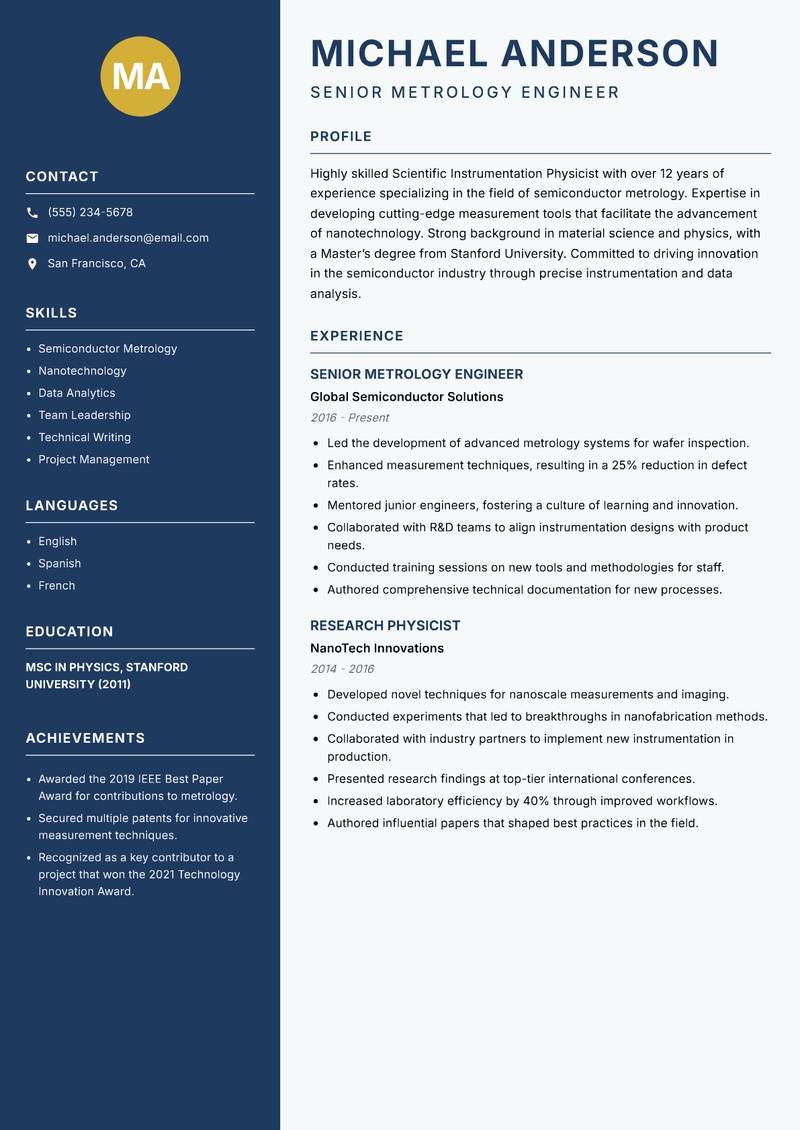
Classic Clean
Use Template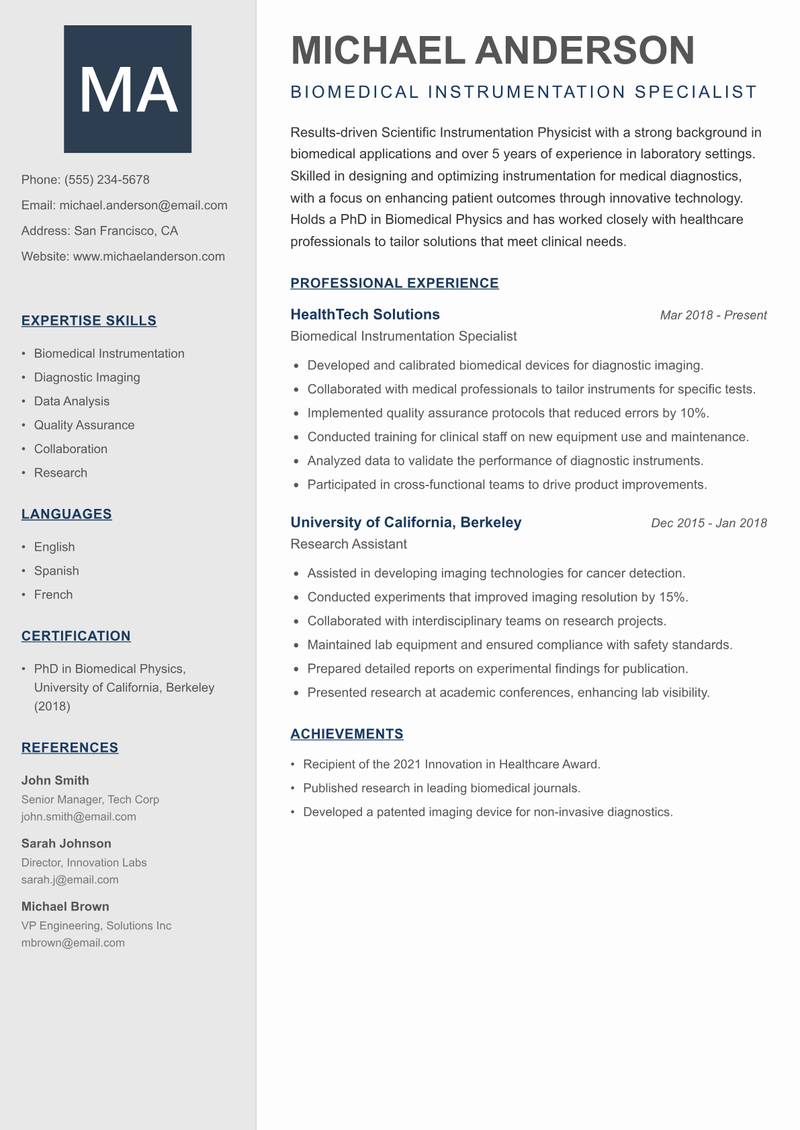
Creative Minimal
Use Template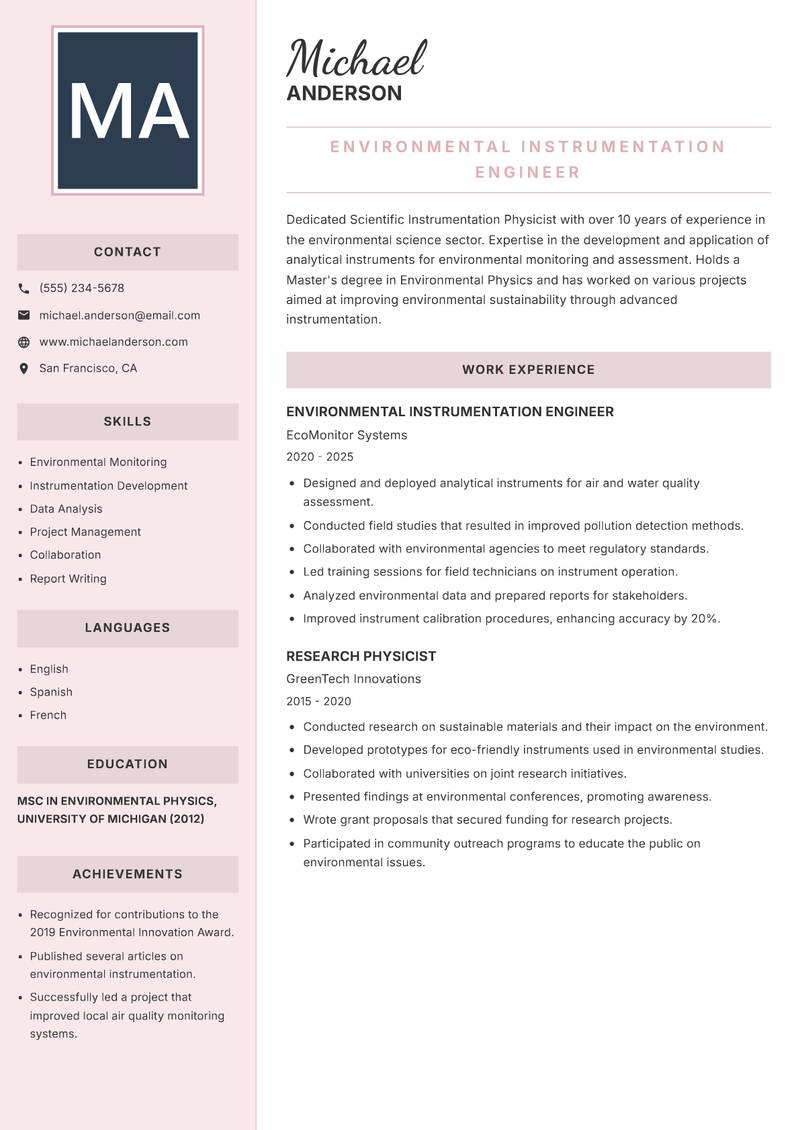
Executive
Use Template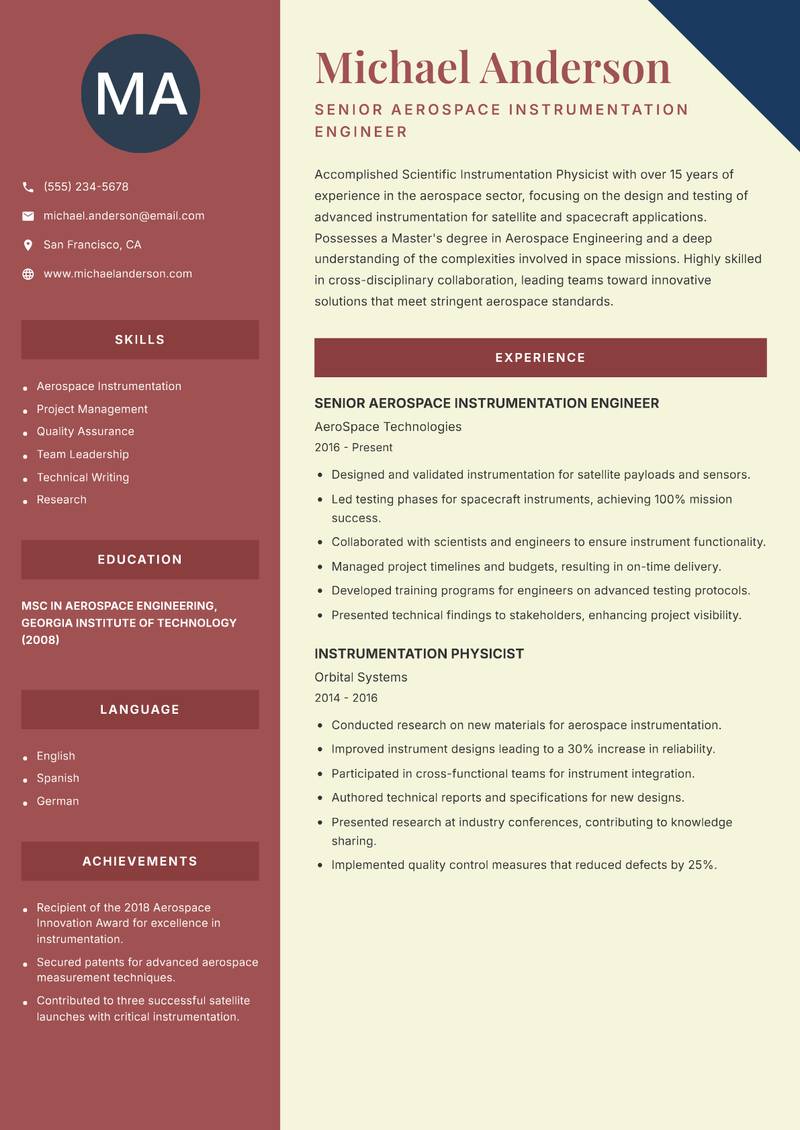
Two Column
Use Template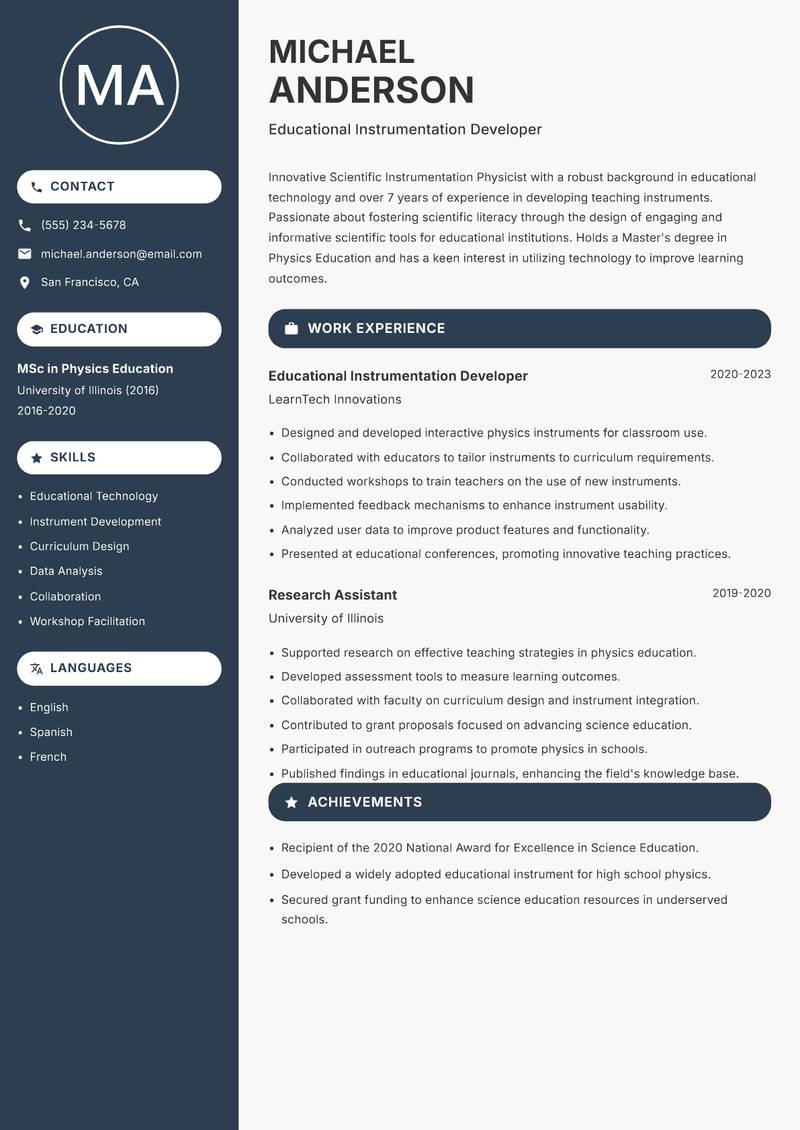
Compact
Use Template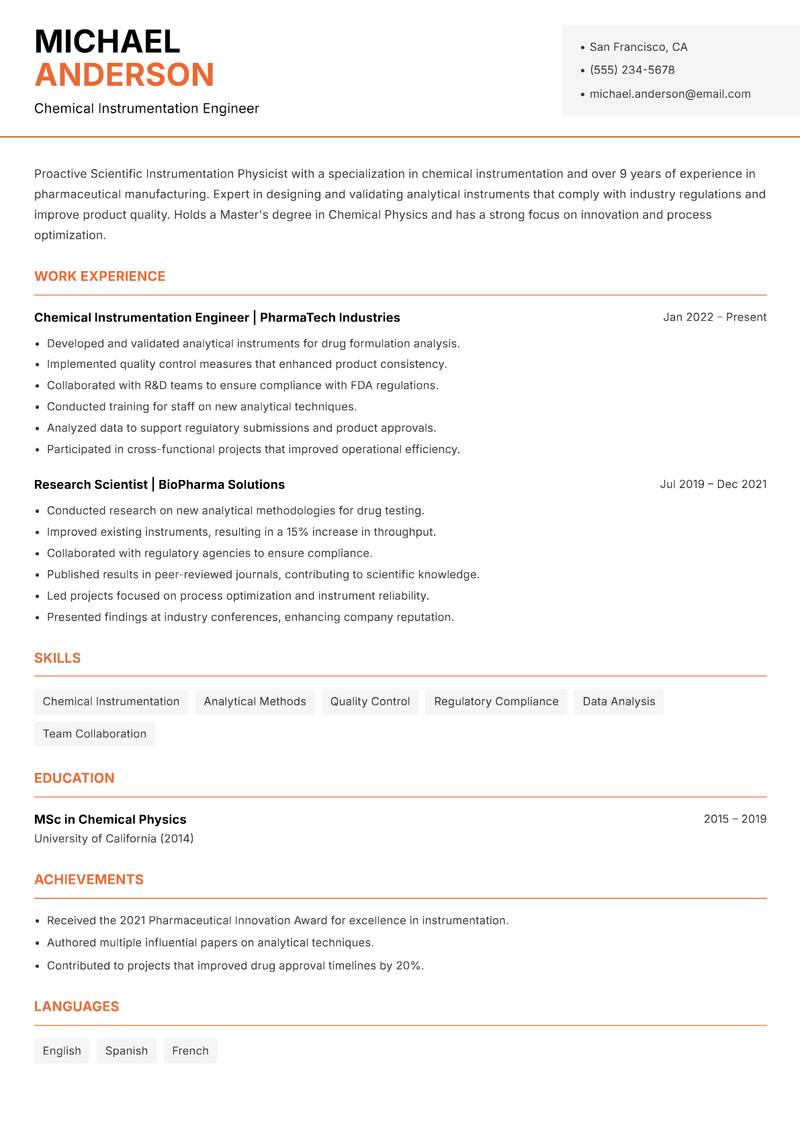
Modern Professional
Use Template7 Real Scientific Instrumentation Physicist Resume Examples
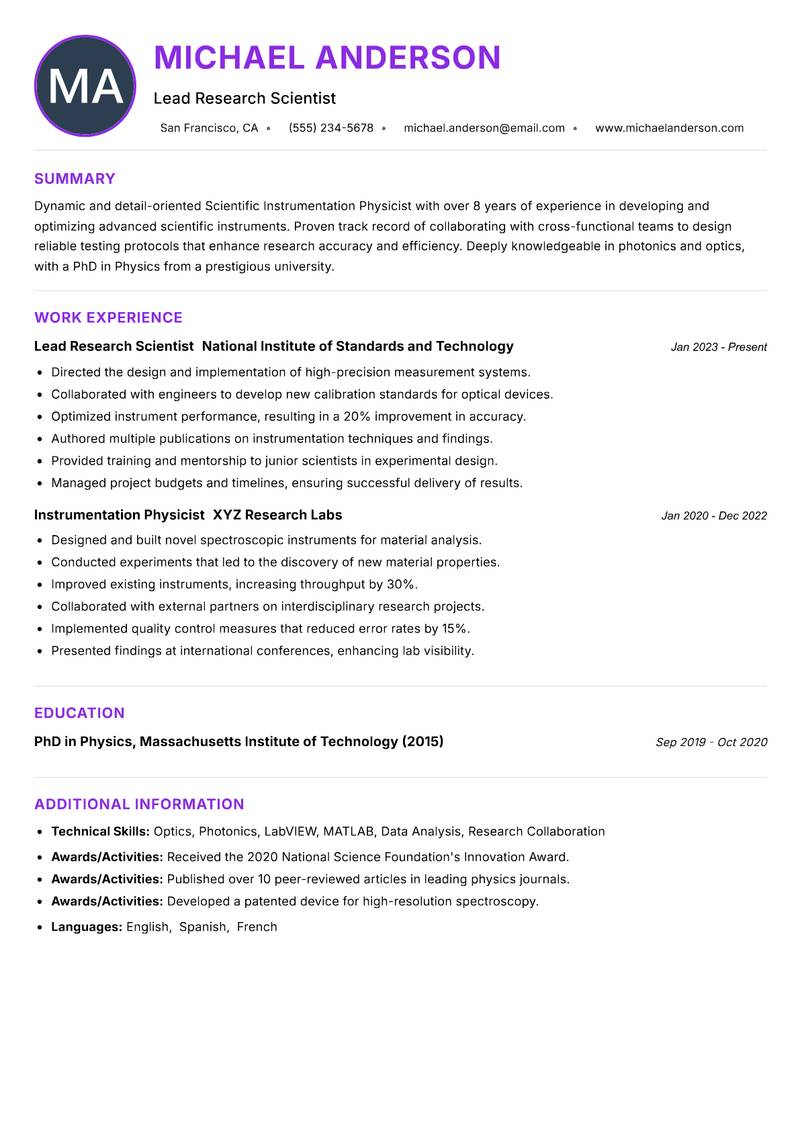
Lead Research Scientist with 8+ Years Experience
Summary: Dynamic and detail-oriented Scientific Instrumentation Physicist with over 8 years of experience in developing and optimizing advanced scientific instruments. Proven track record of collaborating with cross-functional teams to design reliable testing protocols that enhance research accuracy and efficiency. Deeply knowledgeable in photonics and optics, with a PhD in Physics from a prestigious university. Adept at applying theoretical concepts to practical applications in laboratory settings, ensuring compliance with safety and quality standards. Passionate about integrating innovative technologies to improve experimental methodologies and instrumentation reliability. Seeking to leverage expertise in a challenging role within a cutting-edge research institution focused on advancing scientific discovery through instrumentation innovation.
Description:
- Directed the design and implementation of high-precision measurement systems.
- Collaborated with engineers to develop new calibration standards for optical devices.
- Optimized instrument performance, resulting in a 20% improvement in accuracy.
- Authored multiple publications on instrumentation techniques and findings.
- Provided training and mentorship to junior scientists in experimental design.
- Managed project budgets and timelines, ensuring successful delivery of results.
🏆 Key Achievements
Senior Metrology Engineer with 12+ Years Experience
Summary: Highly skilled Scientific Instrumentation Physicist with over 12 years of experience specializing in the field of semiconductor metrology. Expertise in developing cutting-edge measurement tools that facilitate the advancement of nanotechnology. Strong background in material science and physics, with a Master’s degree from Stanford University. Committed to driving innovation in the semiconductor industry through precise instrumentation and data analysis. Proven ability to lead research teams and manage complex projects, ensuring the delivery of high-quality results under tight deadlines. Eager to contribute to a forward-thinking organization that values technological advancement and collaboration.
Description:
- Led the development of advanced metrology systems for wafer inspection.
- Enhanced measurement techniques, resulting in a 25% reduction in defect rates.
- Mentored junior engineers, fostering a culture of learning and innovation.
- Collaborated with R&D teams to align instrumentation designs with product needs.
- Conducted training sessions on new tools and methodologies for staff.
- Authored comprehensive technical documentation for new processes.
🏆 Key Achievements
Biomedical Instrumentation Specialist with 5+ Years Experience
Summary: Experienced Scientific Instrumentation Physicist with a strong background in biomedical applications and over 5 years of experience in laboratory settings. Skilled in designing and optimizing instrumentation for medical diagnostics, with a focus on enhancing patient outcomes through innovative technology. Holds a PhD in Biomedical Physics and has worked closely with healthcare professionals to tailor solutions that meet clinical needs. Known for strong analytical skills and a collaborative approach, I excel in fast-paced environments where precision and reliability are paramount. Seeking a challenging role within a healthcare organization to further advance my expertise in scientific instrumentation.
Description:
- Developed and calibrated biomedical devices for diagnostic imaging.
- Collaborated with medical professionals to tailor instruments for specific tests.
- Implemented quality assurance protocols that reduced errors by 10%.
- Conducted training for clinical staff on new equipment use and maintenance.
- Analyzed data to validate the performance of diagnostic instruments.
- Participated in cross-functional teams to drive product improvements.
🏆 Key Achievements
Environmental Instrumentation Engineer with 10+ Years Experience
Summary: Dedicated Scientific Instrumentation Physicist with over 10 years of experience in the environmental science sector. Expertise in the development and application of analytical instruments for environmental monitoring and assessment. Holds a Master's degree in Environmental Physics and has worked on various projects aimed at improving environmental sustainability through advanced instrumentation. Known for a strong analytical mindset and a commitment to accuracy, I have a proven ability to work effectively under pressure while delivering high-quality results. I am looking to leverage my expertise in a challenging role that emphasizes environmental impact and sustainability.
Description:
- Designed and deployed analytical instruments for air and water quality assessment.
- Conducted field studies that resulted in improved pollution detection methods.
- Collaborated with environmental agencies to meet regulatory standards.
- Led training sessions for field technicians on instrument operation.
- Analyzed environmental data and prepared reports for stakeholders.
- Improved instrument calibration procedures, enhancing accuracy by 20%.
🏆 Key Achievements
Senior Aerospace Instrumentation Engineer with 15+ Years Experience
Summary: Accomplished Scientific Instrumentation Physicist with over 15 years of experience in the aerospace sector, focusing on the design and testing of advanced instrumentation for satellite and spacecraft applications. Possesses a Master's degree in Aerospace Engineering and a deep understanding of the complexities involved in space missions. Highly skilled in cross-disciplinary collaboration, leading teams toward innovative solutions that meet stringent aerospace standards. Proven ability to manage high-stakes projects, ensuring successful deployment of critical instruments. I am now seeking to bring my extensive skill set to a new challenge in a leading aerospace organization committed to pushing technological boundaries.
Description:
- Designed and validated instrumentation for satellite payloads and sensors.
- Led testing phases for spacecraft instruments, achieving 100% mission success.
- Collaborated with scientists and engineers to ensure instrument functionality.
- Managed project timelines and budgets, resulting in on-time delivery.
- Developed training programs for engineers on advanced testing protocols.
- Presented technical findings to stakeholders, enhancing project visibility.
🏆 Key Achievements
Educational Instrumentation Developer with 7+ Years Experience
Summary: Innovative Scientific Instrumentation Physicist with a robust background in educational technology and over 7 years of experience in developing teaching instruments. Passionate about fostering scientific literacy through the design of engaging and informative scientific tools for educational institutions. Holds a Master's degree in Physics Education and has a keen interest in utilizing technology to improve learning outcomes. Known for creativity and adaptability, I strive to create instruments that not only educate but also inspire the next generation of scientists. I am eager to join a collaborative team dedicated to enhancing science education through innovative instrumentation.
Description:
- Designed and developed interactive physics instruments for classroom use.
- Collaborated with educators to tailor instruments to curriculum requirements.
- Conducted workshops to train teachers on the use of new instruments.
- Implemented feedback mechanisms to enhance instrument usability.
- Analyzed user data to improve product features and functionality.
- Presented at educational conferences, promoting innovative teaching practices.
🏆 Key Achievements
Chemical Instrumentation Engineer with 9+ Years Experience
Summary: Driven Scientific Instrumentation Physicist with a specialization in chemical instrumentation and over 9 years of experience in pharmaceutical manufacturing. Expert in designing and validating analytical instruments that comply with industry regulations and improve product quality. Holds a Master's degree in Chemical Physics and has a strong focus on innovation and process optimization. Known for meticulous attention to detail and a collaborative approach to problem-solving, I thrive in fast-paced environments where precision is essential. Seeking to leverage my experience in a dynamic pharmaceutical company focused on quality and compliance in product development.
Description:
- Developed and validated analytical instruments for drug formulation analysis.
- Implemented quality control measures that enhanced product consistency.
- Collaborated with R&D teams to ensure compliance with FDA regulations.
- Conducted training for staff on new analytical techniques.
- Analyzed data to support regulatory submissions and product approvals.
- Participated in cross-functional projects that improved operational efficiency.
🏆 Key Achievements
Key Skills for Scientific Instrumentation Physicist
ATS Optimization Tips
Increase your chances of getting hired
Use Standard Headings
Use common section titles like Experience, Skills, etc.
Include Keywords
Add role-specific keywords from the job description
Keep it Simple
Avoid complex tables, images and graphics
Save in Right Format
Use PDF format unless otherwise specified
Scientific Instrumentation Physicist Salary Insights
Average Salary
$115,000
per year
Salary Range
$85,000 - $145,000
per year
Top Paying Cities
Los Angeles, Seattle, Houston, Dallas, Boston
Source: Glassdoor, Payscale, Indeed (Updated April 2025)
Everything you need to write a great Scientific Instrumentation Physicist resume
Strong Action Verbs to Use
Resume Writing Tips
- →Highlight specific tools and technologies you've worked with, such as Fourier transform infrared (FTIR) spectroscopy or atomic force microscopy (AFM).
- →Emphasize any multidisciplinary projects that showcase collaboration with engineers or scientists from different fields.
- →Detail any publications or presentations at scientific conferences to demonstrate your contributions to the field.
- →Include metrics or outcomes from your projects to provide quantifiable evidence of your impact on research outcomes.
- →Showcase your ability to adapt instrument designs for specific experimental needs, reflecting practical problem-solving skills.
Common Mistakes to Avoid
- ✕Using overly generic language that doesn't reflect specialized skills in scientific measurement and experimentation.
- ✕Failing to detail collaborations or team projects that emphasize communication skills.
- ✕Not mentioning relevant software skills such as LabVIEW or MATLAB, which are crucial in data analysis for instrumentation.
- ✕Omitting continuous education or workshops related to recent advancements in instrumentation technology.
- ✕Neglecting to mention specific instruments or techniques that are industry-standard or notable in your work experience.
ATS Keywords for Scientific Instrumentation Physicist
Scientific Instrumentation Physicist Career Path
Relevant Certifications
Career Progression
Entry-Level Scientific Technician
Works under supervision to assist in the calibration and maintenance of scientific instruments.
Mid-Level Scientific Instrumentation Physicist
Independently conducts research and develops new measurement techniques, often focusing on specialized applications like spectroscopy or laser optics.
Senior Scientific Instrumentation Physicist
Leads projects and teams in developing complex experimental setups and analyzing results for scientific publications.
Principal Scientist
Oversees multiple research initiatives and provides strategic direction for instrumentation development across various scientific domains.
Director of Instrumentation Technology
Responsible for the strategic vision and management of all scientific instrumentation activities within an organization, typically in a leadership role.
Scientific Instrumentation Physicist Interview Questions
Describe a project where you had to develop a new measurement technique. +
Focus on explaining the challenges you faced and the innovations you implemented.
How do you prioritize tasks when working on multiple instrumentation projects simultaneously? +
Provide examples of your project management strategies or tools.
What role does collaboration play in your work as an instrumentation physicist? +
Share experiences of working with multidisciplinary teams or external stakeholders.
Can you explain a time when you had to troubleshoot a malfunctioning instrument? +
Detail your troubleshooting process and any impact on research outcomes.
What emerging technologies in scientific instrumentation are you most excited about? +
Discuss specific technologies and how you see them impacting the field.
How do you ensure your instruments meet the required standards and specifications? +
Mention your approach to quality assurance and compliance in instrumentation.
About the Scientific Instrumentation Physicist Role
Scientific Instrumentation Physicists delve into developing cutting-edge tools and methodologies that push the boundaries of measurement in physical sciences. Their work involves integrating complex technologies, such as sensors and lasers, into innovative experimental setups to gather precise data for research applications. By collaborating with chemists, engineers, and data analysts, they create instruments tailored to specific scientific inquiries and ensure that complex designs perform accurately under diverse conditions.
Frequently Asked Questions
What educational background is required for a Scientific Instrumentation Physicist? +
Typically, a Ph.D. in Physics or Engineering is preferred, with a focus on instrumentation or experimental physics.
What is a typical work environment for a Scientific Instrumentation Physicist? +
Most work in laboratory settings within academic institutions, government research facilities, or private industry sectors focused on innovation.
How does one stay updated with advancements in scientific instrumentation? +
Continuous education through workshops, peer-reviewed journals, and professional organizations is essential for staying current.
Are there opportunities for career advancement in this field? +
Yes, advancement can lead to roles such as project lead, principal scientist, or even director positions overseeing broader scientific initiatives.
What are some applications of the work done by Scientific Instrumentation Physicists? +
Their work is crucial in fields such as materials science, nanotechnology, and quantum computing, influencing both research and industrial applications.
More Resume Examples You Might Like
Related Career Paths
Other roles candidates for Scientific Instrumentation Physicist positions often also consider.
Will this Scientific Instrumentation Physicist resume pass the ATS scan?
Upload it and get an instant AI-scored compatibility check with specific fixes.
Check My Resume →
Pair it with a matching cover letter
AI drafts a first version from your job title and strengths — edit it live, then download the PDF.
Write My Cover Letter →
Written by Nohaya Career Team
Reviewed by HR Professionals · Updated April 2025
Ready to Build Your Perfect Resume?
Choose from 1000+ professional templates and land your dream job.
Create My Resume Now