Build an ATS-Friendly
Computational Physicist Resume
That Gets Interviews
Computational Physicists apply computational techniques and algorithms to solve complex physical problems and simulate physical systems. They leverage their knowledge of physics, mathematics, and computer science to develop models and conduct simulations that inform research and experimentation. This role is critical…
Computational Physicist Resume Templates
Modern Professional
Use Template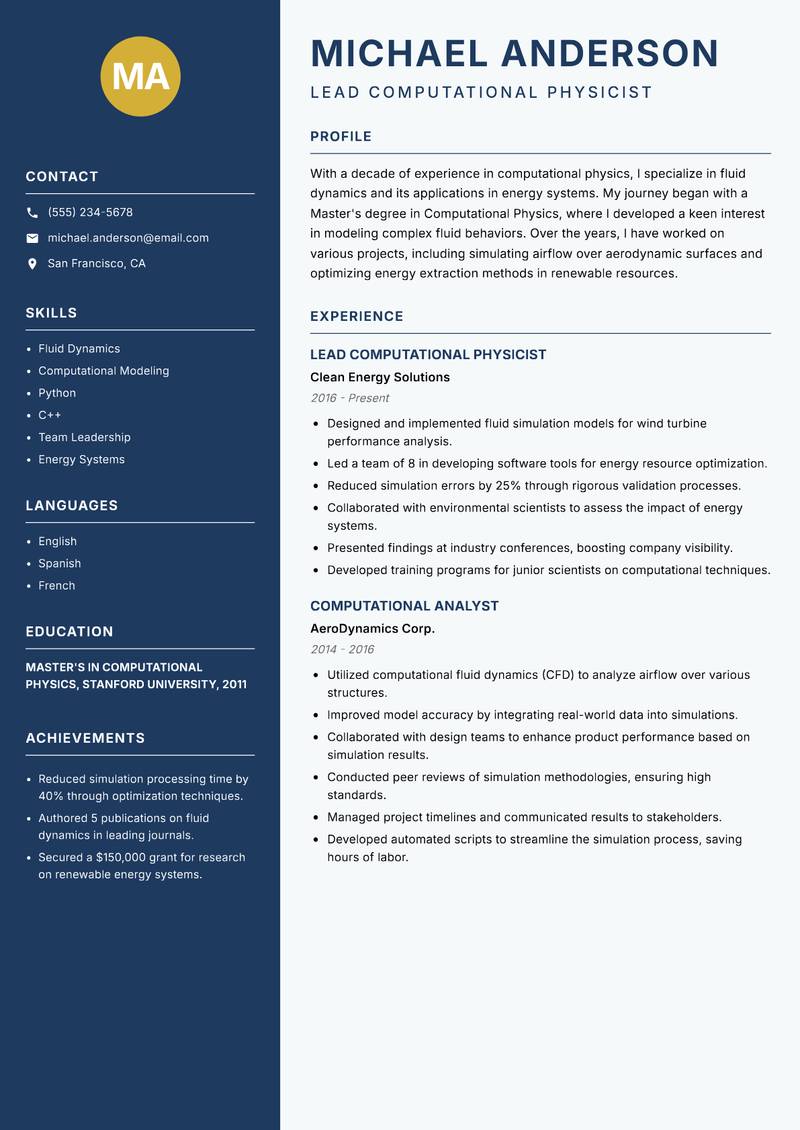
Classic Clean
Use Template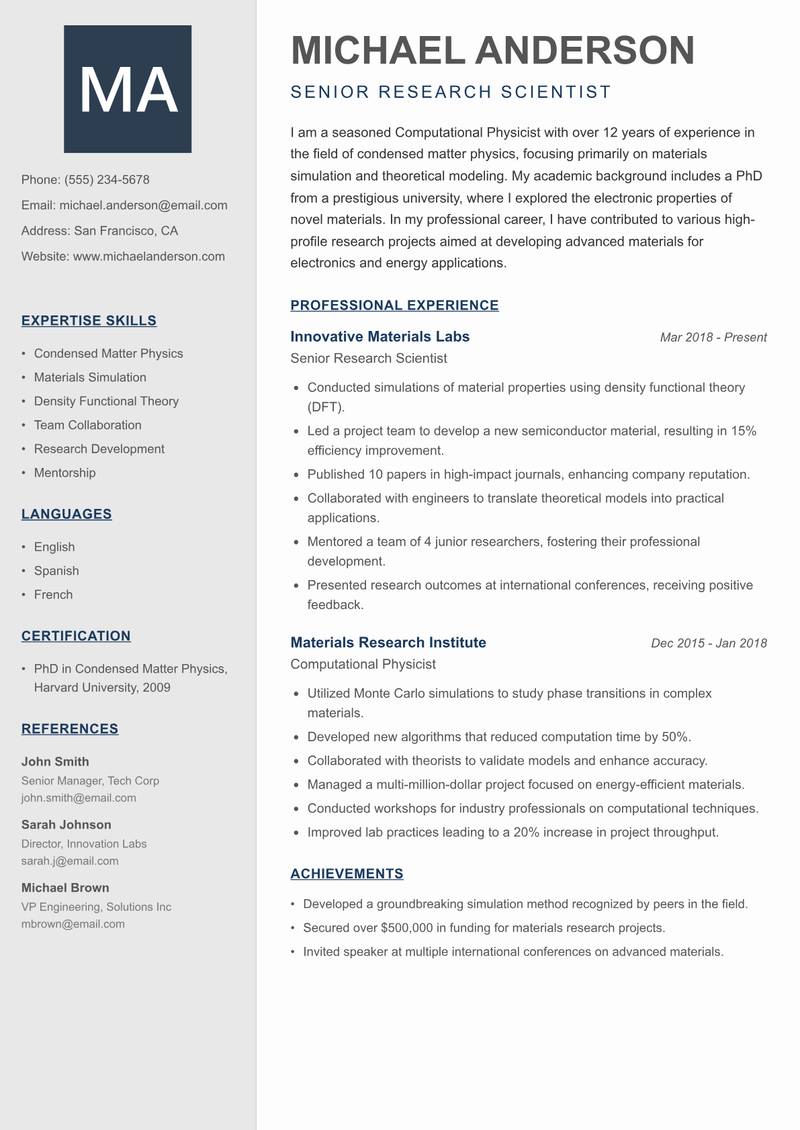
Creative Minimal
Use Template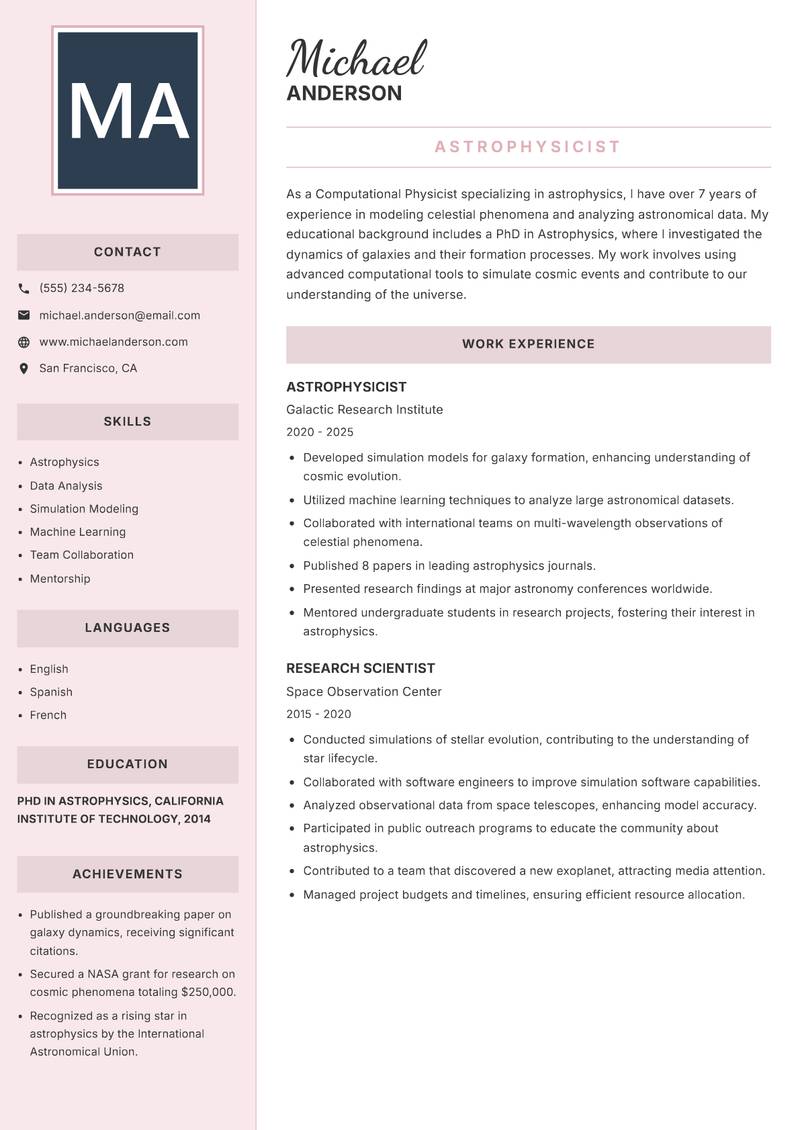
Executive
Use Template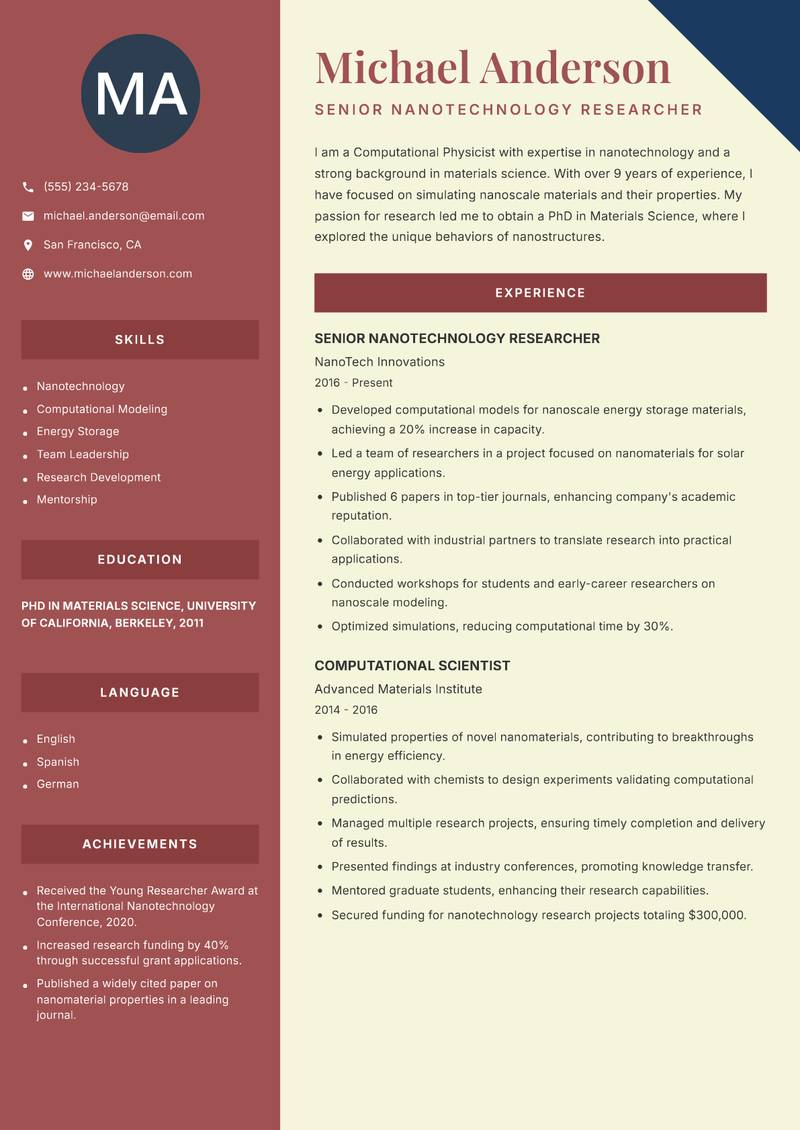
Two Column
Use Template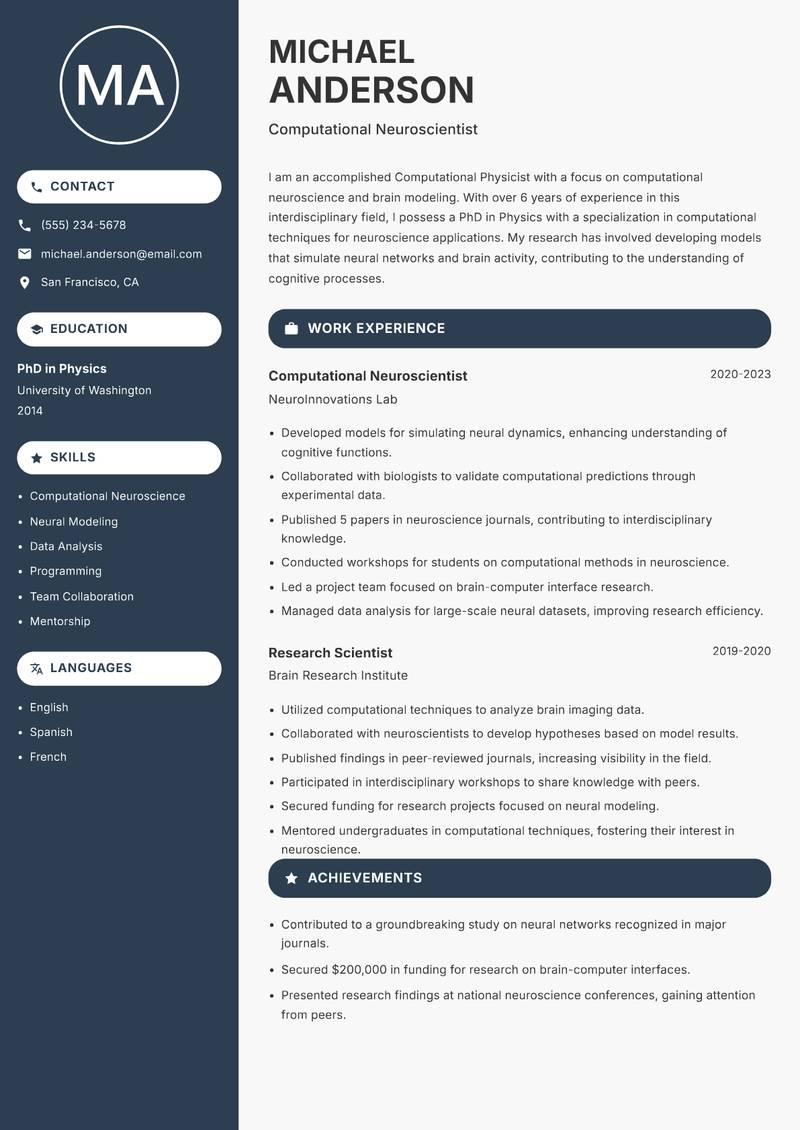
Compact
Use Template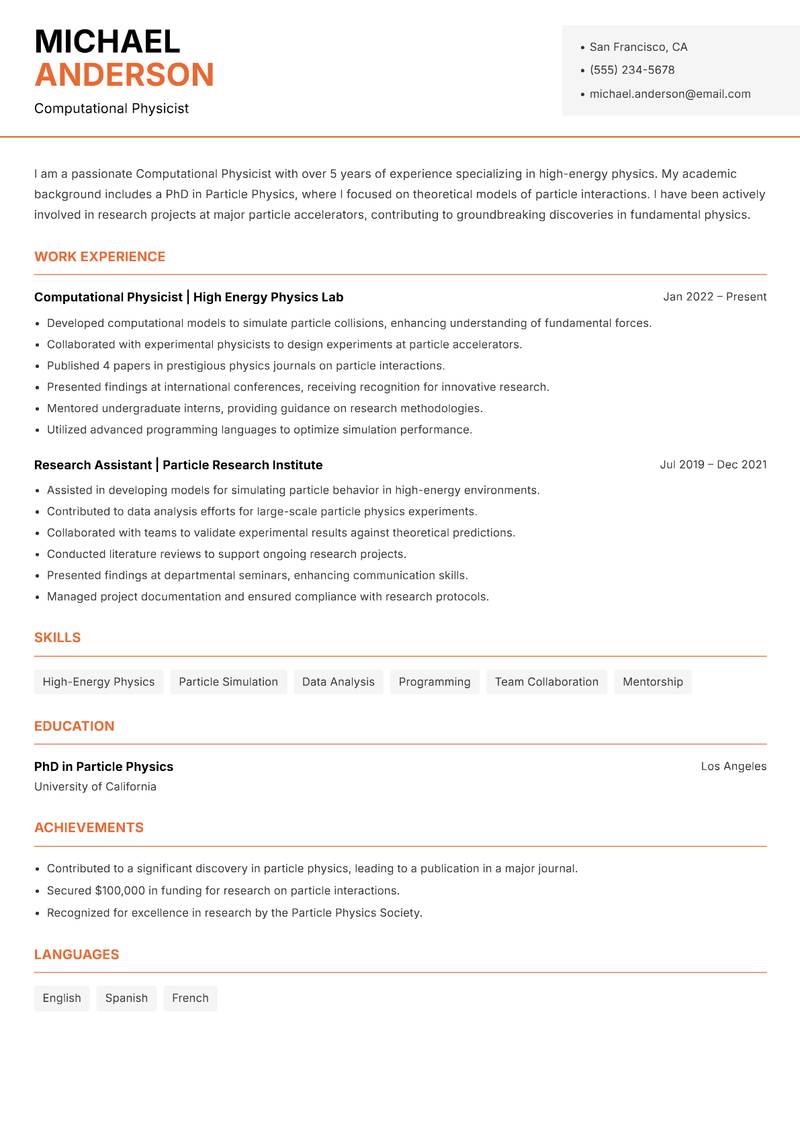
Modern Professional
Use Template7 Real Computational Physicist Resume Examples
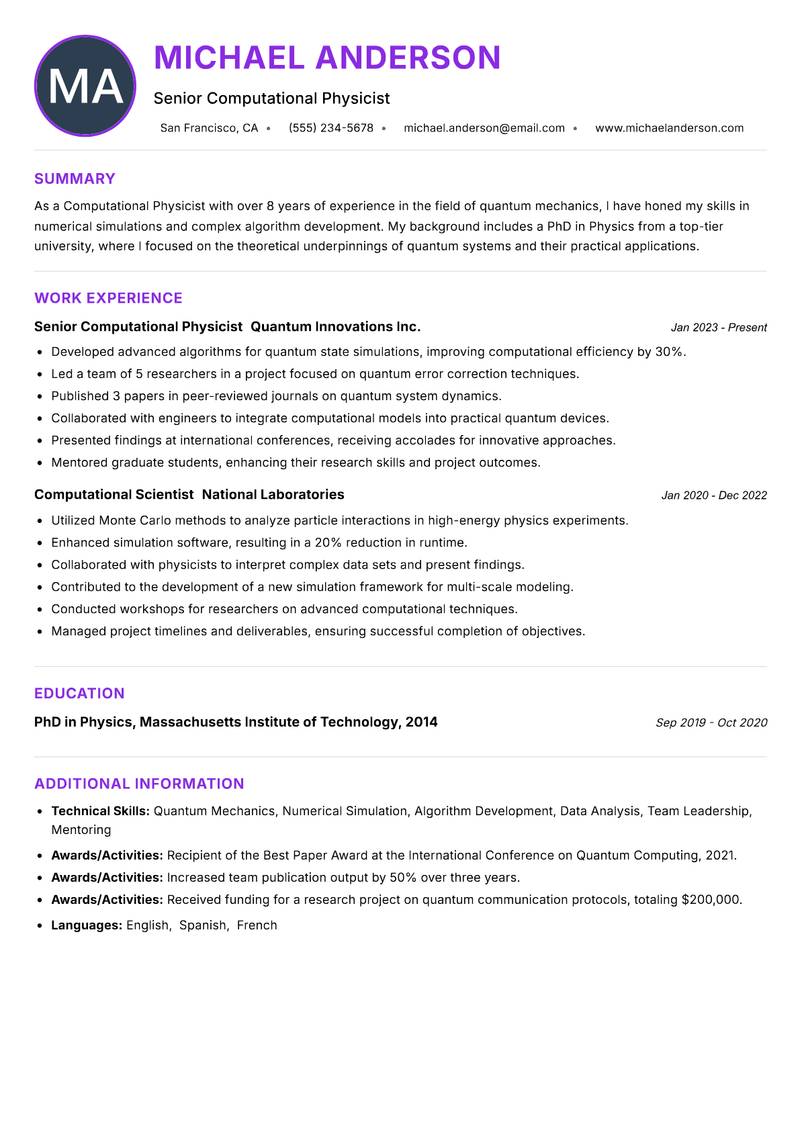
Senior Computational Physicist with 8+ Years Experience
Summary: As a Computational Physicist with over 8 years of experience in the field of quantum mechanics, I have honed my skills in numerical simulations and complex algorithm development. My background includes a PhD in Physics from a top-tier university, where I focused on the theoretical underpinnings of quantum systems and their practical applications. I have worked in academic and industrial settings, contributing to projects that aim to enhance our understanding of quantum computing and its potential to solve real-world problems. My expertise lies in leveraging advanced computational techniques to model physical systems, optimize experiments, and provide insights that drive innovation. I thrive in collaborative environments where cross-disciplinary teams tackle challenging scientific questions. I am passionate about fostering a culture of curiosity and scientific rigor, mentoring junior researchers and guiding them through their projects. With a strong publication record and a commitment to advancing the field, I am eager to bring my knowledge to a forward-thinking organization that values scientific exploration and technological advancement.
Description:
- Developed advanced algorithms for quantum state simulations, improving computational efficiency by 30%.
- Led a team of 5 researchers in a project focused on quantum error correction techniques.
- Published 3 papers in peer-reviewed journals on quantum system dynamics.
- Collaborated with engineers to integrate computational models into practical quantum devices.
- Presented findings at international conferences, receiving accolades for innovative approaches.
- Mentored graduate students, enhancing their research skills and project outcomes.
🏆 Key Achievements
Lead Computational Physicist with 10+ Years Experience
Summary: With a decade of experience in computational physics, I specialize in fluid dynamics and its applications in energy systems. My journey began with a Master's degree in Computational Physics, where I developed a keen interest in modeling complex fluid behaviors. Over the years, I have worked on various projects, including simulating airflow over aerodynamic surfaces and optimizing energy extraction methods in renewable resources. My analytical skills, coupled with a solid programming background in Python and C++, enable me to create robust models that lead to innovative solutions in engineering problems. I have successfully led multidisciplinary teams, fostering collaboration between physicists and engineers to achieve project goals. I am dedicated to continuous learning and staying updated with emerging technologies in computational methods, and I am passionate about applying my expertise to solve pressing global challenges related to energy efficiency and sustainability.
Description:
- Designed and implemented fluid simulation models for wind turbine performance analysis.
- Led a team of 8 in developing software tools for energy resource optimization.
- Reduced simulation errors by 25% through rigorous validation processes.
- Collaborated with environmental scientists to assess the impact of energy systems.
- Presented findings at industry conferences, boosting company visibility.
- Developed training programs for junior scientists on computational techniques.
🏆 Key Achievements
Senior Research Scientist with 12+ Years Experience
Summary: I am a seasoned Computational Physicist with over 12 years of experience in the field of condensed matter physics, focusing primarily on materials simulation and theoretical modeling. My academic background includes a PhD from a prestigious university, where I explored the electronic properties of novel materials. In my professional career, I have contributed to various high-profile research projects aimed at developing advanced materials for electronics and energy applications. My strong foundation in both theoretical and computational techniques allows me to bridge the gap between theory and practical application. I have a proven track record of successful collaborations with interdisciplinary teams, leading to innovative solutions and published research. My passion for education drives me to mentor young scientists, fostering their growth within the field. I am committed to leveraging my expertise to advance research and development in materials science, particularly in applications that promote sustainability and technological advancement.
Description:
- Conducted simulations of material properties using density functional theory (DFT).
- Led a project team to develop a new semiconductor material, resulting in 15% efficiency improvement.
- Published 10 papers in high-impact journals, enhancing company reputation.
- Collaborated with engineers to translate theoretical models into practical applications.
- Mentored a team of 4 junior researchers, fostering their professional development.
- Presented research outcomes at international conferences, receiving positive feedback.
🏆 Key Achievements
Astrophysicist with 7+ Years Experience
Summary: As a Computational Physicist specializing in astrophysics, I have over 7 years of experience in modeling celestial phenomena and analyzing astronomical data. My educational background includes a PhD in Astrophysics, where I investigated the dynamics of galaxies and their formation processes. My work involves using advanced computational tools to simulate cosmic events and contribute to our understanding of the universe. I have collaborated with leading astrophysicists and data scientists to create models that predict the behavior of celestial bodies, contributing to significant discoveries in the field. I am passionate about employing machine learning techniques to enhance data analysis processes and improve the accuracy of simulations. I am dedicated to mentoring the next generation of scientists, sharing my knowledge and enthusiasm for astrophysics. My goal is to continue pushing the boundaries of our understanding of the universe, using computational methods to explore new frontiers in astrophysics.
Description:
- Developed simulation models for galaxy formation, enhancing understanding of cosmic evolution.
- Utilized machine learning techniques to analyze large astronomical datasets.
- Collaborated with international teams on multi-wavelength observations of celestial phenomena.
- Published 8 papers in leading astrophysics journals.
- Presented research findings at major astronomy conferences worldwide.
- Mentored undergraduate students in research projects, fostering their interest in astrophysics.
🏆 Key Achievements
Senior Nanotechnology Researcher with 9+ Years Experience
Summary: I am a Computational Physicist with expertise in nanotechnology and a strong background in materials science. With over 9 years of experience, I have focused on simulating nanoscale materials and their properties. My passion for research led me to obtain a PhD in Materials Science, where I explored the unique behaviors of nanostructures. I have collaborated with cross-disciplinary teams to develop innovative solutions for energy storage and conversion applications. My role involves using advanced computational techniques to predict material behaviors, optimizing processes to enhance performance and sustainability. I prioritize mentorship, providing guidance to aspiring scientists and fostering a collaborative research environment. I am committed to pushing the boundaries of nanotechnology and contributing to advancements in energy-efficient materials.
Description:
- Developed computational models for nanoscale energy storage materials, achieving a 20% increase in capacity.
- Led a team of researchers in a project focused on nanomaterials for solar energy applications.
- Published 6 papers in top-tier journals, enhancing company's academic reputation.
- Collaborated with industrial partners to translate research into practical applications.
- Conducted workshops for students and early-career researchers on nanoscale modeling.
- Optimized simulations, reducing computational time by 30%.
🏆 Key Achievements
Computational Neuroscientist with 6+ Years Experience
Summary: I am an accomplished Computational Physicist with a focus on computational neuroscience and brain modeling. With over 6 years of experience in this interdisciplinary field, I possess a PhD in Physics with a specialization in computational techniques for neuroscience applications. My research has involved developing models that simulate neural networks and brain activity, contributing to the understanding of cognitive processes. I have collaborated with neurologists and data scientists to bridge the gap between physics and biology, leading to innovative approaches in brain research. My skills in programming and data analysis allow me to handle large datasets effectively, and I am passionate about mentoring students and young researchers interested in neuroscience. My goal is to further the field of computational neuroscience by applying advanced computational methods to unravel the complexities of the human brain.
Description:
- Developed models for simulating neural dynamics, enhancing understanding of cognitive functions.
- Collaborated with biologists to validate computational predictions through experimental data.
- Published 5 papers in neuroscience journals, contributing to interdisciplinary knowledge.
- Conducted workshops for students on computational methods in neuroscience.
- Led a project team focused on brain-computer interface research.
- Managed data analysis for large-scale neural datasets, improving research efficiency.
🏆 Key Achievements
Computational Physicist with 5+ Years Experience
Summary: I am a passionate Computational Physicist with over 5 years of experience specializing in high-energy physics. My academic background includes a PhD in Particle Physics, where I focused on theoretical models of particle interactions. I have been actively involved in research projects at major particle accelerators, contributing to groundbreaking discoveries in fundamental physics. My work involves developing simulations that predict particle behavior and analyzing data from experiments to validate theoretical models. I have collaborated with physicists and engineers to design experiments that push the boundaries of our understanding of the universe. I am committed to fostering a collaborative research environment, mentoring students and junior researchers as they develop their skills in high-energy physics. My goal is to continue contributing to the advancement of particle physics through innovative computational approaches and rigorous scientific inquiry.
Description:
- Developed computational models to simulate particle collisions, enhancing understanding of fundamental forces.
- Collaborated with experimental physicists to design experiments at particle accelerators.
- Published 4 papers in prestigious physics journals on particle interactions.
- Presented findings at international conferences, receiving recognition for innovative research.
- Mentored undergraduate interns, providing guidance on research methodologies.
- Utilized advanced programming languages to optimize simulation performance.
🏆 Key Achievements
Key Skills for Computational Physicist
ATS Optimization Tips
Increase your chances of getting hired
Use Standard Headings
Use common section titles like Experience, Skills, etc.
Include Keywords
Add role-specific keywords from the job description
Keep it Simple
Avoid complex tables, images and graphics
Save in Right Format
Use PDF format unless otherwise specified
Computational Physicist Salary Insights
Average Salary
$109,500
per year
Salary Range
$74,000 - $145,000
per year
Top Paying Cities
Los Angeles, Seattle, Houston, Dallas, Boston
Source: Glassdoor, Payscale, Indeed (Updated April 2025)
Everything you need to write a great Computational Physicist resume
Strong Action Verbs to Use
Resume Writing Tips
- →Highlight specific programming projects related to computational physics on your resume.
- →Include metrics that demonstrate the impact of your simulations on research outcomes or publications.
- →Mention any collaborations with experimental physicists to showcase interdisciplinary communication skills.
- →List software tools and languages relevant to your field, emphasizing those used in large-scale simulations.
- →Use descriptive language to illustrate complex projects you've worked on, making your contributions clear and impactful.
Common Mistakes to Avoid
- ✕Failing to include specific programming languages or tools relevant to computational physics.
- ✕Listing generic skills and experiences that do not pertain directly to computational methodologies or physics.
- ✕Omitting key publications or research projects that highlight your contributions to the field.
- ✕Using a generic resume format that does not emphasize quantitative analysis or modeling experiences.
ATS Keywords for Computational Physicist
Computational Physicist Career Path
Relevant Certifications
Career Progression
Entry-Level Computational Physicist
Focuses on assisting with simulations and analyses, usually under the guidance of senior scientists.
Mid-Level Computational Physicist
Responsible for designing and implementing computational models to solve complex physical problems.
Senior Computational Physicist
Leads projects, mentors junior staff, and collaborates with other researchers on high-impact studies.
Principal Investigator
Oversees research projects, securing funding and publishing significant findings in journals.
Research Director
Manages multiple research groups, shaping the strategic direction of computational physics research within an organization.
Computational Physicist Interview Questions
Can you describe a specific project where you used computational methods to solve a physics problem? +
Highlight your approach, the tools you used, and the outcomes.
What programming languages are you proficient in for computational physics tasks? +
Mention specific languages and frameworks relevant to the job role.
How do you validate and verify your computational models? +
Detail your methods for ensuring your work is accurate and reliable.
What experience do you have with high-performance computing environments? +
Discuss any specific architectures or clusters you have utilized for computational tasks.
Can you provide an example of how you collaborated with experimental physicists in your work? +
Emphasize teamwork and inter-disciplinary approaches to research.
Describe your experience with data visualization techniques in presenting your findings. +
Focus on tools or methods you use to effectively communicate complex data.
How do you stay updated with the latest developments in computational physics? +
Mention specific journals, conferences, or online resources you follow.
About the Computational Physicist Role
Computational Physicists apply computational techniques and algorithms to solve complex physical problems and simulate physical systems. They leverage their knowledge of physics, mathematics, and computer science to develop models and conduct simulations that inform research and experimentation. This role is critical in areas such as materials science, astrophysics, and quantum mechanics, where traditional experimentation is often impractical or impossible.
Frequently Asked Questions
What industries hire Computational Physicists? +
Computational Physicists are employed across various sectors, including academia, defense, aerospace, energy, and technology.
What are the typical work environments for Computational Physicists? +
They often work in research labs, universities, or corporate research and development teams, frequently collaborating with scientists from other disciplines.
Do Computational Physicists need a graduate degree? +
While some entry-level positions may be available with a bachelor's degree, most positions require at least a master's degree or PhD in physics or a related field.
What skills are most important for success in this role? +
Strong analytical skills, proficiency in programming, a deep understanding of physics principles, and experience with numerical modeling are critical.
How can I demonstrate my computational skills on my resume? +
Detail specific projects or internships where you've applied computational physics techniques and the tools you used, such as simulation software.
Is there a high demand for Computational Physicists? +
Yes, as technology evolves, the demand for professionals who can apply computational methods to solve complex scientific problems continues to grow.
More Resume Examples You Might Like
Related Career Paths
Other roles candidates for Computational Physicist positions often also consider.
Will this Computational Physicist resume pass the ATS scan?
Upload it and get an instant AI-scored compatibility check with specific fixes.
Check My Resume →
Pair it with a matching cover letter
AI drafts a first version from your job title and strengths — edit it live, then download the PDF.
Write My Cover Letter →
Written by Nohaya Career Team
Reviewed by HR Professionals · Updated April 2025
Ready to Build Your Perfect Resume?
Choose from 1000+ professional templates and land your dream job.
Create My Resume Now