Build an ATS-Friendly
Life Sciences Lab Scientist Resume
That Gets Interviews
Daily life as a Life Sciences Lab Scientist revolves around executing complex experiments that contribute to scientific innovations in healthcare and pharmaceuticals. The role necessitates a solid grasp of biochemical and molecular techniques, as well as adeptness at interpreting data to provide insight into…
Life Sciences Lab Scientist Resume Templates
Modern Professional
Use Template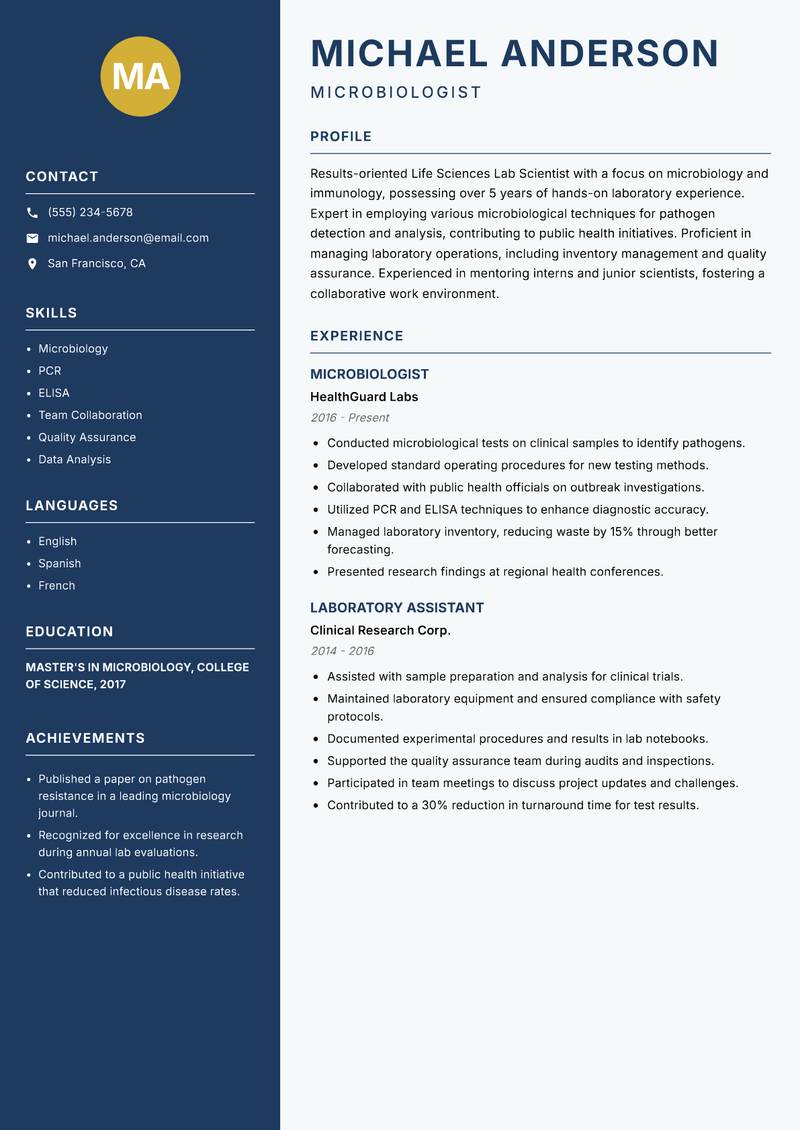
Classic Clean
Use Template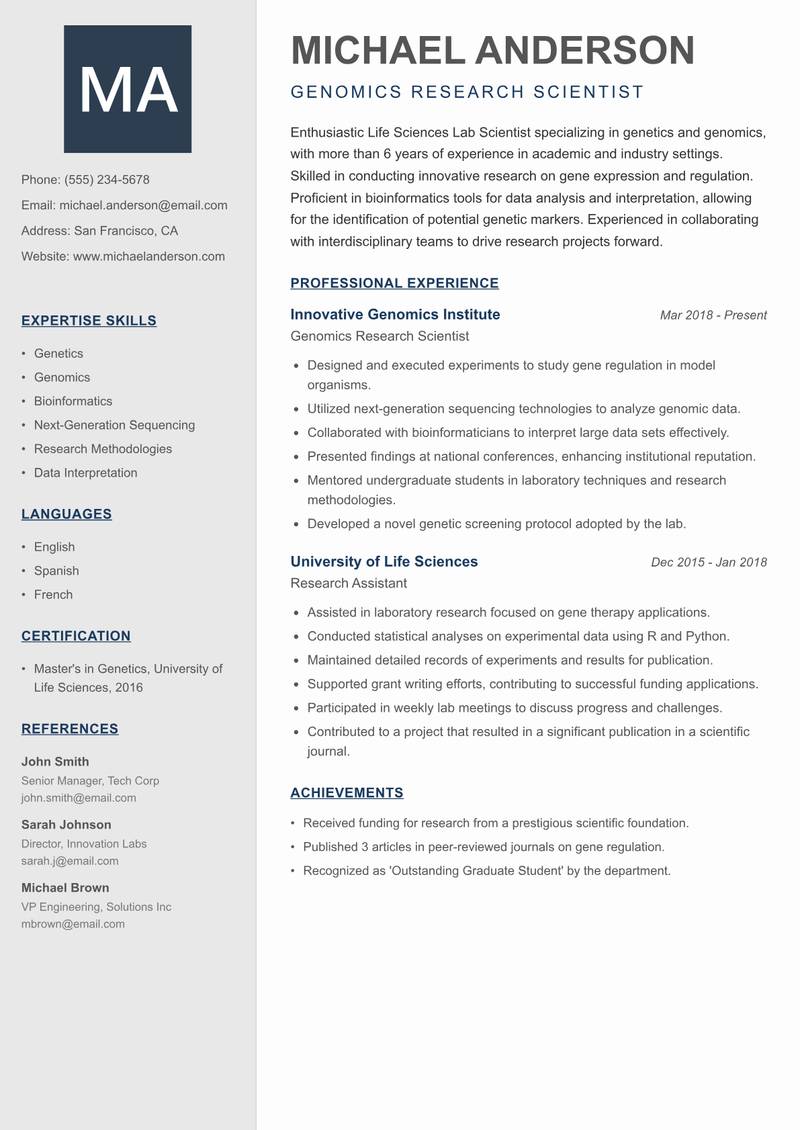
Creative Minimal
Use Template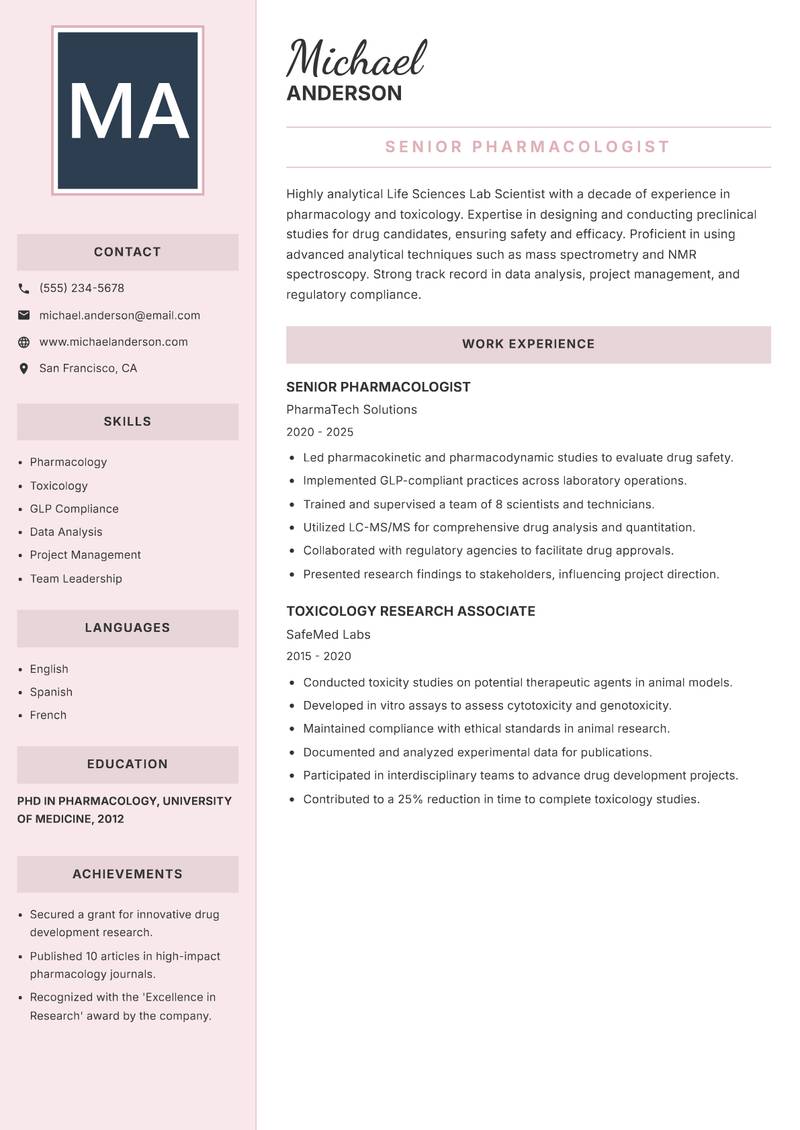
Executive
Use Template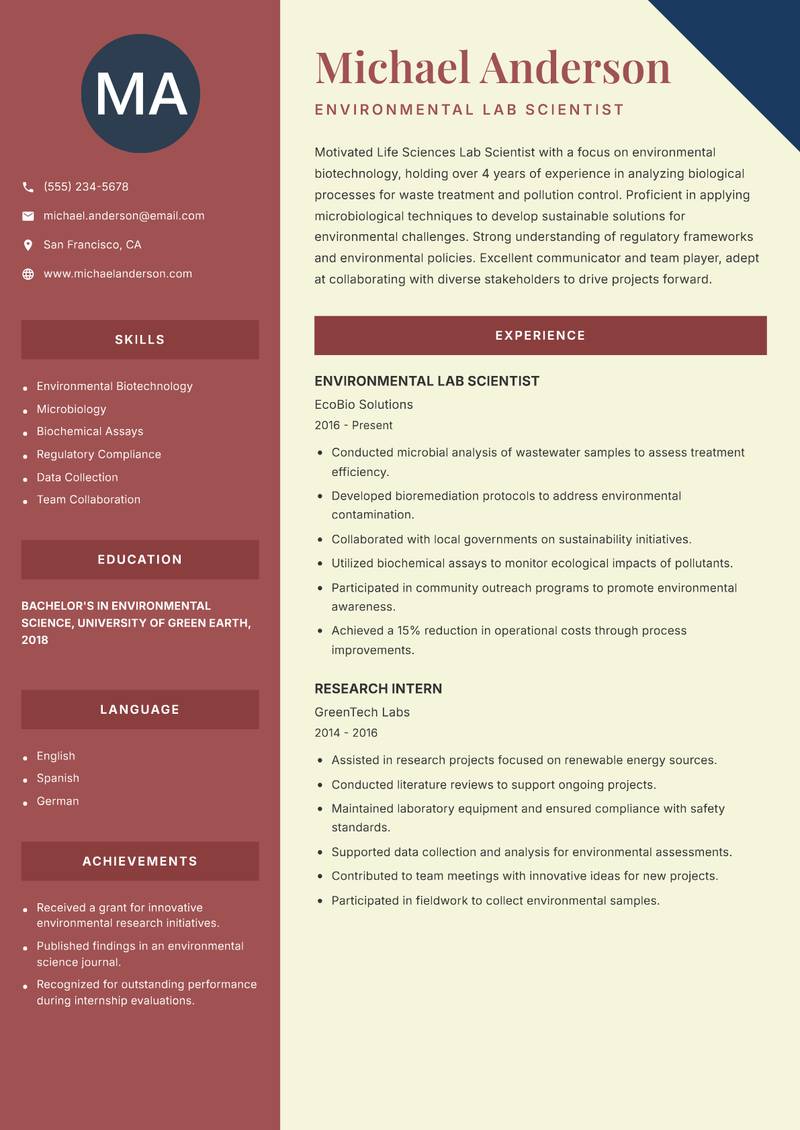
Two Column
Use Template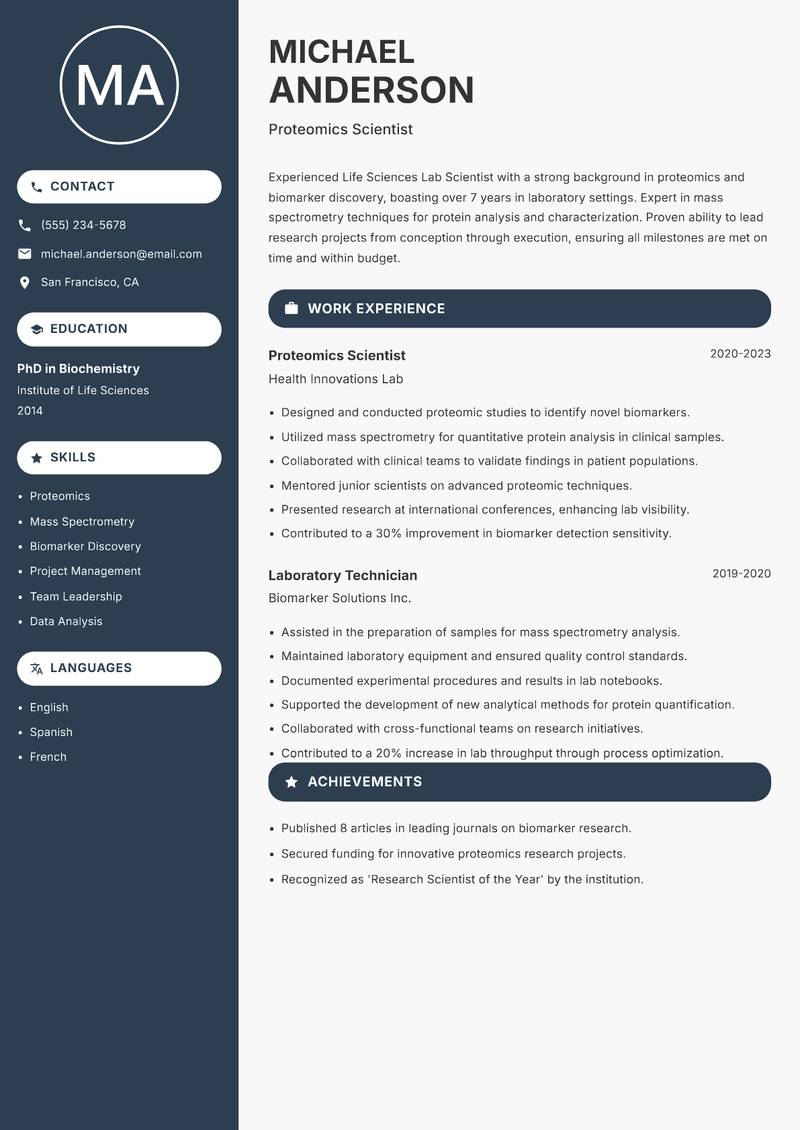
Compact
Use Template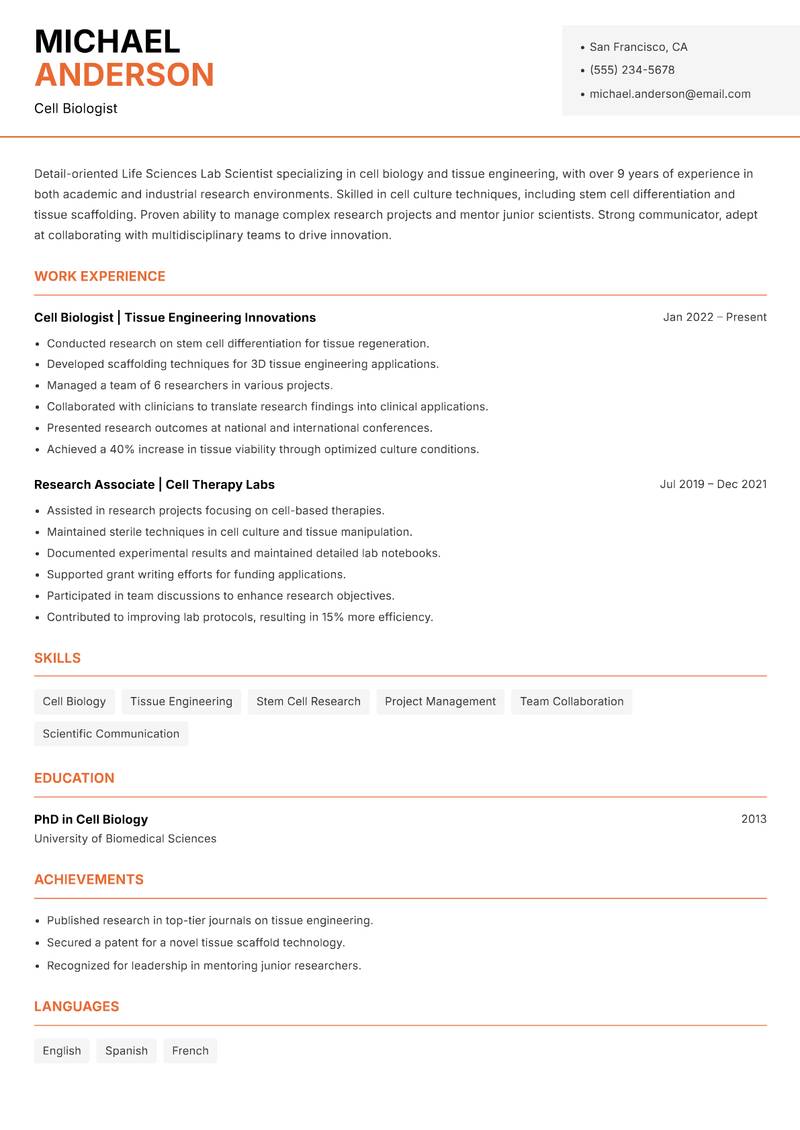
Modern Professional
Use Template7 Real Life Sciences Lab Scientist Resume Examples
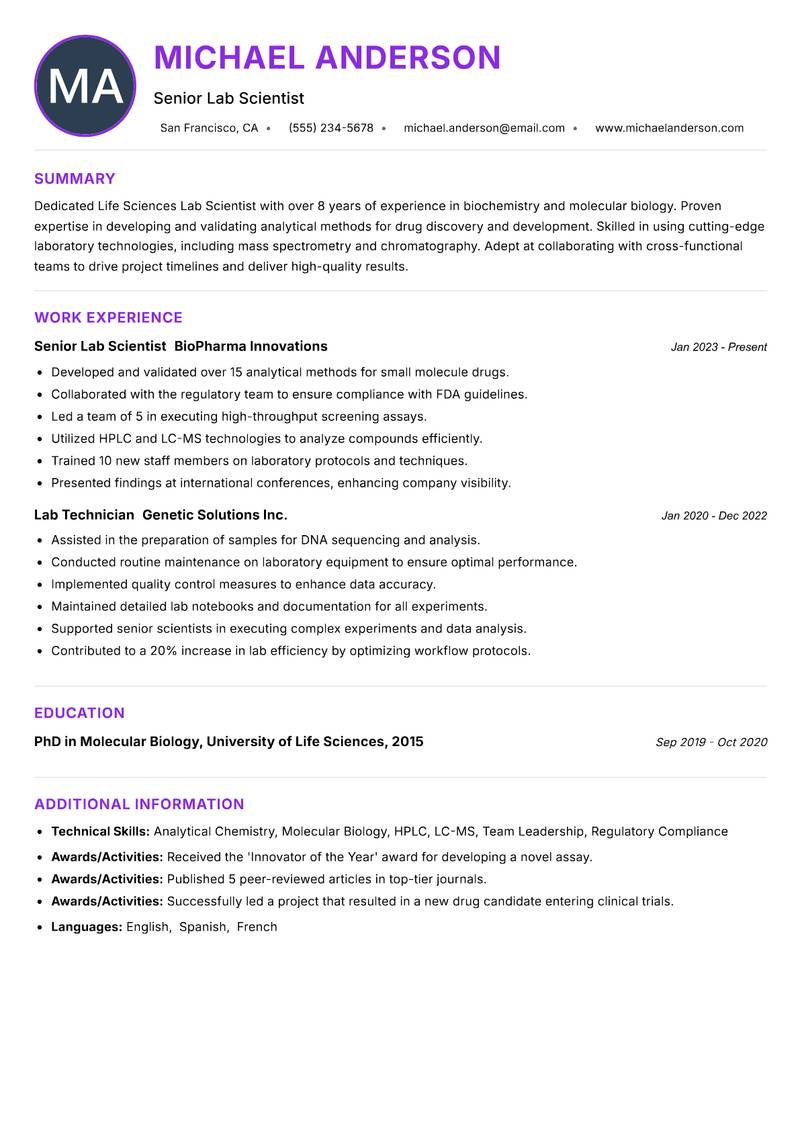
Senior Lab Scientist with 8+ Years Experience
Summary: Dedicated Life Sciences Lab Scientist with over 8 years of experience in biochemistry and molecular biology. Proven expertise in developing and validating analytical methods for drug discovery and development. Skilled in using cutting-edge laboratory technologies, including mass spectrometry and chromatography. Adept at collaborating with cross-functional teams to drive project timelines and deliver high-quality results. Committed to maintaining compliance with industry regulations and laboratory safety protocols. Strong background in training junior scientists and conducting workshops to enhance team capabilities. Passionate about advancing scientific research to improve patient outcomes and contribute to the healthcare sector.
Description:
- Developed and validated over 15 analytical methods for small molecule drugs.
- Collaborated with the regulatory team to ensure compliance with FDA guidelines.
- Led a team of 5 in executing high-throughput screening assays.
- Utilized HPLC and LC-MS technologies to analyze compounds efficiently.
- Trained 10 new staff members on laboratory protocols and techniques.
- Presented findings at international conferences, enhancing company visibility.
🏆 Key Achievements
Microbiologist with 5+ Years Experience
Summary: Accomplished Life Sciences Lab Scientist with a focus on microbiology and immunology, possessing over 5 years of hands-on laboratory experience. Expert in employing various microbiological techniques for pathogen detection and analysis, contributing to public health initiatives. Proficient in managing laboratory operations, including inventory management and quality assurance. Experienced in mentoring interns and junior scientists, fostering a collaborative work environment. Strong analytical and problem-solving skills, with a keen ability to interpret complex data sets. Eager to leverage expertise to support research and development in a dynamic laboratory setting.
Description:
- Conducted microbiological tests on clinical samples to identify pathogens.
- Developed standard operating procedures for new testing methods.
- Collaborated with public health officials on outbreak investigations.
- Utilized PCR and ELISA techniques to enhance diagnostic accuracy.
- Managed laboratory inventory, reducing waste by 15% through better forecasting.
- Presented research findings at regional health conferences.
🏆 Key Achievements
Genomics Research Scientist with 6+ Years Experience
Summary: Enthusiastic Life Sciences Lab Scientist specializing in genetics and genomics, with more than 6 years of experience in academic and industry settings. Skilled in conducting innovative research on gene expression and regulation. Proficient in bioinformatics tools for data analysis and interpretation, allowing for the identification of potential genetic markers. Experienced in collaborating with interdisciplinary teams to drive research projects forward. Committed to fostering an inclusive lab culture that promotes learning and growth. Adept at presenting complex information clearly and engagingly to diverse audiences.
Description:
- Designed and executed experiments to study gene regulation in model organisms.
- Utilized next-generation sequencing technologies to analyze genomic data.
- Collaborated with bioinformaticians to interpret large data sets effectively.
- Presented findings at national conferences, enhancing institutional reputation.
- Mentored undergraduate students in laboratory techniques and research methodologies.
- Developed a novel genetic screening protocol adopted by the lab.
🏆 Key Achievements
Senior Pharmacologist with 10+ Years Experience
Summary: Highly analytical Life Sciences Lab Scientist with a decade of experience in pharmacology and toxicology. Expertise in designing and conducting preclinical studies for drug candidates, ensuring safety and efficacy. Proficient in using advanced analytical techniques such as mass spectrometry and NMR spectroscopy. Strong track record in data analysis, project management, and regulatory compliance. A collaborative leader, skilled in mentoring team members and fostering a culture of continuous improvement. Passionate about advancing pharmaceutical research to improve therapeutic outcomes for patients.
Description:
- Led pharmacokinetic and pharmacodynamic studies to evaluate drug safety.
- Implemented GLP-compliant practices across laboratory operations.
- Trained and supervised a team of 8 scientists and technicians.
- Utilized LC-MS/MS for comprehensive drug analysis and quantitation.
- Collaborated with regulatory agencies to facilitate drug approvals.
- Presented research findings to stakeholders, influencing project direction.
🏆 Key Achievements
Environmental Lab Scientist with 4+ Years Experience
Summary: Driven Life Sciences Lab Scientist with a focus on environmental biotechnology, holding over 4 years of experience in analyzing biological processes for waste treatment and pollution control. Proficient in applying microbiological techniques to develop sustainable solutions for environmental challenges. Strong understanding of regulatory frameworks and environmental policies. Excellent communicator and team player, adept at collaborating with diverse stakeholders to drive projects forward. Committed to promoting sustainability and innovation in the life sciences sector.
Description:
- Conducted microbial analysis of wastewater samples to assess treatment efficiency.
- Developed bioremediation protocols to address environmental contamination.
- Collaborated with local governments on sustainability initiatives.
- Utilized biochemical assays to monitor ecological impacts of pollutants.
- Participated in community outreach programs to promote environmental awareness.
- Achieved a 15% reduction in operational costs through process improvements.
🏆 Key Achievements
Proteomics Scientist with 7+ Years Experience
Summary: Experienced Life Sciences Lab Scientist with a strong background in proteomics and biomarker discovery, boasting over 7 years in laboratory settings. Expert in mass spectrometry techniques for protein analysis and characterization. Proven ability to lead research projects from conception through execution, ensuring all milestones are met on time and within budget. Excellent communicator, able to convey complex scientific concepts to non-technical stakeholders. Passionate about leveraging scientific research to drive innovation in healthcare and improve patient care.
Description:
- Designed and conducted proteomic studies to identify novel biomarkers.
- Utilized mass spectrometry for quantitative protein analysis in clinical samples.
- Collaborated with clinical teams to validate findings in patient populations.
- Mentored junior scientists on advanced proteomic techniques.
- Presented research at international conferences, enhancing lab visibility.
- Contributed to a 30% improvement in biomarker detection sensitivity.
🏆 Key Achievements
Cell Biologist with 9+ Years Experience
Summary: Detail-oriented Life Sciences Lab Scientist specializing in cell biology and tissue engineering, with over 9 years of experience in both academic and industrial research environments. Skilled in cell culture techniques, including stem cell differentiation and tissue scaffolding. Proven ability to manage complex research projects and mentor junior scientists. Strong communicator, adept at collaborating with multidisciplinary teams to drive innovation. Committed to advancing scientific knowledge and improving therapeutic solutions through research and development.
Description:
- Conducted research on stem cell differentiation for tissue regeneration.
- Developed scaffolding techniques for 3D tissue engineering applications.
- Managed a team of 6 researchers in various projects.
- Collaborated with clinicians to translate research findings into clinical applications.
- Presented research outcomes at national and international conferences.
- Achieved a 40% increase in tissue viability through optimized culture conditions.
🏆 Key Achievements
Key Skills for Life Sciences Lab Scientist
ATS Optimization Tips
Increase your chances of getting hired
Use Standard Headings
Use common section titles like Experience, Skills, etc.
Include Keywords
Add role-specific keywords from the job description
Keep it Simple
Avoid complex tables, images and graphics
Save in Right Format
Use PDF format unless otherwise specified
Life Sciences Lab Scientist Salary Insights
Average Salary
$85,000
per year
Salary Range
$60,000 - $110,000
per year
Top Paying Cities
Los Angeles, Seattle, Houston, Dallas, Boston
Source: Glassdoor, Payscale, Indeed (Updated April 2025)
Everything you need to write a great Life Sciences Lab Scientist resume
Strong Action Verbs to Use
Resume Writing Tips
- →Focus on specific laboratory skills relevant to the role, such as experience with PCR, ELISA, and Western blot techniques.
- →Highlight contributions to publications or presentations, showcasing your impact in scientific discourse.
- →Customize your resume for each job application to reflect keywords from the job description, making sure to include relevant ATS tags.
- →Quantify your achievements where possible, such as 'increased throughput by 20% through optimized protocol development.'
- →Include a section dedicated to ongoing education or professional development workshops related to life sciences.
Common Mistakes to Avoid
- ✕Listing overly generic skills that don't reflect the specialized tools or methods used in life sciences.
- ✕Failing to include specific examples of experiments or projects that illustrate your expertise and results achieved.
- ✕Neglecting to demonstrate your ability to work collaboratively in a lab setting or communicate findings effectively.
- ✕Omitting certifications that are industry-specific and relevant to the life sciences field.
ATS Keywords for Life Sciences Lab Scientist
Life Sciences Lab Scientist Career Path
Relevant Certifications
Career Progression
Entry-Level Lab Technician
Assist in basic laboratory procedures under supervision, including sample preparation and routine maintenance of lab equipment.
Life Sciences Lab Scientist
Conduct experiments, analyze data, and interpret results within specialized fields such as molecular biology or biochemistry.
Senior Research Scientist
Lead research projects, oversee lab teams, and develop innovative methodologies to enhance experimental outcomes.
Laboratory Manager
Manage laboratory operations including staff supervision, budget allocation, and compliance with regulatory standards.
Director of Research and Development
Strategically guide research initiatives, collaborating with cross-functional teams to promote advancements in scientific knowledge.
Life Sciences Lab Scientist Interview Questions
What laboratory techniques are you most experienced with and how have you applied them? +
Highlight specific methodologies, focusing on your practical experiences and outcomes.
Can you describe a challenging experiment you conducted and what the results taught you? +
Discuss the complexities faced and how you overcame them to reach conclusions.
How do you ensure compliance with ethical standards in a laboratory setting? +
Share your understanding of the regulatory environment and your practices to uphold ethical research.
What steps do you take when analyzing data and reporting results? +
Walk through your data processing techniques from initial analysis to interpretation and final reporting.
How do you prioritize tasks in a fast-paced lab environment? +
Illustrate your time management skills and how you juggle multiple projects simultaneously.
What tools and software do you use for data analysis in your research? +
Mention specific software tools (ex. SPSS, R, LabVIEW) relevant to life sciences research.
Discuss a time when you had to collaborate with a multidisciplinary team. What role did you play? +
Provide examples of team projects and your contributions that led to successful outcomes.
How do you stay current with advancements in life sciences? +
Explain your continued educational efforts such as attending workshops, reading journals, or participating in seminars.
About the Life Sciences Lab Scientist Role
Daily life as a Life Sciences Lab Scientist revolves around executing complex experiments that contribute to scientific innovations in healthcare and pharmaceuticals. The role necessitates a solid grasp of biochemical and molecular techniques, as well as adeptness at interpreting data to provide insight into biological processes. Collaboration with fellow scientists and stakeholders in related fields is crucial, ensuring that research objectives align with industry standards and patient needs.
Frequently Asked Questions
View all →What is the average work environment like for a Life Sciences Lab Scientist? +
Life Sciences Lab Scientists typically work in laboratory settings, which may vary from high-tech labs in commercial biotech firms to academic research institutions. The environment is often collaborative, fast-paced, and may involve strict adherence to safety and ethical protocols.
What industries employ Life Sciences Lab Scientists? +
Life Sciences Lab Scientists are commonly employed in biotechnology, pharmaceutical companies, academic institutions, and government research laboratories.
What is the most critical skill for a Life Sciences Lab Scientist? +
A proficiency in analytical techniques and a keen attention to detail are crucial for success in this role, as they directly affect the quality and reliability of experimental results.
What advancement opportunities exist for Life Sciences Lab Scientists? +
With experience, a Lab Scientist can progress to senior scientist roles, laboratory management, or even leadership positions in research and development.
Is a graduate degree necessary for a Life Sciences Lab Scientist? +
While many positions require at least a bachelor's degree in a relevant field, advanced roles may prefer candidates with a master's or doctorate.
How significant is teamwork in this role? +
Team collaboration is essential, as Lab Scientists often work in multidisciplinary teams to drive research projects and achieve common goals.
What types of projects might a Life Sciences Lab Scientist undertake? +
Projects can range from fundamental research in cellular biology to applied studies developing new diagnostic tests or therapies for diseases.
More Resume Examples You Might Like
Related Career Paths
Other roles candidates for Life Sciences Lab Scientist positions often also consider.
Will this Life Sciences Lab Scientist resume pass the ATS scan?
Upload it and get an instant AI-scored compatibility check with specific fixes.
Check My Resume →
Pair it with a matching cover letter
AI drafts a first version from your job title and strengths — edit it live, then download the PDF.
Write My Cover Letter →
Written by Nohaya Career Team
Reviewed by HR Professionals · Updated April 2025
Ready to Build Your Perfect Resume?
Choose from 1000+ professional templates and land your dream job.
Create My Resume Now