Build an ATS-Friendly
Botanist Resume
That Gets Interviews
The role of a botanist encompasses extensive fieldwork where precise observations of plant habitats and ecosystems are paramount. Engaging with local flora, a botanist conducts rigorous experiments to explore plant physiology and environmental interactions, contributing to both academic research and practical…
Botanist Resume Templates
Modern Professional
Use Template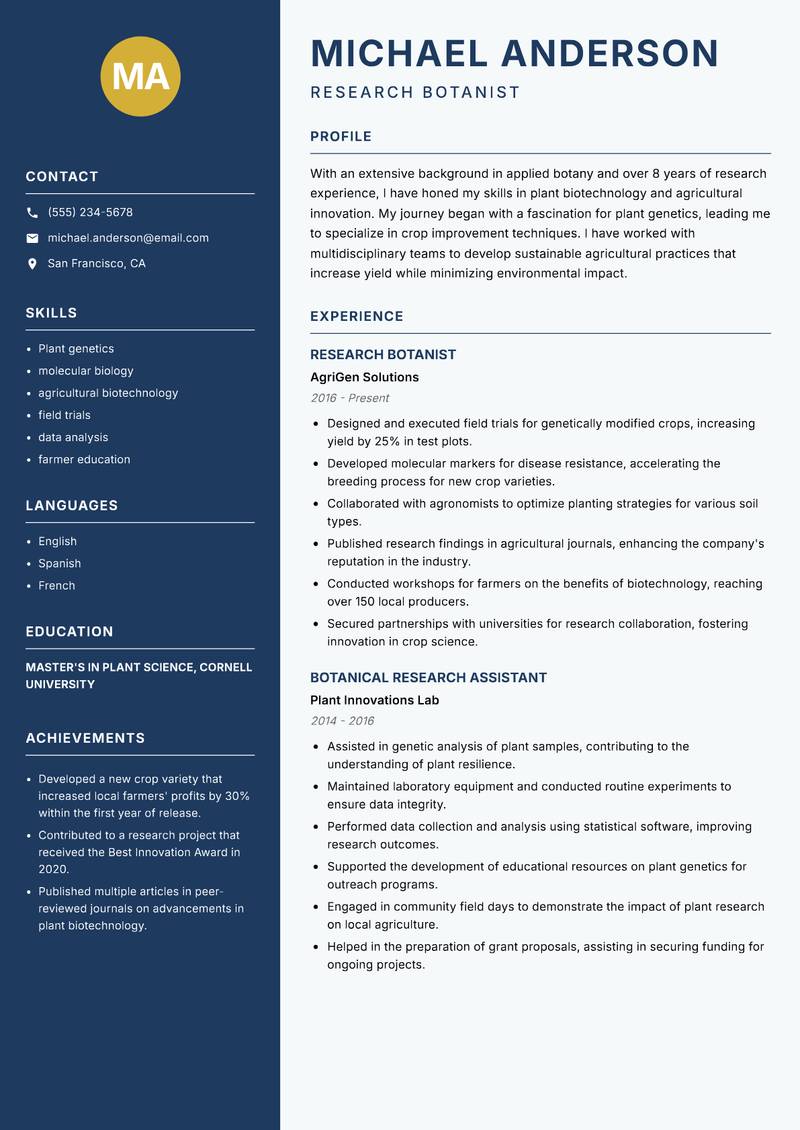
Classic Clean
Use Template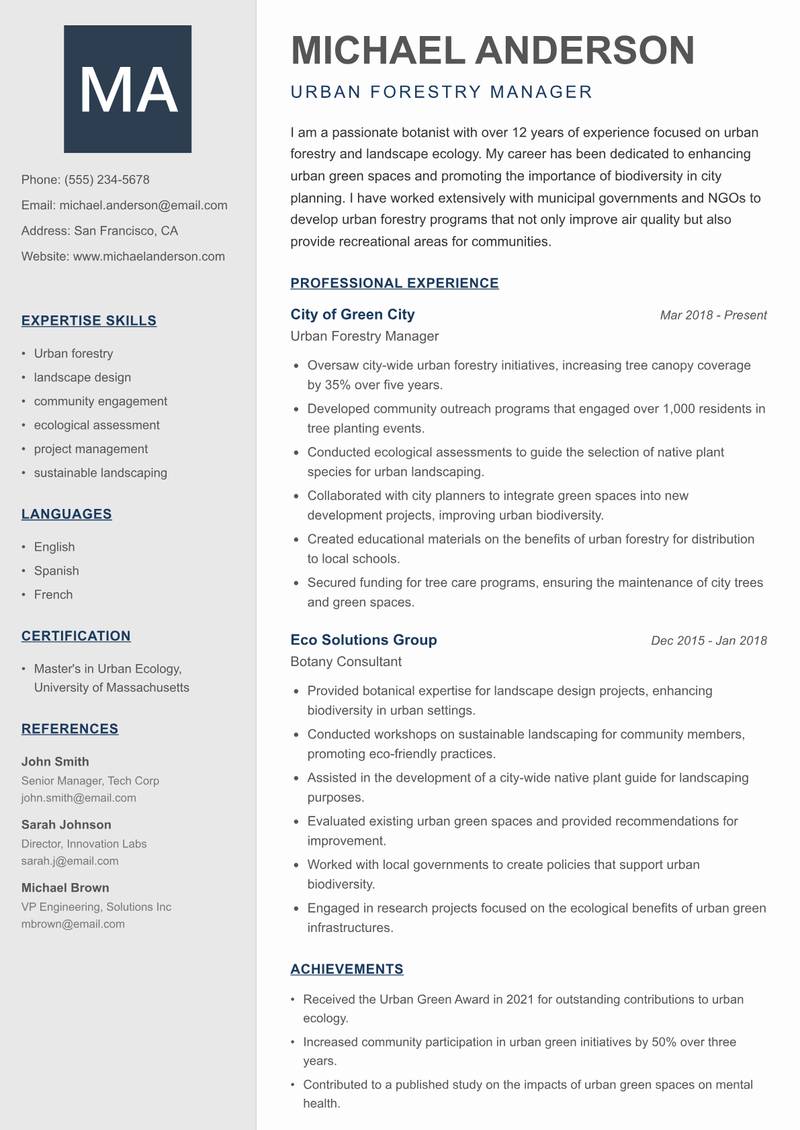
Creative Minimal
Use Template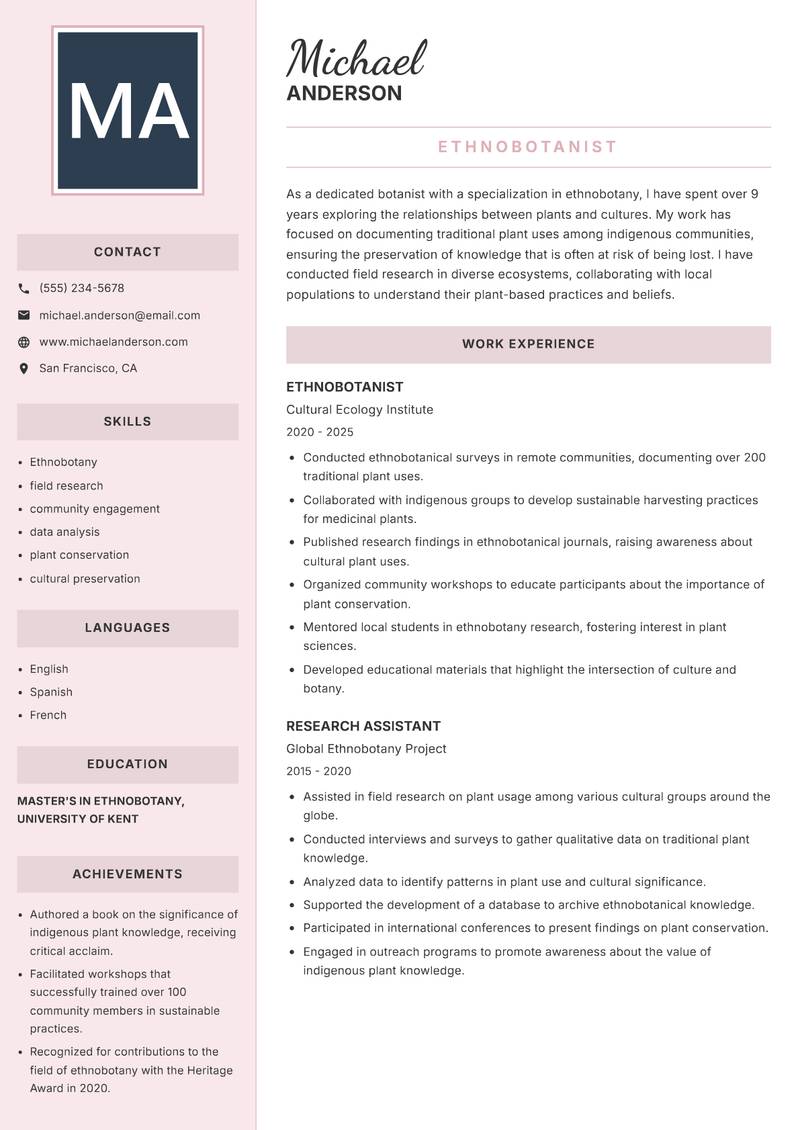
Executive
Use Template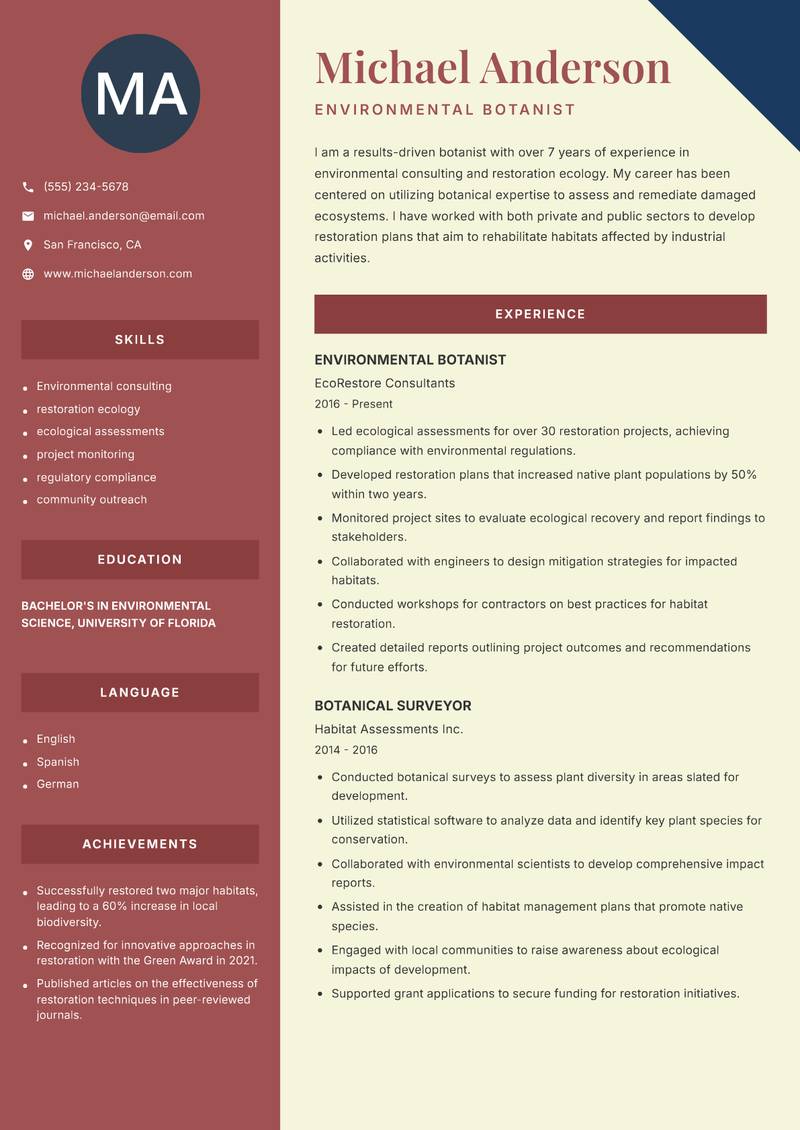
Two Column
Use Template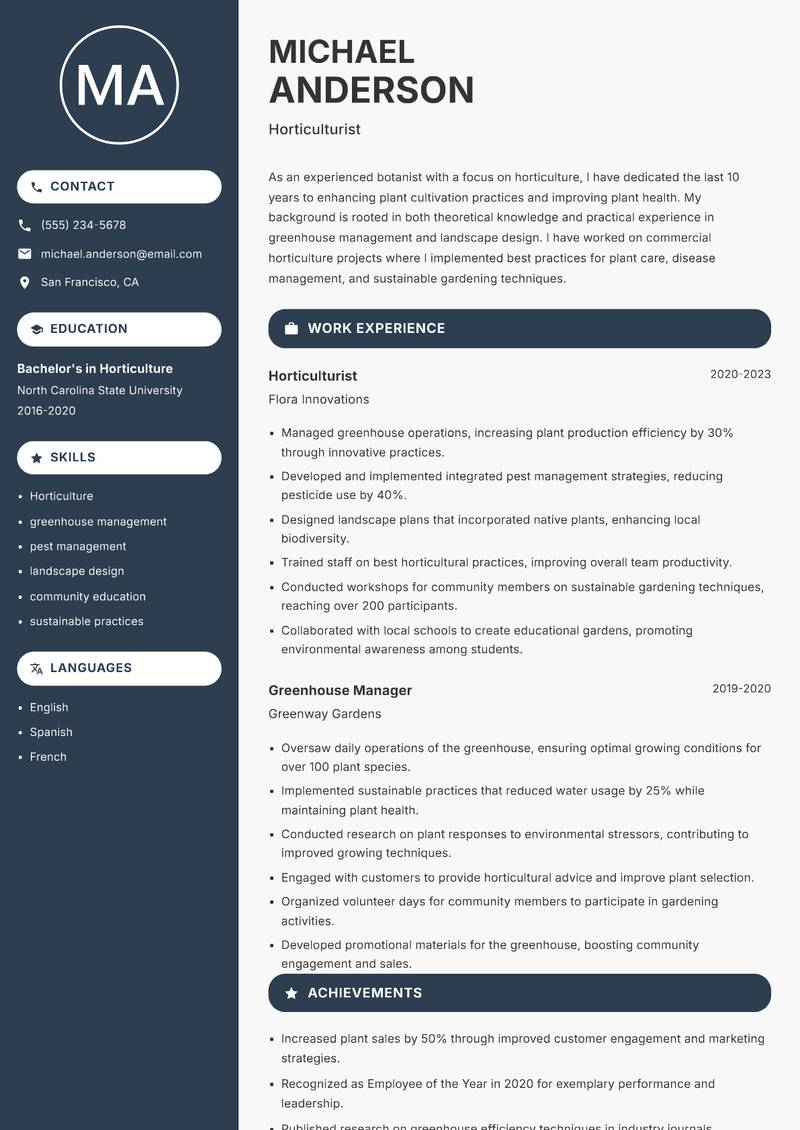
Compact
Use Template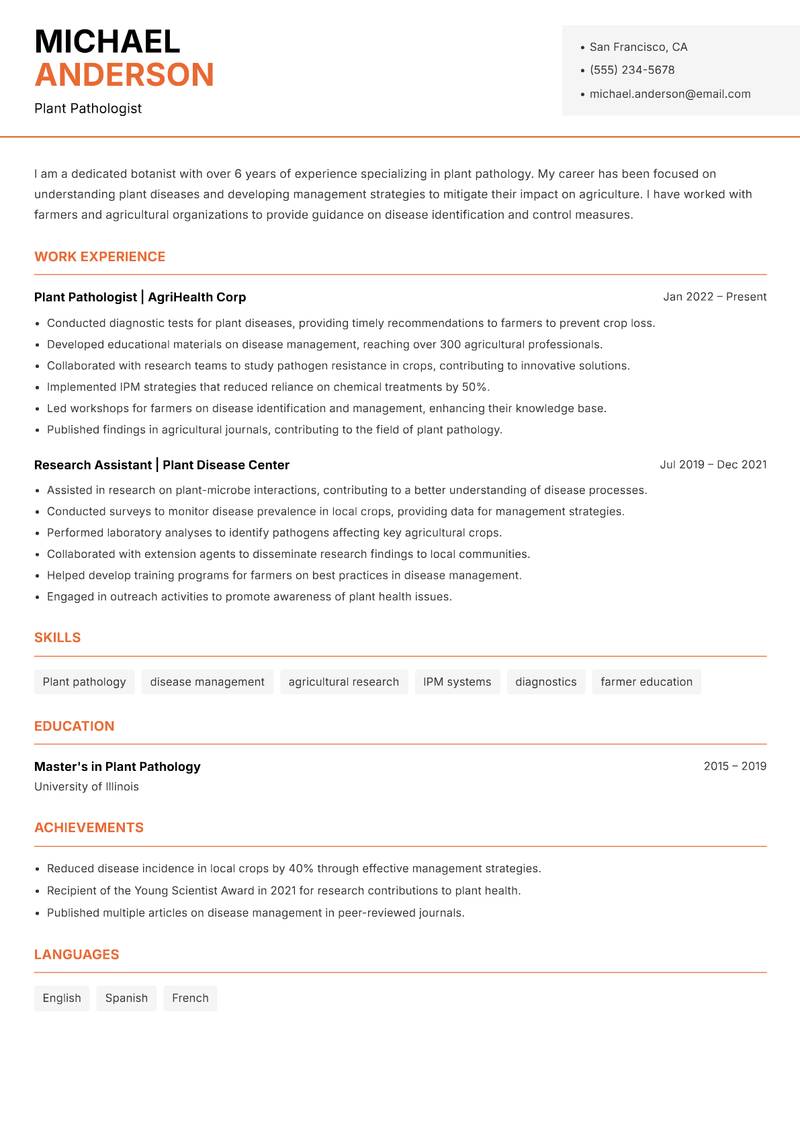
Modern Professional
Use Template7 Real Botanist Resume Examples
Senior Botanist with 11+ Years Experience
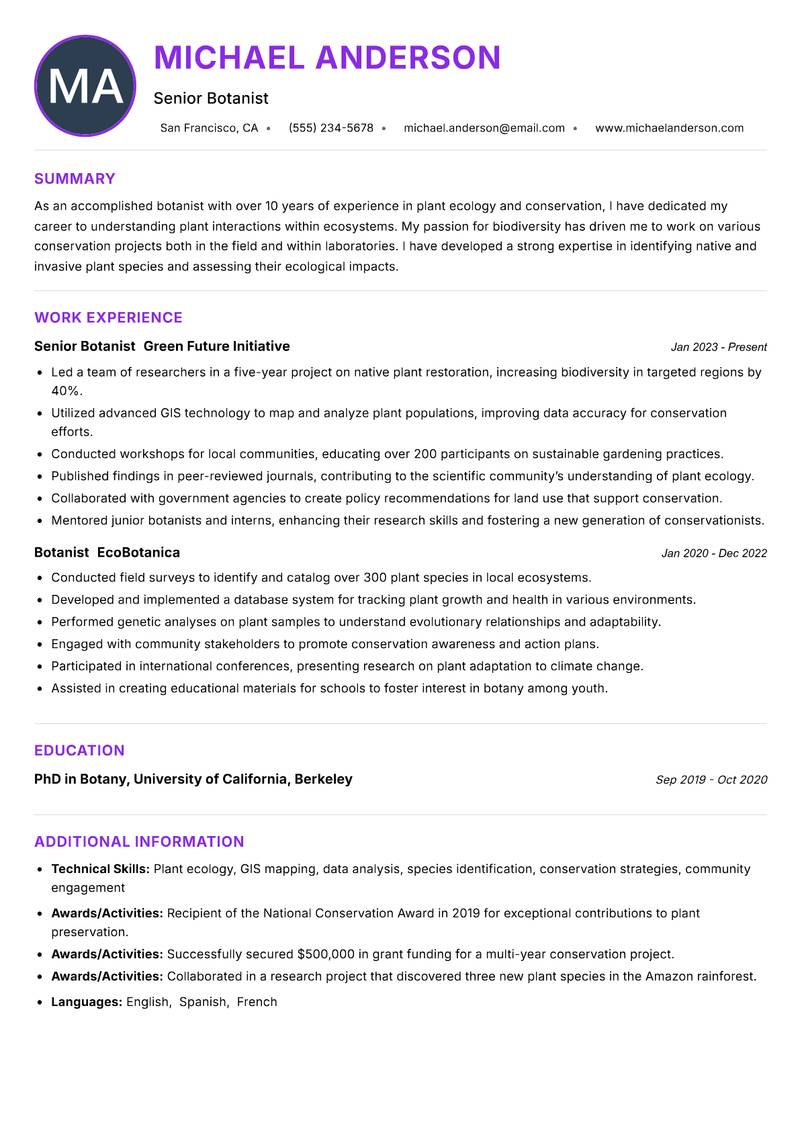
Summary: As an accomplished botanist with over 10 years of experience in plant ecology and conservation, I have dedicated my career to understanding plant interactions within ecosystems. My passion for biodiversity has driven me to work on various conservation projects both in the field and within laboratories. I have developed a strong expertise in identifying native and invasive plant species and assessing their ecological impacts. My role has often involved collaborating with interdisciplinary teams to achieve project goals, including habitat restoration and sustainable land management. I possess extensive knowledge of plant physiology and genetics, which I have applied in research settings to help develop strategies for preserving endangered species. With a solid background in data analysis and GIS mapping, I excel in translating complex ecological data into actionable insights. I aim to contribute to global efforts to combat climate change through innovative botanical research and education. Continuous learning and adaptation to new methodologies have been key in my career, and I am eager to bring my skills to new challenges in the field of botany.
Description:
- Led a team of researchers in a five-year project on native plant restoration, increasing biodiversity in targeted regions by 40%.
- Utilized advanced GIS technology to map and analyze plant populations, improving data accuracy for conservation efforts.
- Conducted workshops for local communities, educating over 200 participants on sustainable gardening practices.
- Published findings in peer-reviewed journals, contributing to the scientific community’s understanding of plant ecology.
- Collaborated with government agencies to create policy recommendations for land use that support conservation.
- Mentored junior botanists and interns, enhancing their research skills and fostering a new generation of conservationists.
🏆 Key Achievements
Research Botanist with 8+ Years Experience
Summary: With an extensive background in applied botany and over 8 years of research experience, I have honed my skills in plant biotechnology and agricultural innovation. My journey began with a fascination for plant genetics, leading me to specialize in crop improvement techniques. I have worked with multidisciplinary teams to develop sustainable agricultural practices that increase yield while minimizing environmental impact. Proficient in molecular biology techniques, I have successfully engineered plant varieties that are resistant to pests and diseases, benefiting farmers and contributing to food security. My work often involves field trials and laboratory experiments, where I analyze plant responses to various environmental stresses. I believe in the importance of bridging the gap between scientific research and practical applications, ensuring that advancements in botany translate into real-world benefits. I am committed to continuous learning and professional development, and I am excited about the potential to innovate in the field of sustainable agriculture.
Description:
- Designed and executed field trials for genetically modified crops, increasing yield by 25% in test plots.
- Developed molecular markers for disease resistance, accelerating the breeding process for new crop varieties.
- Collaborated with agronomists to optimize planting strategies for various soil types.
- Published research findings in agricultural journals, enhancing the company's reputation in the industry.
- Conducted workshops for farmers on the benefits of biotechnology, reaching over 150 local producers.
- Secured partnerships with universities for research collaboration, fostering innovation in crop science.
🏆 Key Achievements
Urban Forestry Manager with 12+ Years Experience
Summary: I am a passionate botanist with over 12 years of experience focused on urban forestry and landscape ecology. My career has been dedicated to enhancing urban green spaces and promoting the importance of biodiversity in city planning. I have worked extensively with municipal governments and NGOs to develop urban forestry programs that not only improve air quality but also provide recreational areas for communities. My expertise lies in selecting appropriate plant species that thrive in urban environments, conducting ecological assessments, and implementing sustainable landscaping practices. I have a strong background in community engagement, often leading workshops and educational programs to raise awareness about the benefits of urban green spaces. My goal is to create livable cities that prioritize ecological health while enhancing the quality of life for residents. I believe in the power of collaboration and have successfully partnered with architects and city planners to integrate green solutions into urban development projects.
Description:
- Oversaw city-wide urban forestry initiatives, increasing tree canopy coverage by 35% over five years.
- Developed community outreach programs that engaged over 1,000 residents in tree planting events.
- Conducted ecological assessments to guide the selection of native plant species for urban landscaping.
- Collaborated with city planners to integrate green spaces into new development projects, improving urban biodiversity.
- Created educational materials on the benefits of urban forestry for distribution to local schools.
- Secured funding for tree care programs, ensuring the maintenance of city trees and green spaces.
🏆 Key Achievements
Ethnobotanist with 9+ Years Experience
Summary: As a dedicated botanist with a specialization in ethnobotany, I have spent over 9 years exploring the relationships between plants and cultures. My work has focused on documenting traditional plant uses among indigenous communities, ensuring the preservation of knowledge that is often at risk of being lost. I have conducted field research in diverse ecosystems, collaborating with local populations to understand their plant-based practices and beliefs. My aim is to bridge the gap between scientific research and traditional knowledge, promoting sustainable practices that honor cultural heritage. I have published several articles on the importance of plant conservation and the role of indigenous knowledge in modern science. My passion for education has led me to create programs that teach about the benefits of biodiversity and the significance of plants in cultural practices. I believe in empowering communities through knowledge and fostering respect for their traditional ecological wisdom.
Description:
- Conducted ethnobotanical surveys in remote communities, documenting over 200 traditional plant uses.
- Collaborated with indigenous groups to develop sustainable harvesting practices for medicinal plants.
- Published research findings in ethnobotanical journals, raising awareness about cultural plant uses.
- Organized community workshops to educate participants about the importance of plant conservation.
- Mentored local students in ethnobotany research, fostering interest in plant sciences.
- Developed educational materials that highlight the intersection of culture and botany.
🏆 Key Achievements
Environmental Botanist with 7+ Years Experience
Summary: I am a results-driven botanist with over 7 years of experience in environmental consulting and restoration ecology. My career has been centered on utilizing botanical expertise to assess and remediate damaged ecosystems. I have worked with both private and public sectors to develop restoration plans that aim to rehabilitate habitats affected by industrial activities. My work involves conducting ecological assessments, developing site-specific restoration strategies, and monitoring the success of implemented projects. I have a solid understanding of regulatory requirements and have collaborated with stakeholders to ensure compliance throughout the restoration process. My analytical skills allow me to identify ecological impacts and propose effective solutions that enhance biodiversity. I am dedicated to fostering healthy ecosystems and educating communities about the importance of environmental stewardship. I believe that effective communication and collaboration are key to achieving successful restoration outcomes.
Description:
- Led ecological assessments for over 30 restoration projects, achieving compliance with environmental regulations.
- Developed restoration plans that increased native plant populations by 50% within two years.
- Monitored project sites to evaluate ecological recovery and report findings to stakeholders.
- Collaborated with engineers to design mitigation strategies for impacted habitats.
- Conducted workshops for contractors on best practices for habitat restoration.
- Created detailed reports outlining project outcomes and recommendations for future efforts.
🏆 Key Achievements
Horticulturist with 10+ Years Experience
Summary: As an experienced botanist with a focus on horticulture, I have dedicated the last 10 years to enhancing plant cultivation practices and improving plant health. My background is rooted in both theoretical knowledge and practical experience in greenhouse management and landscape design. I have worked on commercial horticulture projects where I implemented best practices for plant care, disease management, and sustainable gardening techniques. My strengths include developing innovative growing systems that maximize yield while minimizing resource use. I thrive in team environments, collaborating with other horticulturists and landscape architects to create sustainable green spaces that are both functional and aesthetically pleasing. I am passionate about educating others about horticultural practices and have led numerous workshops aimed at sharing knowledge with aspiring gardeners and horticulturists. My goal is to continue advancing horticultural practices through research and hands-on experience, promoting environmental sustainability.
Description:
- Managed greenhouse operations, increasing plant production efficiency by 30% through innovative practices.
- Developed and implemented integrated pest management strategies, reducing pesticide use by 40%.
- Designed landscape plans that incorporated native plants, enhancing local biodiversity.
- Trained staff on best horticultural practices, improving overall team productivity.
- Conducted workshops for community members on sustainable gardening techniques, reaching over 200 participants.
- Collaborated with local schools to create educational gardens, promoting environmental awareness among students.
🏆 Key Achievements
Plant Pathologist with 6+ Years Experience
Summary: I am a dedicated botanist with over 6 years of experience specializing in plant pathology. My career has been focused on understanding plant diseases and developing management strategies to mitigate their impact on agriculture. I have worked with farmers and agricultural organizations to provide guidance on disease identification and control measures. My expertise includes conducting research on pathogen-host interactions and implementing integrated pest management (IPM) systems that effectively reduce crop losses. I have a strong background in laboratory techniques and field diagnostics, allowing me to provide accurate assessments and recommendations. I am committed to advancing plant health through education and research, believing that informed practices can lead to sustainable agricultural systems. I strive to communicate complex scientific concepts in an accessible manner, empowering farmers with the knowledge they need to protect their crops.
Description:
- Conducted diagnostic tests for plant diseases, providing timely recommendations to farmers to prevent crop loss.
- Developed educational materials on disease management, reaching over 300 agricultural professionals.
- Collaborated with research teams to study pathogen resistance in crops, contributing to innovative solutions.
- Implemented IPM strategies that reduced reliance on chemical treatments by 50%.
- Led workshops for farmers on disease identification and management, enhancing their knowledge base.
- Published findings in agricultural journals, contributing to the field of plant pathology.
🏆 Key Achievements
Key Skills for Botanist
ATS Optimization Tips
Increase your chances of getting hired
Use Standard Headings
Use common section titles like Experience, Skills, etc.
Include Keywords
Add role-specific keywords from the job description
Keep it Simple
Avoid complex tables, images and graphics
Save in Right Format
Use PDF format unless otherwise specified
Botanist Salary Insights
Average Salary
$70,000
per year
Salary Range
$50,000 - $90,000
per year
Top Paying Cities
Los Angeles, Seattle, Houston, Dallas, Boston
Source: Glassdoor, Payscale, Indeed (Updated April 2025)
Everything you need to write a great Botanist resume
Strong Action Verbs to Use
Resume Writing Tips
- →Emphasize specific field research techniques and tools you have mastered.
- →Highlight any publishing experience in botanical journals to showcase your scholarly contributions.
- →Detail your collaborations with multi-disciplinary teams to illustrate your versatility.
- →Include specific conservation programs or projects you've contributed to, focusing on outcomes.
- →Tailor your skills section to mention both lab and field capabilities relevant to botanist roles.
Common Mistakes to Avoid
- ✕Failing to highlight specific scientific methodologies used in research.
- ✕Omitting details of field experience or environmental impact knowledge.
- ✕Not updating skills related to plant biotechnology or conservation techniques.
- ✕Lack of measurable outcomes in previous work descriptions; quantify wherever possible.
ATS Keywords for Botanist
Botanist Career Path
Career Progression
Entry-Level Botanist
Conducts basic research and field studies while assisting experienced botanists with data collection and analysis.
Botanist
Independently designs and conducts experiments, manages herbarium collections, and analyzes biological data.
Senior Botanist
Leads research projects, supervises teams, and collaborates across departments to inform conservation strategies.
Botanical Consultant
Provides expertise to environmental agencies and NGOs, shaping policy and conservation initiatives.
Research Director
Oversees large research teams and budgets, directing significant projects in plant research and education.
Botanist Interview Questions
Can you describe a specific research project you've worked on and its significance? +
Focus on the project's objectives, methodologies, outcomes, and any unique approaches you took.
How do you handle the identification and classification of new plant species? +
Discuss your process, including fieldwork, laboratory techniques, and any relevant technology.
What techniques do you use for preserving plant specimens? +
Mention specific preservation methods and how they relate to your research.
How do you approach data analysis in your studies? +
Explain your preferred software and methods, including statistical analysis and bioinformatics tools.
Can you provide an example of your collaboration with interdisciplinary teams? +
Highlight your ability to communicate across different scientific fields and share insights.
What are the most challenging aspects of field research for you? +
Be honest about personal experiences and how you overcame these challenges.
About the Botanist Role
The role of a botanist encompasses extensive fieldwork where precise observations of plant habitats and ecosystems are paramount. Engaging with local flora, a botanist conducts rigorous experiments to explore plant physiology and environmental interactions, contributing to both academic research and practical conservation efforts. Collaboration with government agencies, universities, and conservation organizations is essential to ensure that findings inform sustainable practices and policy development.
Frequently Asked Questions
What types of environments do botanists typically work in? +
Botanists often work in diverse settings including forests, wetlands, deserts, and laboratories, depending on their research focus.
What educational background is necessary for a career in botany? +
Most positions require at least a bachelor's degree in botany, biology, or environmental science, with advanced roles often necessitating a master's or Ph.D.
What is the primary focus of a botanist's research? +
A botanist's research may focus on plant taxonomy, ecology, physiology, or conservation, often aiming to preserve plant species and their ecosystems.
How can a botanist affect environmental policies? +
Through research and expertise, botanists provide critical data that can shape conservation policies and sustainable plant management practices.
What technological advancements are impacting botany today? +
Technologies like geographic information systems (GIS), remote sensing, and genetic analysis are transforming how botanists conduct research and conservation efforts.
What opportunities exist for botanists in the private sector? +
Botanists may pursue careers in pharmaceuticals, agriculture, and horticulture, applying their expertise to support product development and environmental sustainability.
More Resume Examples You Might Like
Related Career Paths
Other roles candidates for Botanist positions often also consider.
Will this Botanist resume pass the ATS scan?
Upload it and get an instant AI-scored compatibility check with specific fixes.
Check My Resume →
Pair it with a matching cover letter
AI drafts a first version from your job title and strengths — edit it live, then download the PDF.
Write My Cover Letter →
Written by Nohaya Career Team
Reviewed by HR Professionals · Updated April 2025
Ready to Build Your Perfect Resume?
Choose from 1000+ professional templates and land your dream job.
Create My Resume Now