Build an ATS-Friendly
Computational Biologist Resume
That Gets Interviews
In the dynamic field of life sciences, a Computational Biologist harnesses computational techniques to analyze biological data, bridging the gap between experimental biology and computational analysis. Frequently employing advanced algorithms and statistical methods, these professionals work on genomic sequences,…
Computational Biologist Resume Templates
Modern Professional
Use Template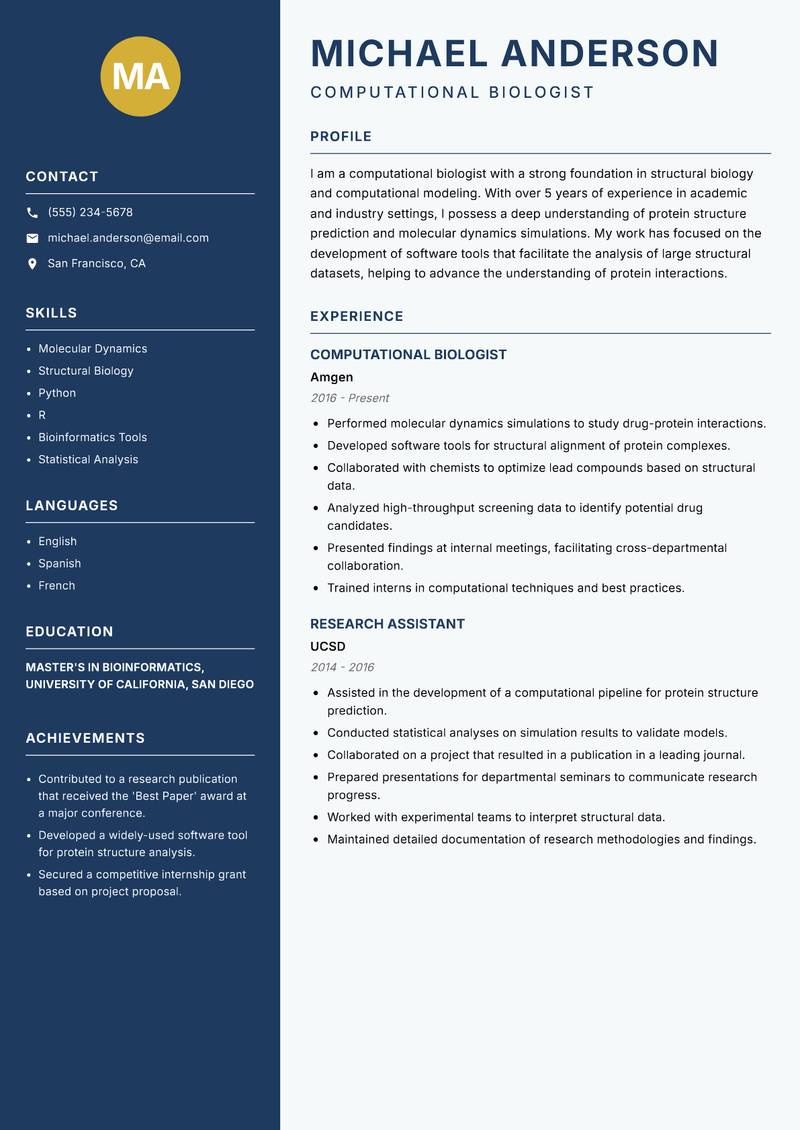
Classic Clean
Use Template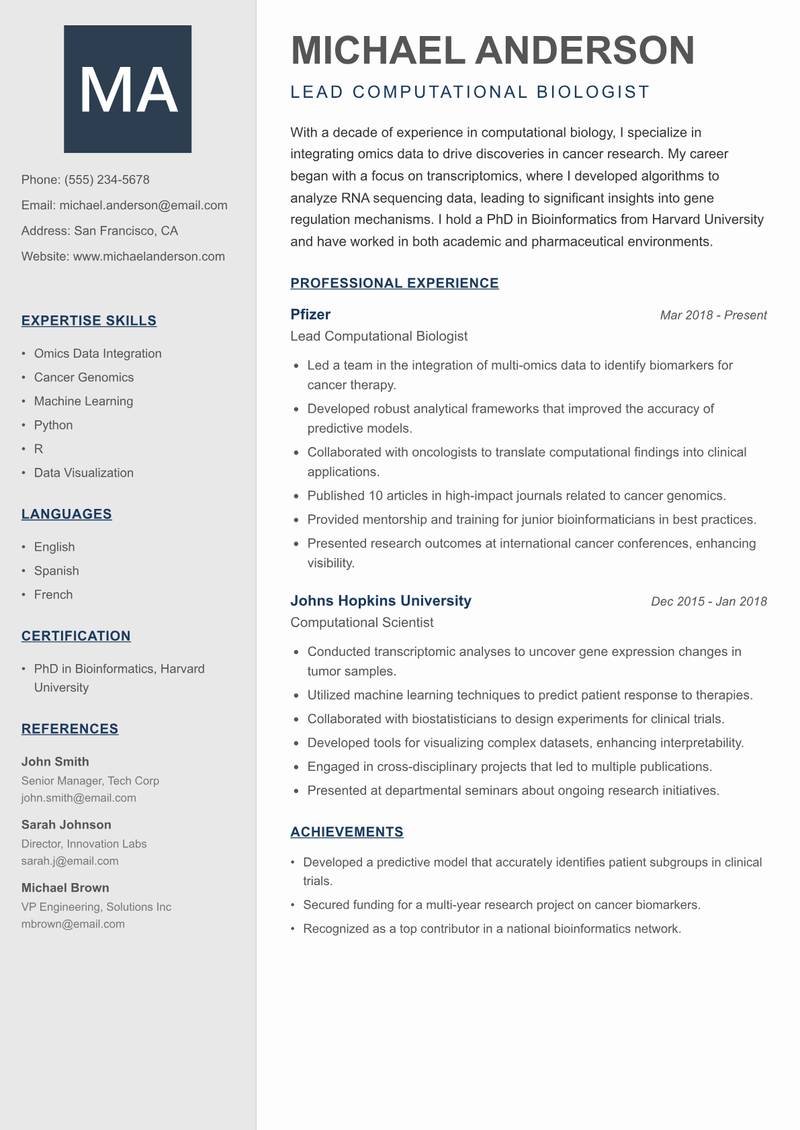
Creative Minimal
Use Template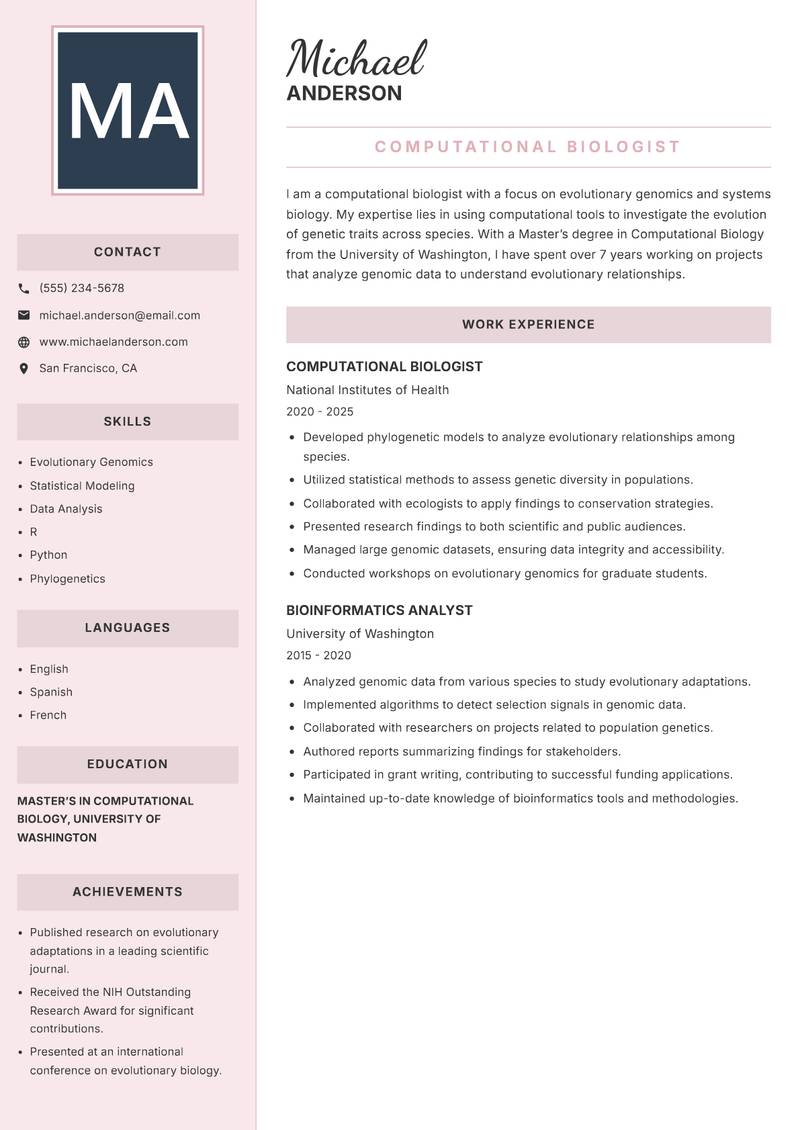
Executive
Use Template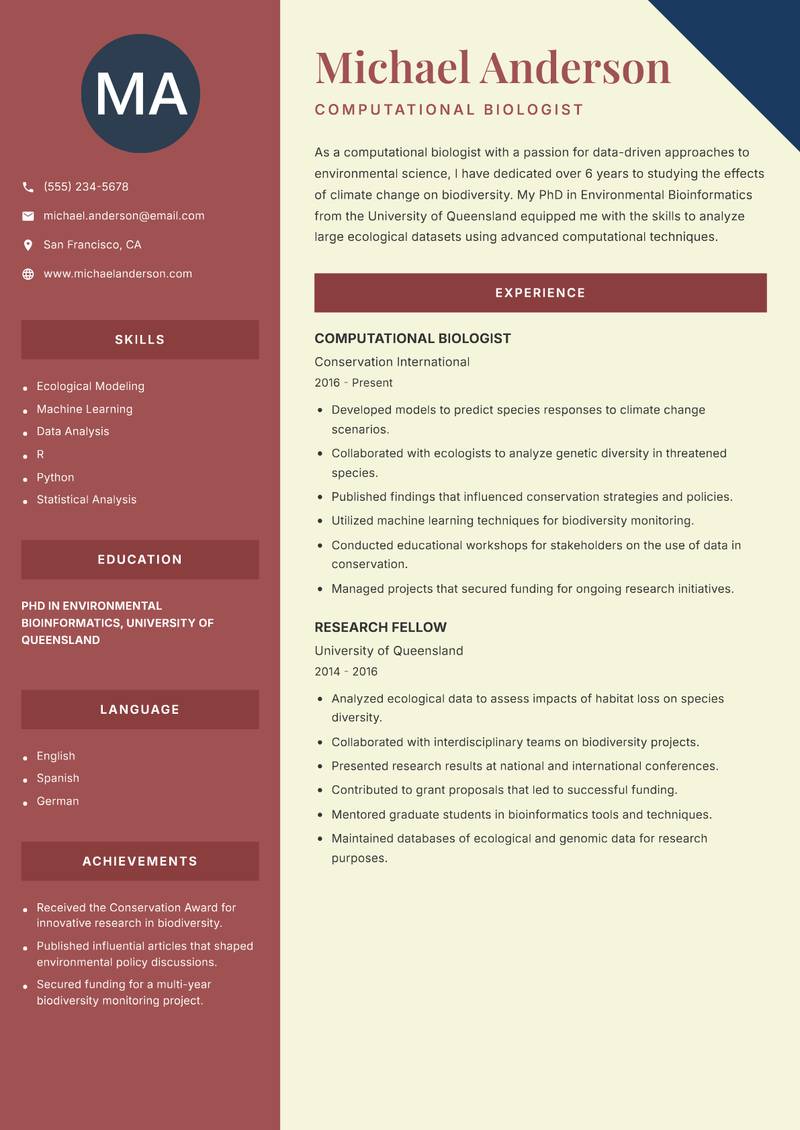
Two Column
Use Template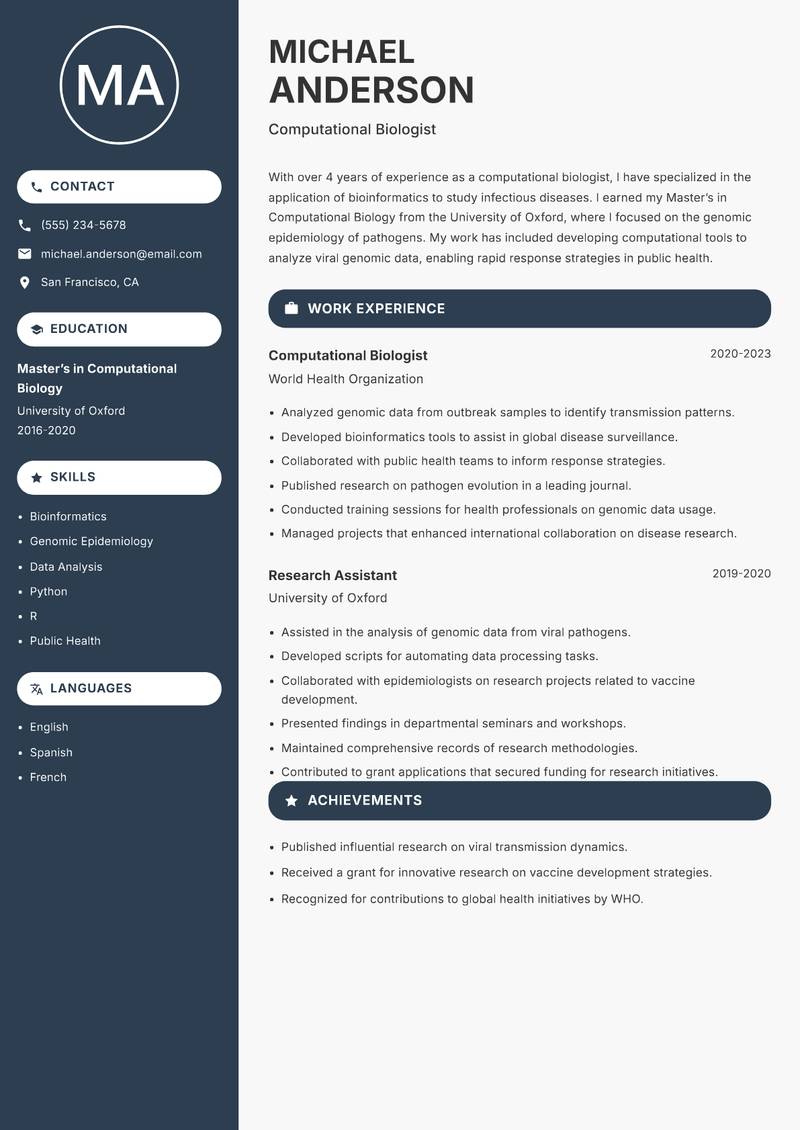
Compact
Use Template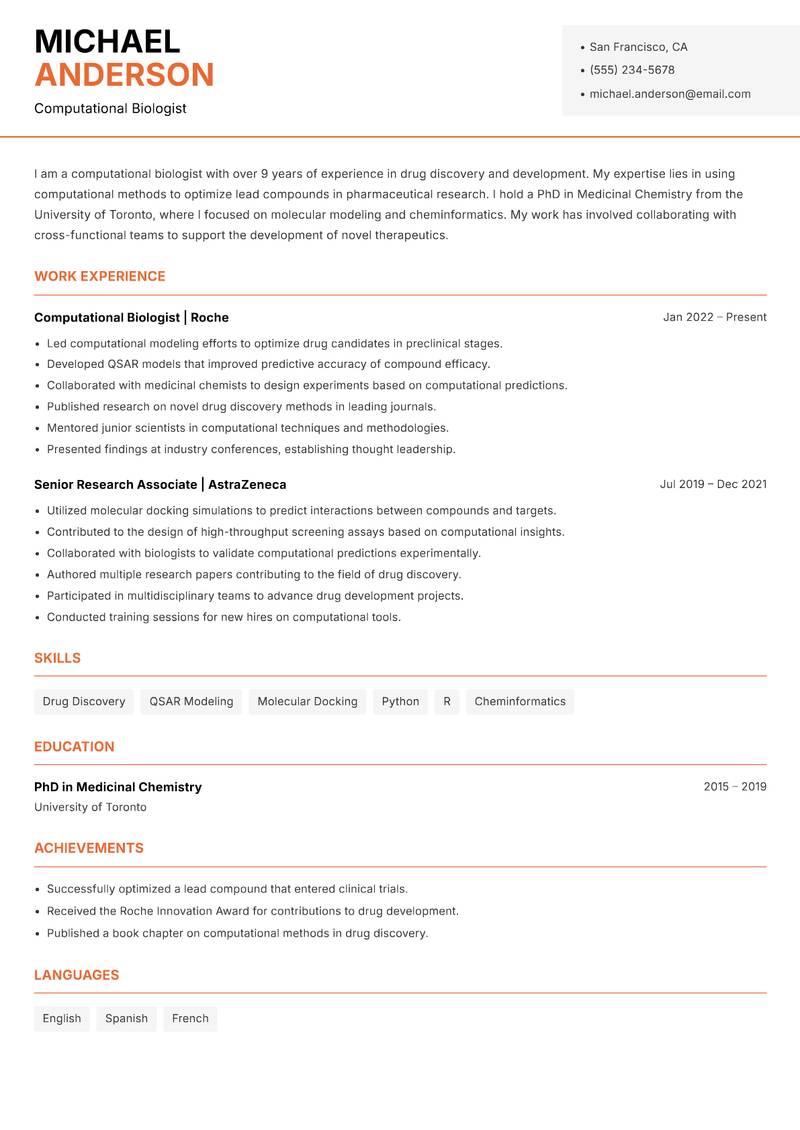
Modern Professional
Use Template7 Real Computational Biologist Resume Examples
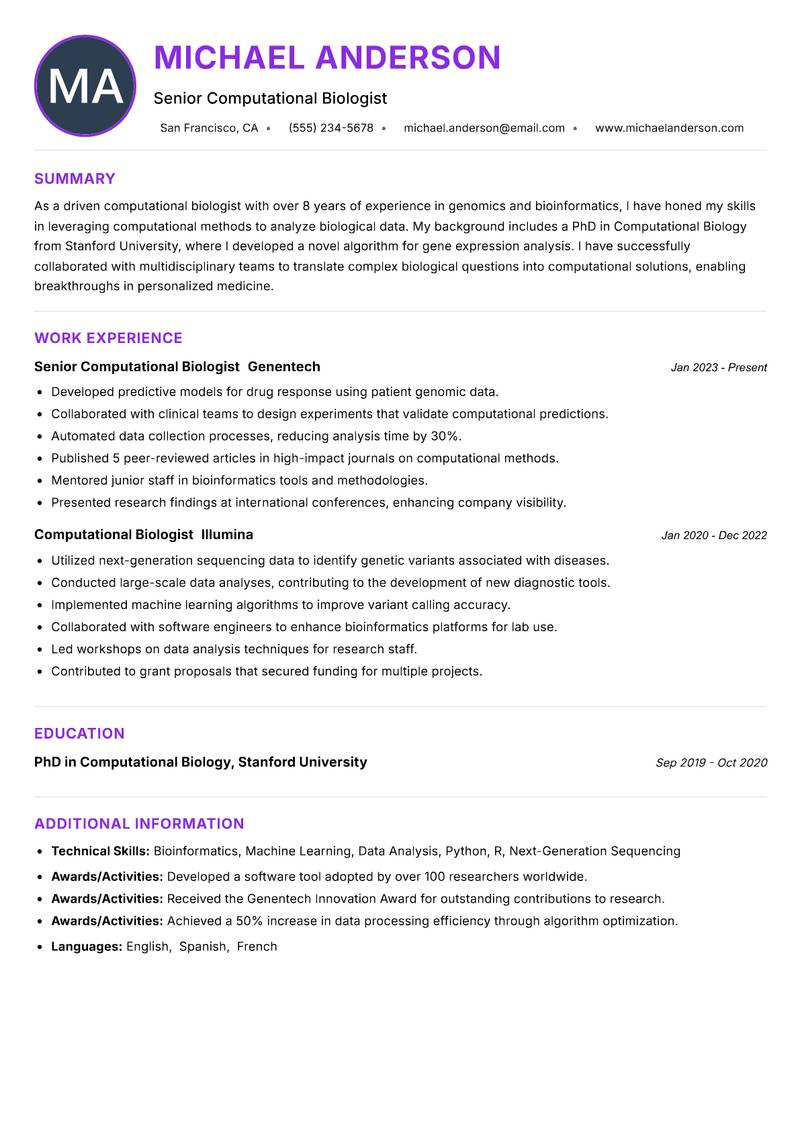
Senior Computational Biologist with 8+ Years Experience
Summary: As a driven computational biologist with over 8 years of experience in genomics and bioinformatics, I have honed my skills in leveraging computational methods to analyze biological data. My background includes a PhD in Computational Biology from Stanford University, where I developed a novel algorithm for gene expression analysis. I have successfully collaborated with multidisciplinary teams to translate complex biological questions into computational solutions, enabling breakthroughs in personalized medicine. My expertise lies in using machine learning techniques to uncover patterns in large datasets, which has significantly accelerated research timelines in several projects. I am passionate about applying my skills to contribute to innovative research that impacts human health positively. I thrive in dynamic environments and am adept at communicating technical concepts to diverse audiences, making me an invaluable member of any research team.
Description:
- Developed predictive models for drug response using patient genomic data.
- Collaborated with clinical teams to design experiments that validate computational predictions.
- Automated data collection processes, reducing analysis time by 30%.
- Published 5 peer-reviewed articles in high-impact journals on computational methods.
- Mentored junior staff in bioinformatics tools and methodologies.
- Presented research findings at international conferences, enhancing company visibility.
🏆 Key Achievements
Computational Biologist with 5+ Years Experience
Summary: I am a computational biologist with a strong foundation in structural biology and computational modeling. With over 5 years of experience in academic and industry settings, I possess a deep understanding of protein structure prediction and molecular dynamics simulations. My work has focused on the development of software tools that facilitate the analysis of large structural datasets, helping to advance the understanding of protein interactions. I hold a Master's degree in Bioinformatics from the University of California, San Diego, and I have a proven track record of successfully collaborating with experimental biologists to validate computational predictions. I am passionate about integrating computational techniques into biological research to drive innovation and discovery.
Description:
- Performed molecular dynamics simulations to study drug-protein interactions.
- Developed software tools for structural alignment of protein complexes.
- Collaborated with chemists to optimize lead compounds based on structural data.
- Analyzed high-throughput screening data to identify potential drug candidates.
- Presented findings at internal meetings, facilitating cross-departmental collaboration.
- Trained interns in computational techniques and best practices.
🏆 Key Achievements
Lead Computational Biologist with 10+ Years Experience
Summary: With a decade of experience in computational biology, I specialize in integrating omics data to drive discoveries in cancer research. My career began with a focus on transcriptomics, where I developed algorithms to analyze RNA sequencing data, leading to significant insights into gene regulation mechanisms. I hold a PhD in Bioinformatics from Harvard University and have worked in both academic and pharmaceutical environments. My expertise extends to systems biology, where I model complex biological systems to predict outcomes of therapeutic interventions. I am committed to advancing personalized medicine through data-driven insights and have a strong publication record in top-tier journals.
Description:
- Led a team in the integration of multi-omics data to identify biomarkers for cancer therapy.
- Developed robust analytical frameworks that improved the accuracy of predictive models.
- Collaborated with oncologists to translate computational findings into clinical applications.
- Published 10 articles in high-impact journals related to cancer genomics.
- Provided mentorship and training for junior bioinformaticians in best practices.
- Presented research outcomes at international cancer conferences, enhancing visibility.
🏆 Key Achievements
Computational Biologist with 7+ Years Experience
Summary: I am a computational biologist with a focus on evolutionary genomics and systems biology. My expertise lies in using computational tools to investigate the evolution of genetic traits across species. With a Master’s degree in Computational Biology from the University of Washington, I have spent over 7 years working on projects that analyze genomic data to understand evolutionary relationships. My goal is to combine computational methods with biological insights to elucidate the mechanisms driving evolution. I am well-versed in statistical modeling and have a strong foundation in programming languages essential for data analysis.
Description:
- Developed phylogenetic models to analyze evolutionary relationships among species.
- Utilized statistical methods to assess genetic diversity in populations.
- Collaborated with ecologists to apply findings to conservation strategies.
- Presented research findings to both scientific and public audiences.
- Managed large genomic datasets, ensuring data integrity and accessibility.
- Conducted workshops on evolutionary genomics for graduate students.
🏆 Key Achievements
Computational Biologist with 6+ Years Experience
Summary: As a computational biologist with a passion for data-driven approaches to environmental science, I have dedicated over 6 years to studying the effects of climate change on biodiversity. My PhD in Environmental Bioinformatics from the University of Queensland equipped me with the skills to analyze large ecological datasets using advanced computational techniques. I have worked on interdisciplinary teams to assess the impacts of environmental changes on genetic diversity in various species. My goal is to leverage computational biology to inform conservation efforts and policy-making. I have a robust background in machine learning and statistical analysis, which I utilize to derive insights from complex datasets.
Description:
- Developed models to predict species responses to climate change scenarios.
- Collaborated with ecologists to analyze genetic diversity in threatened species.
- Published findings that influenced conservation strategies and policies.
- Utilized machine learning techniques for biodiversity monitoring.
- Conducted educational workshops for stakeholders on the use of data in conservation.
- Managed projects that secured funding for ongoing research initiatives.
🏆 Key Achievements
Computational Biologist with 4+ Years Experience
Summary: With over 4 years of experience as a computational biologist, I have specialized in the application of bioinformatics to study infectious diseases. I earned my Master’s in Computational Biology from the University of Oxford, where I focused on the genomic epidemiology of pathogens. My work has included developing computational tools to analyze viral genomic data, enabling rapid response strategies in public health. I am dedicated to using my skills to drive innovations in disease research and contribute to global health initiatives. My strong analytical skills and proficiency in various programming languages allow me to address complex biological questions effectively.
Description:
- Analyzed genomic data from outbreak samples to identify transmission patterns.
- Developed bioinformatics tools to assist in global disease surveillance.
- Collaborated with public health teams to inform response strategies.
- Published research on pathogen evolution in a leading journal.
- Conducted training sessions for health professionals on genomic data usage.
- Managed projects that enhanced international collaboration on disease research.
🏆 Key Achievements
Computational Biologist with 9+ Years Experience
Summary: I am a computational biologist with over 9 years of experience in drug discovery and development. My expertise lies in using computational methods to optimize lead compounds in pharmaceutical research. I hold a PhD in Medicinal Chemistry from the University of Toronto, where I focused on molecular modeling and cheminformatics. My work has involved collaborating with cross-functional teams to support the development of novel therapeutics. I am skilled in applying quantitative structure-activity relationship (QSAR) modeling and molecular docking techniques to enhance compound efficacy. I am committed to advancing drug discovery processes through innovative computational strategies.
Description:
- Led computational modeling efforts to optimize drug candidates in preclinical stages.
- Developed QSAR models that improved predictive accuracy of compound efficacy.
- Collaborated with medicinal chemists to design experiments based on computational predictions.
- Published research on novel drug discovery methods in leading journals.
- Mentored junior scientists in computational techniques and methodologies.
- Presented findings at industry conferences, establishing thought leadership.
🏆 Key Achievements
Key Skills for Computational Biologist
ATS Optimization Tips
Increase your chances of getting hired
Use Standard Headings
Use common section titles like Experience, Skills, etc.
Include Keywords
Add role-specific keywords from the job description
Keep it Simple
Avoid complex tables, images and graphics
Save in Right Format
Use PDF format unless otherwise specified
Computational Biologist Salary Insights
Average Salary
$95,000
per year
Salary Range
$70,000 - $120,000
per year
Top Paying Cities
Los Angeles, Seattle, Houston, Dallas, Boston
Source: Glassdoor, Payscale, Indeed (Updated April 2025)
Everything you need to write a great Computational Biologist resume
Strong Action Verbs to Use
Resume Writing Tips
- →Highlight specific programming languages like Python or R, especially experiences with relevant libraries.
- →Showcase contributions to publications or presentations in computational biology to demonstrate research impact.
- →Detail your experience with machine learning applications tailored to biological datasets, specifying tools used.
- →Emphasize collaboration experiences with experimental biologists and the outcomes of those partnerships.
- →Outline your familiarity with high-performance computing environments and data management systems for large datasets.
Common Mistakes to Avoid
- ✕Listing programming skills generically without highlighting specific projects or applications.
- ✕Failing to mention collaboration with wet-lab scientists, which is crucial in this interdisciplinary field.
- ✕Neglecting to relate achievements to the impact on biological research or clinical applications.
- ✕Using non-specific metrics to describe past work instead of concrete results or contributions made.
ATS Keywords for Computational Biologist
Computational Biologist Career Path
Relevant Certifications
Career Progression
Entry-Level Computational Biologist
Typically involves working on data parsing, algorithm implementation, and preliminary data analysis under the supervision of senior scientists.
Intermediate Computational Biologist
Takes ownership of specific projects, including designing computational experiments and collaborating with experimental biologists to validate findings.
Senior Computational Biologist
Leads research initiatives, mentors junior staff, and is responsible for developing novel bioinformatics pipelines and methodologies.
Principal Scientist
Oversees large-scale research programs, secures funding, and drives interdisciplinary collaborations between computational biology and other scientific domains.
Director of Computational Biology
Manages a team of researchers, directs strategic research directions, and contributes to organizational vision on a corporate or academic level.
Computational Biologist Interview Questions
Can you describe a computational project you led and the impact it had on the research team? +
Focus on the methodologies used and how they influenced experimental design or outcomes.
What programming languages and tools are you most comfortable with for data analysis? +
Mention specific libraries or frameworks relevant to computational biology.
How do you prioritize tasks when managing multiple projects? +
Provide examples of your time management strategies and tools you use.
Describe your experience with machine learning techniques in biological data analysis. +
Discuss specific algorithms you've implemented and the type of data analyzed.
Have you ever had to present complex results to a non-technical audience? How did you ensure clarity? +
Share your approach to communication and any tools or methods you used.
What challenges have you faced in maintaining data integrity throughout your analyses? +
Highlight your understanding of data management best practices.
Can you give an example of how you've collaborated with experimental biologists? +
Discuss specific projects and the outcomes of those collaborations.
About the Computational Biologist Role
In the dynamic field of life sciences, a Computational Biologist harnesses computational techniques to analyze biological data, bridging the gap between experimental biology and computational analysis. Frequently employing advanced algorithms and statistical methods, these professionals work on genomic sequences, protein structures, and cellular processes, enabling significant advancements in health and biomedicine. Their role often includes developing software tools for high-throughput data analysis and collaborating with multi-disciplinary teams to translate complex data into actionable biological insights.
Frequently Asked Questions
View all →What is the primary role of a Computational Biologist? +
A Computational Biologist primarily focuses on using computational methods and tools to analyze biological data, uncover patterns, and support experimental findings.
What educational background is typical for a Computational Biologist? +
Most Computational Biologists hold advanced degrees in computational biology, bioinformatics, biology, or related fields that blend biology with statistics and computer science.
Which programming languages are essential for a Computational Biologist? +
Key programming languages include Python, R, and sometimes C++, with a strong emphasis on data manipulation and analysis libraries.
How does a Computational Biologist collaborate with experimental biologists? +
They often work together to design experiments, analyze data generated from those experiments, and validate computational predictions.
What tools are commonly used in computational biology? +
Common tools include software for sequence analysis (like BLAST), statistical analysis tools, and frameworks for machine learning.
What challenges do Computational Biologists face? +
They often encounter challenges related to data integration, ensuring data quality, and translating complex results into practical applications.
Is a certification important for a Computational Biologist? +
While not always mandatory, certifications can demonstrate expertise and commitment to the field, making candidates more competitive.
More Resume Examples You Might Like
Related Career Paths
Other roles candidates for Computational Biologist positions often also consider.
Will this Computational Biologist resume pass the ATS scan?
Upload it and get an instant AI-scored compatibility check with specific fixes.
Check My Resume →
Pair it with a matching cover letter
AI drafts a first version from your job title and strengths — edit it live, then download the PDF.
Write My Cover Letter →
Written by Nohaya Career Team
Reviewed by HR Professionals · Updated April 2025
Ready to Build Your Perfect Resume?
Choose from 1000+ professional templates and land your dream job.
Create My Resume Now