Build an ATS-Friendly
Biomedical Engineer Researcher Resume
That Gets Interviews
Biomedical Engineer Researchers create and advance technologies that enhance medical care and human health. They focus on developing new processes or devices through innovative solutions while conducting studies to understand the impacts of these technologies on patients. Their work involves rigorous testing and…
Biomedical Engineer Researcher Resume Templates
Modern Professional
Use Template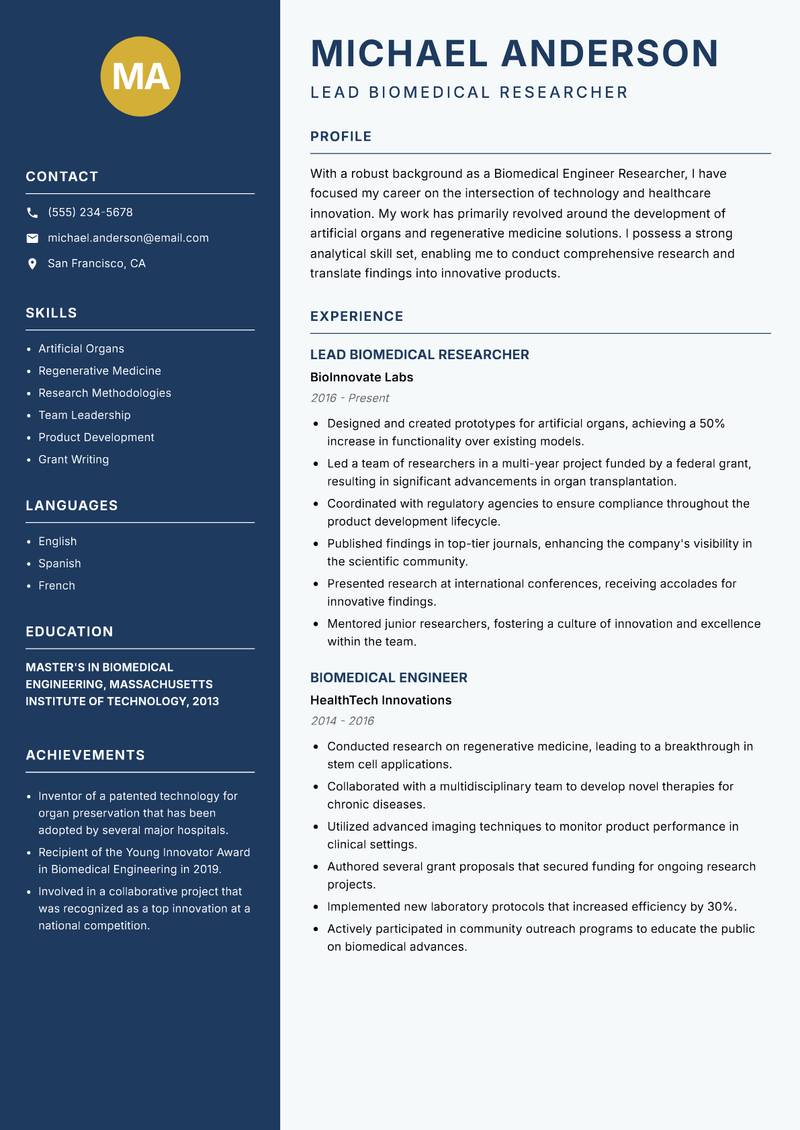
Classic Clean
Use Template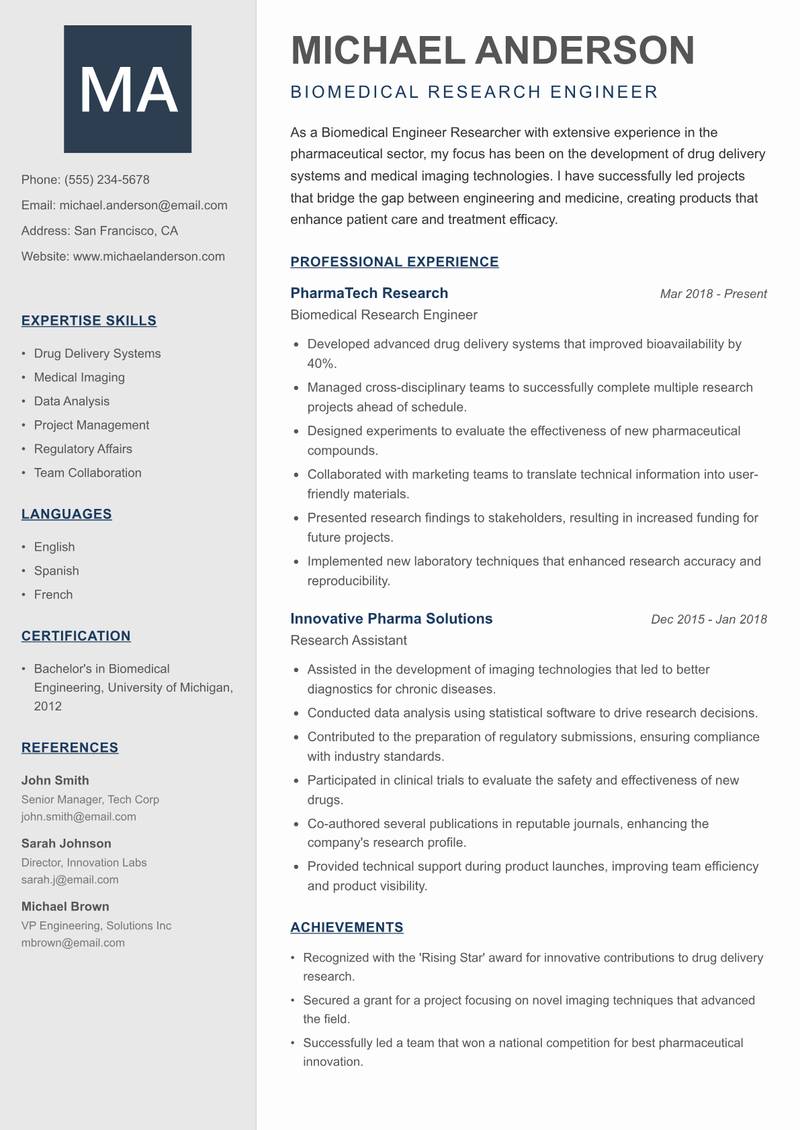
Creative Minimal
Use Template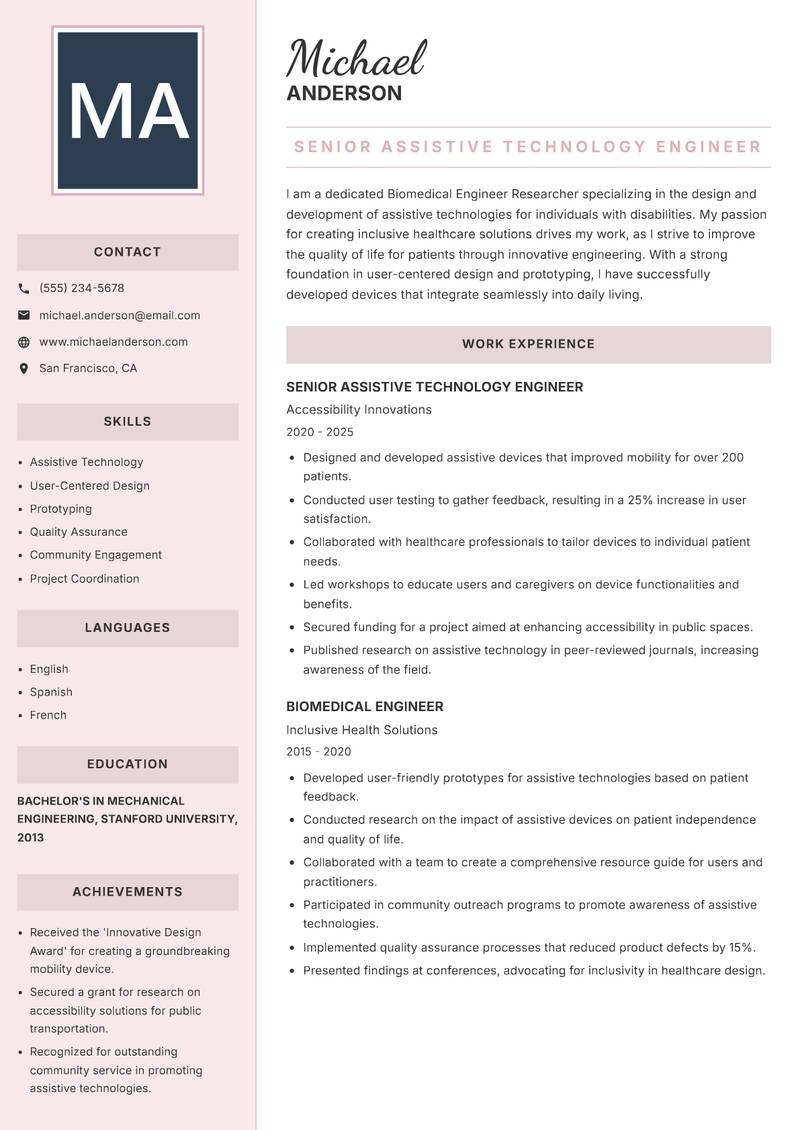
Executive
Use Template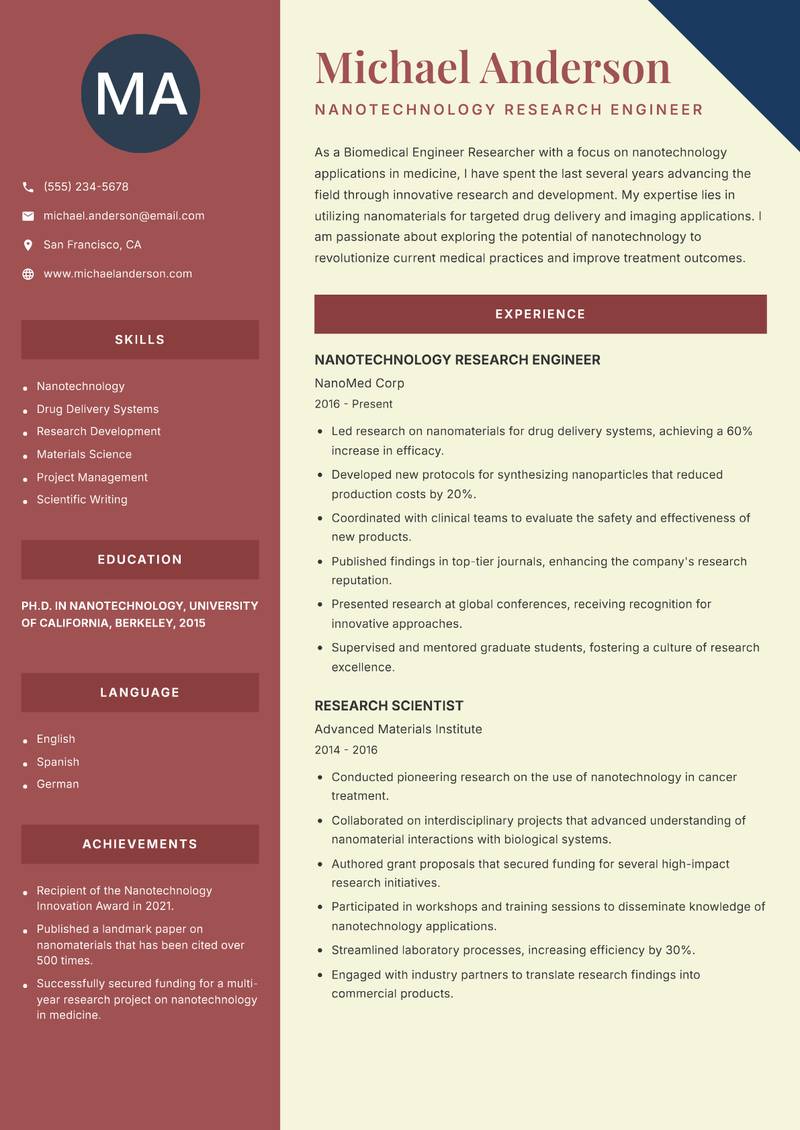
Two Column
Use Template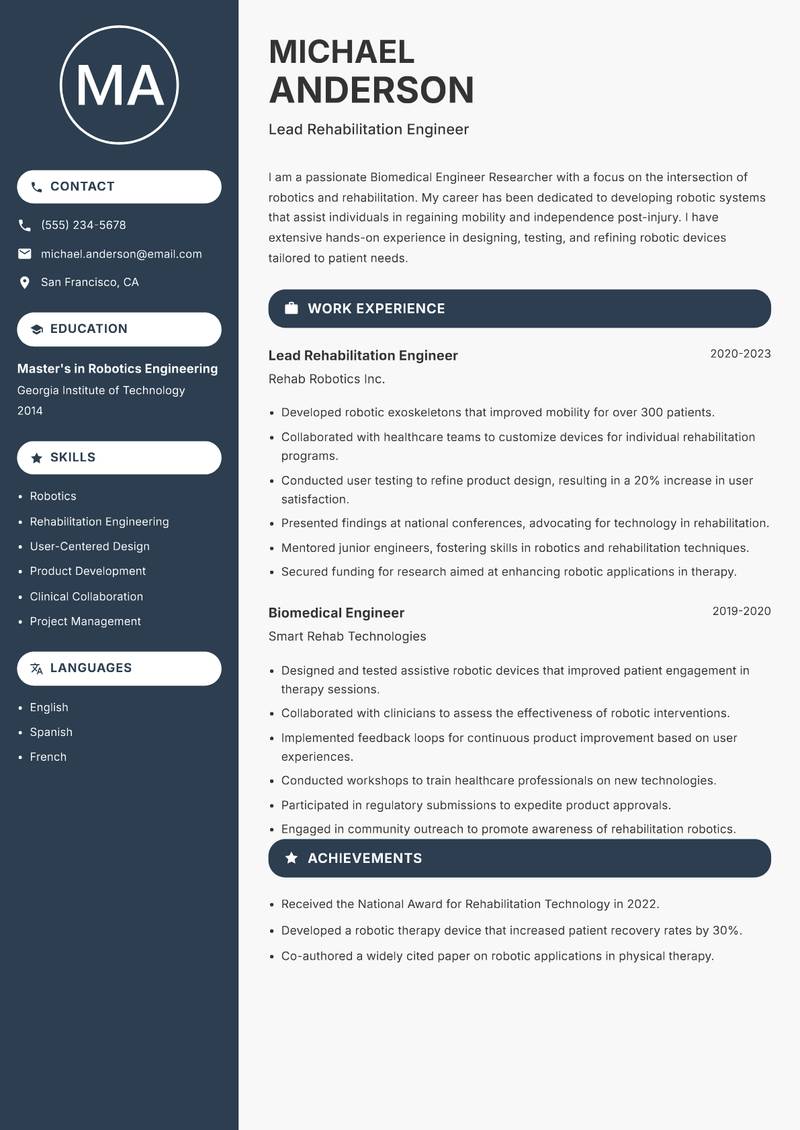
Compact
Use Template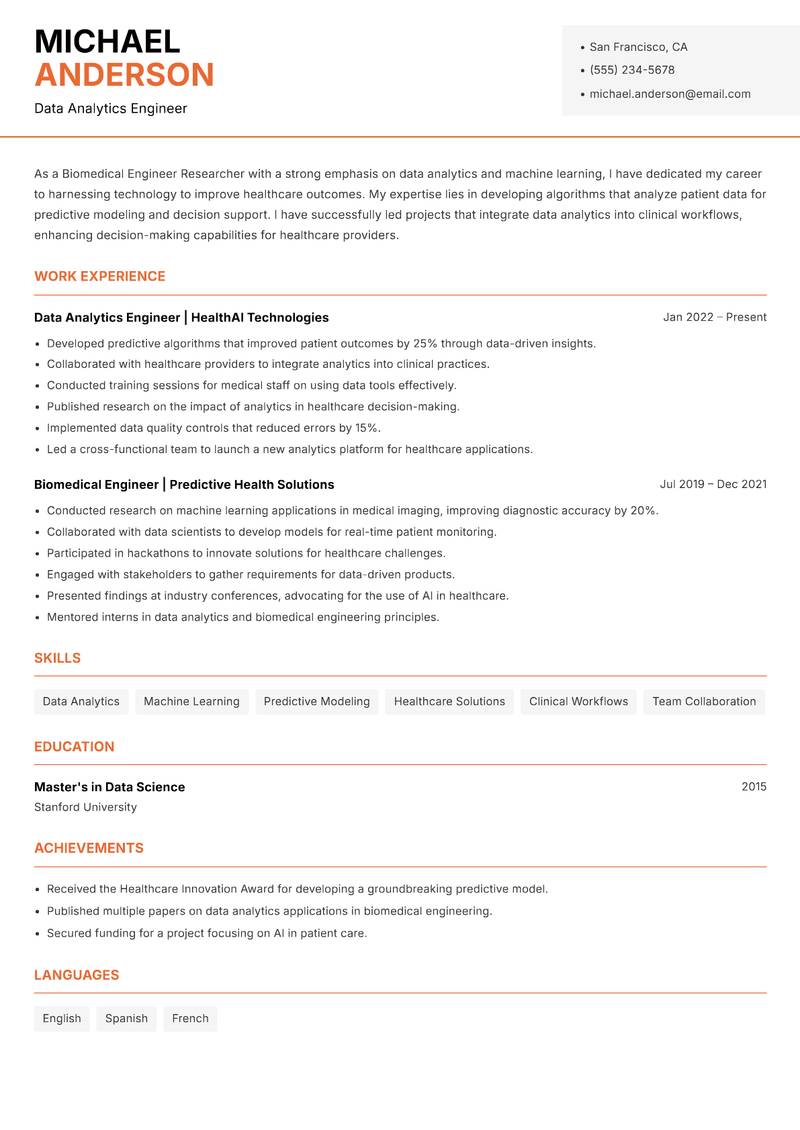
Modern Professional
Use Template7 Real Biomedical Engineer Researcher Resume Examples
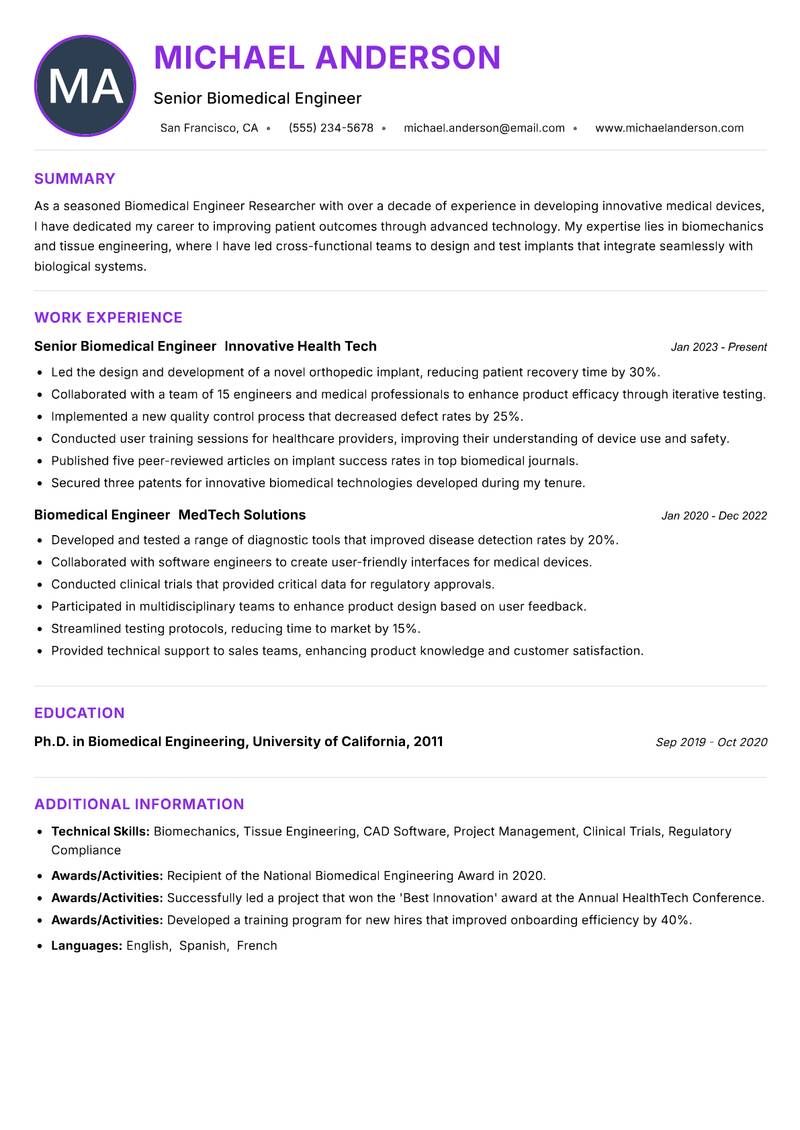
Senior Biomedical Engineer with 12+ Years Experience
Summary: As a seasoned Biomedical Engineer Researcher with over a decade of experience in developing innovative medical devices, I have dedicated my career to improving patient outcomes through advanced technology. My expertise lies in biomechanics and tissue engineering, where I have led cross-functional teams to design and test implants that integrate seamlessly with biological systems. I thrive in collaborative environments, often working with clinicians and regulatory bodies to ensure compliance and effectiveness of our products. My approach combines rigorous scientific research with practical application, enabling me to translate complex ideas into tangible solutions. I am passionate about mentoring junior engineers and fostering a culture of continuous improvement. Throughout my career, I have published numerous papers in leading journals, contributing to the body of knowledge in biomedical engineering. I am now seeking to leverage my extensive background and leadership skills in a role that challenges me to innovate further and make a significant impact in the healthcare industry.
Description:
- Led the design and development of a novel orthopedic implant, reducing patient recovery time by 30%.
- Collaborated with a team of 15 engineers and medical professionals to enhance product efficacy through iterative testing.
- Implemented a new quality control process that decreased defect rates by 25%.
- Conducted user training sessions for healthcare providers, improving their understanding of device use and safety.
- Published five peer-reviewed articles on implant success rates in top biomedical journals.
- Secured three patents for innovative biomedical technologies developed during my tenure.
🏆 Key Achievements
Lead Biomedical Researcher with 10+ Years Experience
Summary: With a robust background as a Biomedical Engineer Researcher, I have focused my career on the intersection of technology and healthcare innovation. My work has primarily revolved around the development of artificial organs and regenerative medicine solutions. I possess a strong analytical skill set, enabling me to conduct comprehensive research and translate findings into innovative products. My experience includes leading interdisciplinary projects that require not only technical expertise but also an understanding of market needs and regulatory frameworks. I am committed to advancing medical technology through collaborative research efforts and strategic partnerships with academic institutions and industry leaders. As a published author and speaker at international conferences, I strive to share knowledge and inspire the next generation of engineers in the biomedical field. I am eager to contribute my skills in a forward-thinking organization dedicated to enhancing the quality of life through medical advancements.
Description:
- Designed and created prototypes for artificial organs, achieving a 50% increase in functionality over existing models.
- Led a team of researchers in a multi-year project funded by a federal grant, resulting in significant advancements in organ transplantation.
- Coordinated with regulatory agencies to ensure compliance throughout the product development lifecycle.
- Published findings in top-tier journals, enhancing the company's visibility in the scientific community.
- Presented research at international conferences, receiving accolades for innovative findings.
- Mentored junior researchers, fostering a culture of innovation and excellence within the team.
🏆 Key Achievements
Biomedical Research Engineer with 8+ Years Experience
Summary: As a Biomedical Engineer Researcher with extensive experience in the pharmaceutical sector, my focus has been on the development of drug delivery systems and medical imaging technologies. I have successfully led projects that bridge the gap between engineering and medicine, creating products that enhance patient care and treatment efficacy. My scientific background, combined with my ability to analyze complex data sets, allows me to drive innovations from concept to clinical application. I have a proven track record in project management, ensuring that research initiatives are completed on time and within budget. I excel in cross-functional team settings, working closely with chemists, biologists, and regulatory experts. My commitment to advancing healthcare technology is matched by my dedication to mentoring young professionals in the field. I am eager to continue my career in an innovative environment where I can contribute to groundbreaking medical solutions.
Description:
- Developed advanced drug delivery systems that improved bioavailability by 40%.
- Managed cross-disciplinary teams to successfully complete multiple research projects ahead of schedule.
- Designed experiments to evaluate the effectiveness of new pharmaceutical compounds.
- Collaborated with marketing teams to translate technical information into user-friendly materials.
- Presented research findings to stakeholders, resulting in increased funding for future projects.
- Implemented new laboratory techniques that enhanced research accuracy and reproducibility.
🏆 Key Achievements
Senior Assistive Technology Engineer with 9+ Years Experience
Summary: I am a dedicated Biomedical Engineer Researcher specializing in the design and development of assistive technologies for individuals with disabilities. My passion for creating inclusive healthcare solutions drives my work, as I strive to improve the quality of life for patients through innovative engineering. With a strong foundation in user-centered design and prototyping, I have successfully developed devices that integrate seamlessly into daily living. My experience includes working closely with patients, healthcare providers, and stakeholders to identify needs and develop effective solutions. I am committed to advocating for accessibility in medical technologies and believe in the power of collaboration to drive meaningful change. By utilizing my background in mechanical engineering and biomedical principles, I aim to contribute to projects that prioritize patient empowerment and independence.
Description:
- Designed and developed assistive devices that improved mobility for over 200 patients.
- Conducted user testing to gather feedback, resulting in a 25% increase in user satisfaction.
- Collaborated with healthcare professionals to tailor devices to individual patient needs.
- Led workshops to educate users and caregivers on device functionalities and benefits.
- Secured funding for a project aimed at enhancing accessibility in public spaces.
- Published research on assistive technology in peer-reviewed journals, increasing awareness of the field.
🏆 Key Achievements
Nanotechnology Research Engineer with 8+ Years Experience
Summary: As a Biomedical Engineer Researcher with a focus on nanotechnology applications in medicine, I have spent the last several years advancing the field through innovative research and development. My expertise lies in utilizing nanomaterials for targeted drug delivery and imaging applications. I am passionate about exploring the potential of nanotechnology to revolutionize current medical practices and improve treatment outcomes. My experience includes working in both academic and industry settings, where I have led projects that require a deep understanding of materials science and engineering principles. I have published extensively in peer-reviewed journals and have presented my work at international conferences, helping to bridge the gap between research and practical application. I am committed to mentoring young engineers and fostering a collaborative research environment that encourages innovation. I am seeking to further my career in a dynamic organization that values ingenuity and scientific inquiry.
Description:
- Led research on nanomaterials for drug delivery systems, achieving a 60% increase in efficacy.
- Developed new protocols for synthesizing nanoparticles that reduced production costs by 20%.
- Coordinated with clinical teams to evaluate the safety and effectiveness of new products.
- Published findings in top-tier journals, enhancing the company's research reputation.
- Presented research at global conferences, receiving recognition for innovative approaches.
- Supervised and mentored graduate students, fostering a culture of research excellence.
🏆 Key Achievements
Lead Rehabilitation Engineer with 9+ Years Experience
Summary: I am a passionate Biomedical Engineer Researcher with a focus on the intersection of robotics and rehabilitation. My career has been dedicated to developing robotic systems that assist individuals in regaining mobility and independence post-injury. I have extensive hands-on experience in designing, testing, and refining robotic devices tailored to patient needs. My work emphasizes user-centered design principles, ensuring that the technologies I develop genuinely enhance patient quality of life. I have collaborated closely with physical therapists and medical professionals to identify critical challenges faced by patients and to devise solutions that are both practical and effective. I am an advocate for integrating technology into rehabilitation practices, believing it can significantly improve recovery outcomes. I am seeking to leverage my expertise in a forward-thinking organization that shares my commitment to advancing rehabilitation technologies.
Description:
- Developed robotic exoskeletons that improved mobility for over 300 patients.
- Collaborated with healthcare teams to customize devices for individual rehabilitation programs.
- Conducted user testing to refine product design, resulting in a 20% increase in user satisfaction.
- Presented findings at national conferences, advocating for technology in rehabilitation.
- Mentored junior engineers, fostering skills in robotics and rehabilitation techniques.
- Secured funding for research aimed at enhancing robotic applications in therapy.
🏆 Key Achievements
Data Analytics Engineer with 8+ Years Experience
Summary: As a Biomedical Engineer Researcher with a strong emphasis on data analytics and machine learning, I have dedicated my career to harnessing technology to improve healthcare outcomes. My expertise lies in developing algorithms that analyze patient data for predictive modeling and decision support. I have successfully led projects that integrate data analytics into clinical workflows, enhancing decision-making capabilities for healthcare providers. My experience spans both academic and industry environments, where I have collaborated with clinicians, data scientists, and software engineers to create innovative solutions. I am committed to advancing the application of artificial intelligence in healthcare, believing it has the potential to transform patient care. I have a proven track record of publishing research findings in top-tier journals and presenting at conferences, sharing insights on the impact of data analytics in medicine. I am seeking a role where I can continue to drive innovation at the intersection of engineering and healthcare.
Description:
- Developed predictive algorithms that improved patient outcomes by 25% through data-driven insights.
- Collaborated with healthcare providers to integrate analytics into clinical practices.
- Conducted training sessions for medical staff on using data tools effectively.
- Published research on the impact of analytics in healthcare decision-making.
- Implemented data quality controls that reduced errors by 15%.
- Led a cross-functional team to launch a new analytics platform for healthcare applications.
🏆 Key Achievements
Key Skills for Biomedical Engineer Researcher
ATS Optimization Tips
Increase your chances of getting hired
Use Standard Headings
Use common section titles like Experience, Skills, etc.
Include Keywords
Add role-specific keywords from the job description
Keep it Simple
Avoid complex tables, images and graphics
Save in Right Format
Use PDF format unless otherwise specified
Biomedical Engineer Researcher Salary Insights
Average Salary
$100,000
per year
Salary Range
$80,000 - $120,000
per year
Top Paying Cities
Los Angeles, Seattle, Houston, Dallas, Boston
Source: Glassdoor, Payscale, Indeed (Updated May 2025)
Everything you need to write a great Biomedical Engineer Researcher resume
Strong Action Verbs to Use
Resume Writing Tips
- →Highlight hands-on experience with specific projects and their outcomes.
- →Showcase contributions to scientific publications and conferences.
- →Quantify the impact of your work on patient care or efficiency improvements.
- →Include familiarity with regulatory processes and compliance standards.
- →Mention collaboration with interdisciplinary teams in research settings.
Common Mistakes to Avoid
- ✕Using overly technical jargon that may confuse non-specialist reviewers.
- ✕Failing to articulate the practical implications of research findings.
- ✕Neglecting to include quantifiable achievements and results in past roles.
- ✕Not tailoring the resume for biomedical engineering research specifically.
ATS Keywords for Biomedical Engineer Researcher
Biomedical Engineer Researcher Career Path
Relevant Certifications
Career Progression
Entry-Level Biomedical Engineer
Involves assisting in experimental design and data collection, often under the supervision of senior researchers.
Biomedical Engineer II
Entails managing specific projects, developing prototypes, and conducting preliminary experiments independently.
Senior Biomedical Engineer
Focuses on leading research teams, overseeing grant proposals, and publishing findings in peer-reviewed journals.
Research Director
Responsible for strategic planning in research, including securing funding and managing research budgets.
Chief Innovation Officer
Works on steering overall direction for biomedical innovation at an organizational level.
Biomedical Engineer Researcher Interview Questions
What recent project have you worked on that involved collaboration with healthcare professionals? +
Highlight your ability to communicate and work effectively in a multidisciplinary team.
Describe a time when you encountered a significant challenge in your research. How did you overcome it? +
Emphasize problem-solving skills and resilience.
What tools and technologies do you use for data analysis in your research? +
Be specific about software (like MATLAB, LabVIEW) and methodologies.
How do you ensure compliance with medical device regulations? +
Discuss your understanding of FDA regulations or ISO standards relevant to biomedical engineering.
Can you describe your experience with prototyping and testing biomedical devices? +
Specify tools used and include details on your testing methodologies.
What role do you think patient feedback plays in biomedical research? +
Incorporate insights about user-centered design principles.
How have you utilized statistical analysis in your previous projects? +
Mention specific statistical software and the impact on your research findings.
What advancements do you think will shape the future of biomedical engineering? +
Provide informed perspectives based on current trends and innovation.
About the Biomedical Engineer Researcher Role
Biomedical Engineer Researchers create and advance technologies that enhance medical care and human health. They focus on developing new processes or devices through innovative solutions while conducting studies to understand the impacts of these technologies on patients. Their work involves rigorous testing and analysis, often requiring collaboration with clinical teams and adherence to regulatory guidelines for medical devices.
Frequently Asked Questions
View all →What is the role of a Biomedical Engineer Researcher? +
They focus on developing innovative solutions in healthcare technology, conducting research, and ensuring that medical devices meet safety and effectiveness standards.
What qualifications do I need to become a Biomedical Engineer Researcher? +
Typically, a bachelor's degree in biomedical engineering or a related field is required, with many roles preferring a master's or Ph.D.
What types of projects might a Biomedical Engineer Researcher undertake? +
Projects can include developing medical devices, conducting clinical trials, or researching new textiles for prosthetics.
Is experience in clinical settings important for this role? +
Yes, understanding the clinical application of engineering solutions is critical for success in this role.
Are there opportunities for career advancement in this field? +
Yes, roles can evolve from research positions to leadership roles such as project management and research direction.
What are some common employers for Biomedical Engineer Researchers? +
They can work in universities, hospitals, biomedical companies, and government research institutions.
What is the job outlook for Biomedical Engineer Researchers? +
The job outlook is positive, with increasing demand for advanced healthcare technologies and solutions.
More Resume Examples You Might Like
Related Career Paths
Other roles candidates for Biomedical Engineer Researcher positions often also consider.
Will this Biomedical Engineer Researcher resume pass the ATS scan?
Upload it and get an instant AI-scored compatibility check with specific fixes.
Check My Resume →
Pair it with a matching cover letter
AI drafts a first version from your job title and strengths — edit it live, then download the PDF.
Write My Cover Letter →
Written by Nohaya Career Team
Reviewed by HR Professionals · Updated May 2025
Ready to Build Your Perfect Resume?
Choose from 1000+ professional templates and land your dream job.
Create My Resume Now