Build an ATS-Friendly
Judicial Academy Faculty Resume
That Gets Interviews
A Judicial Academy Faculty member cultivates the next generation of judicial leaders by designing innovative, practice-based courses that bridge academic theory with practical courtroom experience. Alongside instruction, they engage in formative research that enhances the learning environment and informs judicial…
Judicial Academy Faculty Resume Templates
Modern Professional
Use Template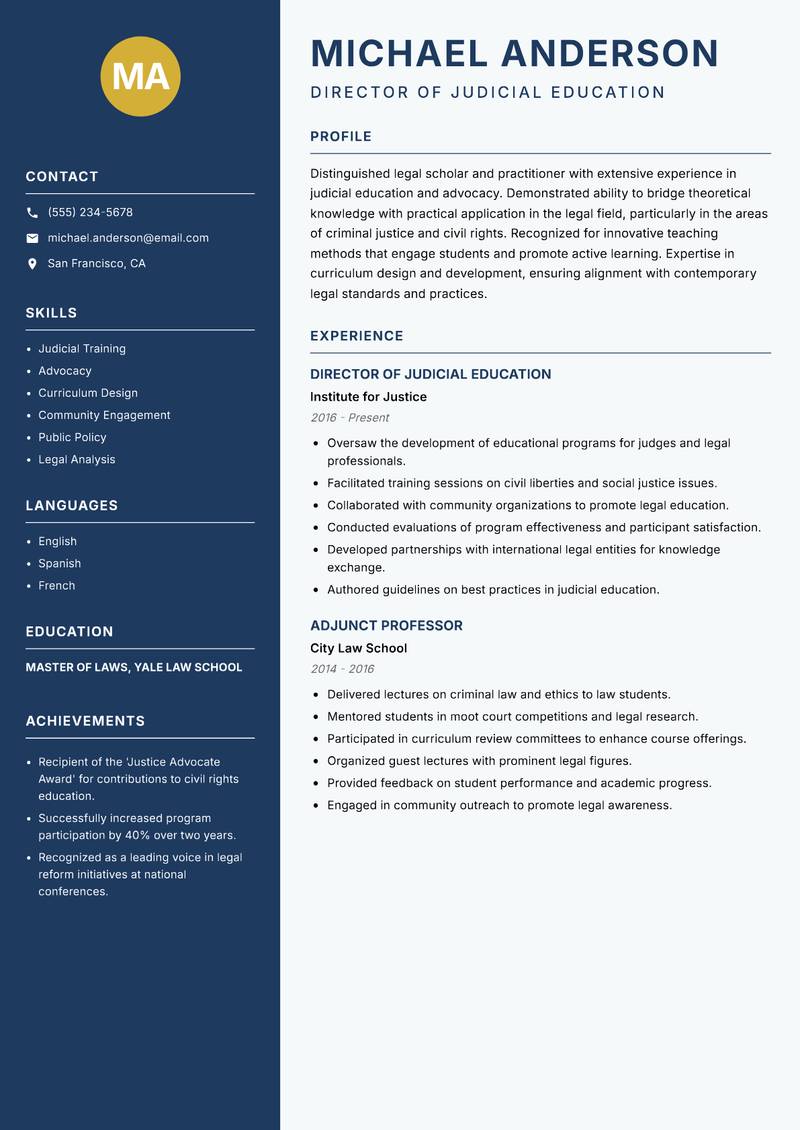
Classic Clean
Use Template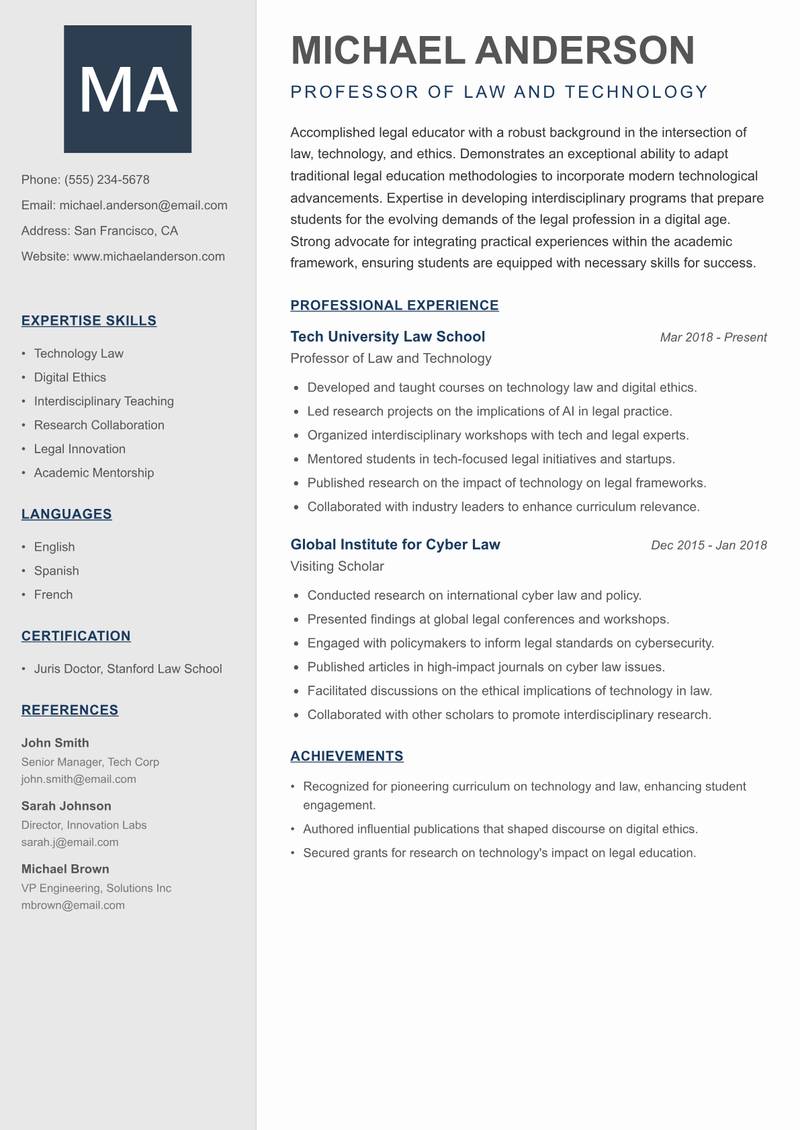
Creative Minimal
Use Template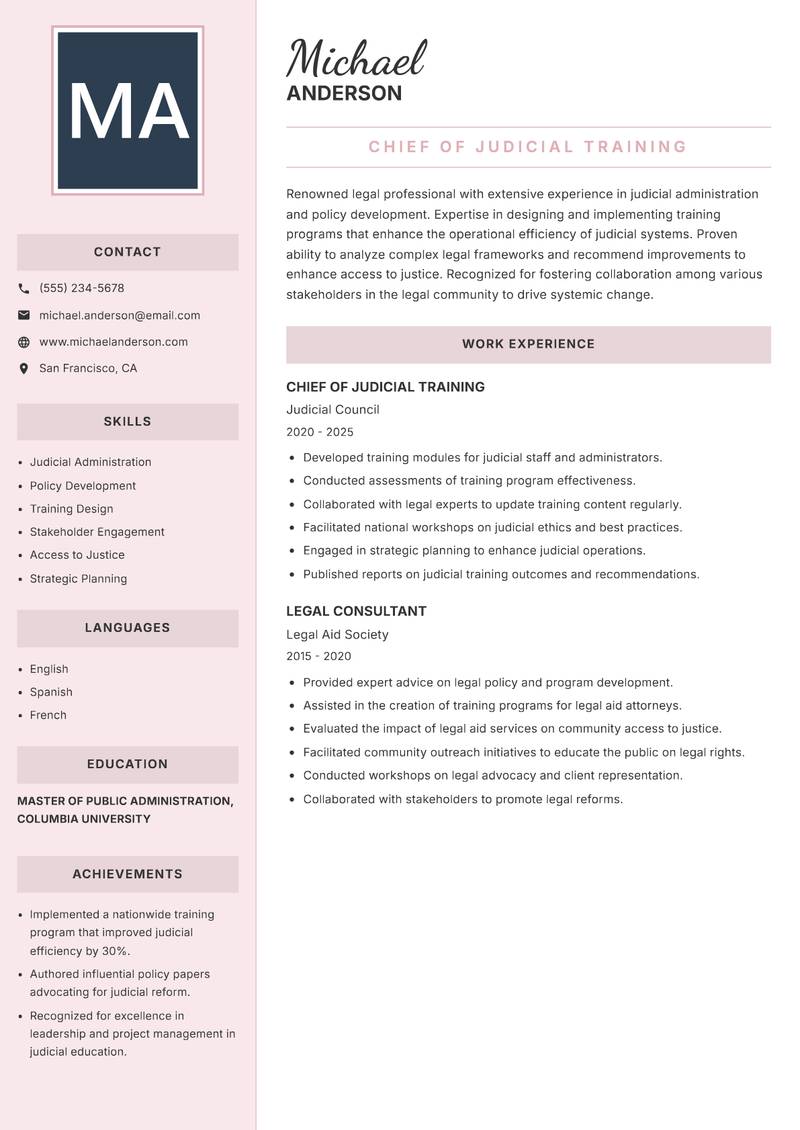
Executive
Use Template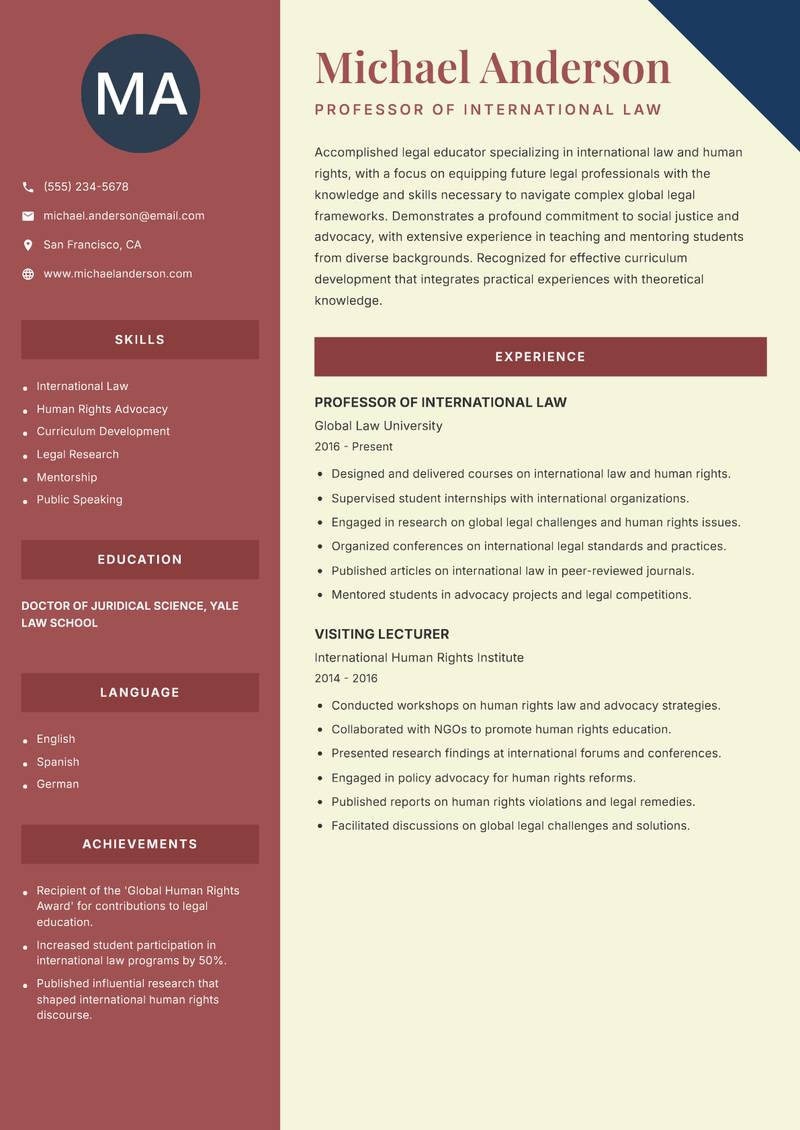
Two Column
Use Template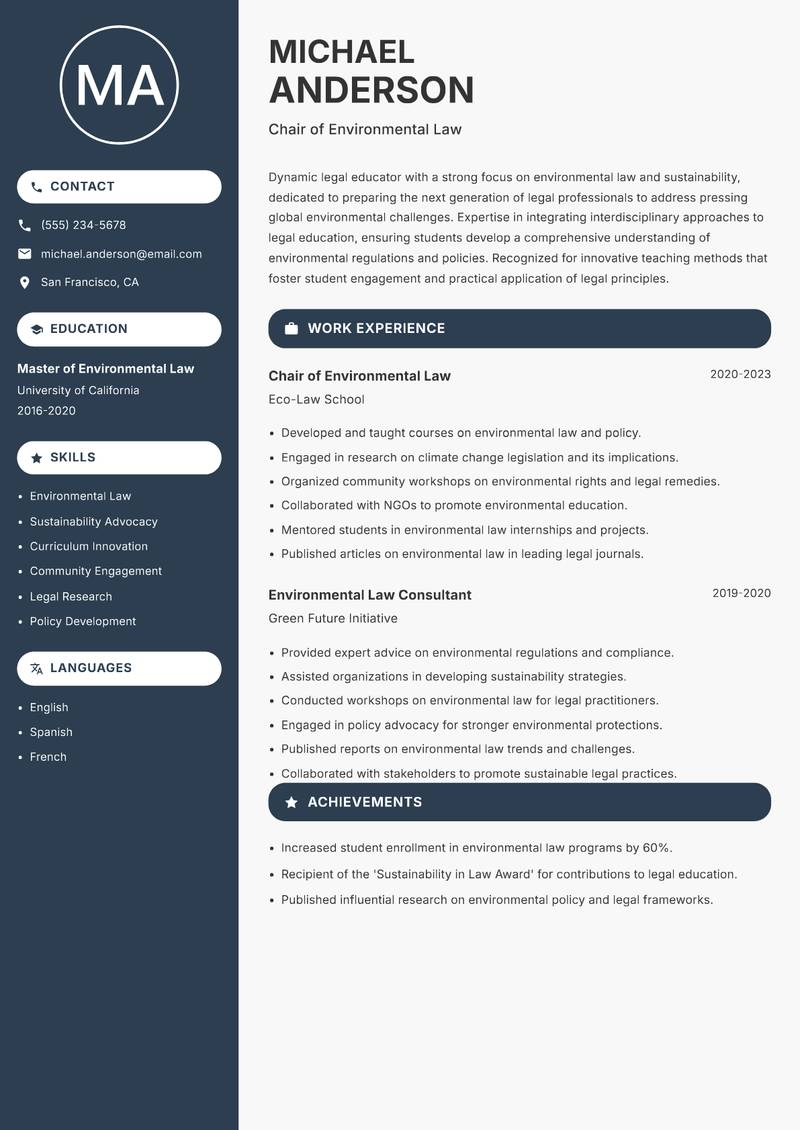
Compact
Use Template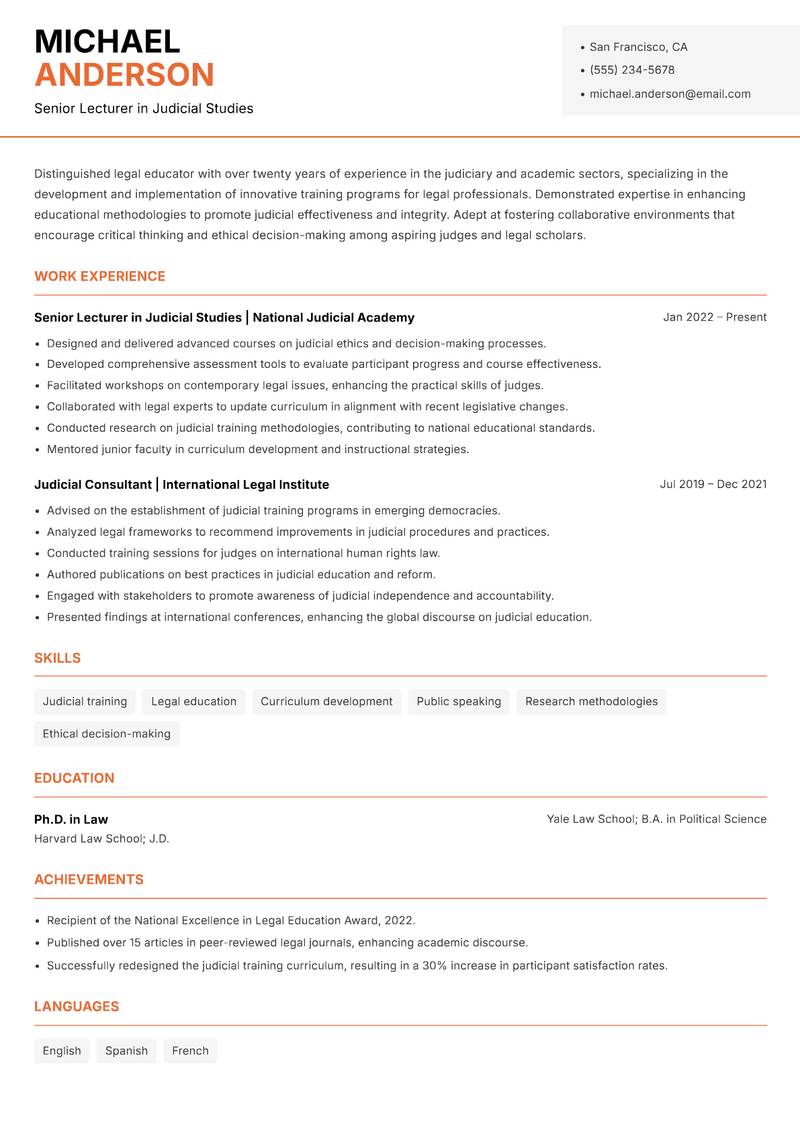
Modern Professional
Use Template7 Real Judicial Academy Faculty Resume Examples
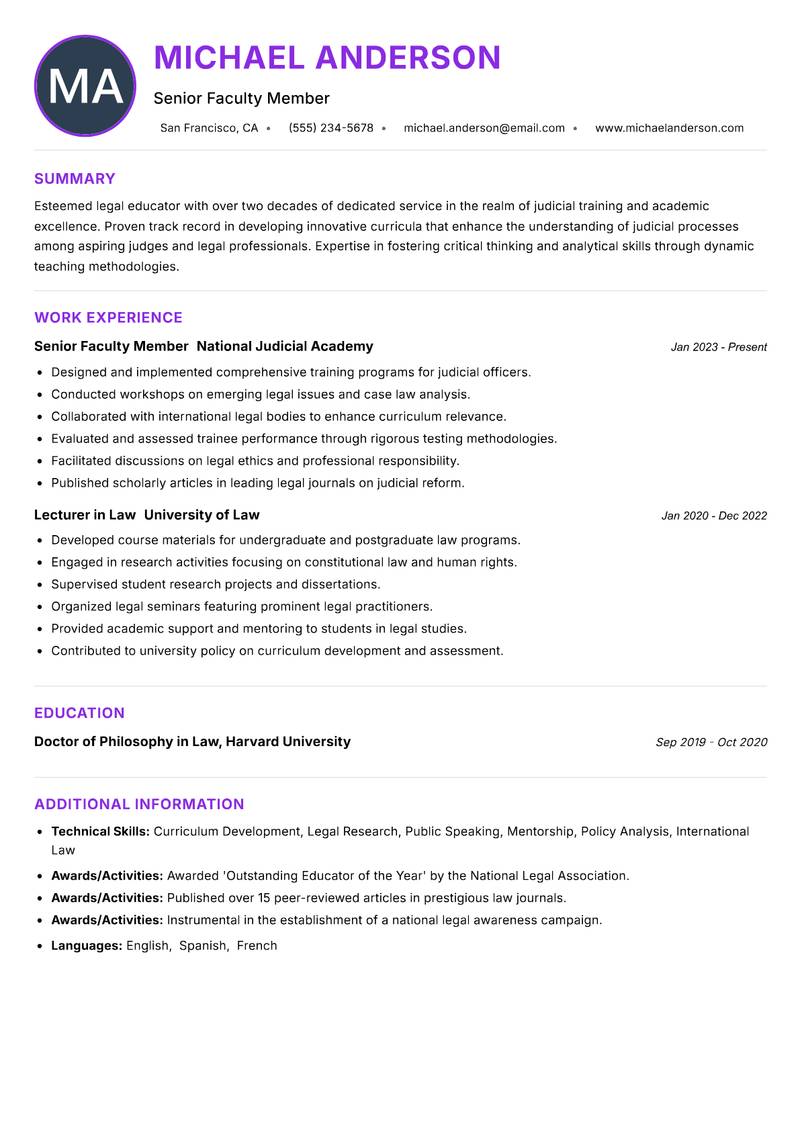
Senior Faculty Member with 14+ Years Experience
Summary: Esteemed legal educator with over two decades of dedicated service in the realm of judicial training and academic excellence. Proven track record in developing innovative curricula that enhance the understanding of judicial processes among aspiring judges and legal professionals. Expertise in fostering critical thinking and analytical skills through dynamic teaching methodologies. Adept at collaborating with governmental and educational institutions to promote legal literacy and enhance the judicial system's integrity. Committed to mentoring future leaders in the legal field, ensuring they are well-versed in both theoretical and practical aspects of law. Recognized for contributions to legal education and commitment to public service, facilitating a more informed and equitable legal landscape.
Description:
- Designed and implemented comprehensive training programs for judicial officers.
- Conducted workshops on emerging legal issues and case law analysis.
- Collaborated with international legal bodies to enhance curriculum relevance.
- Evaluated and assessed trainee performance through rigorous testing methodologies.
- Facilitated discussions on legal ethics and professional responsibility.
- Published scholarly articles in leading legal journals on judicial reform.
🏆 Key Achievements
Director of Judicial Education with 9+ Years Experience
Summary: Distinguished legal scholar and practitioner with extensive experience in judicial education and advocacy. Demonstrated ability to bridge theoretical knowledge with practical application in the legal field, particularly in the areas of criminal justice and civil rights. Recognized for innovative teaching methods that engage students and promote active learning. Expertise in curriculum design and development, ensuring alignment with contemporary legal standards and practices. Strong commitment to fostering a diverse and inclusive learning environment. Proven track record of collaboration with legal institutions to advance judicial training initiatives and enhance public understanding of the law.
Description:
- Oversaw the development of educational programs for judges and legal professionals.
- Facilitated training sessions on civil liberties and social justice issues.
- Collaborated with community organizations to promote legal education.
- Conducted evaluations of program effectiveness and participant satisfaction.
- Developed partnerships with international legal entities for knowledge exchange.
- Authored guidelines on best practices in judicial education.
🏆 Key Achievements
Professor of Law and Technology with 7+ Years Experience
Summary: Accomplished legal educator with a robust background in the intersection of law, technology, and ethics. Demonstrates an exceptional ability to adapt traditional legal education methodologies to incorporate modern technological advancements. Expertise in developing interdisciplinary programs that prepare students for the evolving demands of the legal profession in a digital age. Strong advocate for integrating practical experiences within the academic framework, ensuring students are equipped with necessary skills for success. Proven ability to engage diverse audiences through innovative teaching techniques and collaborative learning environments. Committed to promoting ethical standards in legal practice and education.
Description:
- Developed and taught courses on technology law and digital ethics.
- Led research projects on the implications of AI in legal practice.
- Organized interdisciplinary workshops with tech and legal experts.
- Mentored students in tech-focused legal initiatives and startups.
- Published research on the impact of technology on legal frameworks.
- Collaborated with industry leaders to enhance curriculum relevance.
🏆 Key Achievements
Chief of Judicial Training with 11+ Years Experience
Summary: Renowned legal professional with extensive experience in judicial administration and policy development. Expertise in designing and implementing training programs that enhance the operational efficiency of judicial systems. Proven ability to analyze complex legal frameworks and recommend improvements to enhance access to justice. Recognized for fostering collaboration among various stakeholders in the legal community to drive systemic change. Committed to promoting transparency and accountability within the judiciary while ensuring adherence to ethical standards. A strong advocate for legal reforms that drive equitable access to justice for all.
Description:
- Developed training modules for judicial staff and administrators.
- Conducted assessments of training program effectiveness.
- Collaborated with legal experts to update training content regularly.
- Facilitated national workshops on judicial ethics and best practices.
- Engaged in strategic planning to enhance judicial operations.
- Published reports on judicial training outcomes and recommendations.
🏆 Key Achievements
Professor of International Law with 13+ Years Experience
Summary: Accomplished legal educator specializing in international law and human rights, with a focus on equipping future legal professionals with the knowledge and skills necessary to navigate complex global legal frameworks. Demonstrates a profound commitment to social justice and advocacy, with extensive experience in teaching and mentoring students from diverse backgrounds. Recognized for effective curriculum development that integrates practical experiences with theoretical knowledge. Proven ability to engage students through innovative teaching strategies and real-world legal scenarios. Committed to fostering a collaborative learning environment that encourages critical thinking and ethical decision-making.
Description:
- Designed and delivered courses on international law and human rights.
- Supervised student internships with international organizations.
- Engaged in research on global legal challenges and human rights issues.
- Organized conferences on international legal standards and practices.
- Published articles on international law in peer-reviewed journals.
- Mentored students in advocacy projects and legal competitions.
🏆 Key Achievements
Chair of Environmental Law with 8+ Years Experience
Summary: Dynamic legal educator with a strong focus on environmental law and sustainability, dedicated to preparing the next generation of legal professionals to address pressing global environmental challenges. Expertise in integrating interdisciplinary approaches to legal education, ensuring students develop a comprehensive understanding of environmental regulations and policies. Recognized for innovative teaching methods that foster student engagement and practical application of legal principles. Proven ability to collaborate with environmental organizations to enhance curriculum relevance and impact. Committed to promoting ethical standards in environmental advocacy and legal practice. A passionate advocate for sustainability and responsible legal practices.
Description:
- Developed and taught courses on environmental law and policy.
- Engaged in research on climate change legislation and its implications.
- Organized community workshops on environmental rights and legal remedies.
- Collaborated with NGOs to promote environmental education.
- Mentored students in environmental law internships and projects.
- Published articles on environmental law in leading legal journals.
🏆 Key Achievements
Senior Lecturer in Judicial Studies with 20+ Years Experience
Summary: Distinguished legal educator with over twenty years of experience in the judiciary and academic sectors, specializing in the development and implementation of innovative training programs for legal professionals. Demonstrated expertise in enhancing educational methodologies to promote judicial effectiveness and integrity. Adept at fostering collaborative environments that encourage critical thinking and ethical decision-making among aspiring judges and legal scholars. Possesses a profound understanding of current legal frameworks and pedagogical strategies, ensuring that curriculum remains relevant and impactful. Recognized for contributions to legal scholarship and public policy advocacy, with a commitment to advancing the rule of law and justice. Proven ability to engage diverse audiences through dynamic presentations and workshops, facilitating a deeper understanding of complex legal principles and their practical applications.
Description:
- Designed and delivered advanced courses on judicial ethics and decision-making processes.
- Developed comprehensive assessment tools to evaluate participant progress and course effectiveness.
- Facilitated workshops on contemporary legal issues, enhancing the practical skills of judges.
- Collaborated with legal experts to update curriculum in alignment with recent legislative changes.
- Conducted research on judicial training methodologies, contributing to national educational standards.
- Mentored junior faculty in curriculum development and instructional strategies.
🏆 Key Achievements
Key Skills for Judicial Academy Faculty
ATS Optimization Tips
Increase your chances of getting hired
Use Standard Headings
Use common section titles like Experience, Skills, etc.
Include Keywords
Add role-specific keywords from the job description
Keep it Simple
Avoid complex tables, images and graphics
Save in Right Format
Use PDF format unless otherwise specified
Judicial Academy Faculty Salary Insights
Average Salary
$100,000
per year
Salary Range
$80,000 - $120,000
per year
Top Paying Cities
Los Angeles, Seattle, Houston, Dallas, Boston
Source: Glassdoor, Payscale, Indeed (Updated November 2025)
Everything you need to write a great Judicial Academy Faculty resume
Strong Action Verbs to Use
Resume Writing Tips
- →Highlight specific judicial training methodologies you have developed or implemented.
- →Demonstrate your engagement with the legal community through continuing education or professional development contributions.
- →Include examples of interdisciplinary teaching experiences that showcase innovative teaching strategies.
- →Mention any collaborative projects with local courts that illustrate practical application of legal theory.
- →Use metrics to quantify the impact of your educational strategies, such as improved student performance or increased program enrollments.
- →List any publications or presentations that articulate your expertise in legal education.
Common Mistakes to Avoid
- ✕Failing to tailor your teaching philosophy to the specific needs of judicial education.
- ✕Overlooking the importance of practical training within your curriculum design summaries.
- ✕Not emphasizing collaboration with state and federal judicial bodies that enhances program credibility.
- ✕Neglecting to include key achievements in faculty development or student mentorship.
- ✕Using vague language about legal concepts instead of providing concrete examples of instructional innovation.
ATS Keywords for Judicial Academy Faculty
Judicial Academy Faculty Career Path
Career Progression
Entry-Level Faculty
Leverage academic credentials and teaching skills to support non-tenured faculty in course instruction and administrative tasks.
Tenured Faculty Member
Secure a position with permanent employment status, engaging in advanced legal curriculum development and peer-reviewed research.
Department Chair
Oversee curriculum standards, faculty assignments, and departmental governance, liaising with academic boards and the judiciary.
Senior Fellow
Contribute to national judiciary education initiatives, shaping policies for judicial training and mentoring programs.
Chief Academic Officer
Lead academic strategy for a prominent judiciary educational institution, influencing national legal education reforms.
Judicial Academy Faculty Interview Questions
What unique approaches do you bring to curriculum development for legal education? +
Discuss specific methodologies, such as incorporating real-world case studies or interactive simulations.
How do you stay current with evolving legal standards and educational best practices? +
Highlight your involvement in legal forums, continuous education pursuits, or research participation.
Can you provide an example of how you've successfully mentored students or junior faculty? +
Illustrate your mentoring techniques or specific successes—such as students' career advancements—through your guidance.
What strategies do you use to assess student comprehension in a complex legal subject? +
Detail specific assessments or feedback loops unique to judicial education.
How would you handle resistance to new teaching methods from faculty or administration? +
Demonstrate conflict resolution skills, emphasizing collaboration and open communication.
What role do you believe simulation plays in training future judges? +
Discuss value in practical applications and real-life trial recreations for skill development.
About the Judicial Academy Faculty Role
A Judicial Academy Faculty member cultivates the next generation of judicial leaders by designing innovative, practice-based courses that bridge academic theory with practical courtroom experience. Alongside instruction, they engage in formative research that enhances the learning environment and informs judicial best practices. Collaborative relationships with judicial bodies ensure that curricula remain relevant and aligned with current legal standards and societal needs.
Frequently Asked Questions
What academic background is best for a Judicial Academy Faculty position? +
Candidates often require a Juris Doctor (JD) degree and substantial experience within the judicial system, including teaching or training roles.
Is it necessary to have prior teaching experience at a law school to apply? +
While prior teaching can be beneficial, practical experience in the judiciary and a passion for educational development are equally valued.
What are the key skills needed to excel as a Judicial Academy Faculty? +
Essential skills include effective communication, curriculum design, legal research expertise, and mentoring capabilities.
How can one remain updated with the latest developments in judicial education? +
Engagement in professional organizations, attending legal education conferences, and publishing research in relevant journals are crucial.
What is the typical career progression for a Judicial Academy Faculty member? +
Career progression often involves moving from entry-level teaching roles to tenure-track positions and eventually into administrative leadership.
In what ways do Judicial Academy Faculty contribute to national legal standards? +
They influence standards through curriculum development, conducting research, and offering insights at legal educational conferences.
More Resume Examples You Might Like
Related Career Paths
Other roles candidates for Judicial Academy Faculty positions often also consider.
Will this Judicial Academy Faculty resume pass the ATS scan?
Upload it and get an instant AI-scored compatibility check with specific fixes.
Check My Resume →
Pair it with a matching cover letter
AI drafts a first version from your job title and strengths — edit it live, then download the PDF.
Write My Cover Letter →
Written by Nohaya Career Team
Reviewed by HR Professionals · Updated November 2025
Ready to Build Your Perfect Resume?
Choose from 1000+ professional templates and land your dream job.
Create My Resume Now