Build an ATS-Friendly
Agronomy Scientist Resume
That Gets Interviews
An Agronomy Scientist conducts empirical research to improve crop yield and soil health, integrating principles of biology, chemistry, and environmental science. This role entails developing innovative agricultural practices tailored to specific environmental conditions while analyzing data from field trials and lab…
Agronomy Scientist Resume Templates
Modern Professional
Use Template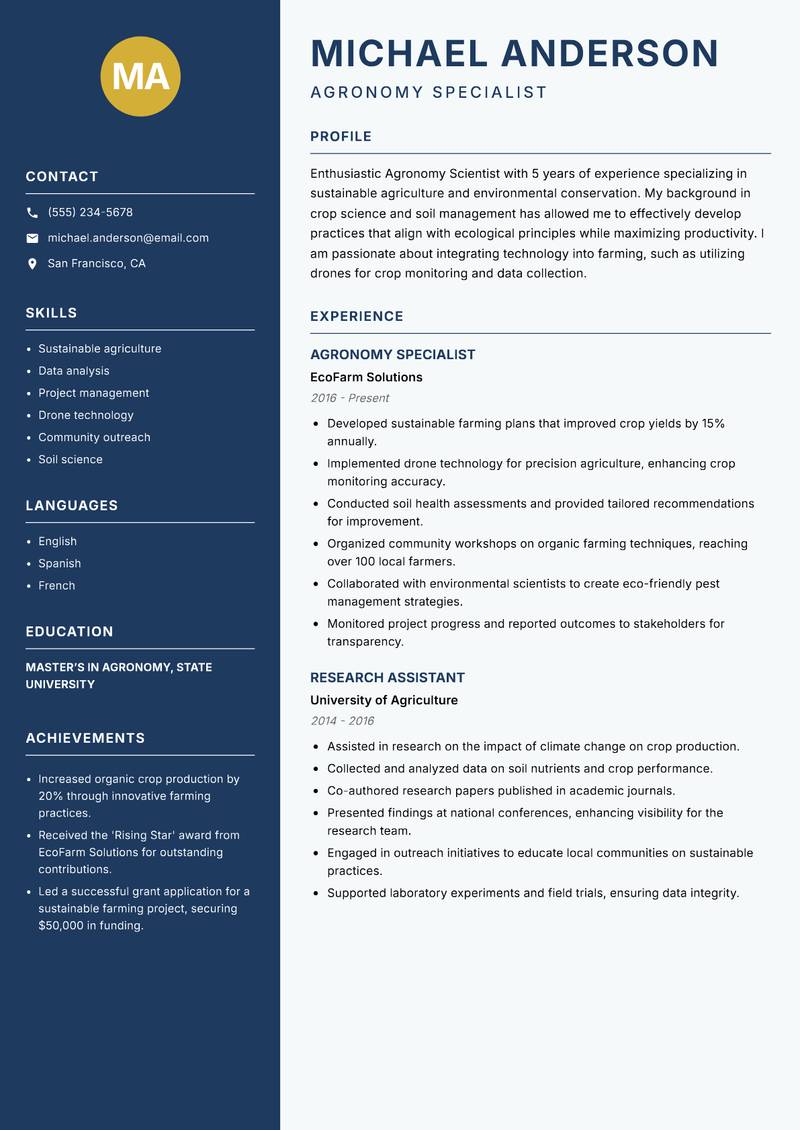
Classic Clean
Use Template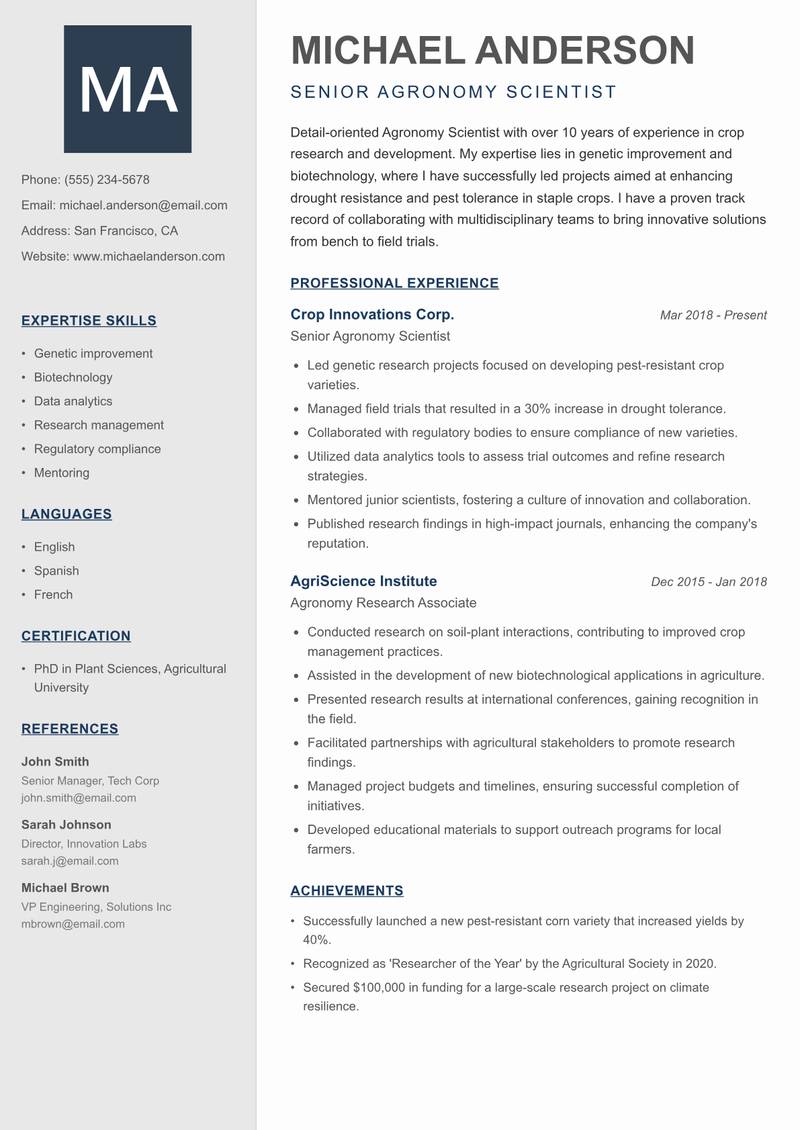
Creative Minimal
Use Template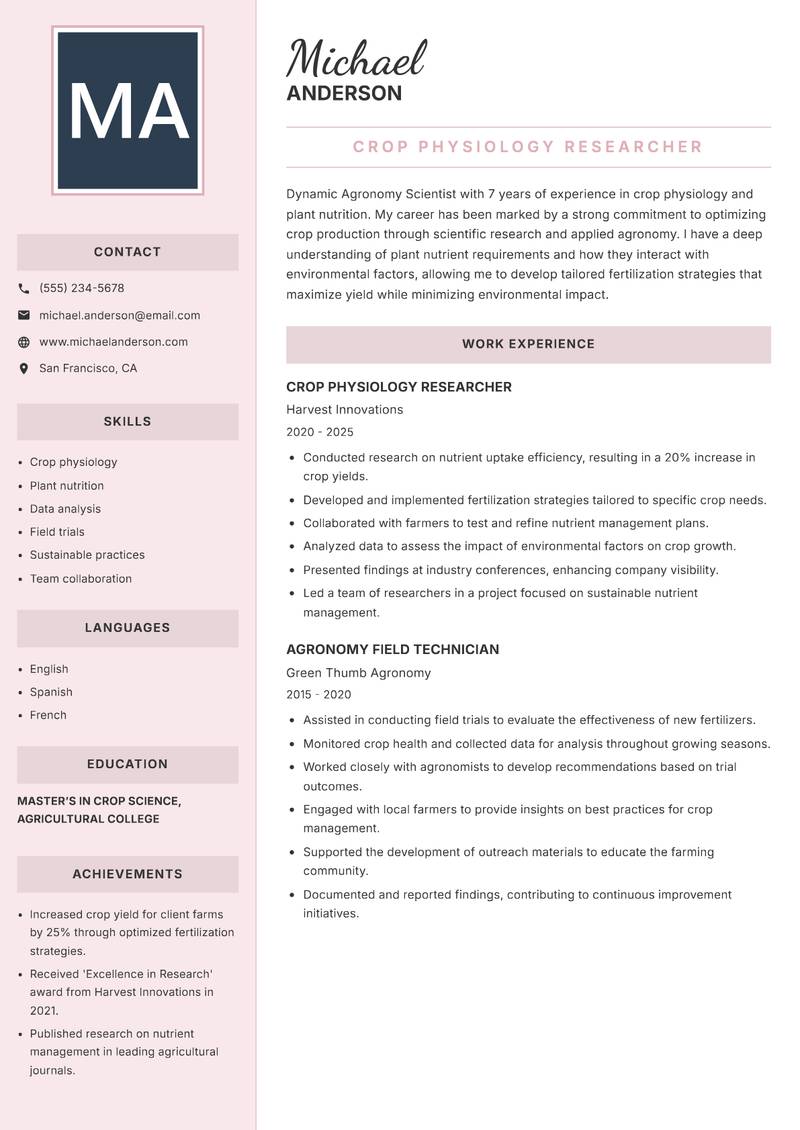
Executive
Use Template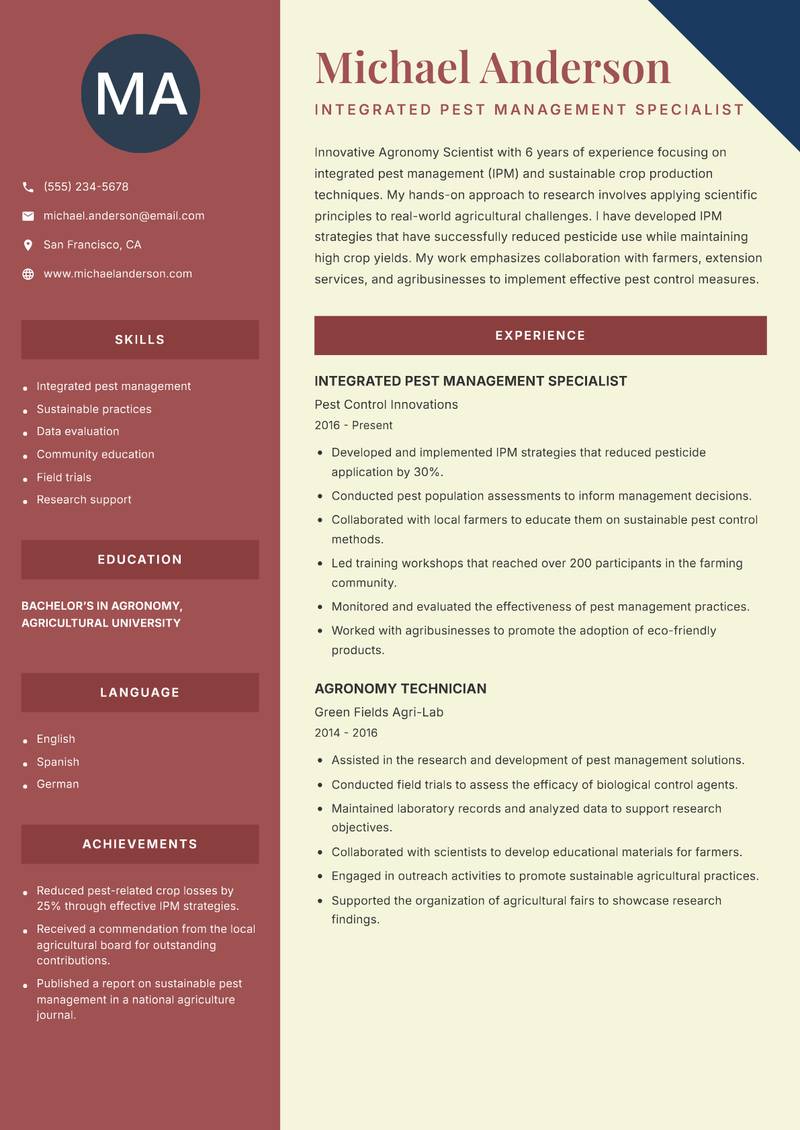
Two Column
Use Template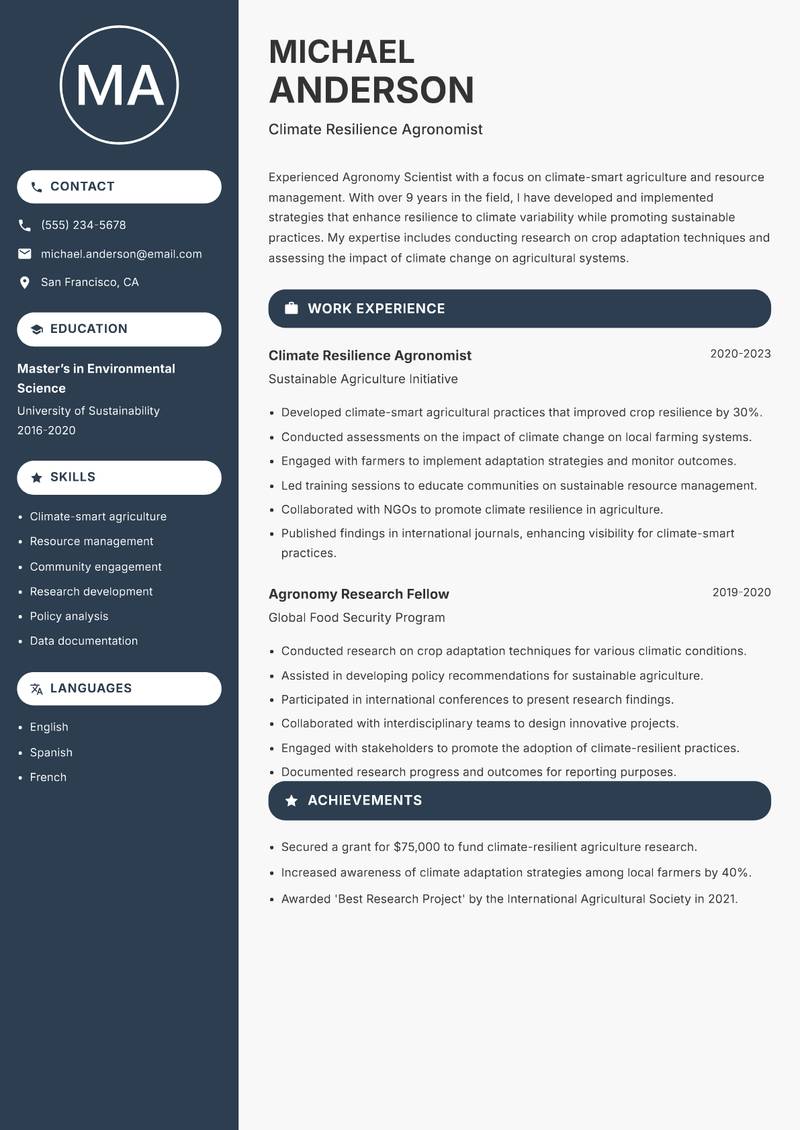
Compact
Use Template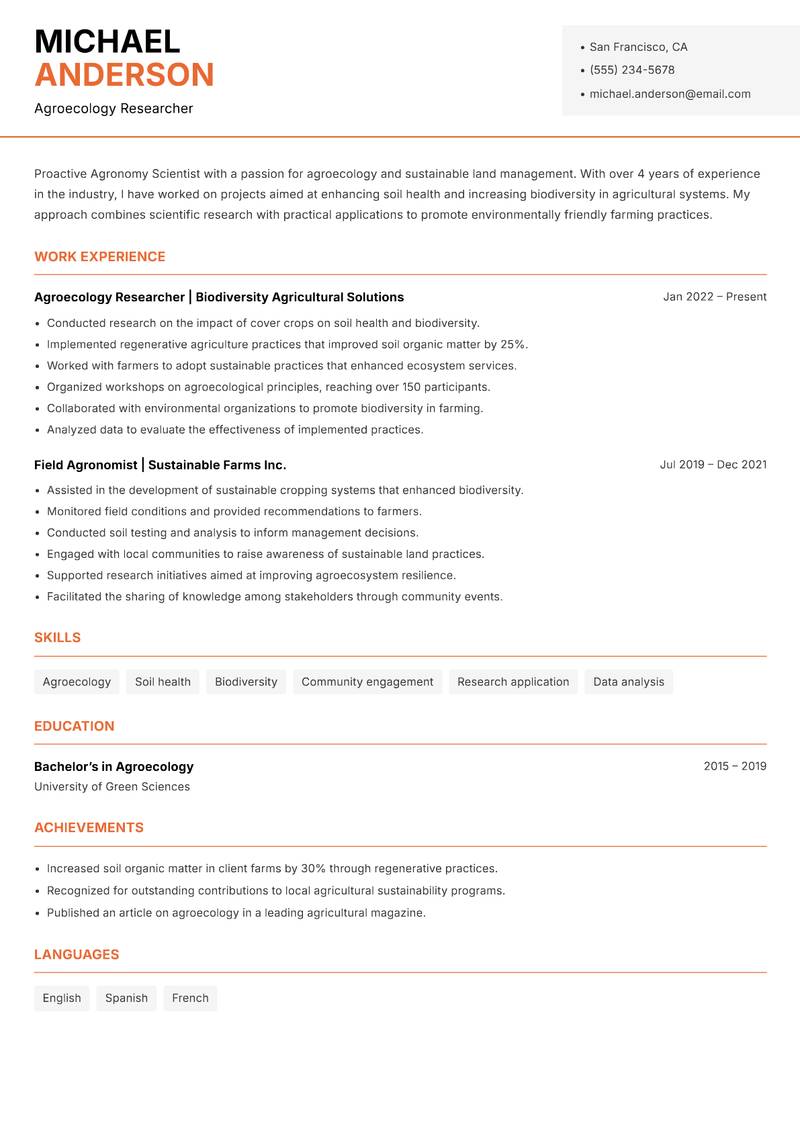
Modern Professional
Use Template7 Real Agronomy Scientist Resume Examples
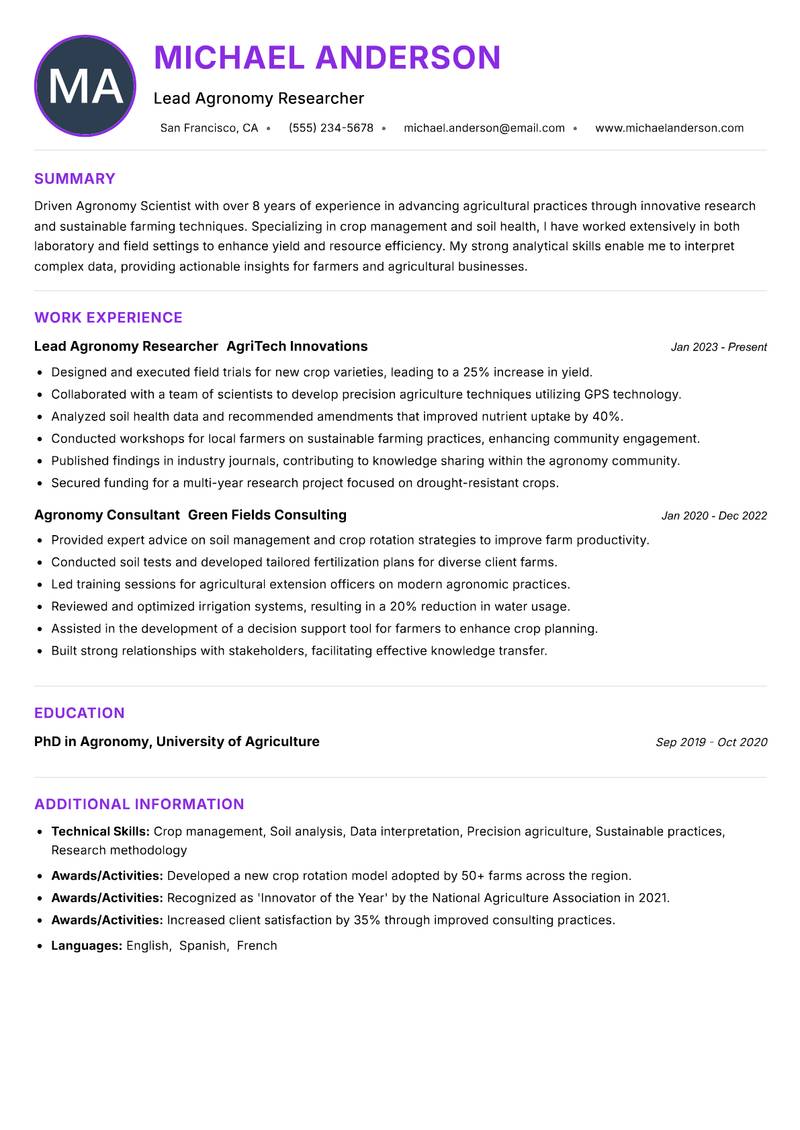
Lead Agronomy Researcher with 8+ Years Experience
Summary: Driven Agronomy Scientist with over 8 years of experience in advancing agricultural practices through innovative research and sustainable farming techniques. Specializing in crop management and soil health, I have worked extensively in both laboratory and field settings to enhance yield and resource efficiency. My strong analytical skills enable me to interpret complex data, providing actionable insights for farmers and agricultural businesses. I am adept at collaborating with cross-functional teams, including agronomists, biologists, and engineers, to develop comprehensive solutions for crop production challenges. With a commitment to sustainability, I have contributed to projects that have reduced pesticide usage by 30% and improved soil quality across multiple sites. Passionate about educating stakeholders on the latest agronomic practices, I frequently conduct workshops and presentations that empower farmers to make informed decisions. I hold a PhD in Agronomy and have published numerous articles in peer-reviewed journals, further establishing my expertise in the field.
Description:
- Designed and executed field trials for new crop varieties, leading to a 25% increase in yield.
- Collaborated with a team of scientists to develop precision agriculture techniques utilizing GPS technology.
- Analyzed soil health data and recommended amendments that improved nutrient uptake by 40%.
- Conducted workshops for local farmers on sustainable farming practices, enhancing community engagement.
- Published findings in industry journals, contributing to knowledge sharing within the agronomy community.
- Secured funding for a multi-year research project focused on drought-resistant crops.
🏆 Key Achievements
Agronomy Specialist with 5+ Years Experience
Summary: Enthusiastic Agronomy Scientist with 5 years of experience specializing in sustainable agriculture and environmental conservation. My background in crop science and soil management has allowed me to effectively develop practices that align with ecological principles while maximizing productivity. I am passionate about integrating technology into farming, such as utilizing drones for crop monitoring and data collection. My experience includes working directly with farmers to implement innovative solutions that address specific challenges in crop yield and pest management. I excel in project management, leading teams through complex operational tasks while ensuring adherence to regulatory standards. My commitment to education is demonstrated through my active participation in community outreach programs, training farmers on sustainable techniques and the importance of biodiversity in agriculture. I hold a Master’s degree in Agronomy and am eager to contribute to a team focused on advancing agricultural technologies.
Description:
- Developed sustainable farming plans that improved crop yields by 15% annually.
- Implemented drone technology for precision agriculture, enhancing crop monitoring accuracy.
- Conducted soil health assessments and provided tailored recommendations for improvement.
- Organized community workshops on organic farming techniques, reaching over 100 local farmers.
- Collaborated with environmental scientists to create eco-friendly pest management strategies.
- Monitored project progress and reported outcomes to stakeholders for transparency.
🏆 Key Achievements
Senior Agronomy Scientist with 10+ Years Experience
Summary: Detail-oriented Agronomy Scientist with over 10 years of experience in crop research and development. My expertise lies in genetic improvement and biotechnology, where I have successfully led projects aimed at enhancing drought resistance and pest tolerance in staple crops. I have a proven track record of collaborating with multidisciplinary teams to bring innovative solutions from bench to field trials. My role often involves liaising with government agencies and stakeholders to ensure compliance and promote the adoption of new technologies. Additionally, I am skilled in utilizing data analytics to drive decision-making processes, contributing to the strategic planning of research initiatives. With a PhD in Plant Sciences, I am committed to advancing agricultural sustainability and productivity through scientific innovation and outreach. My passion for mentoring junior scientists has also played a significant role in shaping the next generation of agronomists.
Description:
- Led genetic research projects focused on developing pest-resistant crop varieties.
- Managed field trials that resulted in a 30% increase in drought tolerance.
- Collaborated with regulatory bodies to ensure compliance of new varieties.
- Utilized data analytics tools to assess trial outcomes and refine research strategies.
- Mentored junior scientists, fostering a culture of innovation and collaboration.
- Published research findings in high-impact journals, enhancing the company's reputation.
🏆 Key Achievements
Crop Physiology Researcher with 7+ Years Experience
Summary: Dynamic Agronomy Scientist with 7 years of experience in crop physiology and plant nutrition. My career has been marked by a strong commitment to optimizing crop production through scientific research and applied agronomy. I have a deep understanding of plant nutrient requirements and how they interact with environmental factors, allowing me to develop tailored fertilization strategies that maximize yield while minimizing environmental impact. My experience includes conducting extensive field trials and collaborating with farmers to implement my findings. I am passionate about using data-driven approaches to solve agronomic challenges and have a proven record of increasing crop yields through targeted interventions. As a team player, I thrive in collaborative environments and enjoy leading cross-functional projects that bridge scientific research with practical applications. I hold a Master’s degree in Crop Science and am continuously seeking ways to improve agricultural sustainability.
Description:
- Conducted research on nutrient uptake efficiency, resulting in a 20% increase in crop yields.
- Developed and implemented fertilization strategies tailored to specific crop needs.
- Collaborated with farmers to test and refine nutrient management plans.
- Analyzed data to assess the impact of environmental factors on crop growth.
- Presented findings at industry conferences, enhancing company visibility.
- Led a team of researchers in a project focused on sustainable nutrient management.
🏆 Key Achievements
Integrated Pest Management Specialist with 6+ Years Experience
Summary: Innovative Agronomy Scientist with 6 years of experience focusing on integrated pest management (IPM) and sustainable crop production techniques. My hands-on approach to research involves applying scientific principles to real-world agricultural challenges. I have developed IPM strategies that have successfully reduced pesticide use while maintaining high crop yields. My work emphasizes collaboration with farmers, extension services, and agribusinesses to implement effective pest control measures. I am passionate about educating stakeholders on sustainable practices and have trained over 200 farmers in pest management techniques. My strong analytical skills allow me to evaluate pest populations and recommend timely interventions that lead to optimal crop health. I hold a Bachelor’s degree in Agronomy and am dedicated to improving agricultural practices for future generations.
Description:
- Developed and implemented IPM strategies that reduced pesticide application by 30%.
- Conducted pest population assessments to inform management decisions.
- Collaborated with local farmers to educate them on sustainable pest control methods.
- Led training workshops that reached over 200 participants in the farming community.
- Monitored and evaluated the effectiveness of pest management practices.
- Worked with agribusinesses to promote the adoption of eco-friendly products.
🏆 Key Achievements
Climate Resilience Agronomist with 9+ Years Experience
Summary: Experienced Agronomy Scientist with a focus on climate-smart agriculture and resource management. With over 9 years in the field, I have developed and implemented strategies that enhance resilience to climate variability while promoting sustainable practices. My expertise includes conducting research on crop adaptation techniques and assessing the impact of climate change on agricultural systems. I have led multidisciplinary teams to address challenges in food security through innovative agricultural practices. My role often involves engaging with local communities to disseminate knowledge on climate adaptation strategies, ensuring farmers are equipped to handle changing conditions. I hold a Master’s degree in Environmental Science with a specialization in Agriculture and have contributed to various international projects aimed at promoting climate resilience in farming systems.
Description:
- Developed climate-smart agricultural practices that improved crop resilience by 30%.
- Conducted assessments on the impact of climate change on local farming systems.
- Engaged with farmers to implement adaptation strategies and monitor outcomes.
- Led training sessions to educate communities on sustainable resource management.
- Collaborated with NGOs to promote climate resilience in agriculture.
- Published findings in international journals, enhancing visibility for climate-smart practices.
🏆 Key Achievements
Agroecology Researcher with 4+ Years Experience
Summary: Driven Agronomy Scientist with a passion for agroecology and sustainable land management. With over 4 years of experience in the industry, I have worked on projects aimed at enhancing soil health and increasing biodiversity in agricultural systems. My approach combines scientific research with practical applications to promote environmentally friendly farming practices. I am skilled in conducting soil assessments and implementing regenerative agricultural techniques that lead to improved ecosystem services. My ability to communicate complex scientific concepts to diverse audiences has been instrumental in driving community engagement and farmer adoption of sustainable practices. I hold a Bachelor’s degree in Agroecology and am dedicated to fostering an understanding of the importance of biodiversity in agriculture.
Description:
- Conducted research on the impact of cover crops on soil health and biodiversity.
- Implemented regenerative agriculture practices that improved soil organic matter by 25%.
- Worked with farmers to adopt sustainable practices that enhanced ecosystem services.
- Organized workshops on agroecological principles, reaching over 150 participants.
- Collaborated with environmental organizations to promote biodiversity in farming.
- Analyzed data to evaluate the effectiveness of implemented practices.
🏆 Key Achievements
Key Skills for Agronomy Scientist
ATS Optimization Tips
Increase your chances of getting hired
Use Standard Headings
Use common section titles like Experience, Skills, etc.
Include Keywords
Add role-specific keywords from the job description
Keep it Simple
Avoid complex tables, images and graphics
Save in Right Format
Use PDF format unless otherwise specified
Agronomy Scientist Salary Insights
Average Salary
$77,500
per year
Salary Range
$55,000 - $100,000
per year
Top Paying Cities
Los Angeles, Seattle, Houston, Dallas, Boston
Source: Glassdoor, Payscale, Indeed (Updated May 2025)
Everything you need to write a great Agronomy Scientist resume
Strong Action Verbs to Use
Resume Writing Tips
- →Highlight specific research projects that resulted in measurable improvements in crop yield.
- →Include your experience with the latest agricultural technologies and methods, particularly in precision farming.
- →Demonstrate your understanding of local agricultural challenges and present tailored solutions in your resume.
- →Showcase any collaborative projects with farmers or agricultural organizations to emphasize stakeholder engagement.
- →Use concrete metrics to illustrate the impact of your work, such as percentage yield increases or cost savings.
Common Mistakes to Avoid
- ✕Neglecting to tailor your resume to specific agronomy-related keywords found in job descriptions.
- ✕Focusing too much on technical jargon without explaining its relevance to practical outcomes.
- ✕Failing to quantify your achievements, such as improvements in yield or reductions in resource usage.
- ✕Listing generic skills instead of specialized agronomic techniques relevant to the job.
ATS Keywords for Agronomy Scientist
Agronomy Scientist Career Path
Relevant Certifications
Career Progression
Entry-Level Agronomy Scientist
Involves supporting senior scientists, collecting field data, and conducting laboratory tests.
Agronomy Research Analyst
Focuses on analyzing crop data trends, producing reports, and contributing to research publications.
Senior Agronomy Scientist
Leads independent research projects, mentors junior staff, and collaborates with stakeholders on agronomic solutions.
Agronomist Manager
Oversees a team of scientists and coordinates large scale agricultural research programs.
Director of Agronomy
Sets organizational research direction, manages budgets, and represents the institution in industry collaborations.
Agronomy Scientist Interview Questions
What specific technologies do you use for data collection in agronomy? +
Explain your hands-on experience with technologies like drones, sensors, or satellite imagery.
Can you give an example of a successful project you led regarding crop rotation? +
Be prepared to describe challenges, methodologies, and results.
How do you ensure compliance with environmental regulations in your agronomy projects? +
Discuss your familiarity with regulations and how you implement guidelines.
Describe your experience working with local farmers or agricultural stakeholders. +
Highlight instances of collaboration and knowledge-sharing.
What role does sustainable agriculture play in your research? +
Provide examples where you've influenced sustainable practices.
How have you contributed to peer-reviewed publications? +
Share specific instances where your research was published or presented.
In your opinion, what is the most significant challenge facing agronomy today? +
Discuss emerging issues and potential solutions.
About the Agronomy Scientist Role
An Agronomy Scientist conducts empirical research to improve crop yield and soil health, integrating principles of biology, chemistry, and environmental science. This role entails developing innovative agricultural practices tailored to specific environmental conditions while analyzing data from field trials and lab experiments. Collaboration with farmers and agribusinesses is critical to translate research findings into practical applications that enhance productivity sustainably.
Frequently Asked Questions
View all →What educational background is necessary to become an Agronomy Scientist? +
A degree in agronomy, plant science, or agricultural science is typically required, often a Master's or Ph.D. for advanced positions.
What tools and technologies should an Agronomy Scientist be familiar with? +
Knowledge of GIS software, remote sensing tools, soil sampling equipment, and statistical analysis software is crucial.
How essential are internships in this career? +
Internships provide practical experience and networking opportunities, making them highly valuable for aspiring Agronomy Scientists.
What professional organizations can benefit an Agronomy Scientist? +
Joining organizations like the American Society of Agronomy can provide resources, networking, and continuing education.
What are the common challenges faced in agronomy research? +
Challenges include climate variability, soil degradation, pest management, and ensuring sustainability amidst agricultural demands.
How can an Agronomy Scientist contribute to sustainability efforts? +
By researching sustainable practices and technologies that improve yield while minimizing environmental impact.
What types of careers opportunities exist beyond field research for Agronomy Scientists? +
Careers can extend to policy development, education, agribusiness consulting, and industry outreach programs.
More Resume Examples You Might Like
Related Career Paths
Other roles candidates for Agronomy Scientist positions often also consider.
Will this Agronomy Scientist resume pass the ATS scan?
Upload it and get an instant AI-scored compatibility check with specific fixes.
Check My Resume →
Pair it with a matching cover letter
AI drafts a first version from your job title and strengths — edit it live, then download the PDF.
Write My Cover Letter →
Written by Nohaya Career Team
Reviewed by HR Professionals · Updated May 2025
Ready to Build Your Perfect Resume?
Choose from 1000+ professional templates and land your dream job.
Create My Resume Now