Build an ATS-Friendly
Volcanologist Resume
That Gets Interviews
Volcanologists study the formation, eruption processes, and movement of volcanoes. They utilize field research and advanced modeling tools to analyze the dynamics of volcanoes, including seismic activity and gas emissions. This role requires rigorous data collection and collaboration with local communities and…
Volcanologist Resume Templates
Modern Professional
Use Template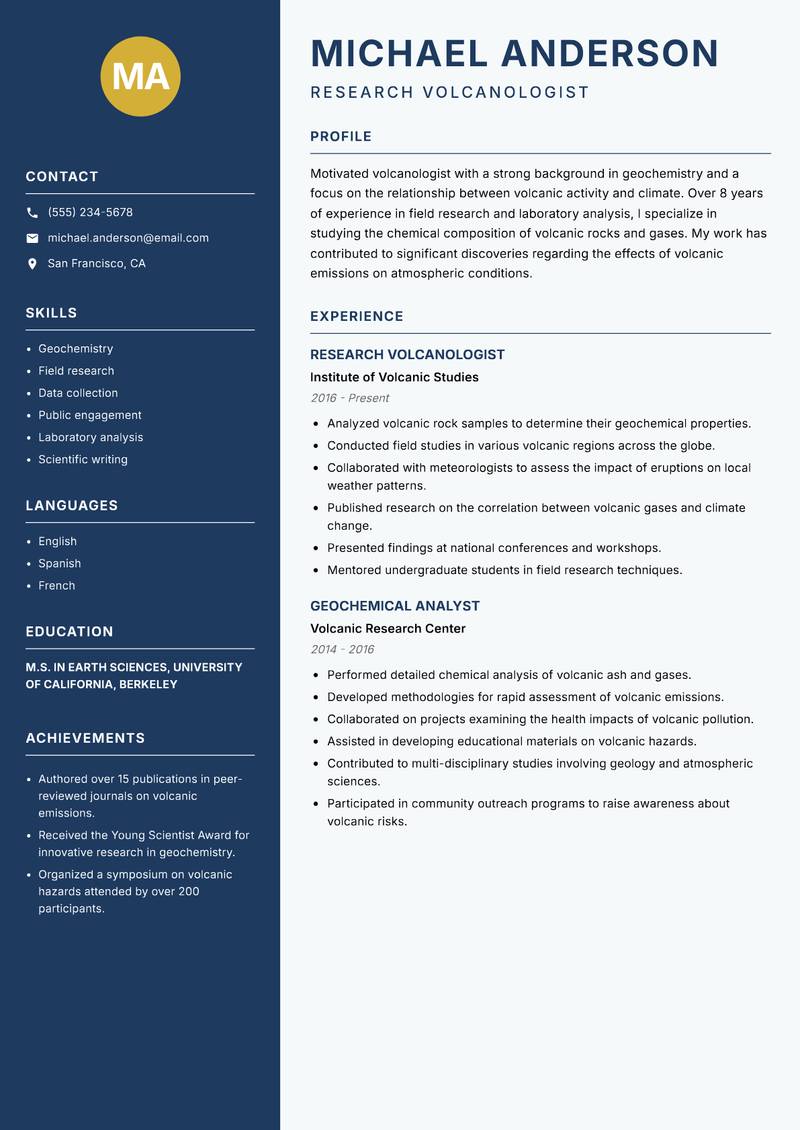
Classic Clean
Use Template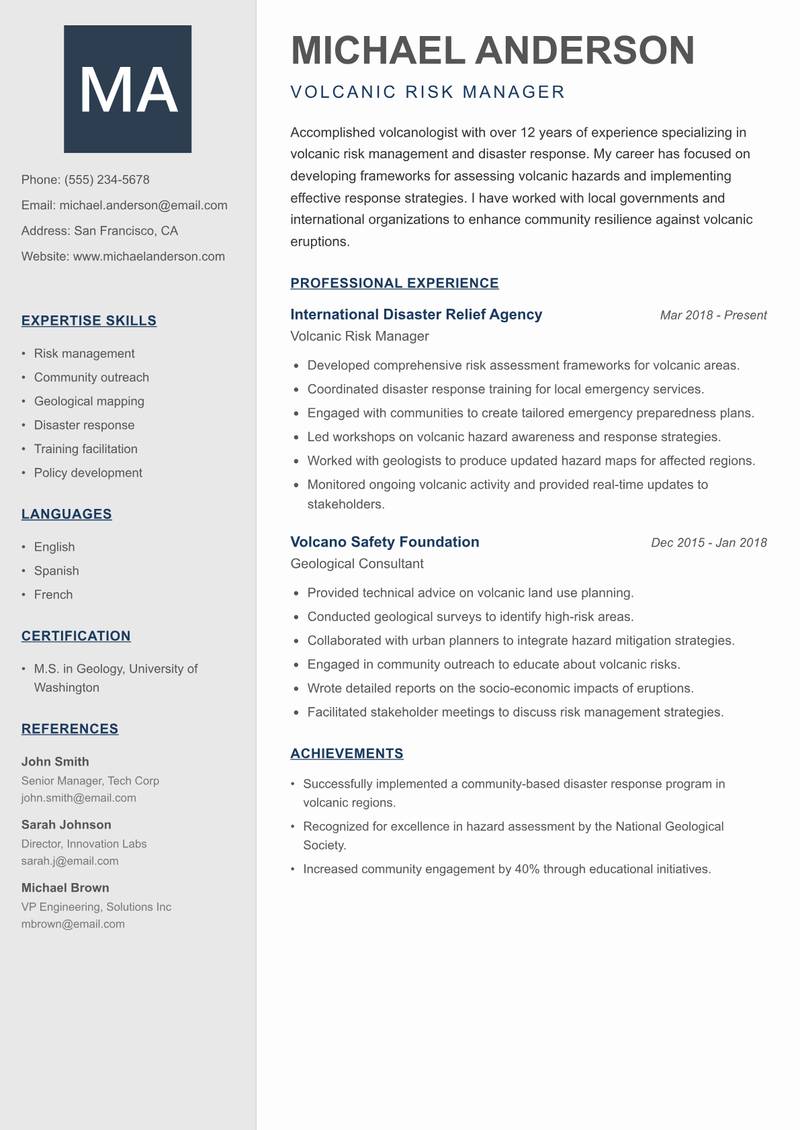
Creative Minimal
Use Template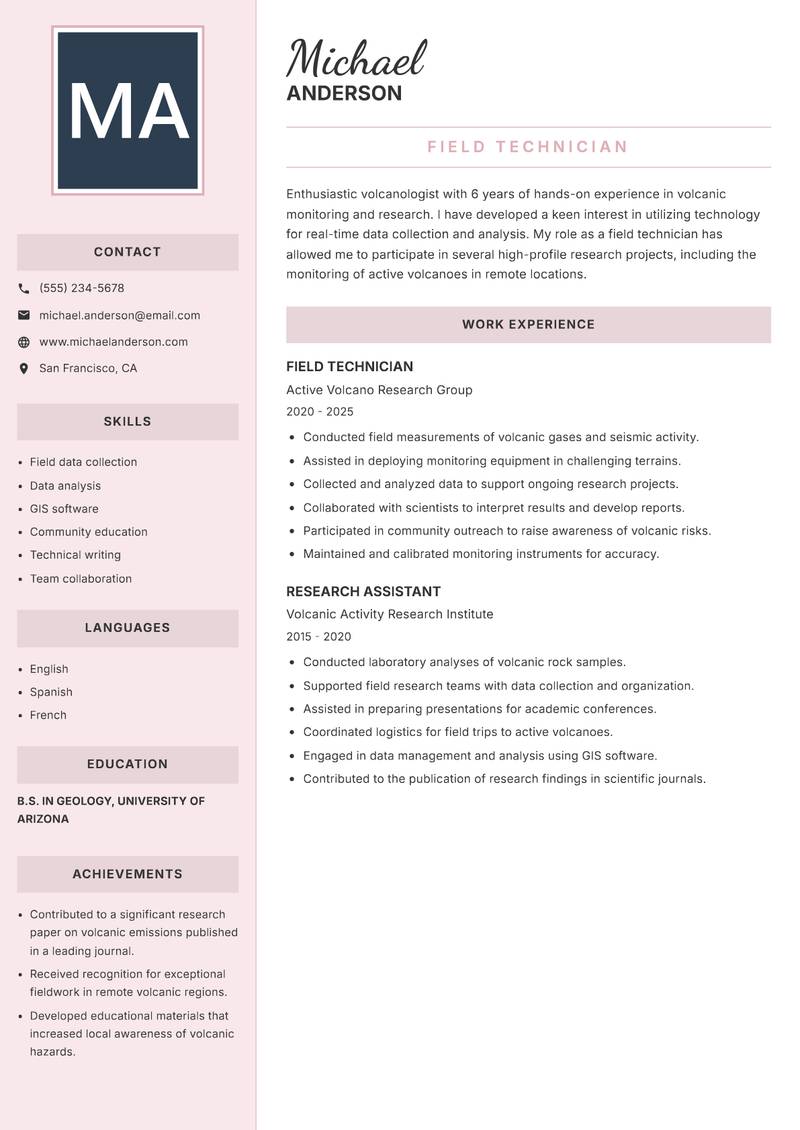
Executive
Use Template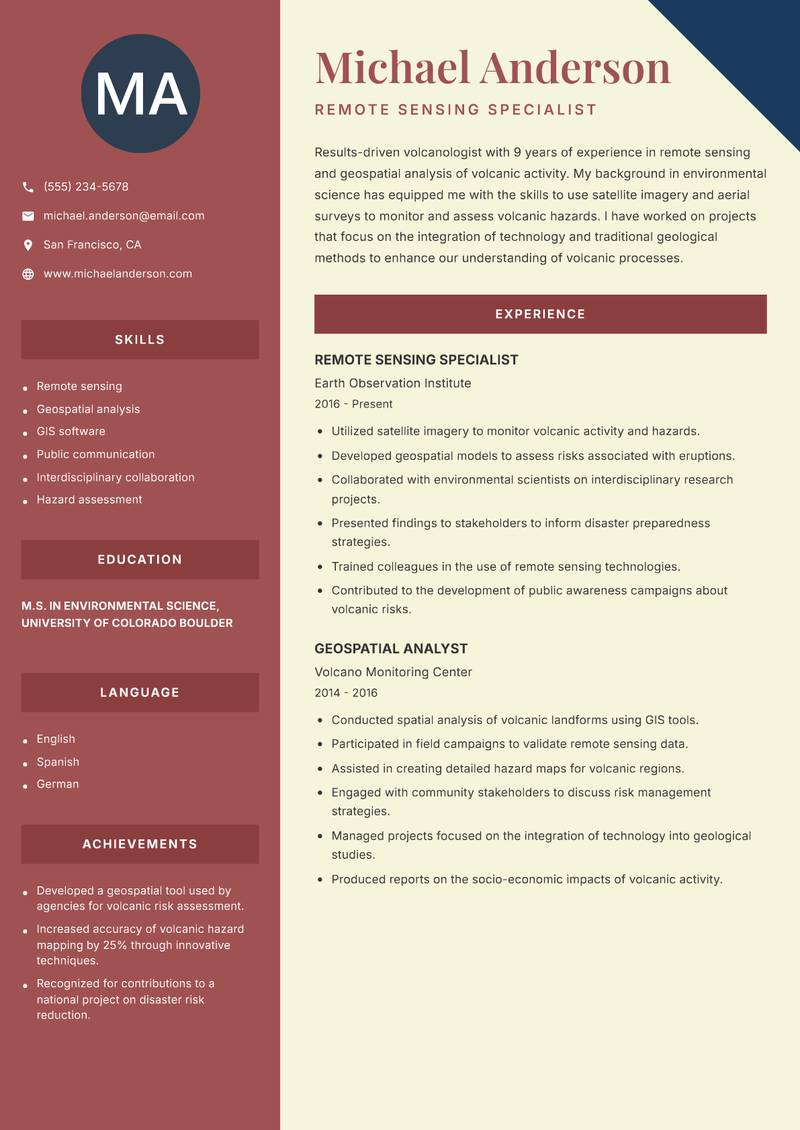
Two Column
Use Template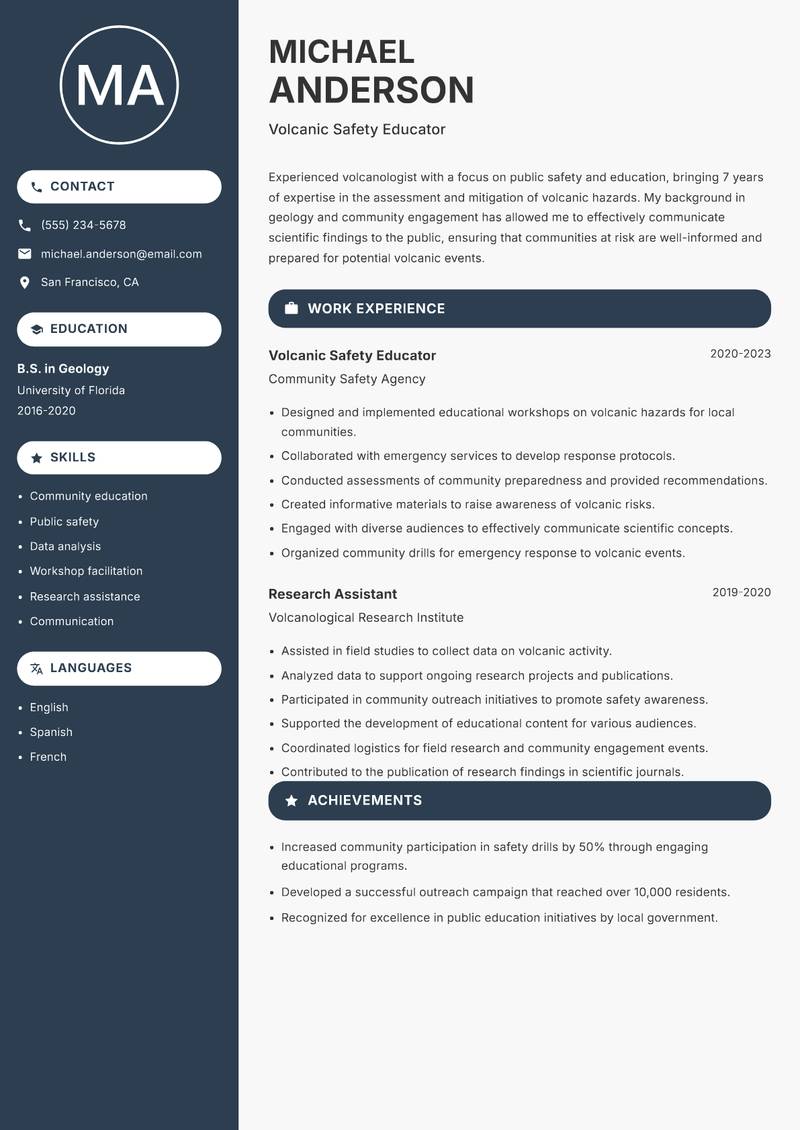
Compact
Use Template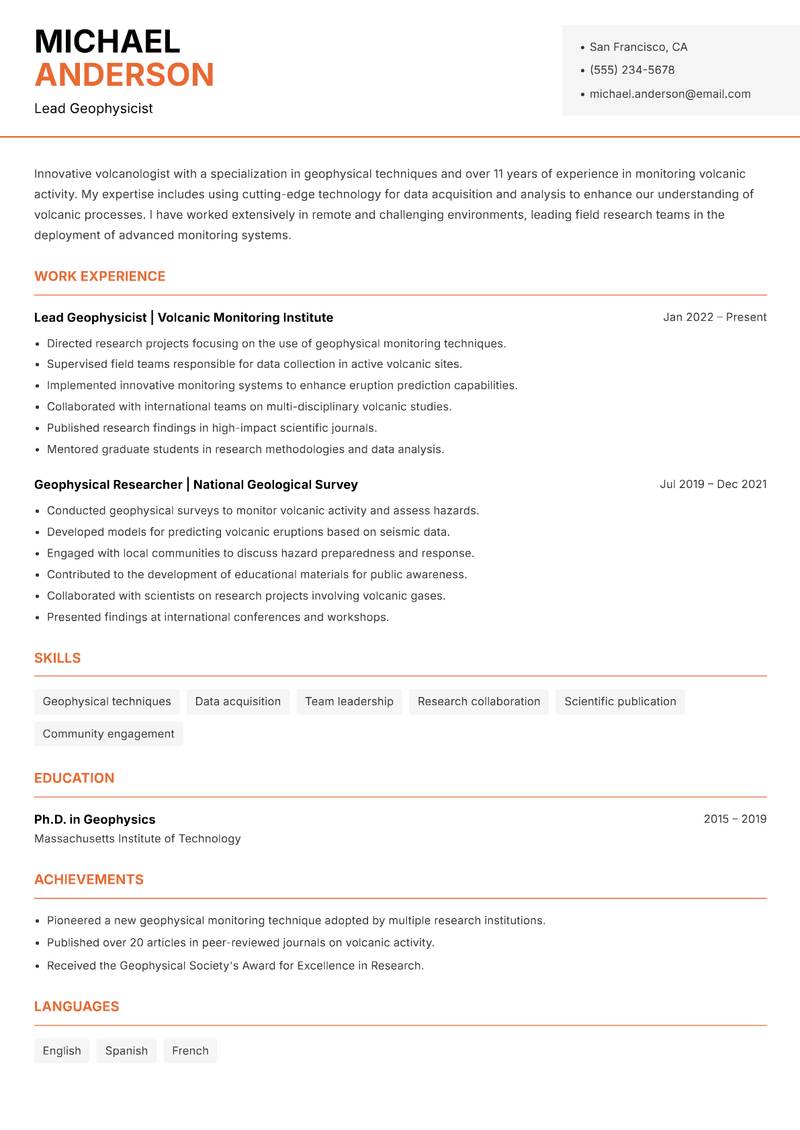
Modern Professional
Use Template7 Real Volcanologist Resume Examples
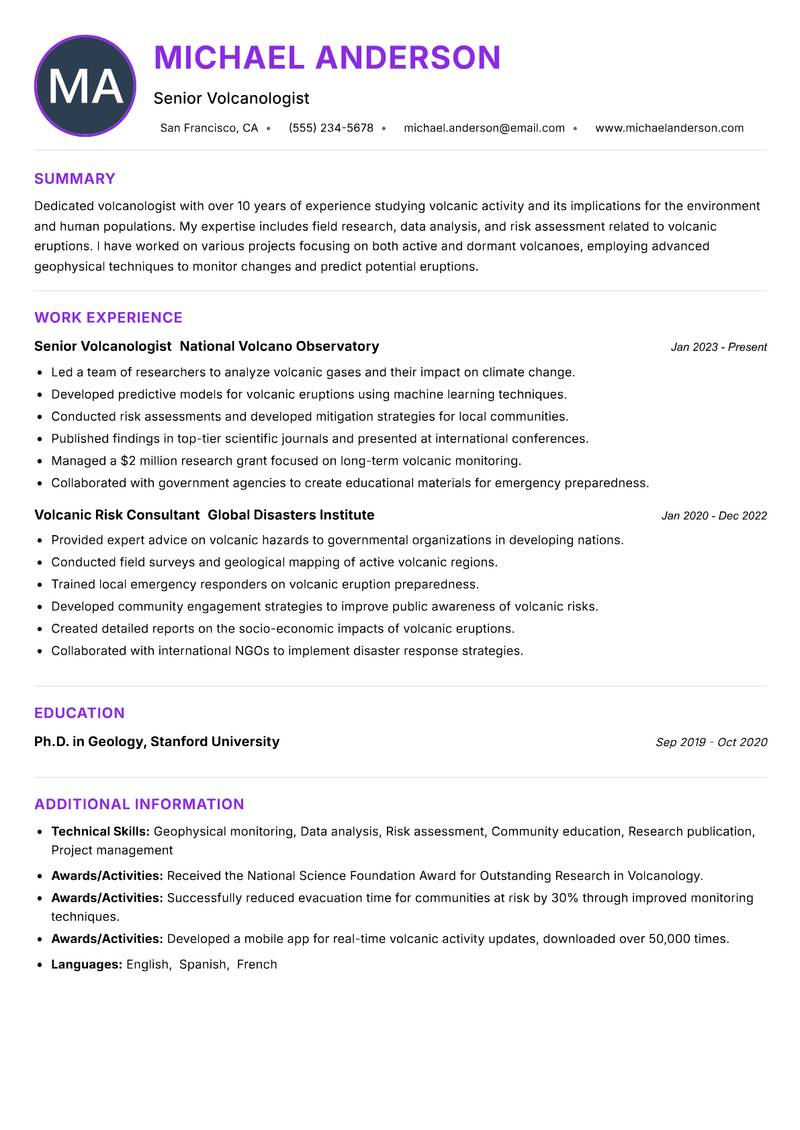
Senior Volcanologist with 10+ Years Experience
Summary: Dedicated volcanologist with over 10 years of experience studying volcanic activity and its implications for the environment and human populations. My expertise includes field research, data analysis, and risk assessment related to volcanic eruptions. I have worked on various projects focusing on both active and dormant volcanoes, employing advanced geophysical techniques to monitor changes and predict potential eruptions. I excel in collaboration with interdisciplinary teams and have contributed significantly to public safety initiatives in areas prone to volcanic activity. My passion for educating communities about volcanic risks and safety measures allows me to bridge the gap between scientific research and practical application. With a Ph.D. in Geology, I am committed to advancing the field of volcanology through innovative research and outreach programs. I thrive in challenging environments and am keen on mentoring the next generation of geoscientists. I have published numerous papers in peer-reviewed journals and presented my findings at international conferences, showcasing my commitment to furthering our understanding of volcanic processes.
Description:
- Led a team of researchers to analyze volcanic gases and their impact on climate change.
- Developed predictive models for volcanic eruptions using machine learning techniques.
- Conducted risk assessments and developed mitigation strategies for local communities.
- Published findings in top-tier scientific journals and presented at international conferences.
- Managed a $2 million research grant focused on long-term volcanic monitoring.
- Collaborated with government agencies to create educational materials for emergency preparedness.
🏆 Key Achievements
Research Volcanologist with 8+ Years Experience
Summary: Driven volcanologist with a strong background in geochemistry and a focus on the relationship between volcanic activity and climate. Over 8 years of experience in field research and laboratory analysis, I specialize in studying the chemical composition of volcanic rocks and gases. My work has contributed to significant discoveries regarding the effects of volcanic emissions on atmospheric conditions. I have a proven track record of collaborating with scientists and environmental agencies to develop strategies for monitoring and mitigating the impacts of volcanic eruptions. With a Master’s degree in Earth Sciences, I am passionate about advancing our understanding of volcanic processes through innovative research methodologies. I am an advocate for integrating scientific findings into policy development and community planning. My commitment to science communication has led me to engage diverse audiences through workshops and educational programs, emphasizing the importance of preparedness in volcanic-prone areas. I am eager to further my research and contribute to the broader scientific community.
Description:
- Analyzed volcanic rock samples to determine their geochemical properties.
- Conducted field studies in various volcanic regions across the globe.
- Collaborated with meteorologists to assess the impact of eruptions on local weather patterns.
- Published research on the correlation between volcanic gases and climate change.
- Presented findings at national conferences and workshops.
- Mentored undergraduate students in field research techniques.
🏆 Key Achievements
Volcanic Risk Manager with 12+ Years Experience
Summary: Accomplished volcanologist with over 12 years of experience specializing in volcanic risk management and disaster response. My career has focused on developing frameworks for assessing volcanic hazards and implementing effective response strategies. I have worked with local governments and international organizations to enhance community resilience against volcanic eruptions. My expertise in geological mapping and hazard assessment has led to the successful creation of educational programs aimed at informing vulnerable populations about volcanic risks. Holding a Master's degree in Geology, I have also contributed to numerous research projects that inform policy decisions regarding land use in volcanic areas. I am passionate about fostering collaboration between scientists, policymakers, and local communities to create sustainable solutions for volcanic hazards. My proactive approach and strong communication skills have proven essential in delivering training and workshops that empower communities to prepare for volcanic events. I am dedicated to continuous learning and adapting best practices in disaster management.
Description:
- Developed comprehensive risk assessment frameworks for volcanic areas.
- Coordinated disaster response training for local emergency services.
- Engaged with communities to create tailored emergency preparedness plans.
- Led workshops on volcanic hazard awareness and response strategies.
- Worked with geologists to produce updated hazard maps for affected regions.
- Monitored ongoing volcanic activity and provided real-time updates to stakeholders.
🏆 Key Achievements
Field Technician with 6+ Years Experience
Summary: Enthusiastic volcanologist with 6 years of hands-on experience in volcanic monitoring and research. I have developed a keen interest in utilizing technology for real-time data collection and analysis. My role as a field technician has allowed me to participate in several high-profile research projects, including the monitoring of active volcanoes in remote locations. I thrive in dynamic environments and enjoy collaborating with teams of scientists to address complex geological questions. My Bachelor's degree in Geology has provided me with a solid foundation in earth sciences, which I continuously build upon through practical experience and professional development. I am committed to enhancing public understanding of volcanic phenomena and promoting safety awareness in at-risk areas. My goal is to leverage my technical skills and passion for volcanology to contribute to cutting-edge research and community education initiatives.
Description:
- Conducted field measurements of volcanic gases and seismic activity.
- Assisted in deploying monitoring equipment in challenging terrains.
- Collected and analyzed data to support ongoing research projects.
- Collaborated with scientists to interpret results and develop reports.
- Participated in community outreach to raise awareness of volcanic risks.
- Maintained and calibrated monitoring instruments for accuracy.
🏆 Key Achievements
Remote Sensing Specialist with 9+ Years Experience
Summary: Experienced volcanologist with 9 years of experience in remote sensing and geospatial analysis of volcanic activity. My background in environmental science has equipped me with the skills to use satellite imagery and aerial surveys to monitor and assess volcanic hazards. I have worked on projects that focus on the integration of technology and traditional geological methods to enhance our understanding of volcanic processes. My commitment to innovation has led to the development of new methodologies for real-time data collection and analysis. I have a proven ability to communicate complex scientific concepts to diverse audiences, which is essential for public education and awareness initiatives. I hold a Master's degree in Environmental Science and am passionate about applying my skills to improve volcanic hazard assessments and community preparedness. I am eager to collaborate with fellow scientists and organizations dedicated to disaster risk reduction.
Description:
- Utilized satellite imagery to monitor volcanic activity and hazards.
- Developed geospatial models to assess risks associated with eruptions.
- Collaborated with environmental scientists on interdisciplinary research projects.
- Presented findings to stakeholders to inform disaster preparedness strategies.
- Trained colleagues in the use of remote sensing technologies.
- Contributed to the development of public awareness campaigns about volcanic risks.
🏆 Key Achievements
Volcanic Safety Educator with 7+ Years Experience
Summary: Experienced volcanologist with a focus on public safety and education, bringing 7 years of expertise in the assessment and mitigation of volcanic hazards. My background in geology and community engagement has allowed me to effectively communicate scientific findings to the public, ensuring that communities at risk are well-informed and prepared for potential volcanic events. I have developed and implemented educational programs aimed at increasing awareness and understanding of volcanic hazards, which has led to improved community preparedness. My work includes collaborating with local governments and NGOs to promote safety measures and establish emergency response protocols. I am dedicated to fostering partnerships that enhance community resilience to volcanic activity. With a Bachelor’s degree in Geology, I am passionate about bridging the gap between scientific research and community action. I aim to continue developing impactful educational initiatives that empower individuals and communities to respond effectively to volcanic threats.
Description:
- Designed and implemented educational workshops on volcanic hazards for local communities.
- Collaborated with emergency services to develop response protocols.
- Conducted assessments of community preparedness and provided recommendations.
- Created informative materials to raise awareness of volcanic risks.
- Engaged with diverse audiences to effectively communicate scientific concepts.
- Organized community drills for emergency response to volcanic events.
🏆 Key Achievements
Lead Geophysicist with 11+ Years Experience
Summary: Innovative volcanologist with a specialization in geophysical techniques and over 11 years of experience in monitoring volcanic activity. My expertise includes using cutting-edge technology for data acquisition and analysis to enhance our understanding of volcanic processes. I have worked extensively in remote and challenging environments, leading field research teams in the deployment of advanced monitoring systems. My strong analytical skills have enabled me to identify patterns in volcanic behavior, contributing to improved prediction models. I hold a Ph.D. in Geophysics and have published numerous research articles that focus on the integration of technology into volcanology. My commitment to knowledge sharing and collaboration has led to successful partnerships with various organizations aimed at improving volcanic hazard assessment and response strategies. I am dedicated to advancing scientific inquiry in volcanology while also mentoring upcoming scientists in the field.
Description:
- Directed research projects focusing on the use of geophysical monitoring techniques.
- Supervised field teams responsible for data collection in active volcanic sites.
- Implemented innovative monitoring systems to enhance eruption prediction capabilities.
- Collaborated with international teams on multi-disciplinary volcanic studies.
- Published research findings in high-impact scientific journals.
- Mentored graduate students in research methodologies and data analysis.
🏆 Key Achievements
Key Skills for Volcanologist
ATS Optimization Tips
Increase your chances of getting hired
Use Standard Headings
Use common section titles like Experience, Skills, etc.
Include Keywords
Add role-specific keywords from the job description
Keep it Simple
Avoid complex tables, images and graphics
Save in Right Format
Use PDF format unless otherwise specified
Volcanologist Salary Insights
Average Salary
$75,000
per year
Salary Range
$50,000 - $100,000
per year
Top Paying Cities
Los Angeles, Seattle, Houston, Dallas, Boston
Source: Glassdoor, Payscale, Indeed (Updated April 2025)
Everything you need to write a great Volcanologist resume
Strong Action Verbs to Use
Resume Writing Tips
- →Highlight specific fieldwork experiences and the geological features you've studied.
- →Incorporate examples of your published research or presentations at conferences.
- →Emphasize any experience with remote sensing technology and data interpretation skills.
- →Showcase collaboration with multidisciplinary teams on volcanic research projects.
- →Include any community outreach or educational initiatives you’ve engaged in related to volcanic risks.
Common Mistakes to Avoid
- ✕Listing generic geoscience skills without focusing on volcanology-specific expertise.
- ✕Failing to highlight unique field experiences or specific tools used in monitoring volcanoes.
- ✕Neglecting to quantify research outcomes or impact on disaster preparedness.
- ✕Not tailoring the resume to specific job descriptions in volcanology.
ATS Keywords for Volcanologist
Volcanologist Career Path
Relevant Certifications
Career Progression
Entry-Level Volcanologist
Typically involves fieldwork assisting in data collection and preliminary analysis, often working under the supervision of senior volcanologists.
Mid-Level Volcanologist
Responsible for more independent research projects, data interpretation, and contributing to scientific publications, usually with some field leadership.
Senior Volcanologist
Leads significant research projects, collaborates with government agencies, and mentors junior staff, often recognized as an expert in specific volcanic systems.
Research Scientist
Engages in advanced volcanological research, publishes findings in peer-reviewed journals, and presents at conferences, while seeking funding for projects.
Volcanology Consultant
Provides expert advice on volcanic activity and hazards to industry or government organizations, integrating scientific insight with public safety initiatives.
Volcanologist Interview Questions
What led you to pursue a career in volcanology? +
Focus on your passion for geology and how specific events or experiences influenced your career choice.
Can you describe your experience with fieldwork? +
Mention any specific projects or sites where you collected data or samples.
How do you approach the analysis of volcanic gases? +
Discuss any specific techniques or tools you’ve used in your research.
What methods do you use to assess volcanic hazards? +
Provide examples of specific frameworks or models you’re familiar with.
Can you discuss a challenging project and how you overcame obstacles? +
Highlight your problem-solving skills and determination in conducting research.
What role does collaboration play in your research efforts? +
Talk about teamwork with other scientists, governmental agencies, and local communities.
About the Volcanologist Role
Volcanologists study the formation, eruption processes, and movement of volcanoes. They utilize field research and advanced modeling tools to analyze the dynamics of volcanoes, including seismic activity and gas emissions. This role requires rigorous data collection and collaboration with local communities and government officials to mitigate volcanic hazards and inform disaster response planning.
Frequently Asked Questions
What educational background is required to become a volcanologist? +
A bachelor's degree in geology or a related field is essential, while most positions require a master's or PhD focusing on volcano-related studies.
What types of employers hire volcanologists? +
Volcanologists can be employed by universities, research institutions, government agencies like the USGS, or private consulting firms.
Is fieldwork a major component of a volcanologist's job? +
Yes, fieldwork is critical for data collection, monitoring volcanic activity, and conducting physical examinations of volcanic sites.
What are common research areas within volcanology? +
Research areas can include eruption prediction, volcanic gas analysis, and the study of lava flows and pyroclastic flow behavior.
What advancements are being made in volcanic monitoring technology? +
Technologies such as drones for aerial surveys and satellite-based remote sensing provide more precise data for volcano assessments.
How important is public communication in volcanology? +
Effective communication is vital for educating the public about volcanic risks and safety measures during an eruption.
More Resume Examples You Might Like
Related Career Paths
Other roles candidates for Volcanologist positions often also consider.
Will this Volcanologist resume pass the ATS scan?
Upload it and get an instant AI-scored compatibility check with specific fixes.
Check My Resume →
Pair it with a matching cover letter
AI drafts a first version from your job title and strengths — edit it live, then download the PDF.
Write My Cover Letter →
Written by Nohaya Career Team
Reviewed by HR Professionals · Updated April 2025
Ready to Build Your Perfect Resume?
Choose from 1000+ professional templates and land your dream job.
Create My Resume Now