Build an ATS-Friendly
VLSI Design Engineer Resume
That Gets Interviews
VLSI Design Engineers conceptualize and refine integrated circuit architectures, often creating tailored solutions for high-performance applications. They extensively utilize tools like Cadence and Synopsys to perform RTL simulations and validate designs through rigorous testing methodologies. Engaging in detailed…
VLSI Design Engineer Resume Templates
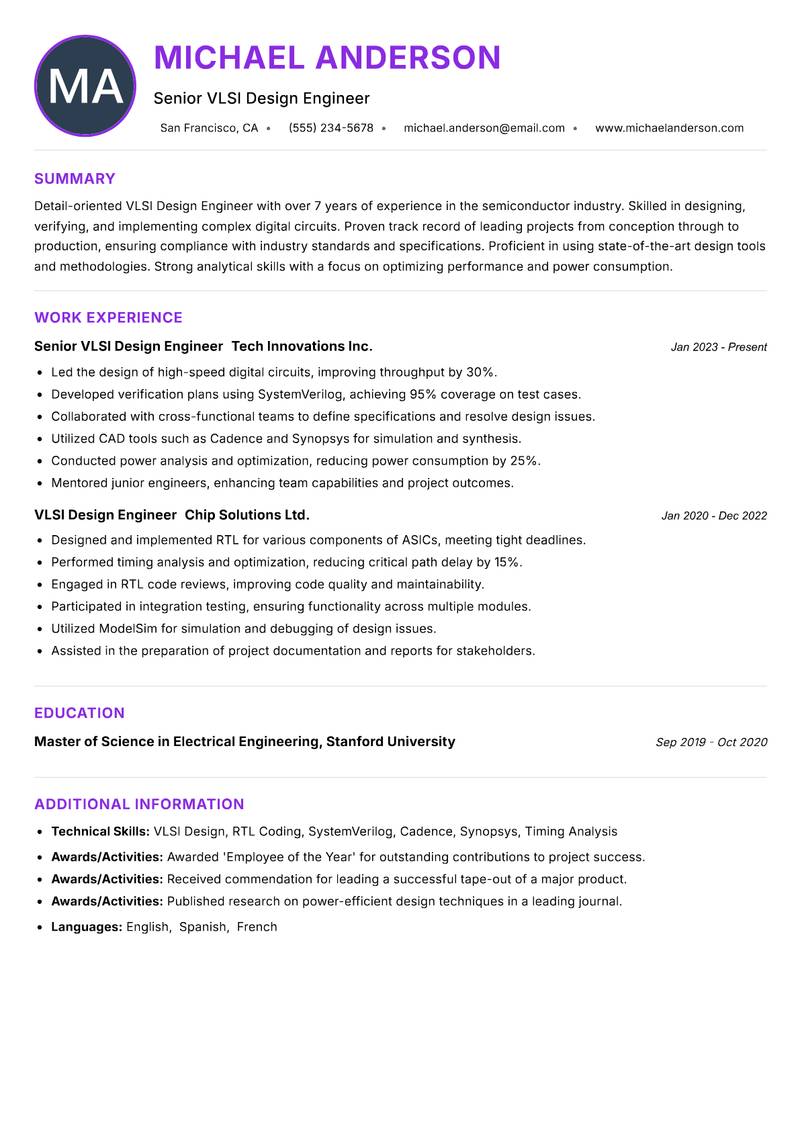
Modern Professional
Use Template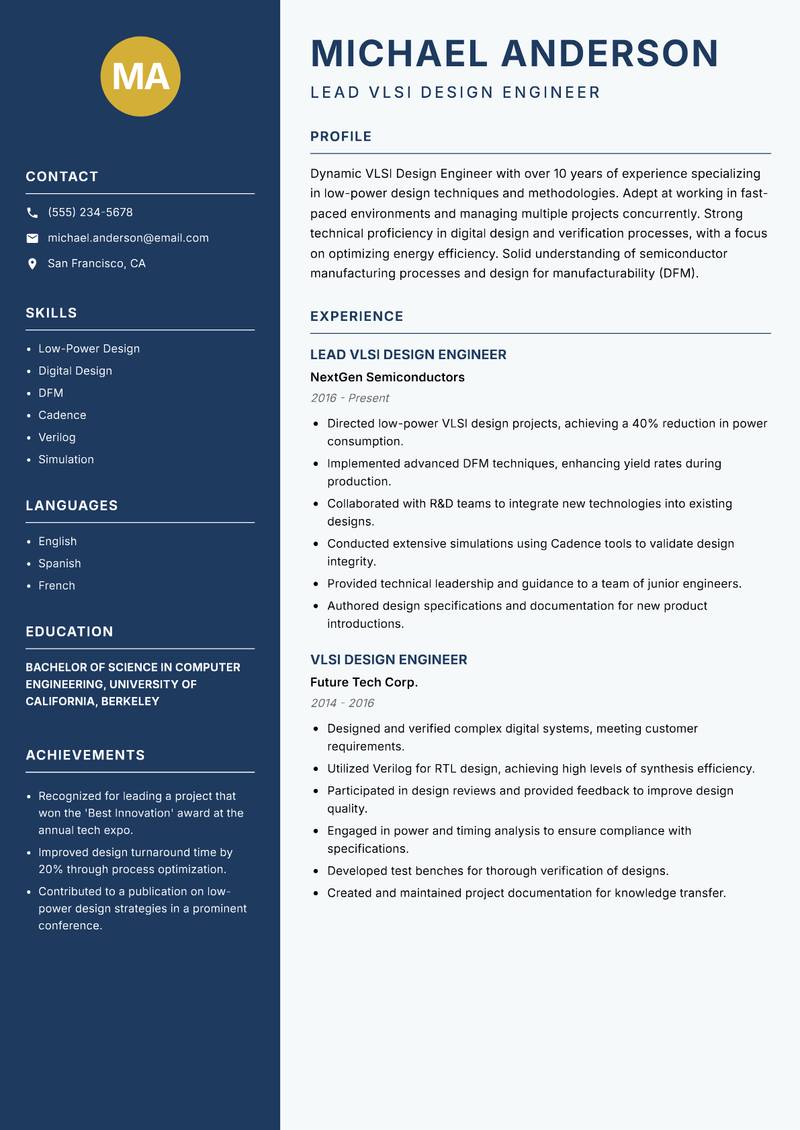
Classic Clean
Use Template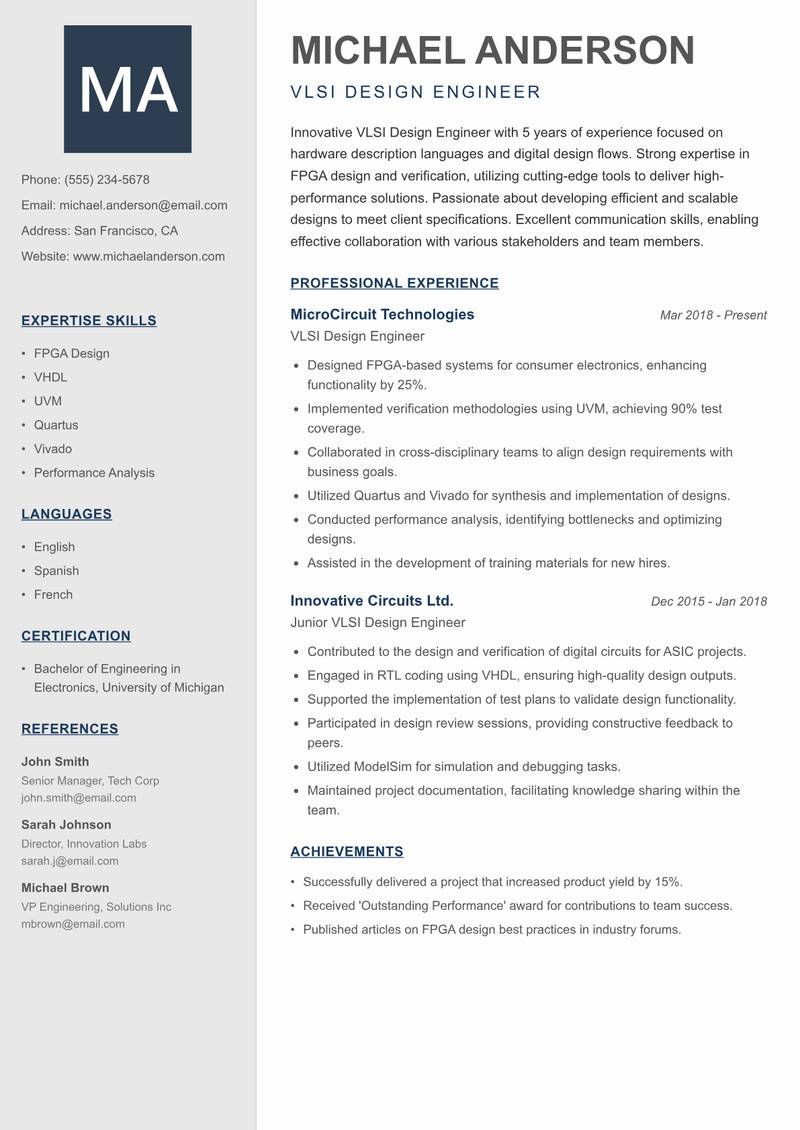
Creative Minimal
Use Template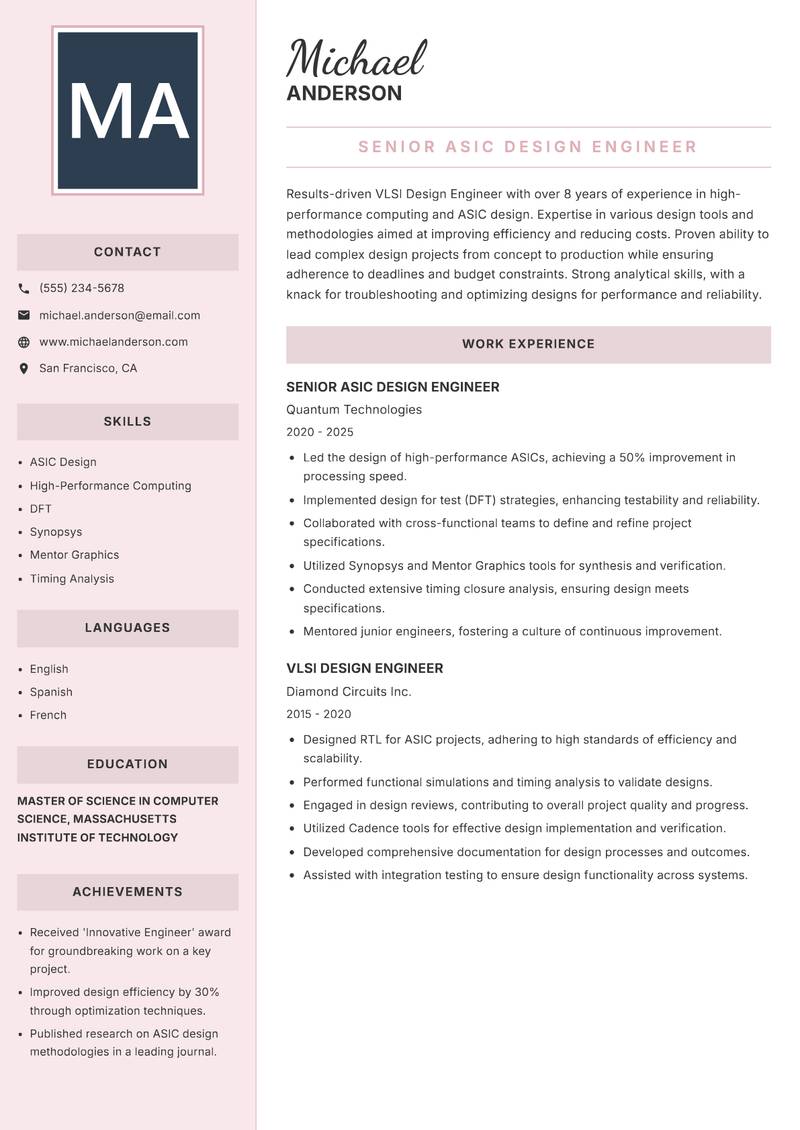
Executive
Use Template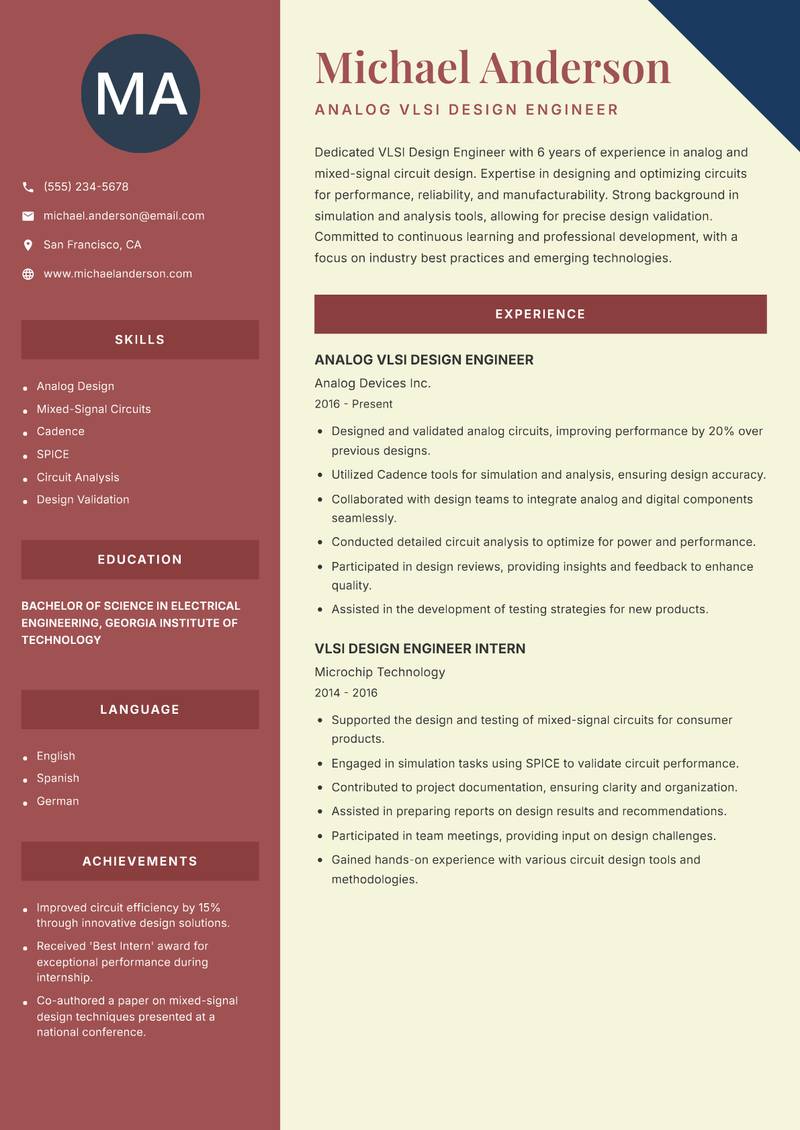
Two Column
Use Template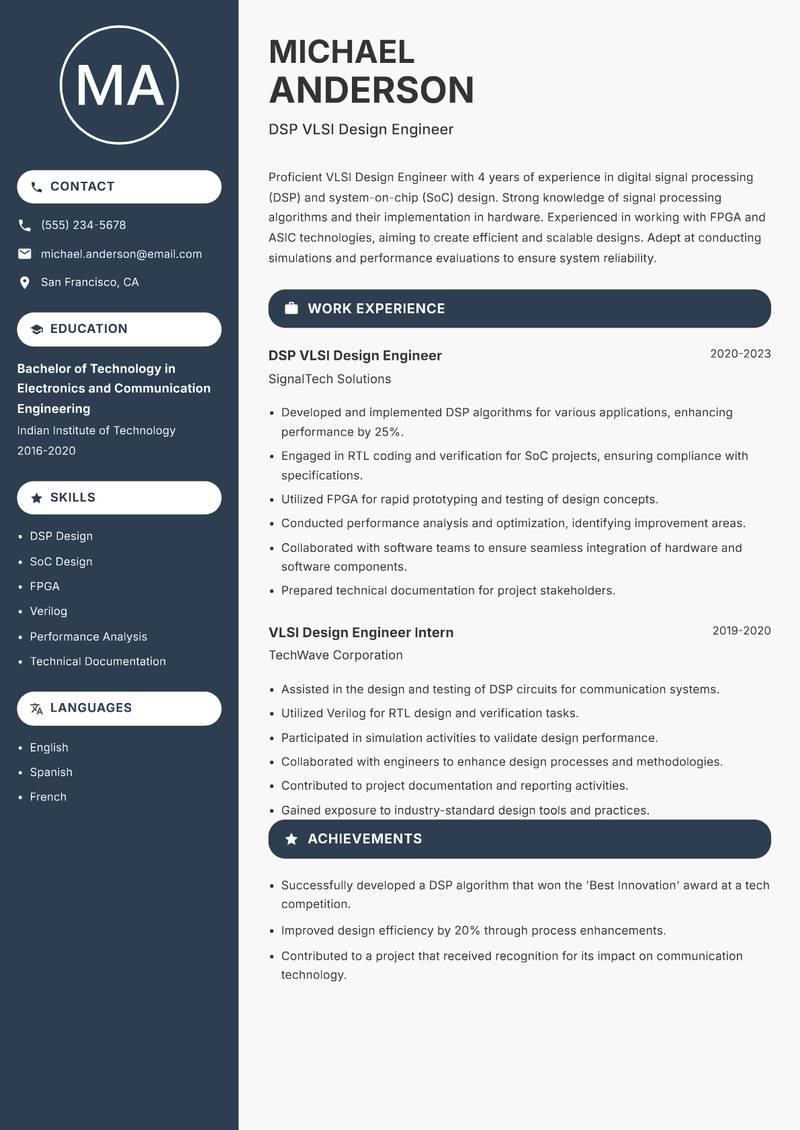
Compact
Use Template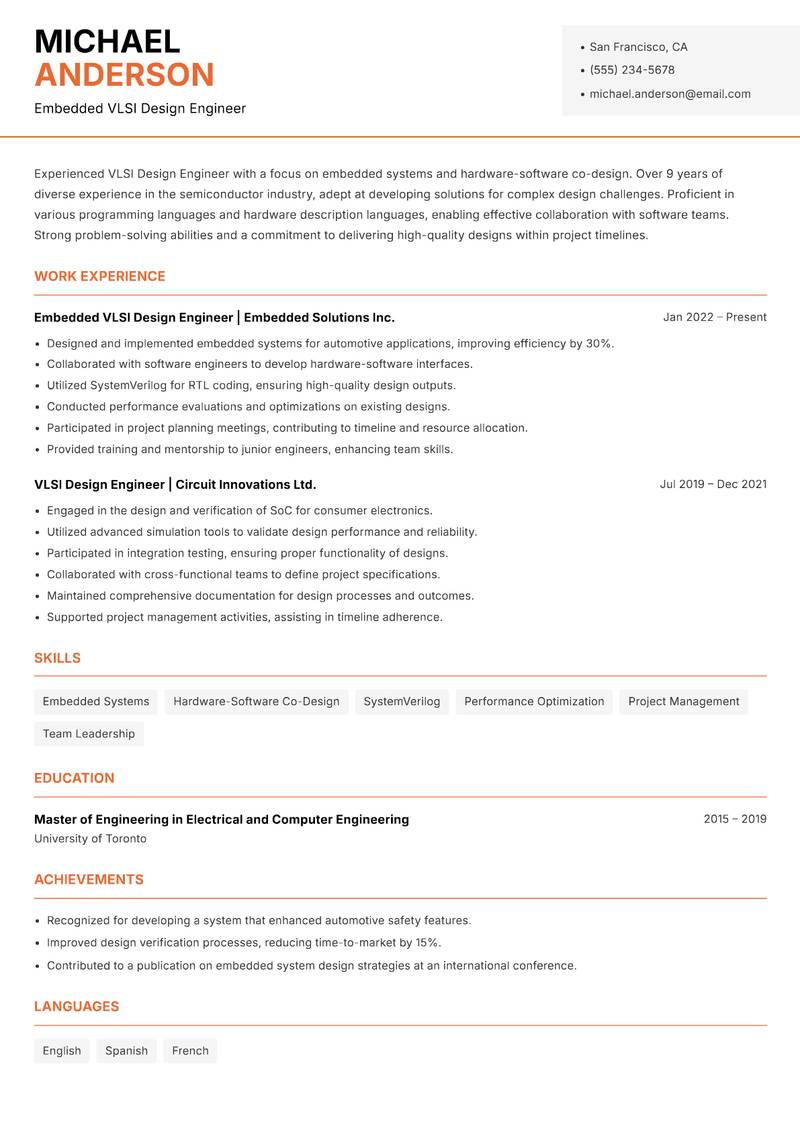
Modern Professional
Use Template7 Real VLSI Design Engineer Resume Examples
Senior VLSI Design Engineer with 7+ Years Experience
Summary: Detail-oriented VLSI Design Engineer with over 7 years of experience in the semiconductor industry. Skilled in designing, verifying, and implementing complex digital circuits. Proven track record of leading projects from conception through to production, ensuring compliance with industry standards and specifications. Proficient in using state-of-the-art design tools and methodologies. Strong analytical skills with a focus on optimizing performance and power consumption. Excellent communication and teamwork abilities, fostering collaboration across multidisciplinary teams. Passionate about driving innovation and enhancing product development processes.
Description:
- Led the design of high-speed digital circuits, improving throughput by 30%.
- Developed verification plans using SystemVerilog, achieving 95% coverage on test cases.
- Collaborated with cross-functional teams to define specifications and resolve design issues.
- Utilized CAD tools such as Cadence and Synopsys for simulation and synthesis.
- Conducted power analysis and optimization, reducing power consumption by 25%.
- Mentored junior engineers, enhancing team capabilities and project outcomes.
🏆 Key Achievements
Lead VLSI Design Engineer with 10+ Years Experience
Summary: Dynamic VLSI Design Engineer with over 10 years of experience specializing in low-power design techniques and methodologies. Adept at working in fast-paced environments and managing multiple projects concurrently. Strong technical proficiency in digital design and verification processes, with a focus on optimizing energy efficiency. Solid understanding of semiconductor manufacturing processes and design for manufacturability (DFM). Committed to continuous professional development and staying up to date with the latest industry trends and technologies. Excellent problem-solving skills and a proactive approach to challenges.
Description:
- Directed low-power VLSI design projects, achieving a 40% reduction in power consumption.
- Implemented advanced DFM techniques, enhancing yield rates during production.
- Collaborated with R&D teams to integrate new technologies into existing designs.
- Conducted extensive simulations using Cadence tools to validate design integrity.
- Provided technical leadership and guidance to a team of junior engineers.
- Authored design specifications and documentation for new product introductions.
🏆 Key Achievements
VLSI Design Engineer with 5+ Years Experience
Summary: Innovative VLSI Design Engineer with 5 years of experience focused on hardware description languages and digital design flows. Strong expertise in FPGA design and verification, utilizing cutting-edge tools to deliver high-performance solutions. Passionate about developing efficient and scalable designs to meet client specifications. Excellent communication skills, enabling effective collaboration with various stakeholders and team members. Eager to embrace new challenges and technologies in the semiconductor industry. Committed to professional growth and contributing to impactful engineering solutions.
Description:
- Designed FPGA-based systems for consumer electronics, enhancing functionality by 25%.
- Implemented verification methodologies using UVM, achieving 90% test coverage.
- Collaborated in cross-disciplinary teams to align design requirements with business goals.
- Utilized Quartus and Vivado for synthesis and implementation of designs.
- Conducted performance analysis, identifying bottlenecks and optimizing designs.
- Assisted in the development of training materials for new hires.
🏆 Key Achievements
Senior ASIC Design Engineer with 8+ Years Experience
Summary: Experienced VLSI Design Engineer with over 8 years of experience in high-performance computing and ASIC design. Expertise in various design tools and methodologies aimed at improving efficiency and reducing costs. Proven ability to lead complex design projects from concept to production while ensuring adherence to deadlines and budget constraints. Strong analytical skills, with a knack for troubleshooting and optimizing designs for performance and reliability. Effective communicator with a talent for collaborating with diverse teams to achieve common objectives. Passionate about leveraging technology to create innovative solutions.
Description:
- Led the design of high-performance ASICs, achieving a 50% improvement in processing speed.
- Implemented design for test (DFT) strategies, enhancing testability and reliability.
- Collaborated with cross-functional teams to define and refine project specifications.
- Utilized Synopsys and Mentor Graphics tools for synthesis and verification.
- Conducted extensive timing closure analysis, ensuring design meets specifications.
- Mentored junior engineers, fostering a culture of continuous improvement.
🏆 Key Achievements
Analog VLSI Design Engineer with 6+ Years Experience
Summary: Dedicated VLSI Design Engineer with 6 years of experience in analog and mixed-signal circuit design. Expertise in designing and optimizing circuits for performance, reliability, and manufacturability. Strong background in simulation and analysis tools, allowing for precise design validation. Committed to continuous learning and professional development, with a focus on industry best practices and emerging technologies. Exceptional problem-solving skills, with the ability to work under pressure and meet project deadlines. A collaborative team player with strong interpersonal skills.
Description:
- Designed and validated analog circuits, improving performance by 20% over previous designs.
- Utilized Cadence tools for simulation and analysis, ensuring design accuracy.
- Collaborated with design teams to integrate analog and digital components seamlessly.
- Conducted detailed circuit analysis to optimize for power and performance.
- Participated in design reviews, providing insights and feedback to enhance quality.
- Assisted in the development of testing strategies for new products.
🏆 Key Achievements
DSP VLSI Design Engineer with 4+ Years Experience
Summary: Proficient VLSI Design Engineer with 4 years of experience in digital signal processing (DSP) and system-on-chip (SoC) design. Strong knowledge of signal processing algorithms and their implementation in hardware. Experienced in working with FPGA and ASIC technologies, aiming to create efficient and scalable designs. Adept at conducting simulations and performance evaluations to ensure system reliability. Excellent teamwork and communication skills, with a focus on achieving project milestones and client satisfaction. Passionate about advancing technology and contributing to innovative engineering projects.
Description:
- Developed and implemented DSP algorithms for various applications, enhancing performance by 25%.
- Engaged in RTL coding and verification for SoC projects, ensuring compliance with specifications.
- Utilized FPGA for rapid prototyping and testing of design concepts.
- Conducted performance analysis and optimization, identifying improvement areas.
- Collaborated with software teams to ensure seamless integration of hardware and software components.
- Prepared technical documentation for project stakeholders.
🏆 Key Achievements
Embedded VLSI Design Engineer with 9+ Years Experience
Summary: Experienced VLSI Design Engineer with a focus on embedded systems and hardware-software co-design. Over 9 years of diverse experience in the semiconductor industry, adept at developing solutions for complex design challenges. Proficient in various programming languages and hardware description languages, enabling effective collaboration with software teams. Strong problem-solving abilities and a commitment to delivering high-quality designs within project timelines. Well-versed in the latest design tools and methodologies, with a passion for innovation and continuous improvement. Excellent interpersonal skills, facilitating effective communication across teams.
Description:
- Designed and implemented embedded systems for automotive applications, improving efficiency by 30%.
- Collaborated with software engineers to develop hardware-software interfaces.
- Utilized SystemVerilog for RTL coding, ensuring high-quality design outputs.
- Conducted performance evaluations and optimizations on existing designs.
- Participated in project planning meetings, contributing to timeline and resource allocation.
- Provided training and mentorship to junior engineers, enhancing team skills.
🏆 Key Achievements
Key Skills for VLSI Design Engineer
ATS Optimization Tips
Increase your chances of getting hired
Use Standard Headings
Use common section titles like Experience, Skills, etc.
Include Keywords
Add role-specific keywords from the job description
Keep it Simple
Avoid complex tables, images and graphics
Save in Right Format
Use PDF format unless otherwise specified
VLSI Design Engineer Salary Insights
Average Salary
$117,500
per year
Salary Range
$85,000 - $150,000
per year
Top Paying Cities
Los Angeles, Seattle, Houston, Dallas, Boston
Source: Glassdoor, Payscale, Indeed (Updated June 2025)
Everything you need to write a great VLSI Design Engineer resume
Strong Action Verbs to Use
Resume Writing Tips
- →Highlight specific projects showcasing your technical skills, especially those that had a measurable impact on performance metrics.
- →Emphasize familiarity with industry-standard EDA tools and programming languages relevant to VLSI design like Verilog or VHDL.
- →Use quantitative data to illustrate your contributions, such as percentages of design efficiency improvements or power reductions achieved.
- →Prioritize listing advanced certifications and relevant workshop expertise to enhance credibility in specialized areas of VLSI design.
- →Detail any experience with cross-disciplinary collaboration, particularly in coordinating efforts between different engineering divisions.
- →Mention any published research or patents, as these reflect expertise and innovation in the field.
Common Mistakes to Avoid
- ✕Listing overly generic skills that don't directly apply to VLSI design, such as basic project management without context.
- ✕Failing to showcase specific software or tools used in designs, which can diminish technical credibility.
- ✕Omitting relevant coursework or projects, which could provide insight into your practical experience and expertise level.
- ✕Neglecting to tailor the resume to specific job applications by not including key qualifications specified in job descriptions.
- ✕Using buzzwords without context, avoiding real-world applications for VLSI practices to detail experience.
ATS Keywords for VLSI Design Engineer
VLSI Design Engineer Career Path
Relevant Certifications
Career Progression
Entry-Level VLSI Design Engineer
Focuses on supporting design verification processes and basic circuit layout tasks using tools like Cadence and Synopsys.
Mid-Level VLSI Design Engineer
Handles complex designs and participates in the full ASIC design flow, overseeing the integration of new features.
Senior VLSI Design Engineer
Leads design projects, mentors junior engineers, and collaborates with cross-functional teams to optimize performance.
VLSI Technical Manager
Oversees VLSI teams, manages project timelines and budgets, and ensures compliance with industry standards.
Director of VLSI Engineering
Strategizes company-wide VLSI initiatives, interfaces with executive leadership, and drives technology roadmaps.
VLSI Design Engineer Interview Questions
Can you describe your experience with RTL design and verification? +
Provide specific examples of projects and the tools you used.
What strategies do you employ to reduce power consumption in VLSI designs? +
Discuss specific techniques like clock gating or multi-threshold voltage.
How do you perform timing analysis on your designs? +
Explain methodologies and tools like STA tools you’ve used.
What are some common challenges in VLSI design projects you have faced? +
Be honest about difficulties and how you overcame them.
Describe a project where you had to collaborate with software engineers or hardware teams. How did you approach this? +
Focus on communication styles and how you ensured alignment of objectives.
What experience do you have with design for testability (DFT) techniques? +
Highlight tools and specific implementations.
About the VLSI Design Engineer Role
VLSI Design Engineers conceptualize and refine integrated circuit architectures, often creating tailored solutions for high-performance applications. They extensively utilize tools like Cadence and Synopsys to perform RTL simulations and validate designs through rigorous testing methodologies. Engaging in detailed collaboration with both hardware and software teams ensures that designs are optimized for functionality and efficiency within defined power and area constraints.
Frequently Asked Questions
What types of projects do VLSI Design Engineers typically work on? +
VLSI engineers often work on projects involving custom ASIC designs, memory chips, and programmable logic devices, focusing on optimizations for speed and power.
What programming languages should a VLSI Design Engineer be proficient in? +
Key languages include Verilog and VHDL for hardware description, while knowledge of C/C++ can be beneficial for system-level design.
Is a master's degree necessary to become a VLSI Design Engineer? +
While it's not mandatory, a master's degree or specialized training can significantly enhance your skills and employability in the field.
How crucial is experience in digital logic design for this role? +
Experience in digital logic is fundamental as it underpins the designs and problem-solving frameworks used in VLSI engineering.
What is the typical work environment for a VLSI Design Engineer? +
VLSI engineers generally work in semiconductor companies, research institutions, or tech firms that design and manufacture electronic components, often in collaborative team settings.
Are there specific industries that are hiring VLSI Design Engineers more than others? +
The consumer electronics, telecommunications, automotive, and healthcare industries are particularly keen on hiring VLSI engineers due to advancements in smart devices and IoT technologies.
More Resume Examples You Might Like
Related Career Paths
Other roles candidates for VLSI Design Engineer positions often also consider.
Will this VLSI Design Engineer resume pass the ATS scan?
Upload it and get an instant AI-scored compatibility check with specific fixes.
Check My Resume →
Pair it with a matching cover letter
AI drafts a first version from your job title and strengths — edit it live, then download the PDF.
Write My Cover Letter →
Written by Nohaya Career Team
Reviewed by HR Professionals · Updated June 2025
Ready to Build Your Perfect Resume?
Choose from 1000+ professional templates and land your dream job.
Create My Resume Now