Build an ATS-Friendly
Veterinary Pathologist Resume
That Gets Interviews
In the role of a Veterinary Pathologist, professionals investigate the underlying causes of diseases through detailed examination of animal tissues. By analyzing biopsies and body fluids, they provide crucial insights into animal health that influence treatment decisions. Interaction with veterinarians and pet owners…
Veterinary Pathologist Resume Templates
Modern Professional
Use Template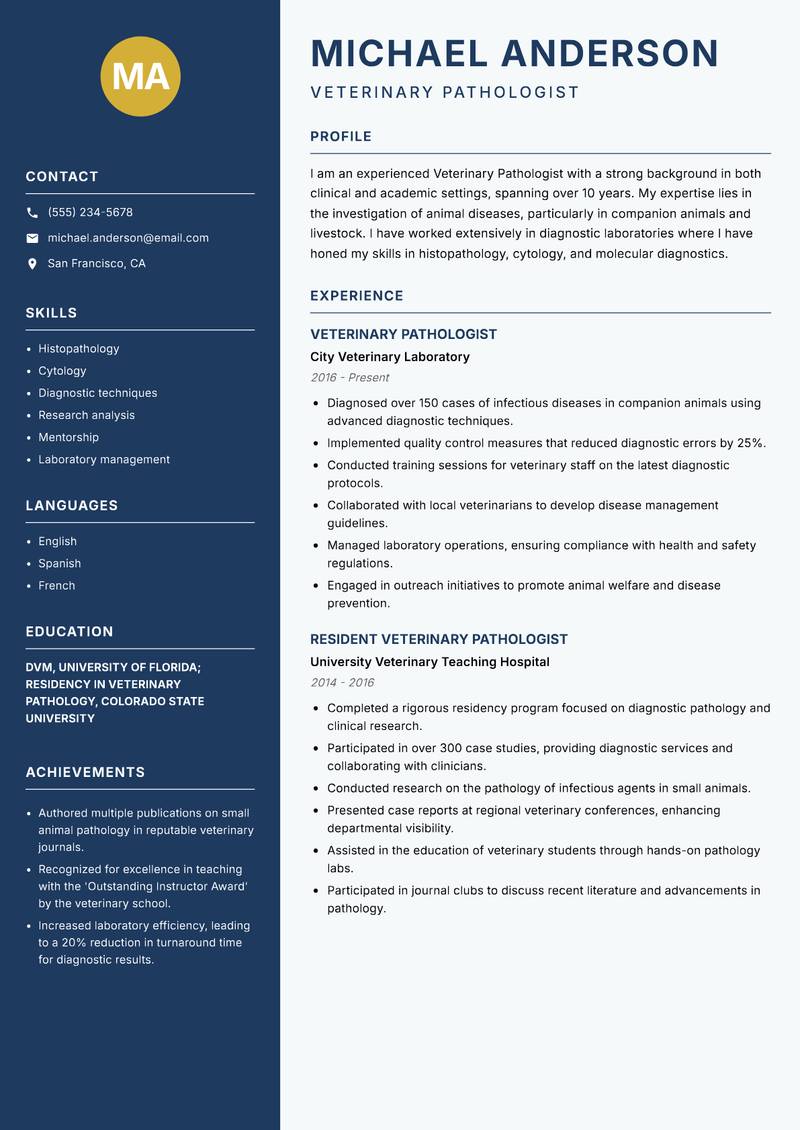
Classic Clean
Use Template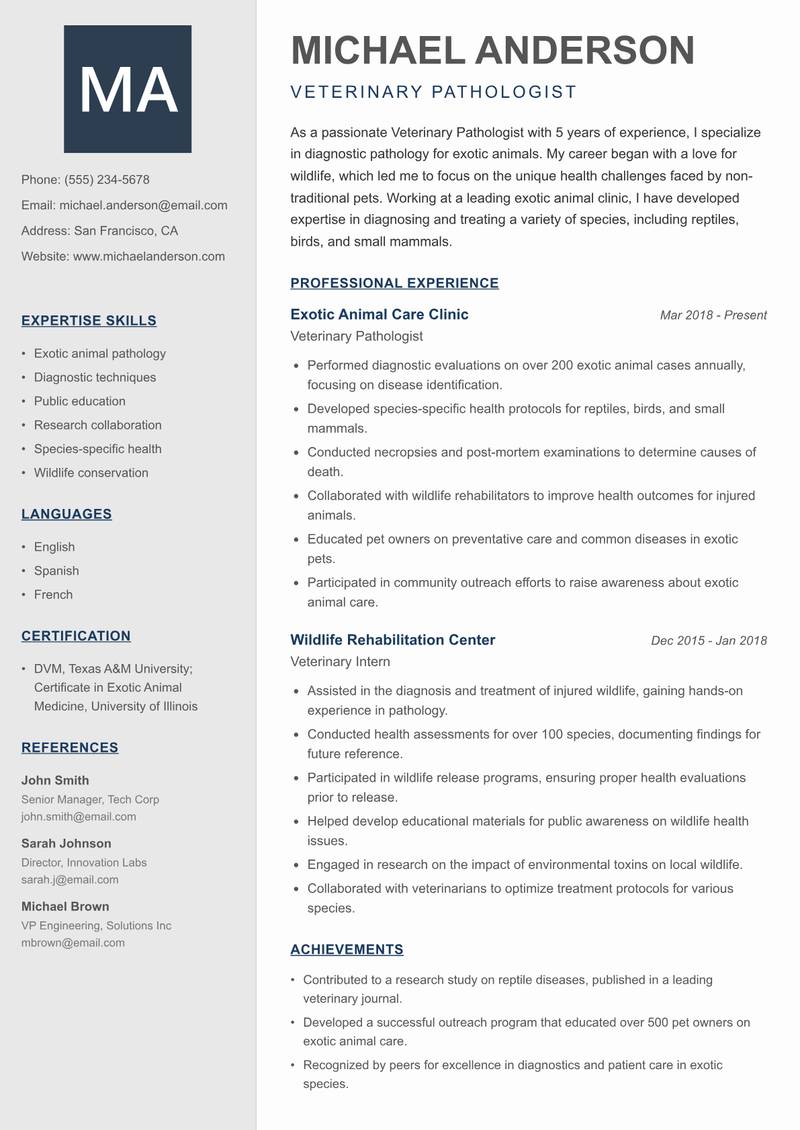
Creative Minimal
Use Template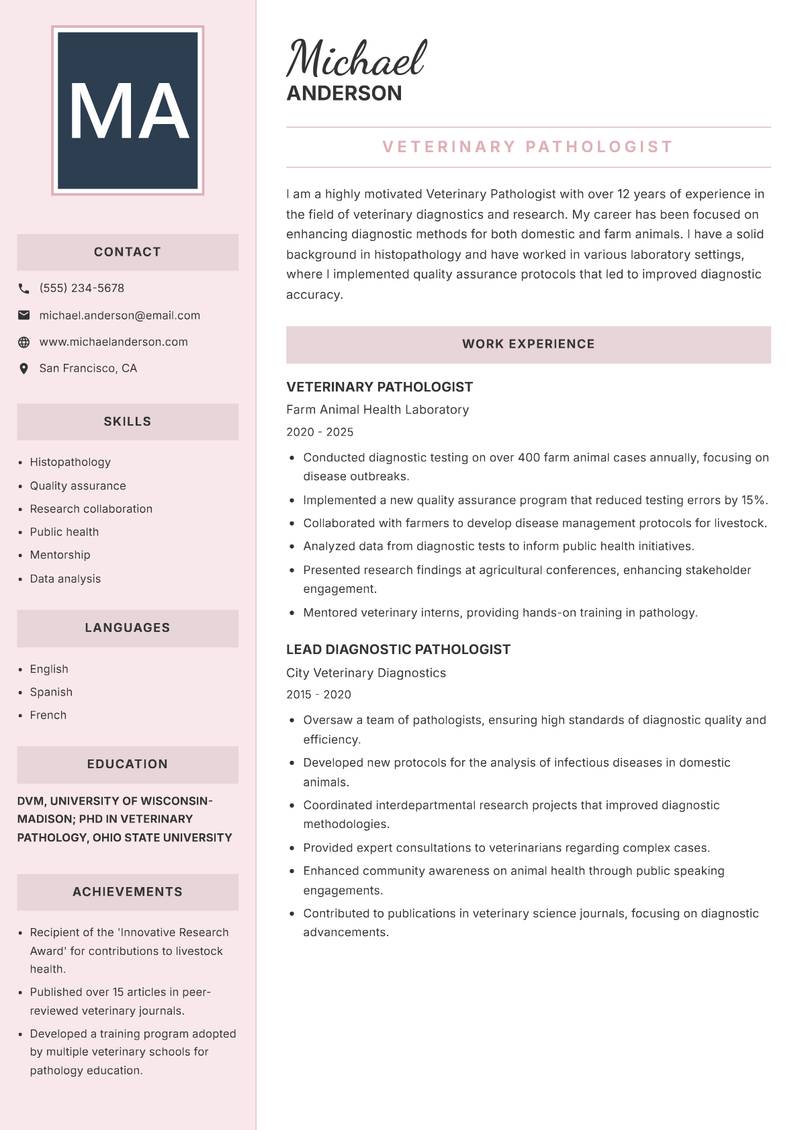
Executive
Use Template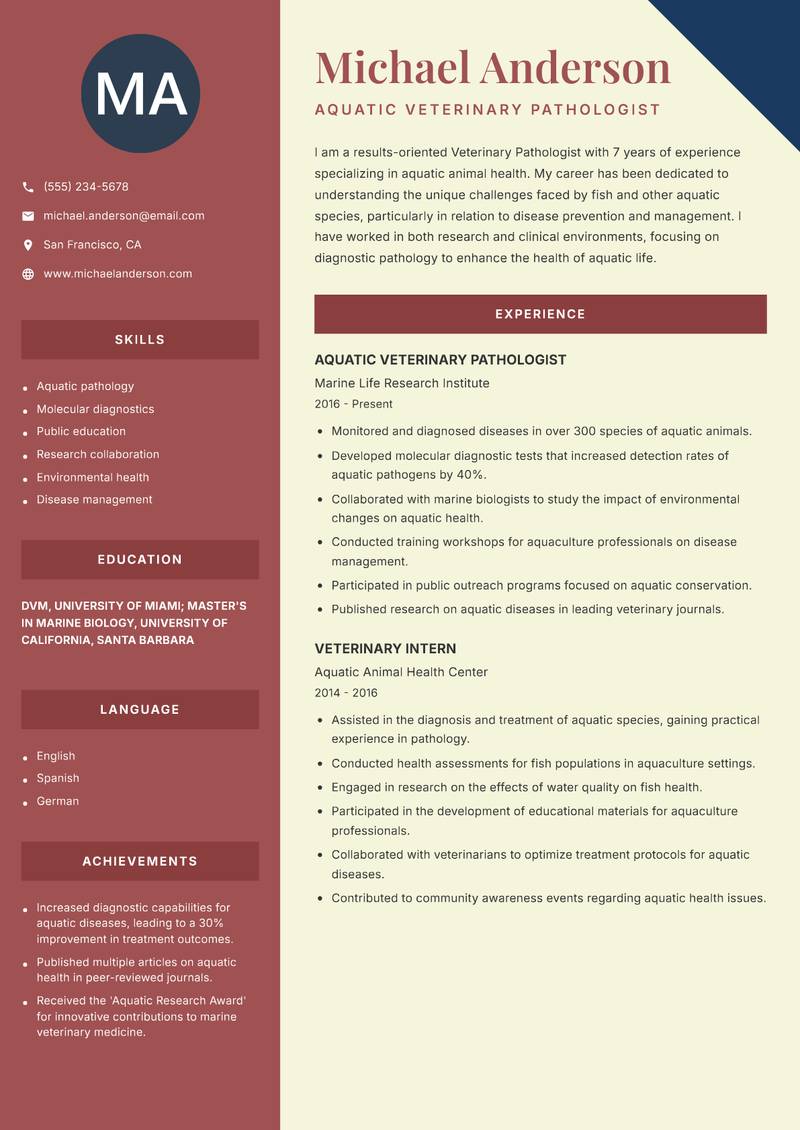
Two Column
Use Template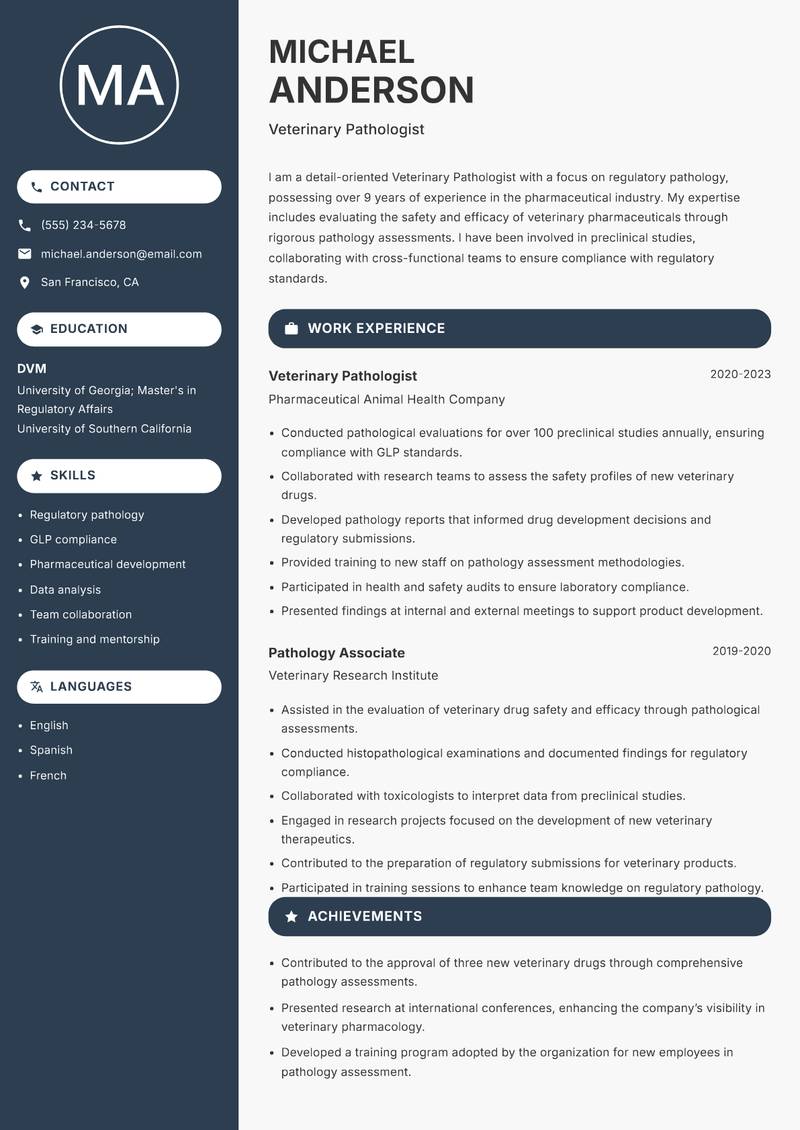
Compact
Use Template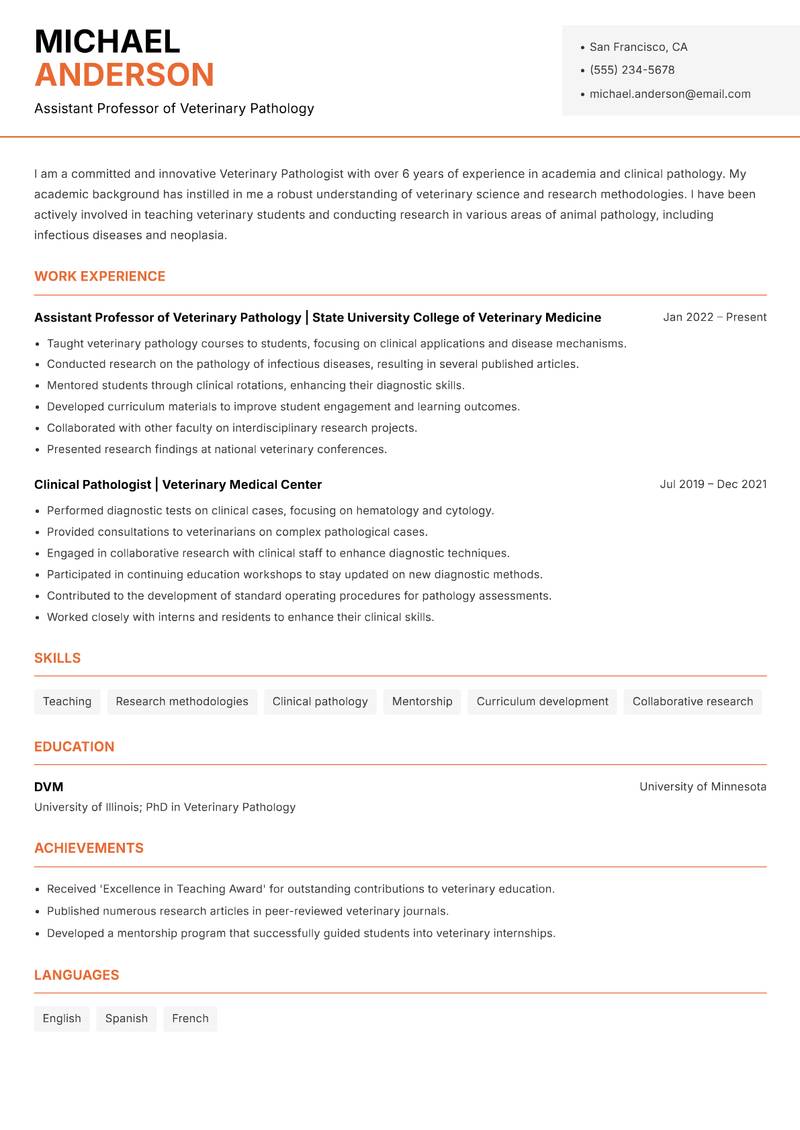
Modern Professional
Use Template7 Real Veterinary Pathologist Resume Examples
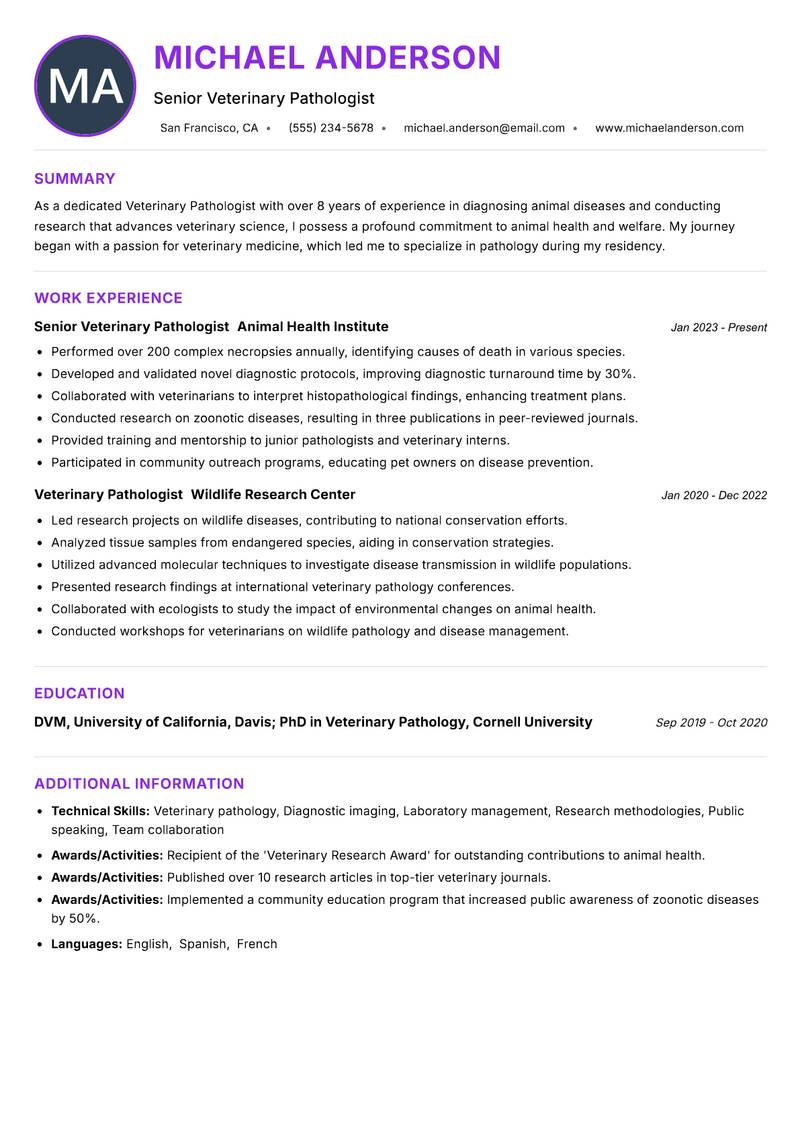
Senior Veterinary Pathologist with 8+ Years Experience
Summary: As a dedicated Veterinary Pathologist with over 8 years of experience in diagnosing animal diseases and conducting research that advances veterinary science, I possess a profound commitment to animal health and welfare. My journey began with a passion for veterinary medicine, which led me to specialize in pathology during my residency. I have worked in both clinical and research settings, collaborating with multidisciplinary teams to improve diagnostic accuracy and treatment outcomes. My strong analytical skills allow me to interpret complex case data, while my proficiency in laboratory techniques ensures the highest standards in diagnostics. I am adept at utilizing state-of-the-art imaging and diagnostic technologies. Furthermore, I actively engage in public outreach, educating pet owners and veterinary professionals about the importance of pathology in animal health. My goal is to bridge the gap between clinical practice and research, thereby enhancing our understanding of animal diseases. I am now seeking opportunities to contribute to an innovative veterinary practice or research institution where my skills can further benefit animal health and science.
Description:
- Performed over 200 complex necropsies annually, identifying causes of death in various species.
- Developed and validated novel diagnostic protocols, improving diagnostic turnaround time by 30%.
- Collaborated with veterinarians to interpret histopathological findings, enhancing treatment plans.
- Conducted research on zoonotic diseases, resulting in three publications in peer-reviewed journals.
- Provided training and mentorship to junior pathologists and veterinary interns.
- Participated in community outreach programs, educating pet owners on disease prevention.
🏆 Key Achievements
Veterinary Pathologist with 10+ Years Experience
Summary: I am an experienced Veterinary Pathologist with a strong background in both clinical and academic settings, spanning over 10 years. My expertise lies in the investigation of animal diseases, particularly in companion animals and livestock. I have worked extensively in diagnostic laboratories where I have honed my skills in histopathology, cytology, and molecular diagnostics. My work has led to significant improvements in disease detection and management protocols, resulting in enhanced animal welfare outcomes. I am committed to continuous learning and staying updated with the latest advancements in veterinary pathology. My passion for teaching has also driven me to mentor veterinary students and professionals, helping them develop their diagnostic skills. I am looking to leverage my expertise in a challenging veterinary pathology role that allows for collaboration and innovation in diagnostics and research.
Description:
- Diagnosed over 150 cases of infectious diseases in companion animals using advanced diagnostic techniques.
- Implemented quality control measures that reduced diagnostic errors by 25%.
- Conducted training sessions for veterinary staff on the latest diagnostic protocols.
- Collaborated with local veterinarians to develop disease management guidelines.
- Managed laboratory operations, ensuring compliance with health and safety regulations.
- Engaged in outreach initiatives to promote animal welfare and disease prevention.
🏆 Key Achievements
Veterinary Pathologist with 5+ Years Experience
Summary: As a passionate Veterinary Pathologist with 5 years of experience, I specialize in diagnostic pathology for exotic animals. My career began with a love for wildlife, which led me to focus on the unique health challenges faced by non-traditional pets. Working at a leading exotic animal clinic, I have developed expertise in diagnosing and treating a variety of species, including reptiles, birds, and small mammals. My role involves not only conducting thorough examinations and necropsies but also educating pet owners and veterinarians about species-specific health issues. I am dedicated to advancing veterinary medicine through research and collaboration, and I am eager to contribute to a team that values innovation in animal care. I seek a challenging position that allows me to utilize my skills in pathology while contributing to conservation efforts and improving animal health.
Description:
- Performed diagnostic evaluations on over 200 exotic animal cases annually, focusing on disease identification.
- Developed species-specific health protocols for reptiles, birds, and small mammals.
- Conducted necropsies and post-mortem examinations to determine causes of death.
- Collaborated with wildlife rehabilitators to improve health outcomes for injured animals.
- Educated pet owners on preventative care and common diseases in exotic pets.
- Participated in community outreach efforts to raise awareness about exotic animal care.
🏆 Key Achievements
Veterinary Pathologist with 12+ Years Experience
Summary: I am a highly motivated Veterinary Pathologist with over 12 years of experience in the field of veterinary diagnostics and research. My career has been focused on enhancing diagnostic methods for both domestic and farm animals. I have a solid background in histopathology and have worked in various laboratory settings, where I implemented quality assurance protocols that led to improved diagnostic accuracy. My research interests include infectious diseases and their impact on animal health, and I have collaborated with agricultural stakeholders to develop effective disease management strategies. I am passionate about educating the next generation of veterinarians and often participate in training programs. I am eager to bring my expertise to a forward-thinking veterinary institution that prioritizes research and innovation in animal health.
Description:
- Conducted diagnostic testing on over 400 farm animal cases annually, focusing on disease outbreaks.
- Implemented a new quality assurance program that reduced testing errors by 15%.
- Collaborated with farmers to develop disease management protocols for livestock.
- Analyzed data from diagnostic tests to inform public health initiatives.
- Presented research findings at agricultural conferences, enhancing stakeholder engagement.
- Mentored veterinary interns, providing hands-on training in pathology.
🏆 Key Achievements
Aquatic Veterinary Pathologist with 7+ Years Experience
Summary: I am a results-oriented Veterinary Pathologist with 7 years of experience specializing in aquatic animal health. My career has been dedicated to understanding the unique challenges faced by fish and other aquatic species, particularly in relation to disease prevention and management. I have worked in both research and clinical environments, focusing on diagnostic pathology to enhance the health of aquatic life. I am proficient in utilizing molecular techniques and have developed protocols that improved diagnostic capabilities for aquatic diseases. My passion for marine biology and veterinary science drives me to educate the public and industry stakeholders about aquatic animal health. I seek to further my career by joining a forward-thinking organization that values research and innovation in aquatic veterinary medicine.
Description:
- Monitored and diagnosed diseases in over 300 species of aquatic animals.
- Developed molecular diagnostic tests that increased detection rates of aquatic pathogens by 40%.
- Collaborated with marine biologists to study the impact of environmental changes on aquatic health.
- Conducted training workshops for aquaculture professionals on disease management.
- Participated in public outreach programs focused on aquatic conservation.
- Published research on aquatic diseases in leading veterinary journals.
🏆 Key Achievements
Veterinary Pathologist with 9+ Years Experience
Summary: I am a detail-oriented Veterinary Pathologist with a focus on regulatory pathology, possessing over 9 years of experience in the pharmaceutical industry. My expertise includes evaluating the safety and efficacy of veterinary pharmaceuticals through rigorous pathology assessments. I have been involved in preclinical studies, collaborating with cross-functional teams to ensure compliance with regulatory standards. My work has contributed to the development of safer medications for animal health. I am passionate about the intersection of science and regulatory affairs, and I strive to enhance animal health through my contributions in the pharmaceutical sector. I am eager to continue my career with a company that prioritizes innovation and integrity in the development of veterinary products.
Description:
- Conducted pathological evaluations for over 100 preclinical studies annually, ensuring compliance with GLP standards.
- Collaborated with research teams to assess the safety profiles of new veterinary drugs.
- Developed pathology reports that informed drug development decisions and regulatory submissions.
- Provided training to new staff on pathology assessment methodologies.
- Participated in health and safety audits to ensure laboratory compliance.
- Presented findings at internal and external meetings to support product development.
🏆 Key Achievements
Assistant Professor of Veterinary Pathology with 6+ Years Experience
Summary: I am a committed and innovative Veterinary Pathologist with over 6 years of experience in academia and clinical pathology. My academic background has instilled in me a robust understanding of veterinary science and research methodologies. I have been actively involved in teaching veterinary students and conducting research in various areas of animal pathology, including infectious diseases and neoplasia. My role as a faculty member has allowed me to mentor aspiring veterinarians and contribute to their professional development. I am passionate about integrating research with clinical practice to improve animal health outcomes. I am seeking a position that allows me to continue my academic pursuits while also engaging in clinical diagnostics and research.
Description:
- Taught veterinary pathology courses to students, focusing on clinical applications and disease mechanisms.
- Conducted research on the pathology of infectious diseases, resulting in several published articles.
- Mentored students through clinical rotations, enhancing their diagnostic skills.
- Developed curriculum materials to improve student engagement and learning outcomes.
- Collaborated with other faculty on interdisciplinary research projects.
- Presented research findings at national veterinary conferences.
🏆 Key Achievements
Key Skills for Veterinary Pathologist
ATS Optimization Tips
Increase your chances of getting hired
Use Standard Headings
Use common section titles like Experience, Skills, etc.
Include Keywords
Add role-specific keywords from the job description
Keep it Simple
Avoid complex tables, images and graphics
Save in Right Format
Use PDF format unless otherwise specified
Veterinary Pathologist Salary Insights
Average Salary
$107,500
per year
Salary Range
$85,000 - $130,000
per year
Top Paying Cities
Los Angeles, Seattle, Houston, Dallas, Boston
Source: Glassdoor, Payscale, Indeed (Updated April 2025)
Everything you need to write a great Veterinary Pathologist resume
Strong Action Verbs to Use
Resume Writing Tips
- →Frame your experience in terms of disease outcomes to show impact on animal health.
- →Include details about specific techniques used in diagnostics to highlight expertise.
- →Emphasize any interdisciplinary collaborations, especially with clinical veterinarians or research teams.
- →Tailor your resume to reflect your specific experience with species—whether it's companion animals or livestock.
- →Showcase any additional research published to emphasize your contributions to the field.
Common Mistakes to Avoid
- ✕Overgeneralizing skills; be specific about the diseases or species you have worked with.
- ✕Neglecting to mention laboratory management experience if applicable.
- ✕Failing to indicate successful case outcomes influenced by your pathology reports.
- ✕Using vague language that doesn't reflect the complexities of veterinary pathology studies.
ATS Keywords for Veterinary Pathologist
Veterinary Pathologist Career Path
Relevant Certifications
Career Progression
Entry-Level (Associate Veterinary Pathologist)
A beginner role focused on assisting with diagnostic work, learning laboratory protocols, and gaining experience in sample analysis.
Mid-Level (Veterinary Pathologist)
Professionals at this level primarily handle complex cases, perform autopsies, and work directly with veterinary practices to interpret results.
Senior-Level (Lead Veterinary Pathologist)
In charge of a pathology lab, overseeing the work of pathologists and technicians while also contributing to research and clinical trials.
Expert-Level (Veterinary Pathology Consultant)
Advises veterinary clinics or research institutions on pathological findings, often integrating diagnostics with broader research initiatives.
Academic-Level (Professor of Veterinary Pathology)
Engages in the education of future veterinarians while conducting high-level research in pathology, contributing to journals and conferences.
Veterinary Pathologist Interview Questions
What methods do you use for diagnosing diseases in animal tissues? +
Describe specific techniques such as histopathology, immunohistochemistry, or molecular diagnostics.
Can you explain a challenging case you worked on and how you handled it? +
Talk about the steps you took in investigation, diagnosis, and communication with the veterinarians.
How do you prioritize cases in a busy veterinary pathology lab? +
Explain your decision-making process and how you handle urgent vs. routine cases.
What experience do you have with necropsies and their importance in veterinary medicine? +
Share your approach to performing necropsies and how you share findings with stakeholders.
Discuss your familiarity with the latest technological advancements in veterinary pathology. +
Highlight any specific tools you have used, such as digital pathology systems.
How do you ensure the accuracy of your diagnostic reports? +
Discuss your process for quality control and collaboration with laboratory personnel.
About the Veterinary Pathologist Role
In the role of a Veterinary Pathologist, professionals investigate the underlying causes of diseases through detailed examination of animal tissues. By analyzing biopsies and body fluids, they provide crucial insights into animal health that influence treatment decisions. Interaction with veterinarians and pet owners is common, as pathologists elucidate results, guiding the course of care and ensuring effective therapeutic interventions.
Frequently Asked Questions
What is the daily work environment like for a Veterinary Pathologist? +
Veterinary Pathologists typically work in a laboratory setting, often within veterinary colleges, private pathology labs, or research facilities, with responsibilities encompassing both diagnostic work and research.
Is a Doctor of Veterinary Medicine (DVM) necessary to become a Veterinary Pathologist? +
Yes, a DVM is required, along with further specialized training in veterinary pathology, typically through a residency program.
What are the key skills needed for success in Veterinary Pathology? +
Attention to detail, strong analytical skills, laboratory proficiency, and effective communication skills are essential for a successful Veterinary Pathologist.
How does a Veterinary Pathologist impact animal health? +
They provide critical diagnostic information that shapes treatment plans, thereby contributing to improved health outcomes for animals.
Is continuing education important in this field? +
Yes, Veterinary Pathologists must engage in ongoing education to remain updated on advancements in diagnostic techniques and research.
More Resume Examples You Might Like
Will this Veterinary Pathologist resume pass the ATS scan?
Upload it and get an instant AI-scored compatibility check with specific fixes.
Check My Resume →
Pair it with a matching cover letter
AI drafts a first version from your job title and strengths — edit it live, then download the PDF.
Write My Cover Letter →
Written by Nohaya Career Team
Reviewed by HR Professionals · Updated April 2025
Ready to Build Your Perfect Resume?
Choose from 1000+ professional templates and land your dream job.
Create My Resume Now