Build an ATS-Friendly
Speech Recognition Engineer Resume
That Gets Interviews
Crafting innovative speech recognition systems involves a blend of algorithms and linguistic knowledge, as Speech Recognition Engineers leverage large datasets to enhance model efficacy. This role demands adeptness in machine learning and familiarity with various frameworks, with engineers often using techniques like…
Speech Recognition Engineer Resume Templates
Modern Professional
Use Template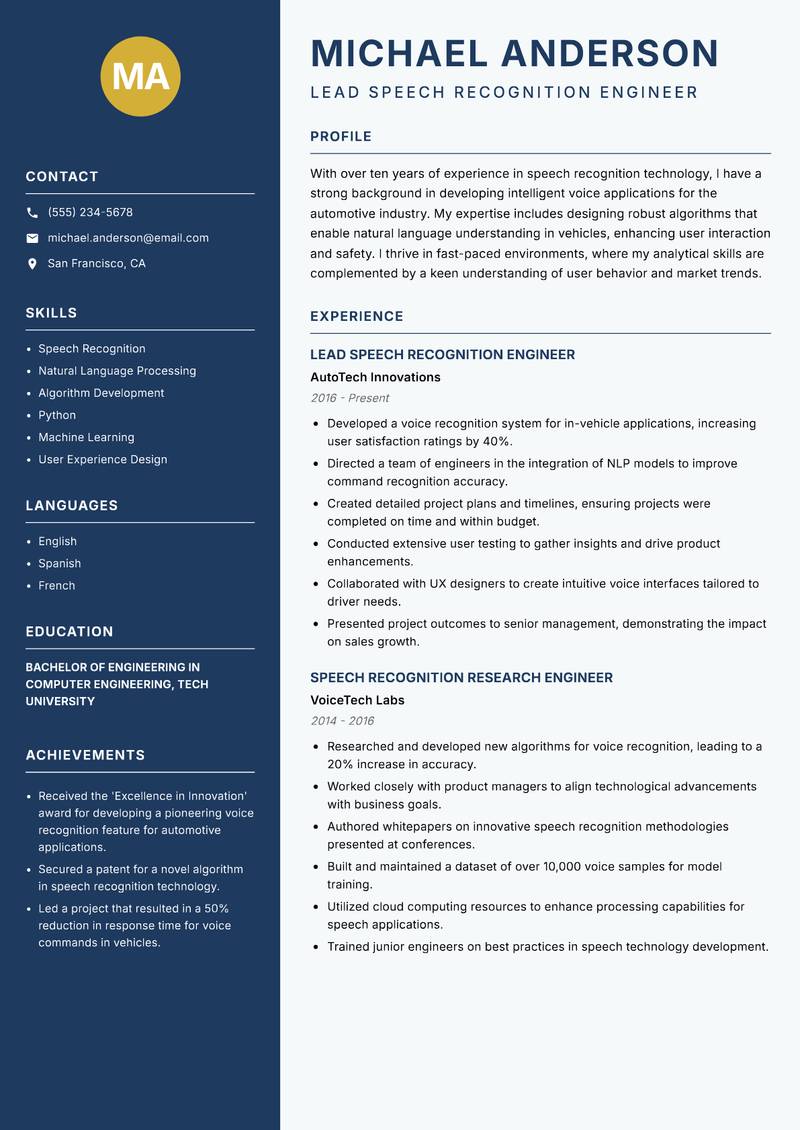
Classic Clean
Use Template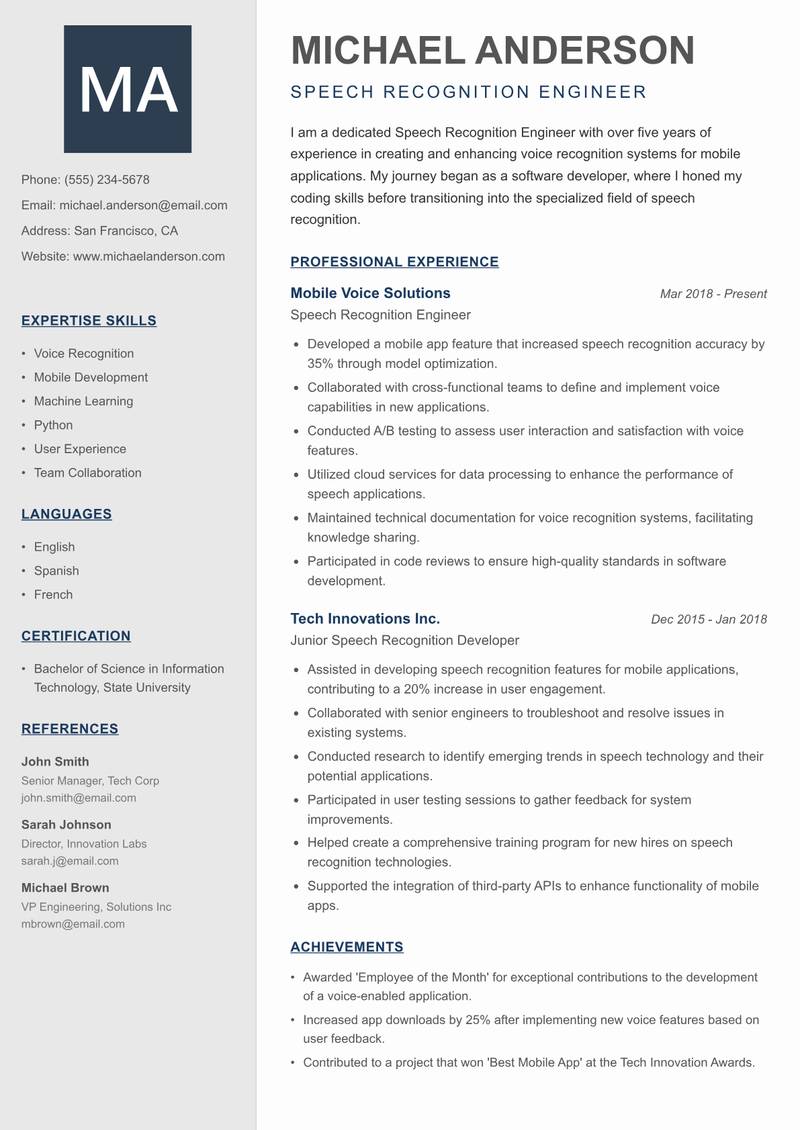
Creative Minimal
Use Template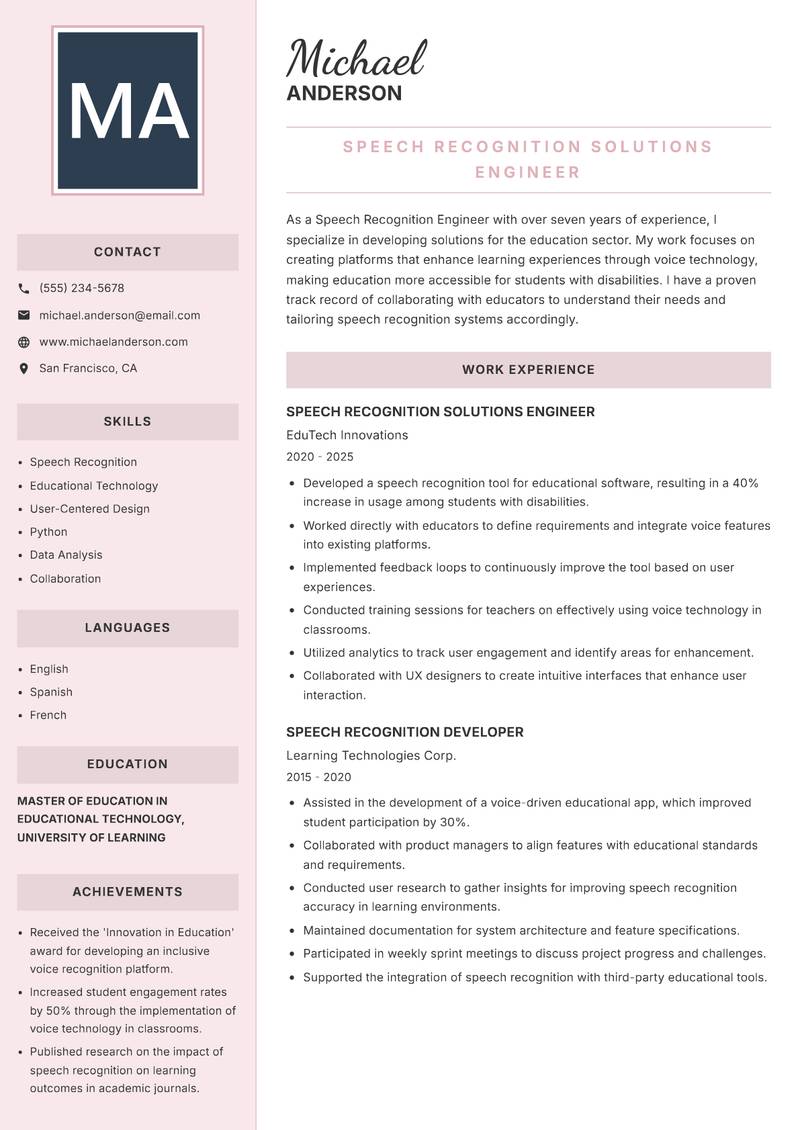
Executive
Use Template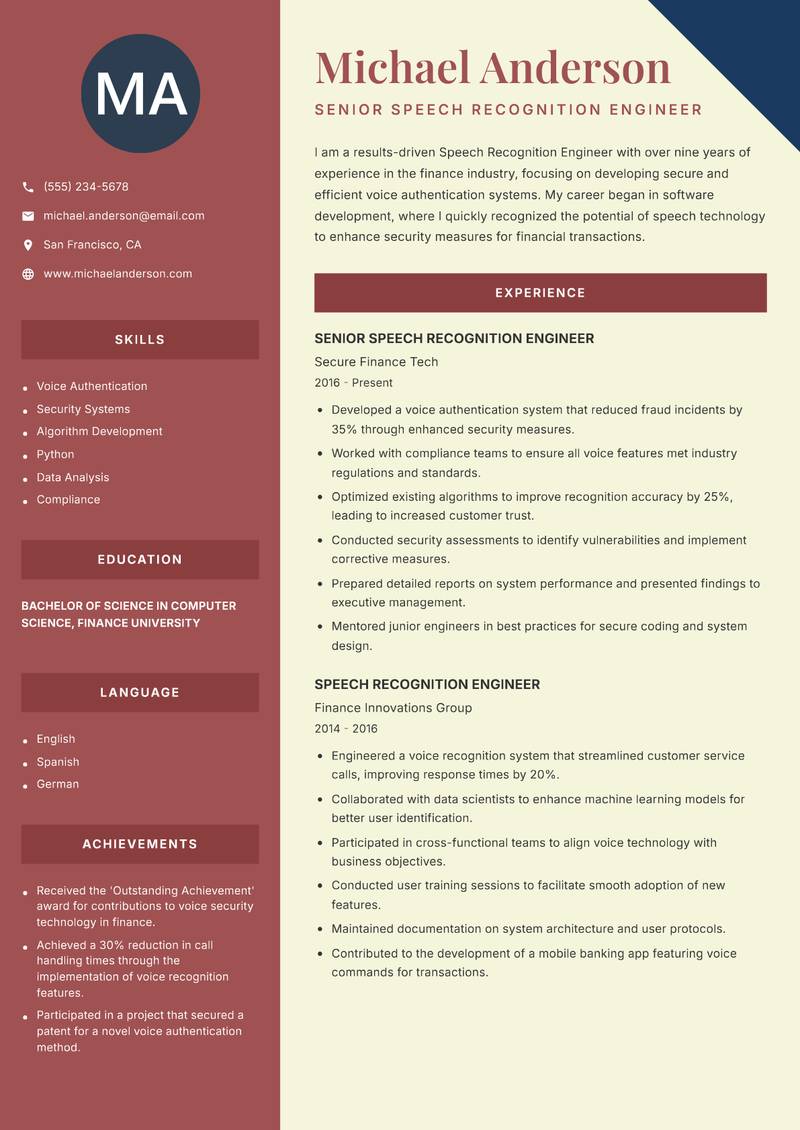
Two Column
Use Template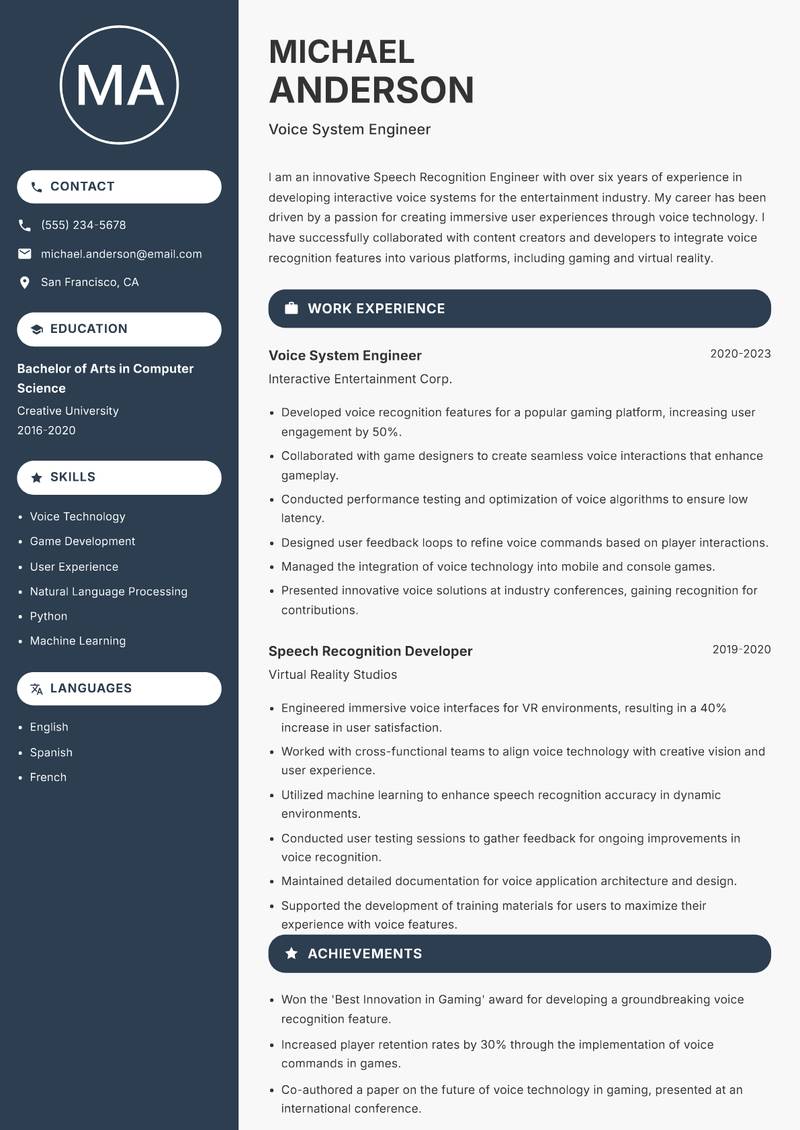
Compact
Use Template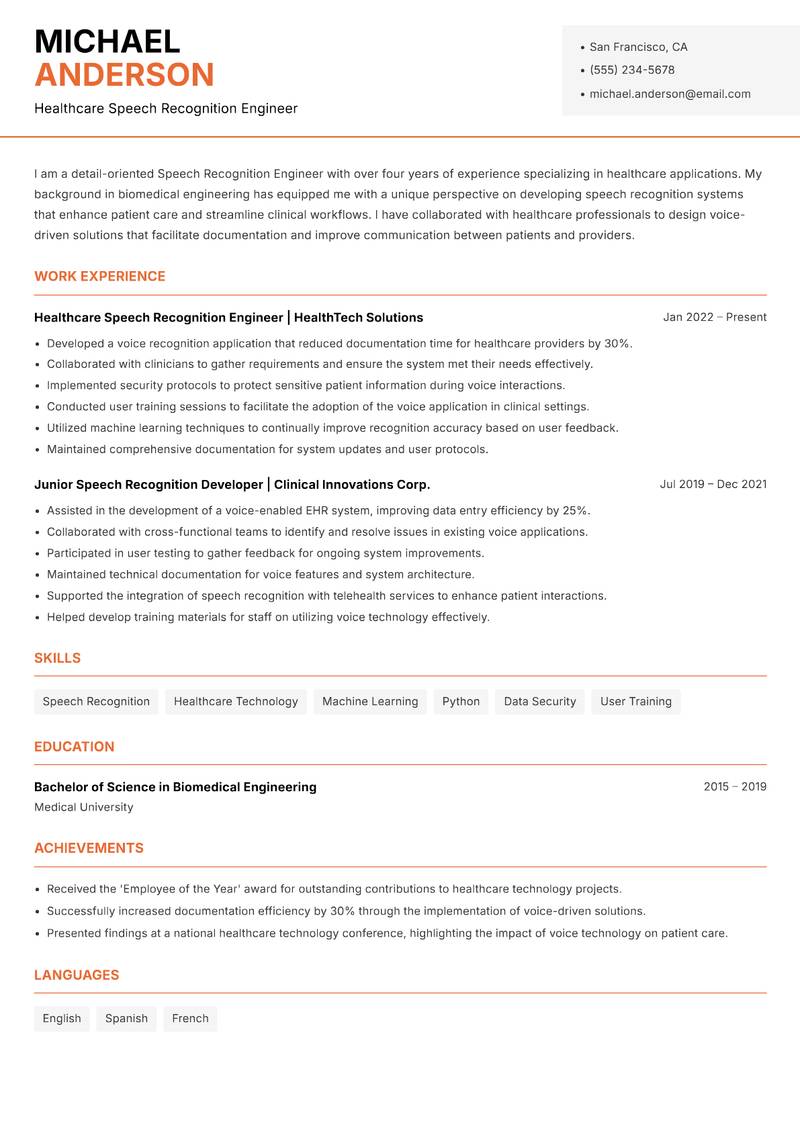
Modern Professional
Use Template7 Real Speech Recognition Engineer Resume Examples
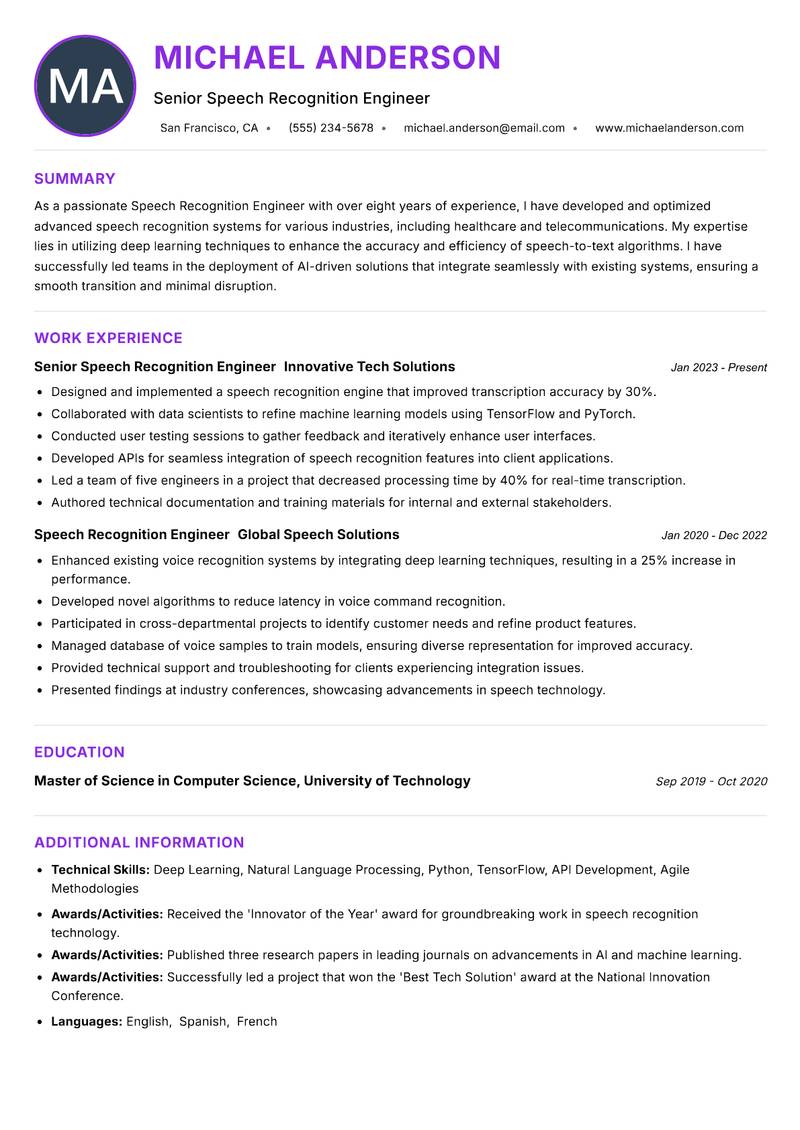
Senior Speech Recognition Engineer with 8+ Years Experience
Summary: As a passionate Speech Recognition Engineer with over eight years of experience, I have developed and optimized advanced speech recognition systems for various industries, including healthcare and telecommunications. My expertise lies in utilizing deep learning techniques to enhance the accuracy and efficiency of speech-to-text algorithms. I have successfully led teams in the deployment of AI-driven solutions that integrate seamlessly with existing systems, ensuring a smooth transition and minimal disruption. My commitment to continuous improvement has driven me to stay abreast of the latest technological advancements in natural language processing and machine learning. I believe in leveraging data analytics to inform system enhancements, resulting in significant reductions in error rates and improved user satisfaction. With a strong background in software engineering, I am adept at collaborating with cross-functional teams to translate complex requirements into user-friendly applications. My goal is to innovate and push the boundaries of what is possible in speech recognition technology, making communication more accessible and efficient for users worldwide.
Description:
- Designed and implemented a speech recognition engine that improved transcription accuracy by 30%.
- Collaborated with data scientists to refine machine learning models using TensorFlow and PyTorch.
- Conducted user testing sessions to gather feedback and iteratively enhance user interfaces.
- Developed APIs for seamless integration of speech recognition features into client applications.
- Led a team of five engineers in a project that decreased processing time by 40% for real-time transcription.
- Authored technical documentation and training materials for internal and external stakeholders.
🏆 Key Achievements
Lead Speech Recognition Engineer with 10+ Years Experience
Summary: With over ten years of experience in speech recognition technology, I have a strong background in developing intelligent voice applications for the automotive industry. My expertise includes designing robust algorithms that enable natural language understanding in vehicles, enhancing user interaction and safety. I thrive in fast-paced environments, where my analytical skills are complemented by a keen understanding of user behavior and market trends. I have led multidisciplinary teams in the implementation of voice-activated systems, ensuring compliance with industry standards and regulations. My passion for innovation drives me to explore emerging technologies, such as edge computing, to deliver solutions that optimize performance and reliability. Throughout my career, I have focused on creating user-friendly interfaces that prioritize accessibility and efficiency, making it easier for drivers to interact with in-car technology. My goal is to continue advancing the field of automotive speech recognition, contributing to safer and more intuitive driving experiences for users.
Description:
- Developed a voice recognition system for in-vehicle applications, increasing user satisfaction ratings by 40%.
- Directed a team of engineers in the integration of NLP models to improve command recognition accuracy.
- Created detailed project plans and timelines, ensuring projects were completed on time and within budget.
- Conducted extensive user testing to gather insights and drive product enhancements.
- Collaborated with UX designers to create intuitive voice interfaces tailored to driver needs.
- Presented project outcomes to senior management, demonstrating the impact on sales growth.
🏆 Key Achievements
Speech Recognition Engineer with 5+ Years Experience
Summary: I am a dedicated Speech Recognition Engineer with over five years of experience in creating and enhancing voice recognition systems for mobile applications. My journey began as a software developer, where I honed my coding skills before transitioning into the specialized field of speech recognition. I have a solid grasp of both the technical and user experience aspects of voice technology, allowing me to build applications that are not only functional but also user-friendly. I have worked extensively with various machine learning frameworks to develop efficient models that cater to diverse user needs. My experience also encompasses collaborating with product teams to ensure that speech features align with business objectives and customer expectations. I am passionate about improving accessibility through technology, aiming to create solutions that empower users regardless of their abilities. My goal is to continue advancing my skills and contribute to innovative projects that revolutionize the way users interact with their devices.
Description:
- Developed a mobile app feature that increased speech recognition accuracy by 35% through model optimization.
- Collaborated with cross-functional teams to define and implement voice capabilities in new applications.
- Conducted A/B testing to assess user interaction and satisfaction with voice features.
- Utilized cloud services for data processing to enhance the performance of speech applications.
- Maintained technical documentation for voice recognition systems, facilitating knowledge sharing.
- Participated in code reviews to ensure high-quality standards in software development.
🏆 Key Achievements
Speech Recognition Solutions Engineer with 7+ Years Experience
Summary: As a Speech Recognition Engineer with over seven years of experience, I specialize in developing solutions for the education sector. My work focuses on creating platforms that enhance learning experiences through voice technology, making education more accessible for students with disabilities. I have a proven track record of collaborating with educators to understand their needs and tailoring speech recognition systems accordingly. My technical skills are complemented by a strong understanding of educational methodologies, which allows me to design features that improve student engagement and retention. I am committed to utilizing technology to bridge gaps in learning and believe that effective communication is key to success. My goal is to continue contributing to projects that prioritize inclusivity and empower learners to achieve their full potential.
Description:
- Developed a speech recognition tool for educational software, resulting in a 40% increase in usage among students with disabilities.
- Worked directly with educators to define requirements and integrate voice features into existing platforms.
- Implemented feedback loops to continuously improve the tool based on user experiences.
- Conducted training sessions for teachers on effectively using voice technology in classrooms.
- Utilized analytics to track user engagement and identify areas for enhancement.
- Collaborated with UX designers to create intuitive interfaces that enhance user interaction.
🏆 Key Achievements
Senior Speech Recognition Engineer with 9+ Years Experience
Summary: I am a results-driven Speech Recognition Engineer with over nine years of experience in the finance industry, focusing on developing secure and efficient voice authentication systems. My career began in software development, where I quickly recognized the potential of speech technology to enhance security measures for financial transactions. I have worked with various stakeholders to design and implement voice recognition features that not only improve user experience but also comply with regulatory standards. My expertise includes developing algorithms that accurately identify users while minimizing false acceptance and rejection rates. I thrive in high-stakes environments where precision and security are paramount. My strong analytical skills and attention to detail ensure that I deliver robust solutions that withstand rigorous testing and scrutiny. I am dedicated to leveraging cutting-edge technology to provide clients with convenient and secure access to financial services, ultimately enhancing overall customer satisfaction.
Description:
- Developed a voice authentication system that reduced fraud incidents by 35% through enhanced security measures.
- Worked with compliance teams to ensure all voice features met industry regulations and standards.
- Optimized existing algorithms to improve recognition accuracy by 25%, leading to increased customer trust.
- Conducted security assessments to identify vulnerabilities and implement corrective measures.
- Prepared detailed reports on system performance and presented findings to executive management.
- Mentored junior engineers in best practices for secure coding and system design.
🏆 Key Achievements
Voice System Engineer with 6+ Years Experience
Summary: I am an innovative Speech Recognition Engineer with over six years of experience in developing interactive voice systems for the entertainment industry. My career has been driven by a passion for creating immersive user experiences through voice technology. I have successfully collaborated with content creators and developers to integrate voice recognition features into various platforms, including gaming and virtual reality. My expertise lies in designing natural language interfaces that enhance user engagement and drive user retention. I have a strong foundation in programming languages and machine learning frameworks, which enables me to build efficient and responsive voice applications. Committed to pushing the boundaries of voice technology, I continuously explore new trends and methodologies to deliver cutting-edge solutions. My goal is to create voice experiences that captivate and entertain users, revolutionizing the way they interact with digital content.
Description:
- Developed voice recognition features for a popular gaming platform, increasing user engagement by 50%.
- Collaborated with game designers to create seamless voice interactions that enhance gameplay.
- Conducted performance testing and optimization of voice algorithms to ensure low latency.
- Designed user feedback loops to refine voice commands based on player interactions.
- Managed the integration of voice technology into mobile and console games.
- Presented innovative voice solutions at industry conferences, gaining recognition for contributions.
🏆 Key Achievements
Healthcare Speech Recognition Engineer with 4+ Years Experience
Summary: I am a detail-oriented Speech Recognition Engineer with over four years of experience specializing in healthcare applications. My background in biomedical engineering has equipped me with a unique perspective on developing speech recognition systems that enhance patient care and streamline clinical workflows. I have collaborated with healthcare professionals to design voice-driven solutions that facilitate documentation and improve communication between patients and providers. My technical skills include proficiency in various programming languages and frameworks, enabling me to create efficient and secure applications. I am dedicated to improving healthcare access through technology and am passionate about creating solutions that prioritize patient safety and confidentiality. My goal is to contribute to projects that harness the power of voice technology to improve health outcomes and the overall patient experience.
Description:
- Developed a voice recognition application that reduced documentation time for healthcare providers by 30%.
- Collaborated with clinicians to gather requirements and ensure the system met their needs effectively.
- Implemented security protocols to protect sensitive patient information during voice interactions.
- Conducted user training sessions to facilitate the adoption of the voice application in clinical settings.
- Utilized machine learning techniques to continually improve recognition accuracy based on user feedback.
- Maintained comprehensive documentation for system updates and user protocols.
🏆 Key Achievements
Key Skills for Speech Recognition Engineer
ATS Optimization Tips
Increase your chances of getting hired
Use Standard Headings
Use common section titles like Experience, Skills, etc.
Include Keywords
Add role-specific keywords from the job description
Keep it Simple
Avoid complex tables, images and graphics
Save in Right Format
Use PDF format unless otherwise specified
Speech Recognition Engineer Salary Insights
Average Salary
$118,000
per year
Salary Range
$86,000 - $150,000
per year
Top Paying Cities
Los Angeles, Seattle, Houston, Dallas, Boston
Source: Glassdoor, Payscale, Indeed (Updated May 2025)
Everything you need to write a great Speech Recognition Engineer resume
Strong Action Verbs to Use
Resume Writing Tips
- →Focus on specific projects that illustrate your proficiency in speech recognition and related technologies.
- →Quantify accomplishments, such as improvements in accuracy or reductions in latency, to provide concrete evidence of skills.
- →Highlight any collaborative projects with cross-functional teams to show your ability to work in diverse environments.
- →Incorporate key technical terms relevant to speech recognition technology to enhance ATS compatibility.
- →Mention any tools or software you are proficient with, especially those popular in speech recognition development.
Common Mistakes to Avoid
- ✕Over-generalizing skills without contextual examples, making it hard to assess relevant experience.
- ✕Neglecting to list specific technologies or frameworks relevant to speech recognition, which can lead to ATS filtering.
- ✕Failing to detail collaborations with other team members, which can understate teamwork abilities essential in development.
- ✕Omitting metrics of success such as reduced error rates or enhanced processing speeds, which can weaken perceived effectiveness.
ATS Keywords for Speech Recognition Engineer
Speech Recognition Engineer Career Path
Relevant Certifications
Career Progression
Junior Speech Recognition Engineer
Typically involves assisting in data collection, annotation, and model training under the guidance of senior engineers.
Mid-Level Speech Recognition Engineer
Responsible for designing and fine-tuning algorithms, often using machine learning frameworks such as TensorFlow or PyTorch.
Senior Speech Recognition Engineer
Leads projects focused on high-quality speech recognition systems, collaborating with data scientists and linguists to enhance model accuracy.
Lead Speech Recognition Engineer
Manages a team of engineers and oversees the entire development cycle from concept to deployment, ensuring alignment with market needs.
Speech Recognition Architect/Director
Defines long-term strategy and technical direction for speech recognition technologies, often interfacing with stakeholders across various departments.
Speech Recognition Engineer Interview Questions
Can you explain how a speech recognition model differs from traditional methods of signal processing? +
Highlight the integration of machine learning techniques and the shift from rule-based systems to data-driven approaches.
What methods do you use to evaluate the performance of a speech recognition system? +
Discuss metrics like WER (Word Error Rate), ROC curves, or evaluation datasets you've worked with.
Describe a time when you improved the accuracy of a speech recognition system. What were the steps you took? +
Provide a specific project example, detailing the methodologies employed and outcomes achieved.
How do you handle noisy data in speech recognition? +
Discuss techniques such as data augmentation, noise reduction, or robust model training.
What advancements do you foresee in speech recognition technology in the next five years? +
Show your knowledge of trends like contextual awareness, multilingual support, or the use of unsupervised learning.
Have you worked with any real-time speech recognition applications? If so, can you share your experience? +
Explain any platforms or technologies used, focusing on latency and responsiveness issues.
About the Speech Recognition Engineer Role
Crafting innovative speech recognition systems involves a blend of algorithms and linguistic knowledge, as Speech Recognition Engineers leverage large datasets to enhance model efficacy. This role demands adeptness in machine learning and familiarity with various frameworks, with engineers often using techniques like acoustic and language modeling to refine their applications. Stakeholder collaboration is critical, ensuring that the developed technology meets user needs and regulatory standards in audio processing contexts.
Frequently Asked Questions
What programming languages should a Speech Recognition Engineer be familiar with? +
Proficiency in Python is essential, with familiarity in others like C++ for performance-critical components.
What types of projects do Speech Recognition Engineers typically work on? +
They work on projects involving virtual assistants, transcription services, and real-time captioning, focusing on enhancing user experience.
Is knowledge of linguistics important for a Speech Recognition Engineer? +
Yes, understanding phonetics and language structure informs better model design and tuning.
What are common challenges faced in speech recognition projects? +
Challenges include managing diverse accents, background noise, and ensuring real-time performance.
Do Speech Recognition Engineers collaborate with non-technical teams? +
Yes, they often work alongside product managers, UX designers, and marketing teams to align technology features with user needs.
How does real-world data impact model training for speech recognition? +
Real-world data introduces variability that improves robustness but requires careful preprocessing and validation to ensure quality.
More Resume Examples You Might Like
Related Career Paths
Other roles candidates for Speech Recognition Engineer positions often also consider.
Will this Speech Recognition Engineer resume pass the ATS scan?
Upload it and get an instant AI-scored compatibility check with specific fixes.
Check My Resume →
Pair it with a matching cover letter
AI drafts a first version from your job title and strengths — edit it live, then download the PDF.
Write My Cover Letter →
Written by Nohaya Career Team
Reviewed by HR Professionals · Updated May 2025
Ready to Build Your Perfect Resume?
Choose from 1000+ professional templates and land your dream job.
Create My Resume Now