Build an ATS-Friendly
Soil Microbiologist Resume
That Gets Interviews
A Soil Microbiologist conducts in-depth analyses of the microbial populations within soil ecosystems, leveraging both laboratory techniques and fieldwork to understand their role in plant health and nutrient cycling. By utilizing advanced tools such as soil DNA extraction and microbial community sequencing, they…
Soil Microbiologist Resume Templates
Modern Professional
Use Template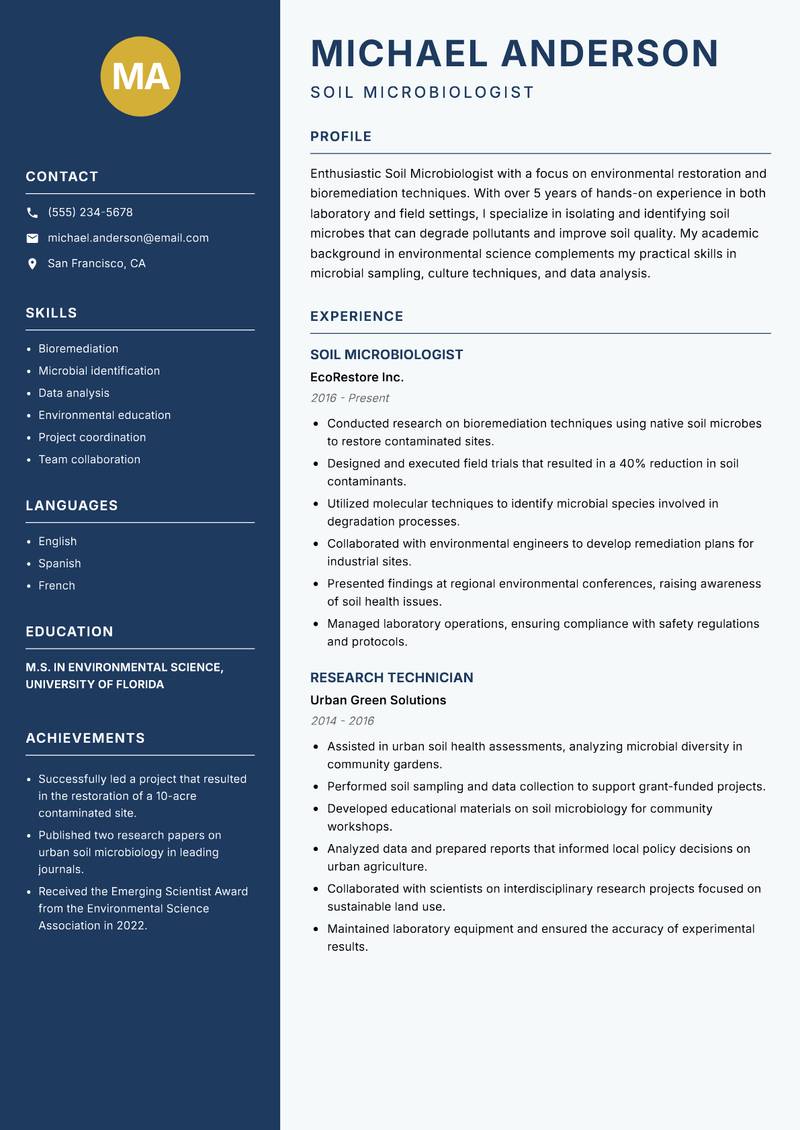
Classic Clean
Use Template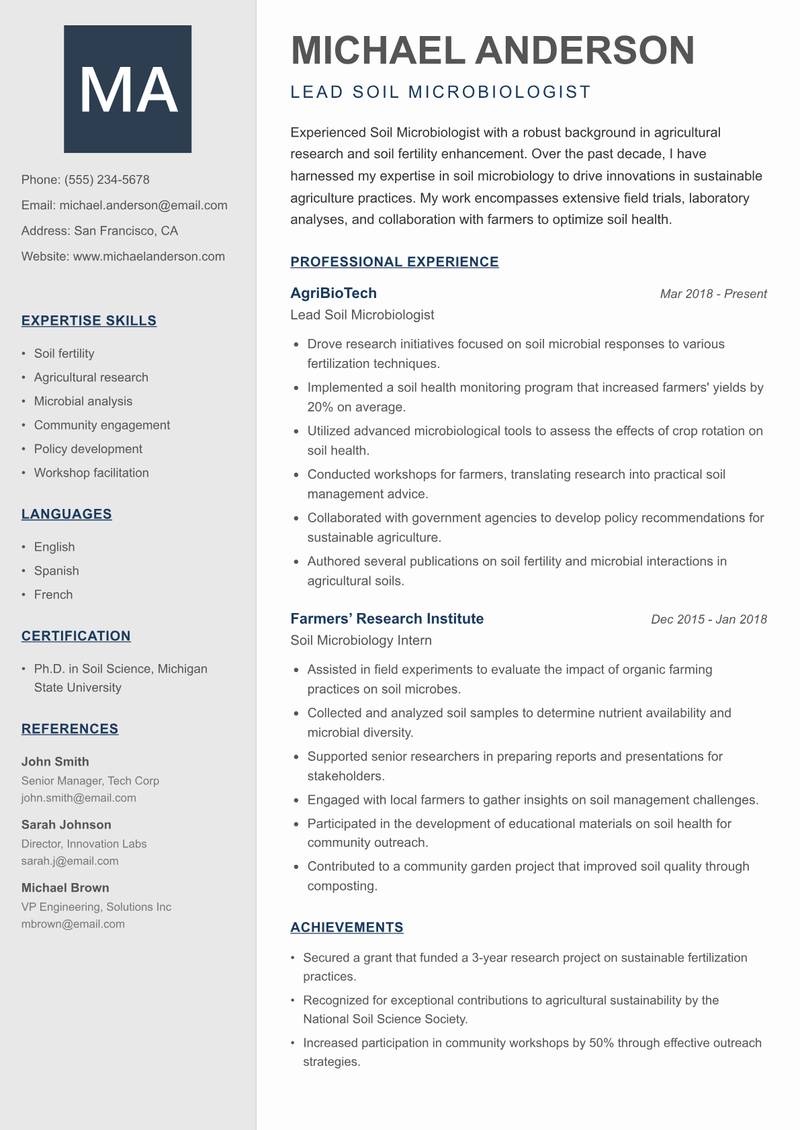
Creative Minimal
Use Template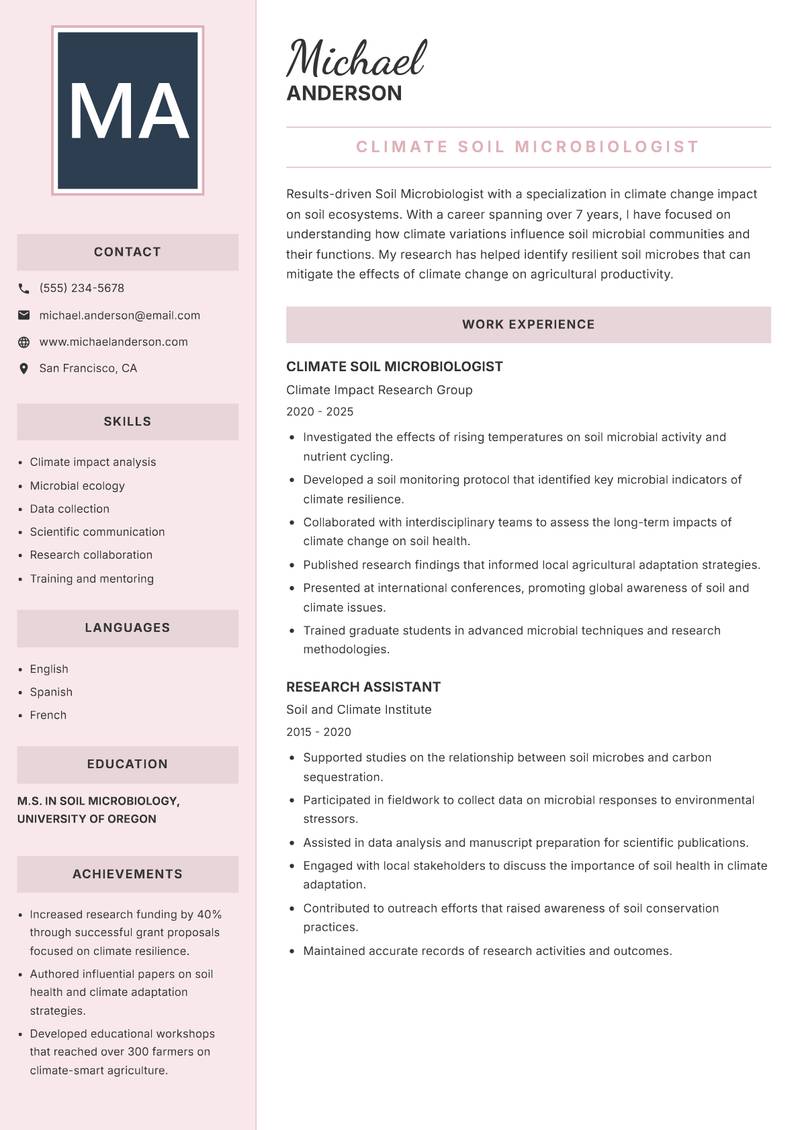
Executive
Use Template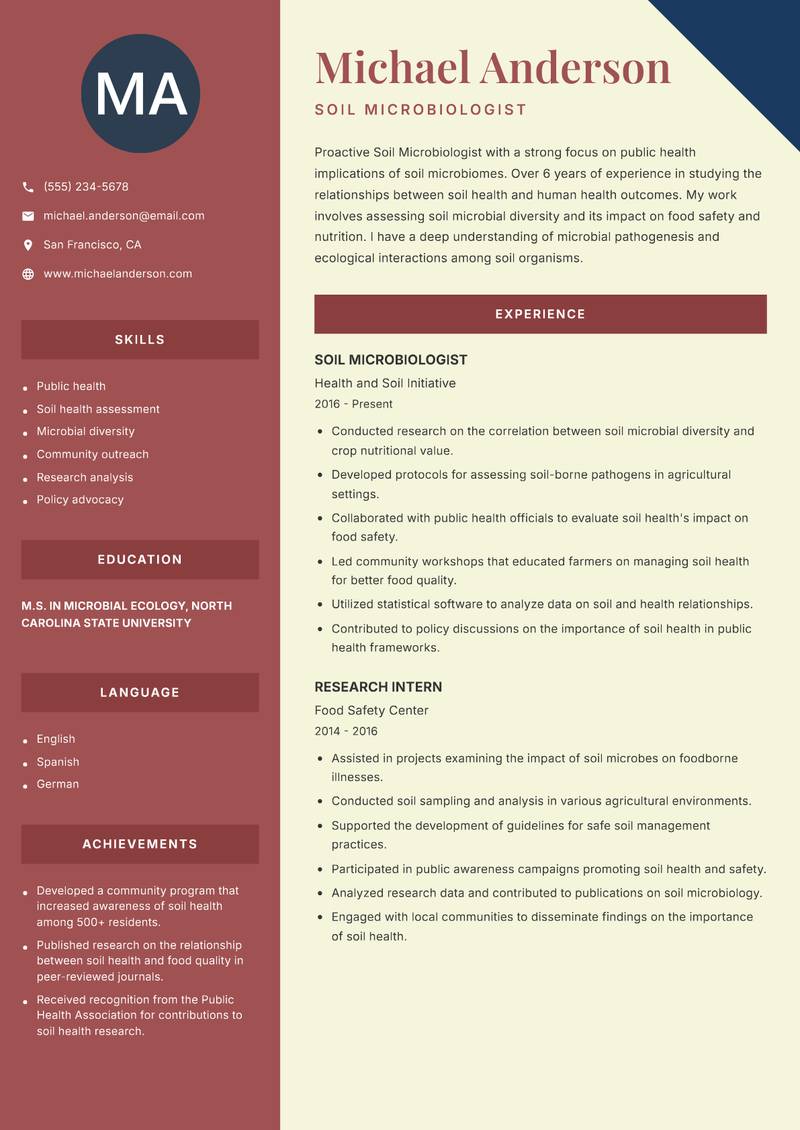
Two Column
Use Template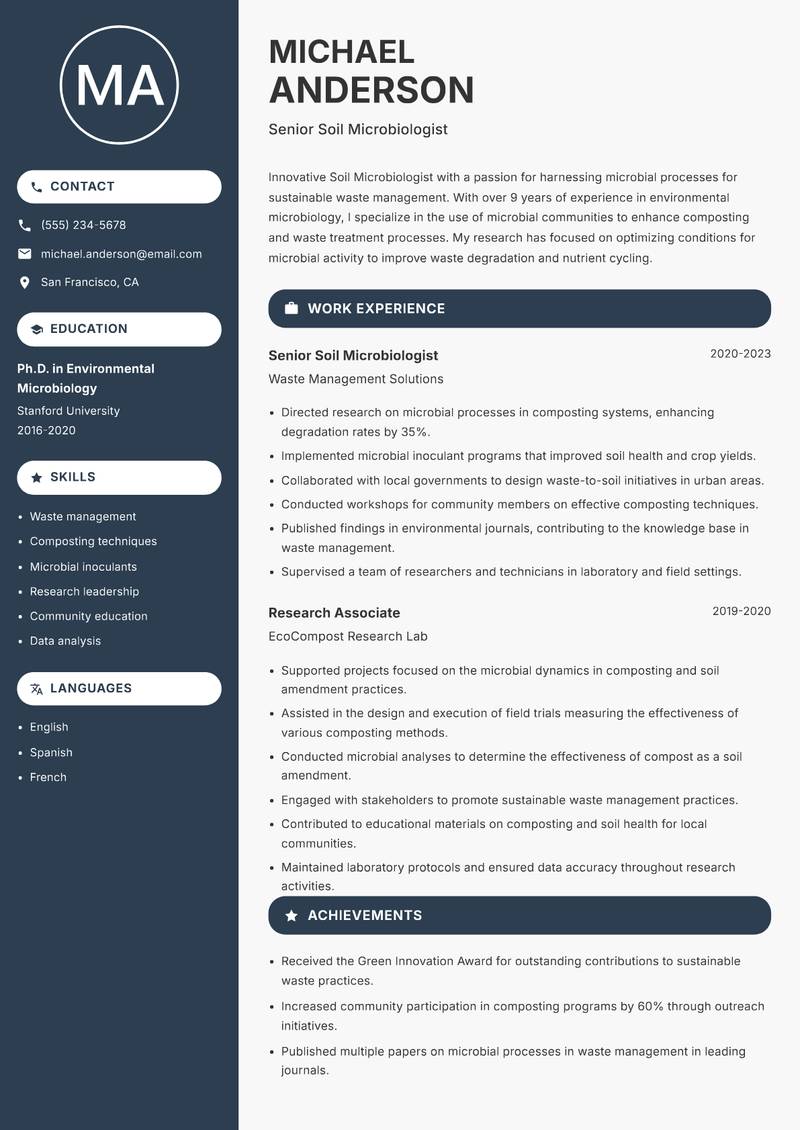
Compact
Use Template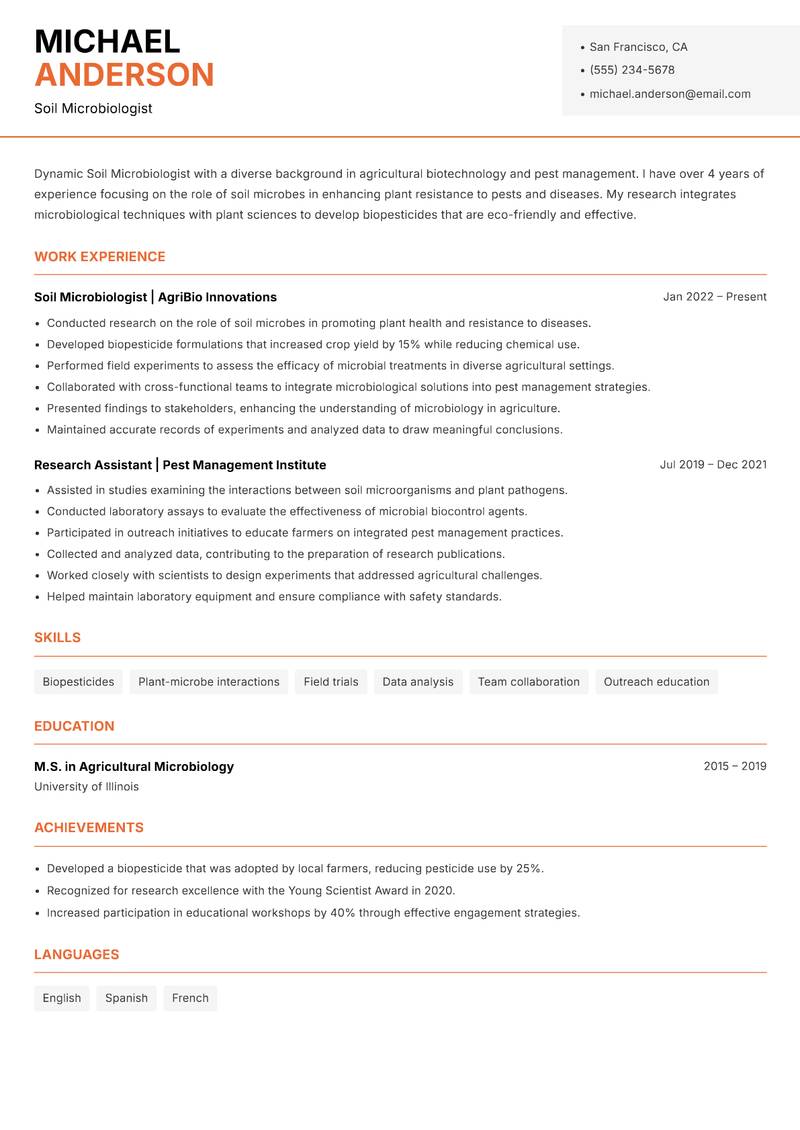
Modern Professional
Use Template7 Real Soil Microbiologist Resume Examples
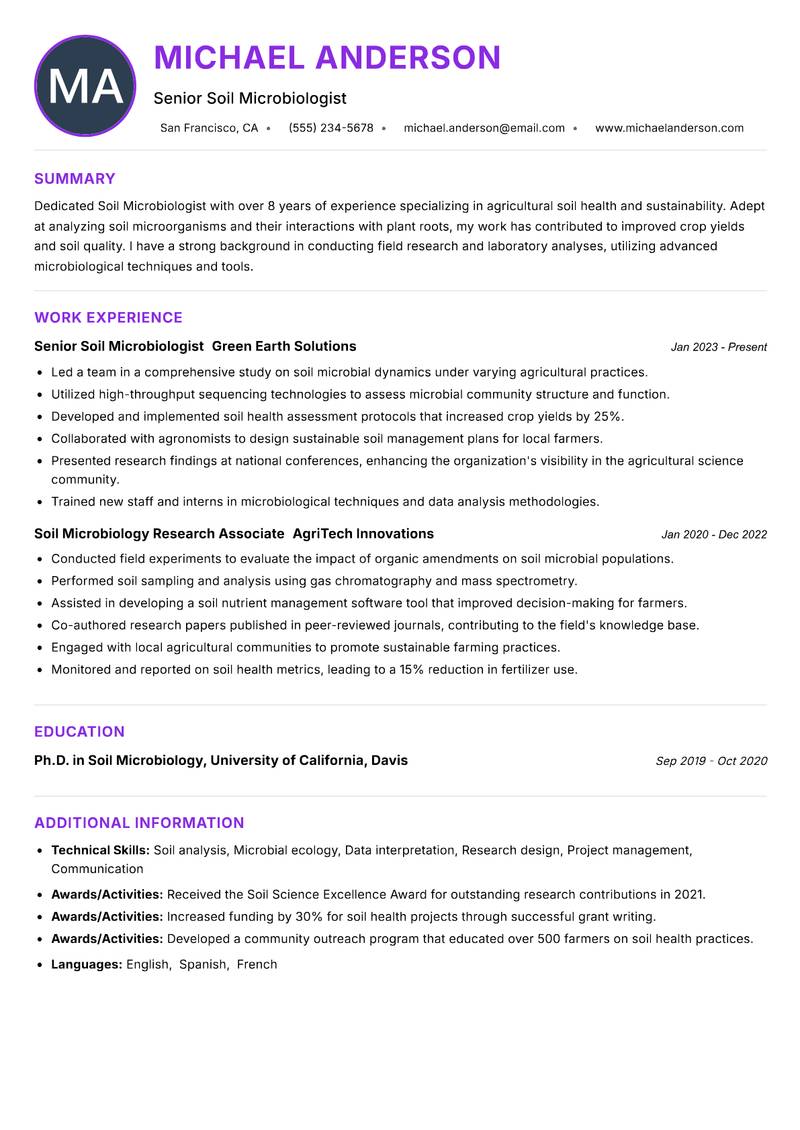
Senior Soil Microbiologist with 8+ Years Experience
Summary: Dedicated Soil Microbiologist with over 8 years of experience specializing in agricultural soil health and sustainability. Adept at analyzing soil microorganisms and their interactions with plant roots, my work has contributed to improved crop yields and soil quality. I have a strong background in conducting field research and laboratory analyses, utilizing advanced microbiological techniques and tools. My expertise extends to developing innovative solutions for soil remediation and nutrient management to promote sustainable farming practices. I have successfully collaborated with interdisciplinary teams to implement research findings into practical applications, ensuring that agricultural practices are both productive and environmentally responsible. My passion for environmental science drives my commitment to advancing soil microbiology, and I am eager to contribute to projects that seek to enhance soil ecosystems and support food security.
Description:
- Led a team in a comprehensive study on soil microbial dynamics under varying agricultural practices.
- Utilized high-throughput sequencing technologies to assess microbial community structure and function.
- Developed and implemented soil health assessment protocols that increased crop yields by 25%.
- Collaborated with agronomists to design sustainable soil management plans for local farmers.
- Presented research findings at national conferences, enhancing the organization's visibility in the agricultural science community.
- Trained new staff and interns in microbiological techniques and data analysis methodologies.
🏆 Key Achievements
Soil Microbiologist with 5+ Years Experience
Summary: Enthusiastic Soil Microbiologist with a focus on environmental restoration and bioremediation techniques. With over 5 years of hands-on experience in both laboratory and field settings, I specialize in isolating and identifying soil microbes that can degrade pollutants and improve soil quality. My academic background in environmental science complements my practical skills in microbial sampling, culture techniques, and data analysis. I have a strong commitment to contributing to sustainability initiatives, particularly in urban agriculture and contaminated land rehabilitation. Through my work, I have developed a keen understanding of the essential role that soil microorganisms play in ecosystem health. I thrive in collaborative environments and am passionate about educating stakeholders on the importance of soil microbiology in environmental conservation.
Description:
- Conducted research on bioremediation techniques using native soil microbes to restore contaminated sites.
- Designed and executed field trials that resulted in a 40% reduction in soil contaminants.
- Utilized molecular techniques to identify microbial species involved in degradation processes.
- Collaborated with environmental engineers to develop remediation plans for industrial sites.
- Presented findings at regional environmental conferences, raising awareness of soil health issues.
- Managed laboratory operations, ensuring compliance with safety regulations and protocols.
🏆 Key Achievements
Lead Soil Microbiologist with 10+ Years Experience
Summary: Experienced Soil Microbiologist with a robust background in agricultural research and soil fertility enhancement. Over the past decade, I have harnessed my expertise in soil microbiology to drive innovations in sustainable agriculture practices. My work encompasses extensive field trials, laboratory analyses, and collaboration with farmers to optimize soil health. I specialize in studying the interactions between soil microorganisms and nutrients, which has led to the development of improved fertilizer application strategies that maximize crop productivity while minimizing environmental impact. I am passionate about translating complex scientific concepts into actionable strategies for farmers, fostering stronger connections between science and agricultural practices. I am committed to advancing the field of soil microbiology through research, education, and community engagement.
Description:
- Drove research initiatives focused on soil microbial responses to various fertilization techniques.
- Implemented a soil health monitoring program that increased farmers' yields by 20% on average.
- Utilized advanced microbiological tools to assess the effects of crop rotation on soil health.
- Conducted workshops for farmers, translating research into practical soil management advice.
- Collaborated with government agencies to develop policy recommendations for sustainable agriculture.
- Authored several publications on soil fertility and microbial interactions in agricultural soils.
🏆 Key Achievements
Climate Soil Microbiologist with 7+ Years Experience
Summary: Experienced Soil Microbiologist with a specialization in climate change impact on soil ecosystems. With a career spanning over 7 years, I have focused on understanding how climate variations influence soil microbial communities and their functions. My research has helped identify resilient soil microbes that can mitigate the effects of climate change on agricultural productivity. I leverage advanced molecular techniques to conduct detailed microbial community analyses and work closely with climate scientists to develop integrated solutions for sustainable land use. My ability to communicate scientific findings to diverse audiences has enhanced collaboration between researchers, policymakers, and farmers. I am dedicated to fostering practices that protect soil health and contribute to climate resilience in agriculture.
Description:
- Investigated the effects of rising temperatures on soil microbial activity and nutrient cycling.
- Developed a soil monitoring protocol that identified key microbial indicators of climate resilience.
- Collaborated with interdisciplinary teams to assess the long-term impacts of climate change on soil health.
- Published research findings that informed local agricultural adaptation strategies.
- Presented at international conferences, promoting global awareness of soil and climate issues.
- Trained graduate students in advanced microbial techniques and research methodologies.
🏆 Key Achievements
Soil Microbiologist with 6+ Years Experience
Summary: Driven Soil Microbiologist with a strong focus on public health implications of soil microbiomes. Over 6 years of experience in studying the relationships between soil health and human health outcomes. My work involves assessing soil microbial diversity and its impact on food safety and nutrition. I have a deep understanding of microbial pathogenesis and ecological interactions among soil organisms. By collaborating with health professionals and agricultural experts, I aim to bridge the gap between soil science and public health. I am passionate about educating communities about the importance of healthy soils for overall well-being and have developed outreach programs to promote sustainable practices that benefit both soil and human health. My goal is to contribute to integrated health approaches that recognize the vital role of soil microbiomes in food systems.
Description:
- Conducted research on the correlation between soil microbial diversity and crop nutritional value.
- Developed protocols for assessing soil-borne pathogens in agricultural settings.
- Collaborated with public health officials to evaluate soil health's impact on food safety.
- Led community workshops that educated farmers on managing soil health for better food quality.
- Utilized statistical software to analyze data on soil and health relationships.
- Contributed to policy discussions on the importance of soil health in public health frameworks.
🏆 Key Achievements
Senior Soil Microbiologist with 9+ Years Experience
Summary: Innovative Soil Microbiologist with a passion for harnessing microbial processes for sustainable waste management. With over 9 years of experience in environmental microbiology, I specialize in the use of microbial communities to enhance composting and waste treatment processes. My research has focused on optimizing conditions for microbial activity to improve waste degradation and nutrient cycling. I have successfully implemented large-scale composting projects that not only reduce waste but also enrich soil quality. My expertise in microbial inoculants has led to the development of effective products that promote healthy soil ecosystems. I believe in the power of education and have conducted numerous workshops to teach sustainable waste management practices to diverse audiences. My goal is to contribute to a circular economy through innovative soil microbiology applications.
Description:
- Directed research on microbial processes in composting systems, enhancing degradation rates by 35%.
- Implemented microbial inoculant programs that improved soil health and crop yields.
- Collaborated with local governments to design waste-to-soil initiatives in urban areas.
- Conducted workshops for community members on effective composting techniques.
- Published findings in environmental journals, contributing to the knowledge base in waste management.
- Supervised a team of researchers and technicians in laboratory and field settings.
🏆 Key Achievements
Soil Microbiologist with 4+ Years Experience
Summary: Dynamic Soil Microbiologist with a diverse background in agricultural biotechnology and pest management. I have over 4 years of experience focusing on the role of soil microbes in enhancing plant resistance to pests and diseases. My research integrates microbiological techniques with plant sciences to develop biopesticides that are eco-friendly and effective. I am skilled in conducting field trials, analyzing microbial interactions with plants, and collaborating with agronomists to create innovative pest management solutions. My passion for sustainable agriculture drives my commitment to finding solutions that benefit both farmers and the environment. I thrive in fast-paced environments where creativity and scientific rigor are essential, and I am eager to contribute to cutting-edge agricultural research initiatives.
Description:
- Conducted research on the role of soil microbes in promoting plant health and resistance to diseases.
- Developed biopesticide formulations that increased crop yield by 15% while reducing chemical use.
- Performed field experiments to assess the efficacy of microbial treatments in diverse agricultural settings.
- Collaborated with cross-functional teams to integrate microbiological solutions into pest management strategies.
- Presented findings to stakeholders, enhancing the understanding of microbiology in agriculture.
- Maintained accurate records of experiments and analyzed data to draw meaningful conclusions.
🏆 Key Achievements
Key Skills for Soil Microbiologist
ATS Optimization Tips
Increase your chances of getting hired
Use Standard Headings
Use common section titles like Experience, Skills, etc.
Include Keywords
Add role-specific keywords from the job description
Keep it Simple
Avoid complex tables, images and graphics
Save in Right Format
Use PDF format unless otherwise specified
Soil Microbiologist Salary Insights
Average Salary
$83,500
per year
Salary Range
$55,000 - $112,000
per year
Top Paying Cities
Los Angeles, Seattle, Houston, Dallas, Boston
Source: Glassdoor, Payscale, Indeed (Updated May 2025)
Everything you need to write a great Soil Microbiologist resume
Strong Action Verbs to Use
Resume Writing Tips
- →Highlight hands-on experience with soil sampling and lab analysis techniques relevant to microbiology.
- →Include specific research projects that demonstrate your contributions to agricultural science and improve soil health.
- →Emphasize collaboration with interdisciplinary teams or external agricultural stakeholders for a broader impact.
- →Cite any publications or presentations at conferences to showcase your expertise and active participation in the scientific community.
- →Focus on results-oriented outcomes from your research that illustrate practical applications in agriculture.
Common Mistakes to Avoid
- ✕Listing generic lab techniques without specifying their relevance to microbiology or soil science.
- ✕Omitting publications or research projects that showcase mastery and contribution to the field.
- ✕Not tailoring the resume to include unique keywords related to soil microbiology and agricultural practices.
- ✕Providing vague descriptions instead of quantifiable achievements in past roles or research.
- ✕Failing to highlight collaborative experiences, which are crucial in interdisciplinary agricultural research.
ATS Keywords for Soil Microbiologist
Soil Microbiologist Career Path
Relevant Certifications
Career Progression
Entry-Level Soil Microbiologist
Focuses on basic microbial analysis in soil samples, assisting in laboratory experiments and data collection.
Research Soil Microbiologist
Conducts independent research on microbial processes affecting soil health and fertility, often publishing findings in scientific journals.
Senior Soil Microbiologist
Leads research projects, managing a team of scientists and collaborating with agricultural stakeholders to develop improved farming practices.
Director of Soil Microbiology Programs
Oversees multiple research initiatives, focusing on microbiome applications in sustainable agriculture, while advocating policy changes.
Consultant in Soil Microbiology
Provides expertise on soil health to agricultural corporations, helping them design microbial inoculant products or improve land management strategies.
Soil Microbiologist Interview Questions
Describe your experience working with soil microbial analysis techniques. +
Be specific about the methods and technologies you've used, such as PCR or microbial culture techniques.
How would you design a study to assess the impact of agricultural practices on soil microbiome diversity? +
Discuss your approach to selecting variables, control measures, and data analysis.
Can you provide an example of how your research has contributed to agricultural practices? +
Share specific outcomes or practices that were influenced by your findings.
What are some challenges you've faced when working in the field versus the laboratory, and how did you overcome them? +
Highlight practical examples from your experience.
How do you keep current with advancements in soil microbiology? +
Mention journals, conferences, or professional organizations relevant to your field.
What methods do you employ for successful collaboration with cross-disciplinary teams? +
Discuss specific instances of collaboration and your communication strategies.
Describe a situation where you had to troubleshoot a significant issue in soil sample analysis. +
Focus on your problem-solving skills and the outcome.
About the Soil Microbiologist Role
A Soil Microbiologist conducts in-depth analyses of the microbial populations within soil ecosystems, leveraging both laboratory techniques and fieldwork to understand their role in plant health and nutrient cycling. By utilizing advanced tools such as soil DNA extraction and microbial community sequencing, they assess how these microorganisms affect soil quality and agricultural productivity. Collaborating closely with agronomists and farmers, they translate their research into actionable farming practices that enhance sustainability and crop yield.
Frequently Asked Questions
View all →What is the primary focus of a Soil Microbiologist's work? +
Soil Microbiologists concentrate on understanding the interactions between soil microbes and their impact on plant health, nutrient cycling, and overall soil fertility.
What kind of education is required to become a Soil Microbiologist? +
Typically, a minimum of a bachelor's degree in microbiology, soil science, or a related field is required, but many positions also require a master's or PhD.
What tools do Soil Microbiologists commonly use? +
Common tools include soil DNA analysis kits, microbiological culture media, field sampling equipment, and various laboratory analytical equipment.
What types of employers hire Soil Microbiologists? +
Soil Microbiologists can work for academic institutions, government agencies, agricultural companies, and environmental consulting firms.
How does soil microbiology contribute to sustainable agriculture? +
Soil microbiology provides insights into soil health and fertility, leading to practices that enhance soil quality and reduce reliance on chemical fertilizers.
What career advancement opportunities are available for Soil Microbiologists? +
Opportunities for advancement include specialized research roles, project leadership positions, or consultancy roles that influence agricultural policy and practices.
Is fieldwork an important part of a Soil Microbiologist's job? +
Yes, fieldwork is crucial for collecting soil samples and observing microbial interactions in their natural environments.
More Resume Examples You Might Like
Related Career Paths
Other roles candidates for Soil Microbiologist positions often also consider.
Will this Soil Microbiologist resume pass the ATS scan?
Upload it and get an instant AI-scored compatibility check with specific fixes.
Check My Resume →
Pair it with a matching cover letter
AI drafts a first version from your job title and strengths — edit it live, then download the PDF.
Write My Cover Letter →
Written by Nohaya Career Team
Reviewed by HR Professionals · Updated May 2025
Ready to Build Your Perfect Resume?
Choose from 1000+ professional templates and land your dream job.
Create My Resume Now