Build an ATS-Friendly
Plasmonics Researcher Resume
That Gets Interviews
Engaging in advanced studies of electron and photon interactions at nanoscale levels, a Plasmonics Researcher explores how light and metallic nano-structures manipulate electromagnetic waves. This role requires mastery of both experimental and theoretical approaches to tackle complex research challenges, often…
Plasmonics Researcher Resume Templates
Modern Professional
Use Template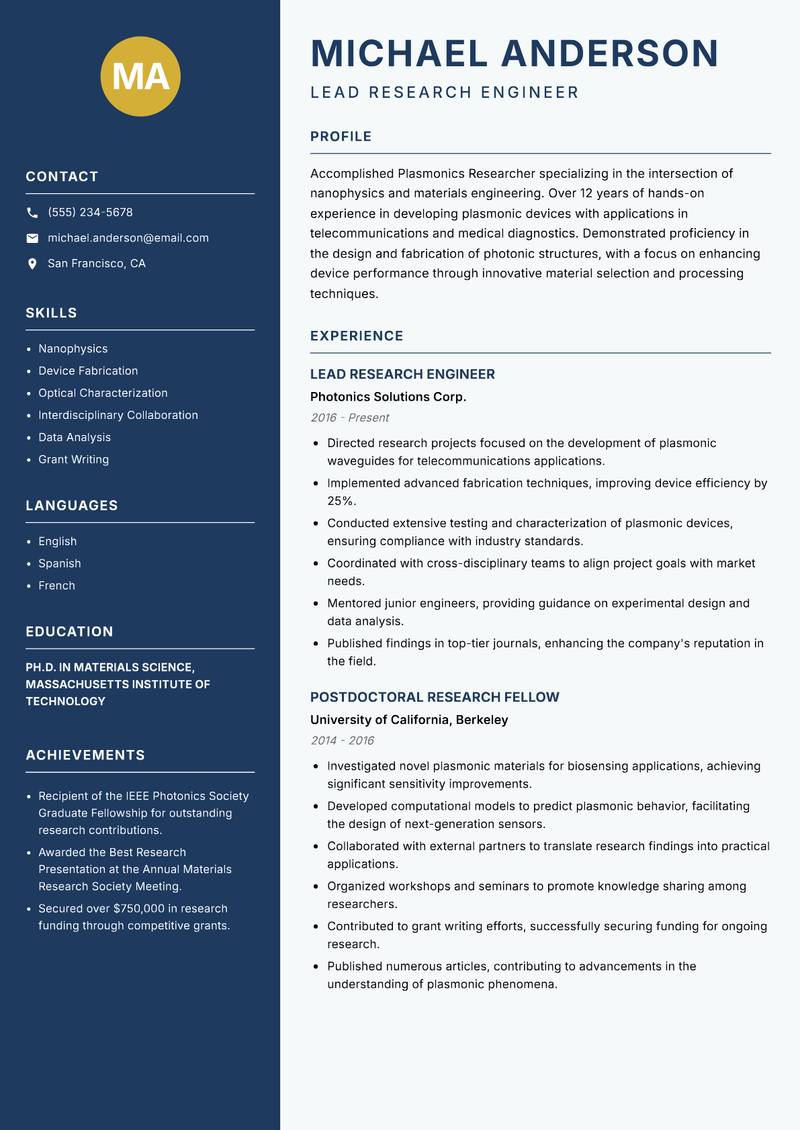
Classic Clean
Use Template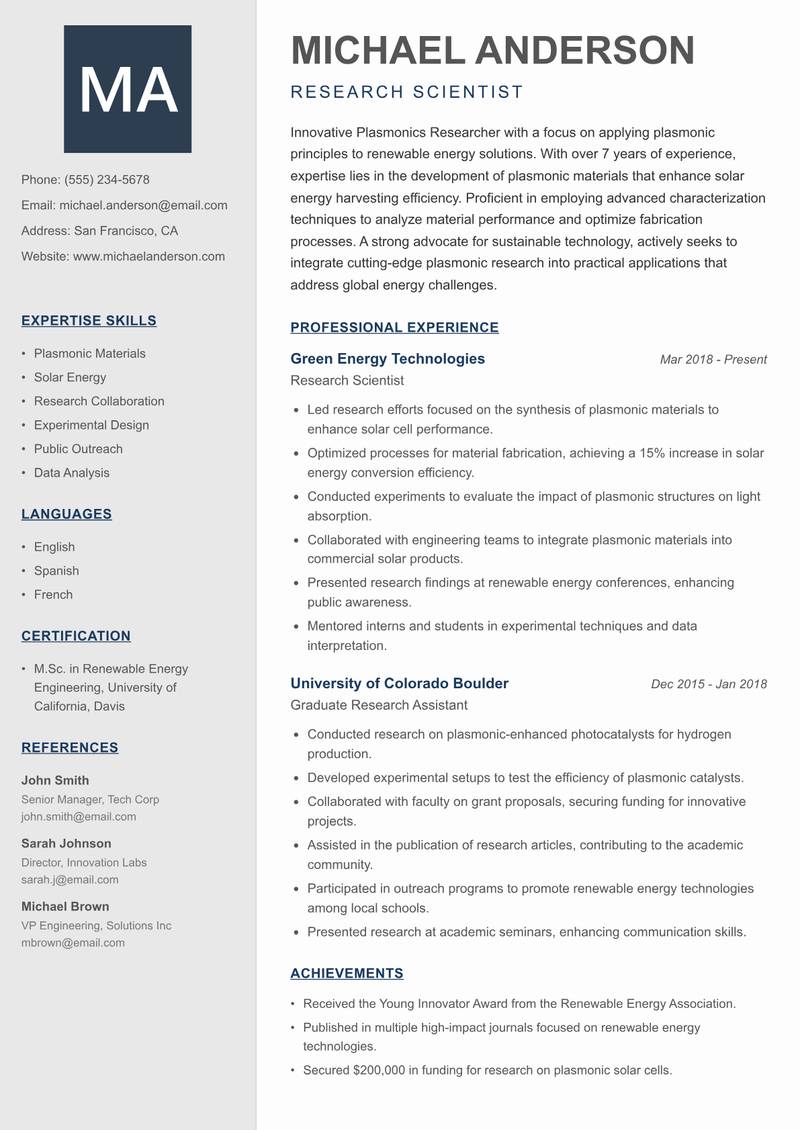
Creative Minimal
Use Template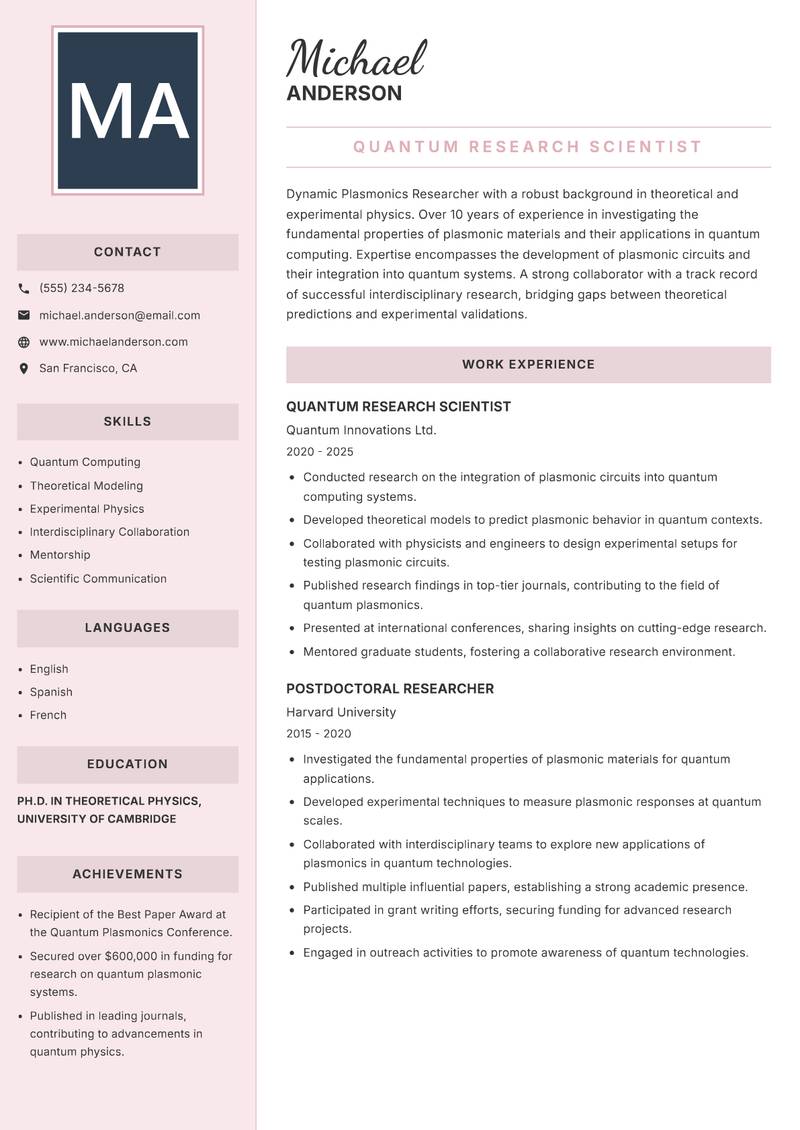
Executive
Use Template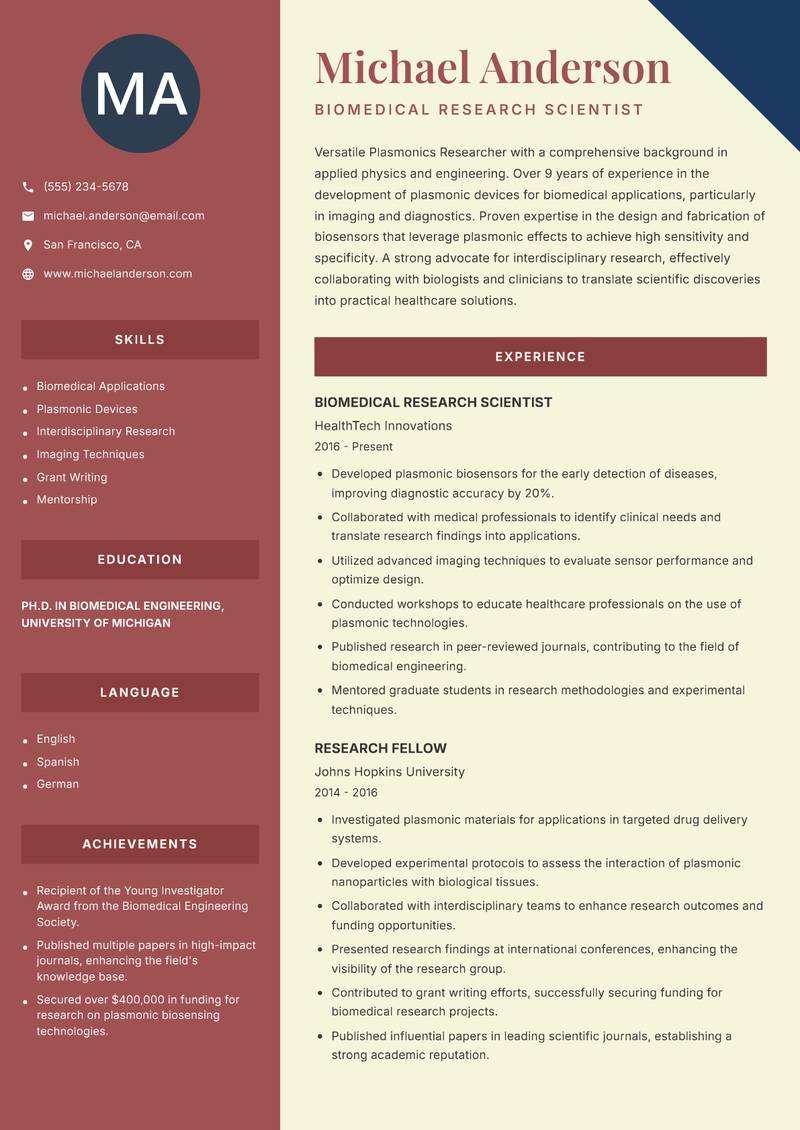
Two Column
Use Template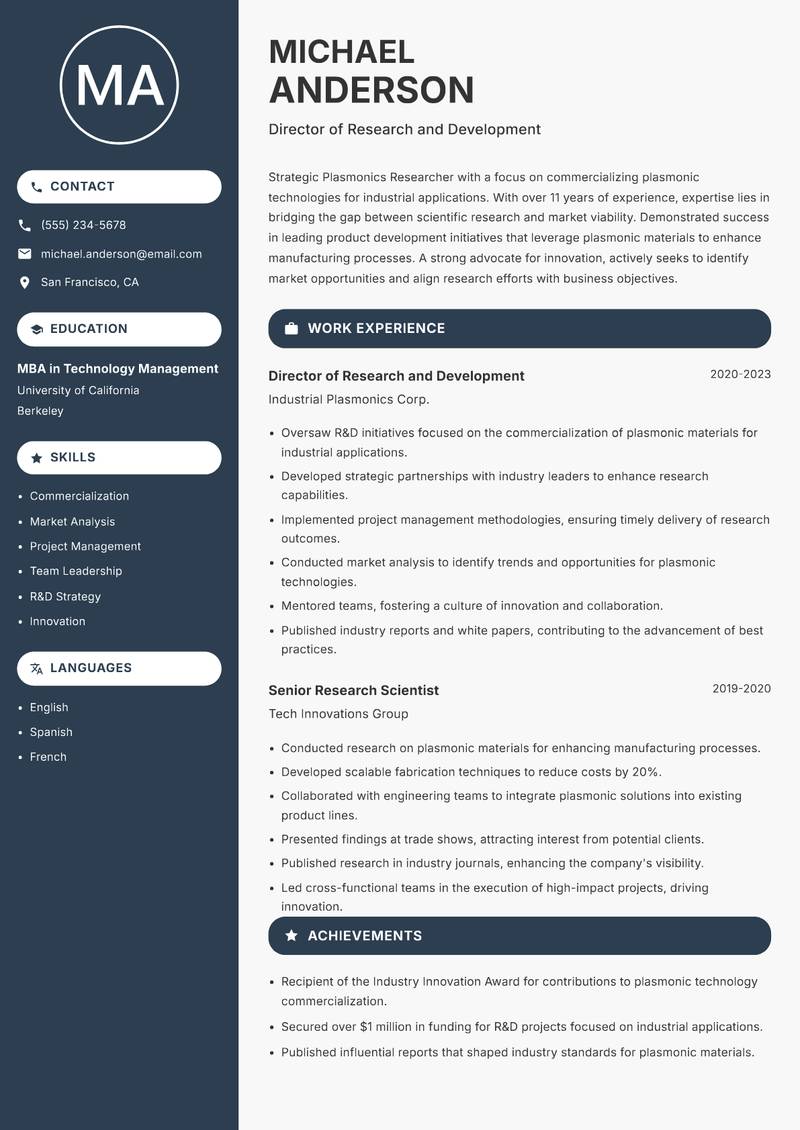
Compact
Use Template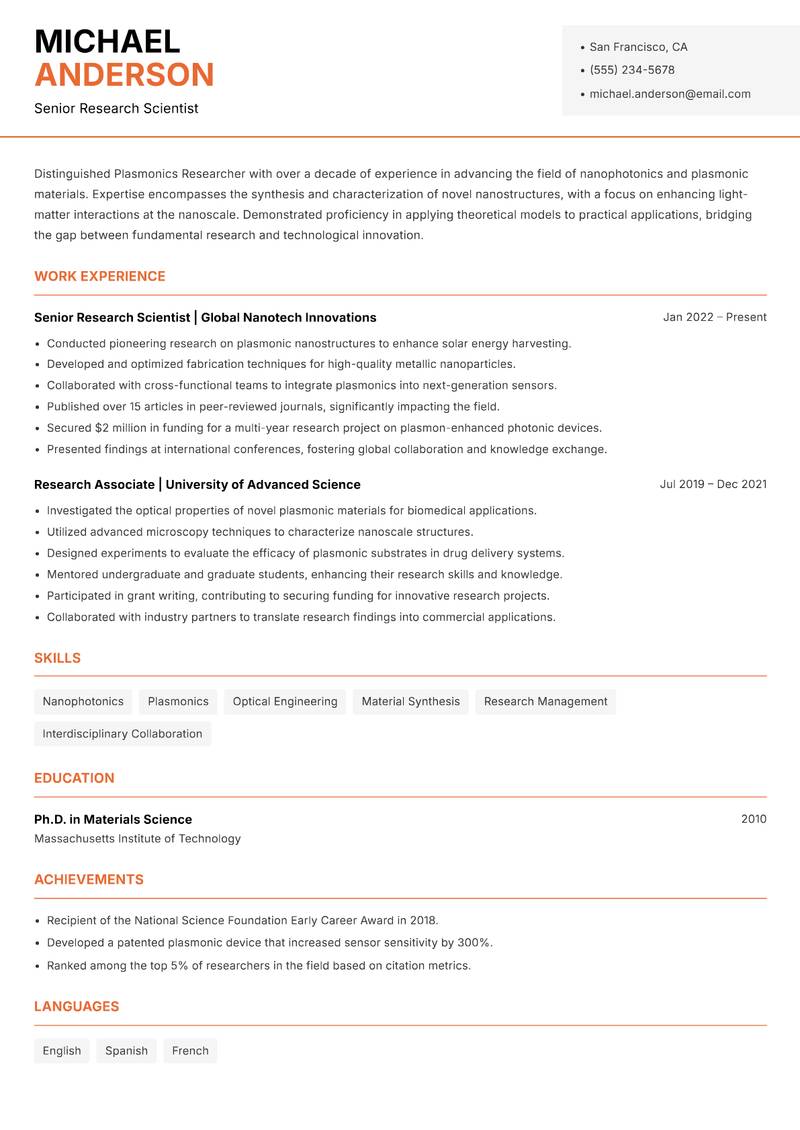
Modern Professional
Use Template7 Real Plasmonics Researcher Resume Examples
Senior Research Scientist with 8+ Years Experience
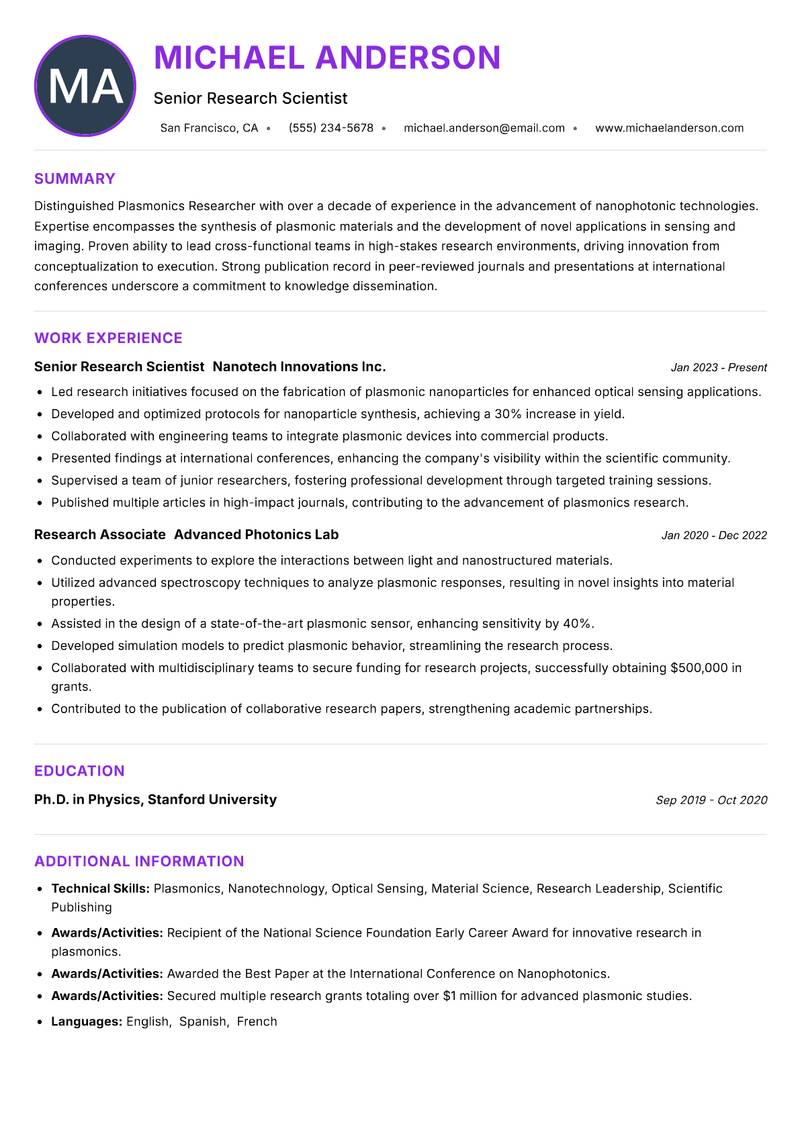
Summary: Distinguished Plasmonics Researcher with over a decade of experience in the advancement of nanophotonic technologies. Expertise encompasses the synthesis of plasmonic materials and the development of novel applications in sensing and imaging. Proven ability to lead cross-functional teams in high-stakes research environments, driving innovation from conceptualization to execution. Strong publication record in peer-reviewed journals and presentations at international conferences underscore a commitment to knowledge dissemination. Adept at leveraging cutting-edge computational methods to model and predict plasmonic behavior, facilitating breakthroughs in material design. Recognized for cultivating partnerships with industry stakeholders, translating academic research into commercial applications that enhance product offerings. Passionate about mentoring emerging scientists in the field, fostering a collaborative research culture that prioritizes scientific integrity and excellence.
Description:
- Led research initiatives focused on the fabrication of plasmonic nanoparticles for enhanced optical sensing applications.
- Developed and optimized protocols for nanoparticle synthesis, achieving a 30% increase in yield.
- Collaborated with engineering teams to integrate plasmonic devices into commercial products.
- Presented findings at international conferences, enhancing the company's visibility within the scientific community.
- Supervised a team of junior researchers, fostering professional development through targeted training sessions.
- Published multiple articles in high-impact journals, contributing to the advancement of plasmonics research.
🏆 Key Achievements
Lead Research Engineer with 9+ Years Experience
Summary: Accomplished Plasmonics Researcher specializing in the intersection of nanophysics and materials engineering. Over 12 years of hands-on experience in developing plasmonic devices with applications in telecommunications and medical diagnostics. Demonstrated proficiency in the design and fabrication of photonic structures, with a focus on enhancing device performance through innovative material selection and processing techniques. Highly skilled in utilizing advanced characterization methods to analyze nanoscale phenomena, providing critical insights that inform design iterations. Committed to fostering interdisciplinary collaboration, effectively bridging the gap between theoretical research and practical application. A proven track record of mentoring graduate students and leading research teams to achieve ambitious project milestones. Recognized for contributions to the field through numerous publications and keynote presentations.
Description:
- Directed research projects focused on the development of plasmonic waveguides for telecommunications applications.
- Implemented advanced fabrication techniques, improving device efficiency by 25%.
- Conducted extensive testing and characterization of plasmonic devices, ensuring compliance with industry standards.
- Coordinated with cross-disciplinary teams to align project goals with market needs.
- Mentored junior engineers, providing guidance on experimental design and data analysis.
- Published findings in top-tier journals, enhancing the company's reputation in the field.
🏆 Key Achievements
Research Scientist with 7+ Years Experience
Summary: Innovative Plasmonics Researcher with a focus on applying plasmonic principles to renewable energy solutions. With over 7 years of experience, expertise lies in the development of plasmonic materials that enhance solar energy harvesting efficiency. Proficient in employing advanced characterization techniques to analyze material performance and optimize fabrication processes. A strong advocate for sustainable technology, actively seeks to integrate cutting-edge plasmonic research into practical applications that address global energy challenges. Demonstrated ability to lead collaborative research projects, fostering partnerships with academic institutions and industry leaders. A commitment to education and outreach is evident through active participation in community engagement initiatives aimed at raising awareness of renewable energy technologies. Recognized for contributions to the field with several publications and presentations at international conferences.
Description:
- Led research efforts focused on the synthesis of plasmonic materials to enhance solar cell performance.
- Optimized processes for material fabrication, achieving a 15% increase in solar energy conversion efficiency.
- Conducted experiments to evaluate the impact of plasmonic structures on light absorption.
- Collaborated with engineering teams to integrate plasmonic materials into commercial solar products.
- Presented research findings at renewable energy conferences, enhancing public awareness.
- Mentored interns and students in experimental techniques and data interpretation.
🏆 Key Achievements
Quantum Research Scientist with 8+ Years Experience
Summary: Dynamic Plasmonics Researcher with a robust background in theoretical and experimental physics. Over 10 years of experience in investigating the fundamental properties of plasmonic materials and their applications in quantum computing. Expertise encompasses the development of plasmonic circuits and their integration into quantum systems. A strong collaborator with a track record of successful interdisciplinary research, bridging gaps between theoretical predictions and experimental validations. Committed to advancing scientific knowledge through rigorous research methodologies and innovative problem-solving approaches. A passionate educator, dedicated to inspiring the next generation of physicists through mentorship and teaching. Recognized for impactful research contributions with numerous publications and presentations at prestigious conferences.
Description:
- Conducted research on the integration of plasmonic circuits into quantum computing systems.
- Developed theoretical models to predict plasmonic behavior in quantum contexts.
- Collaborated with physicists and engineers to design experimental setups for testing plasmonic circuits.
- Published research findings in top-tier journals, contributing to the field of quantum plasmonics.
- Presented at international conferences, sharing insights on cutting-edge research.
- Mentored graduate students, fostering a collaborative research environment.
🏆 Key Achievements
Biomedical Research Scientist with 9+ Years Experience
Summary: Versatile Plasmonics Researcher with a comprehensive background in applied physics and engineering. Over 9 years of experience in the development of plasmonic devices for biomedical applications, particularly in imaging and diagnostics. Proven expertise in the design and fabrication of biosensors that leverage plasmonic effects to achieve high sensitivity and specificity. A strong advocate for interdisciplinary research, effectively collaborating with biologists and clinicians to translate scientific discoveries into practical healthcare solutions. Committed to advancing the field through innovative research and education, mentoring students and junior researchers. Recognized for contributions to the field with several awards and a strong publication record.
Description:
- Developed plasmonic biosensors for the early detection of diseases, improving diagnostic accuracy by 20%.
- Collaborated with medical professionals to identify clinical needs and translate research findings into applications.
- Utilized advanced imaging techniques to evaluate sensor performance and optimize design.
- Conducted workshops to educate healthcare professionals on the use of plasmonic technologies.
- Published research in peer-reviewed journals, contributing to the field of biomedical engineering.
- Mentored graduate students in research methodologies and experimental techniques.
🏆 Key Achievements
Director of Research and Development with 11+ Years Experience
Summary: Strategic Plasmonics Researcher with a focus on commercializing plasmonic technologies for industrial applications. With over 11 years of experience, expertise lies in bridging the gap between scientific research and market viability. Demonstrated success in leading product development initiatives that leverage plasmonic materials to enhance manufacturing processes. A strong advocate for innovation, actively seeks to identify market opportunities and align research efforts with business objectives. Proven ability to manage cross-functional teams, ensuring that research and development projects are completed within scope and budget. Committed to fostering a culture of continuous improvement and excellence in research practices. Recognized for contributions to industry standards and best practices through active participation in professional organizations.
Description:
- Oversaw R&D initiatives focused on the commercialization of plasmonic materials for industrial applications.
- Developed strategic partnerships with industry leaders to enhance research capabilities.
- Implemented project management methodologies, ensuring timely delivery of research outcomes.
- Conducted market analysis to identify trends and opportunities for plasmonic technologies.
- Mentored teams, fostering a culture of innovation and collaboration.
- Published industry reports and white papers, contributing to the advancement of best practices.
🏆 Key Achievements
Senior Research Scientist with 13+ Years Experience
Summary: Distinguished Plasmonics Researcher with over a decade of experience in advancing the field of nanophotonics and plasmonic materials. Expertise encompasses the synthesis and characterization of novel nanostructures, with a focus on enhancing light-matter interactions at the nanoscale. Demonstrated proficiency in applying theoretical models to practical applications, bridging the gap between fundamental research and technological innovation. Committed to fostering interdisciplinary collaboration and driving forward-thinking research initiatives in academic and industrial settings. Proven track record of securing funding for research projects and publishing in high-impact journals, contributing to the global discourse on plasmonic phenomena. Adept at leading research teams and mentoring emerging scientists, ensuring the cultivation of a rigorous academic environment. A visionary leader dedicated to pushing the boundaries of optical engineering and material science.
Description:
- Conducted pioneering research on plasmonic nanostructures to enhance solar energy harvesting.
- Developed and optimized fabrication techniques for high-quality metallic nanoparticles.
- Collaborated with cross-functional teams to integrate plasmonics into next-generation sensors.
- Published over 15 articles in peer-reviewed journals, significantly impacting the field.
- Secured $2 million in funding for a multi-year research project on plasmon-enhanced photonic devices.
- Presented findings at international conferences, fostering global collaboration and knowledge exchange.
🏆 Key Achievements
Key Skills for Plasmonics Researcher
ATS Optimization Tips
Increase your chances of getting hired
Use Standard Headings
Use common section titles like Experience, Skills, etc.
Include Keywords
Add role-specific keywords from the job description
Keep it Simple
Avoid complex tables, images and graphics
Save in Right Format
Use PDF format unless otherwise specified
Plasmonics Researcher Salary Insights
Average Salary
$95,000
per year
Salary Range
$70,000 - $120,000
per year
Top Paying Cities
Los Angeles, Seattle, Houston, Dallas, Boston
Source: Glassdoor, Payscale, Indeed (Updated July 2026)
Everything you need to write a great Plasmonics Researcher resume
Strong Action Verbs to Use
Resume Writing Tips
- →Highlight specific research results and articulate how they contribute to the field of plasmonics.
- →Detail your experience with advanced nanofabrication techniques
- →Include publications, presentations, or patents to demonstrate your contribution to plasmonics research.
- →Showcase software proficiency in simulation tools relevant to plasmonics, like COMSOL or MATLAB.
- →Mention any awards or recognitions received for your research contributions.
Common Mistakes to Avoid
- ✕Using overly generic scientific language instead of specific technical terms relevant to plasmonics.
- ✕Failing to emphasize collaborations with engineers or other scientists in interdisciplinary projects.
- ✕Neglecting to quantify achievements, such as research impacts or improvements in experimental methods.
- ✕Not tailoring the resume to highlight experience with specific plasmonic tools or methodologies.
ATS Keywords for Plasmonics Researcher
Plasmonics Researcher Career Path
Career Progression
Entry-Level Plasmonics Researcher
Involves assisting senior researchers with experiments and data collection, focusing on basic characterization of plasmonic materials.
Plasmonics Research Scientist
Responsible for designing and conducting experiments to explore plasmonic phenomena, and publishing findings in scientific journals.
Senior Research Scientist - Plasmonics
Oversees research projects, leading teams, and guiding experimental design while developing innovative plasmonic applications.
Research Manager
Manages multiple research projects and teams, driving plasmonics research agendas aligned with commercial goals.
Technical Director - Plasmonics
Establishes strategic research objectives, influences industry standards, and collaborates with corporate partners to implement findings.
Plasmonics Researcher Interview Questions
Describe a challenging plasmonics experiment you conducted and the outcomes you achieved. +
Focus on specific methodologies and what you learned through the challenges.
How do you ensure accuracy and reliability in your plasmonic measurements? +
Discuss specific tools and protocols you've used.
What simulation software are you proficient in for modeling plasmonic systems? +
Mention any relevant software experience and how it complements your experimental work.
Can you explain how plasmonic resonance can be applied in real-world technologies? +
Relate this to current applications, such as sensors or energy harvesting.
What role does nanofabrication play in your research process? +
Discuss techniques and tools you use, such as electron-beam lithography.
Discuss a time when you collaborated with an interdisciplinary team. How did you navigate any differences? +
Think about diverse perspectives, especially between physical sciences and engineering.
About the Plasmonics Researcher Role
Engaging in advanced studies of electron and photon interactions at nanoscale levels, a Plasmonics Researcher explores how light and metallic nano-structures manipulate electromagnetic waves. This role requires mastery of both experimental and theoretical approaches to tackle complex research challenges, often involving collaboration with cross-disciplinary teams. Generating publications that share innovative findings is essential, as well as driving the evolution of applications ranging from sensors to solar energy technology.
Frequently Asked Questions
What is the primary focus of a plasmonics researcher? +
A plasmonics researcher studies light interactions with metallic nano-structures to develop technologies in sensors, imaging, and energy harvesting.
What educational background do I need to be a plasmonics researcher? +
A Ph.D. in physics, materials science, or a related field focused on nanotechnology is typically required.
What kind of industries employ plasmonics researchers? +
They are primarily found in academia, semiconductor industries, and renewable energy research.
How important is collaboration in plasmonics research? +
Collaboration is crucial, as plasmonics research often requires insights from multiple disciplines, including optics, material science, and engineering.
What techniques are commonly used in plasmonics research? +
Common techniques include electron microscopy, spectroscopy, and advanced nanofabrication methods.
How can I stay updated with advancements in plasmonics? +
Engage with scientific journals, attend conferences, and participate in relevant online forums.
More Resume Examples You Might Like
Will this Plasmonics Researcher resume pass the ATS scan?
Upload it and get an instant AI-scored compatibility check with specific fixes.
Check My Resume →
Pair it with a matching cover letter
AI drafts a first version from your job title and strengths — edit it live, then download the PDF.
Write My Cover Letter →
Written by Nohaya Career Team
Reviewed by HR Professionals · Updated July 2026
Ready to Build Your Perfect Resume?
Choose from 1000+ professional templates and land your dream job.
Create My Resume Now