Build an ATS-Friendly
Orbital Mechanics Engineer Resume
That Gets Interviews
The Orbital Mechanics Engineer applies principles of physics and mathematics to analyze and optimize spacecraft trajectories and orbits. This role merges theoretical knowledge with practical applications, often involving simulation tools to predict orbital behaviors. Engineers in this field work closely with project…
Orbital Mechanics Engineer Resume Templates
Modern Professional
Use Template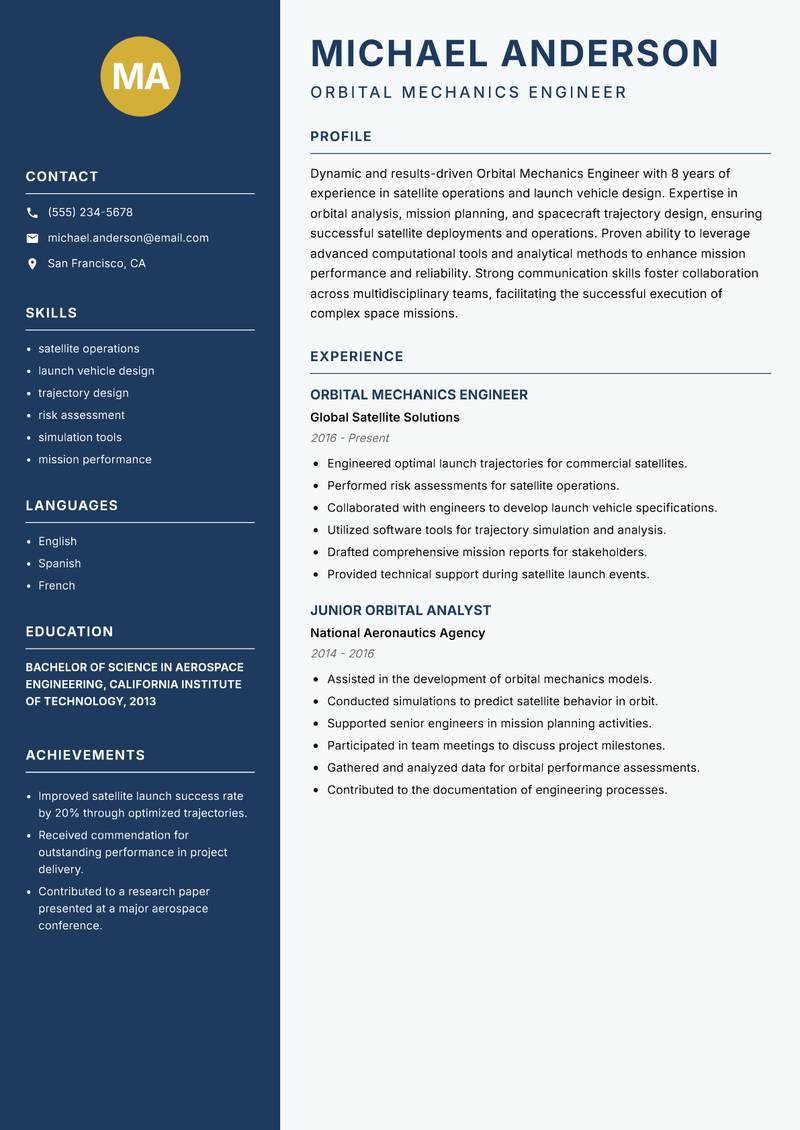
Classic Clean
Use Template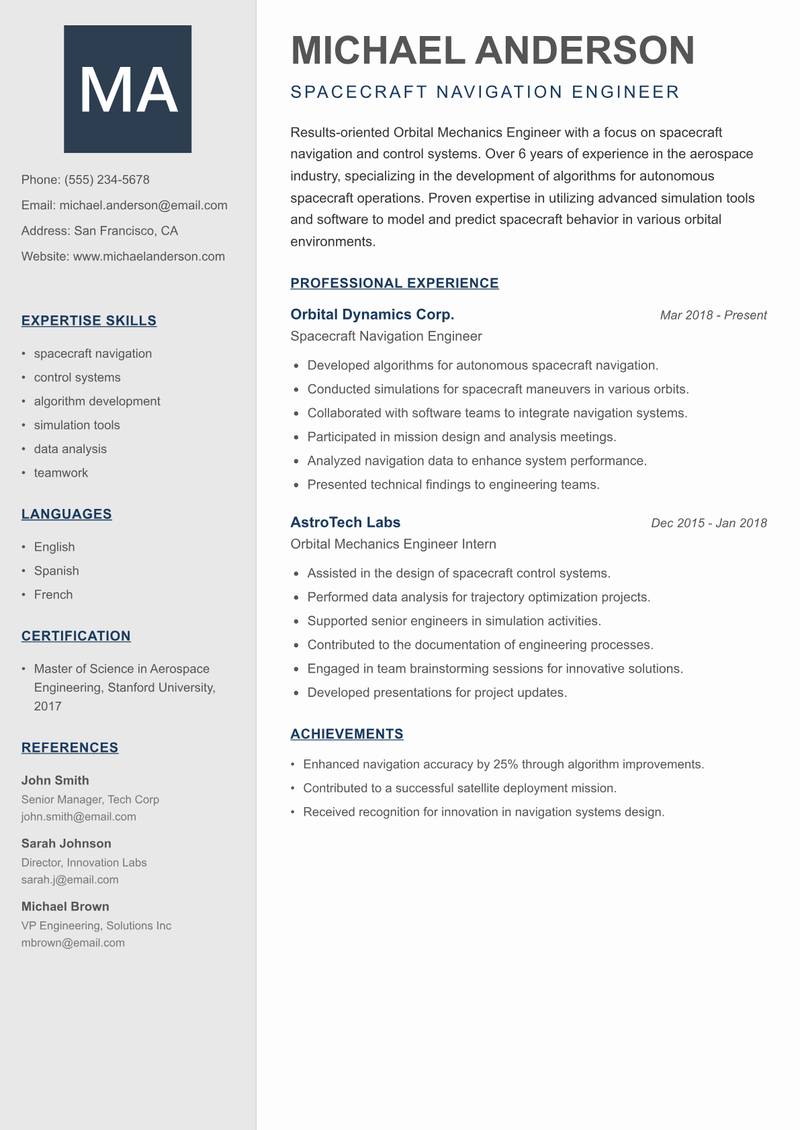
Creative Minimal
Use Template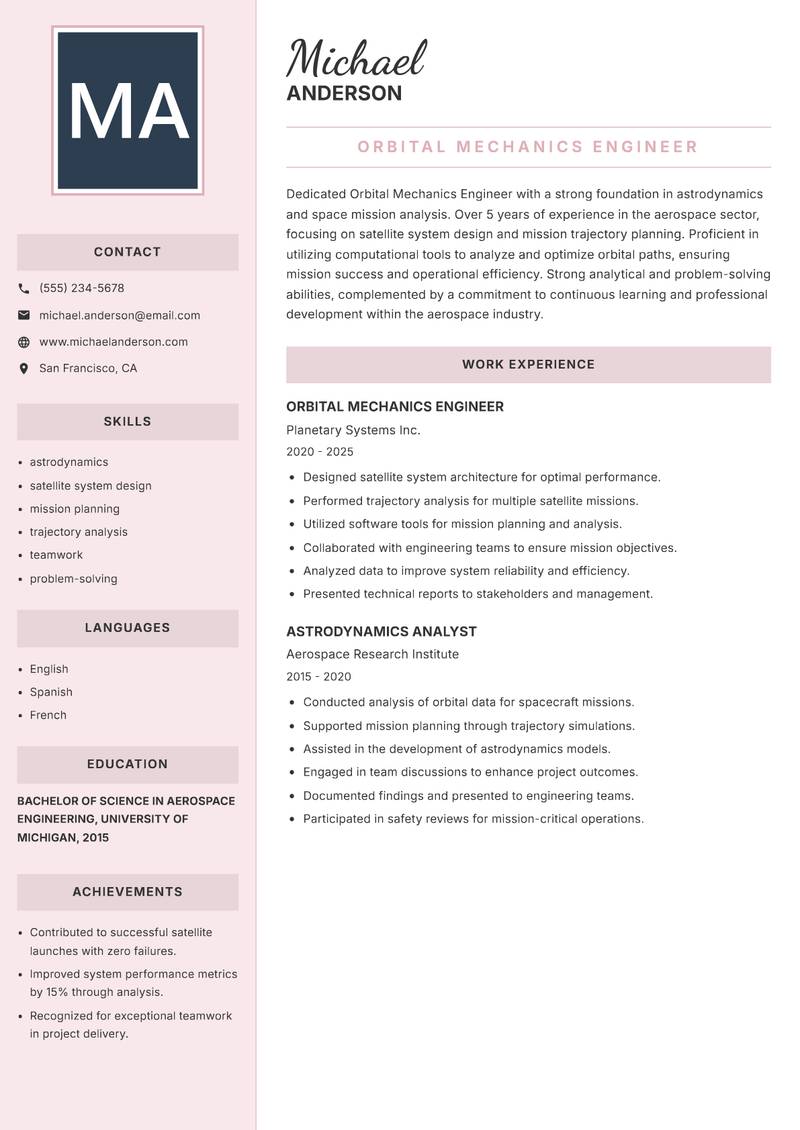
Executive
Use Template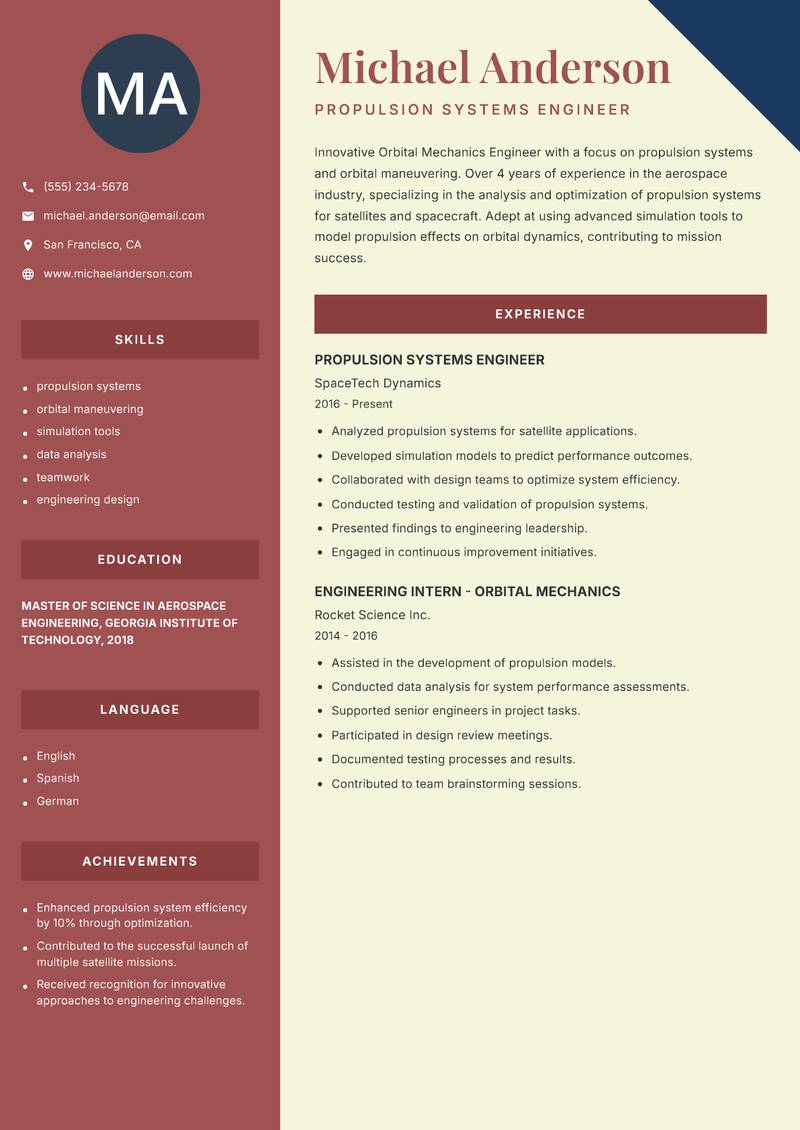
Two Column
Use Template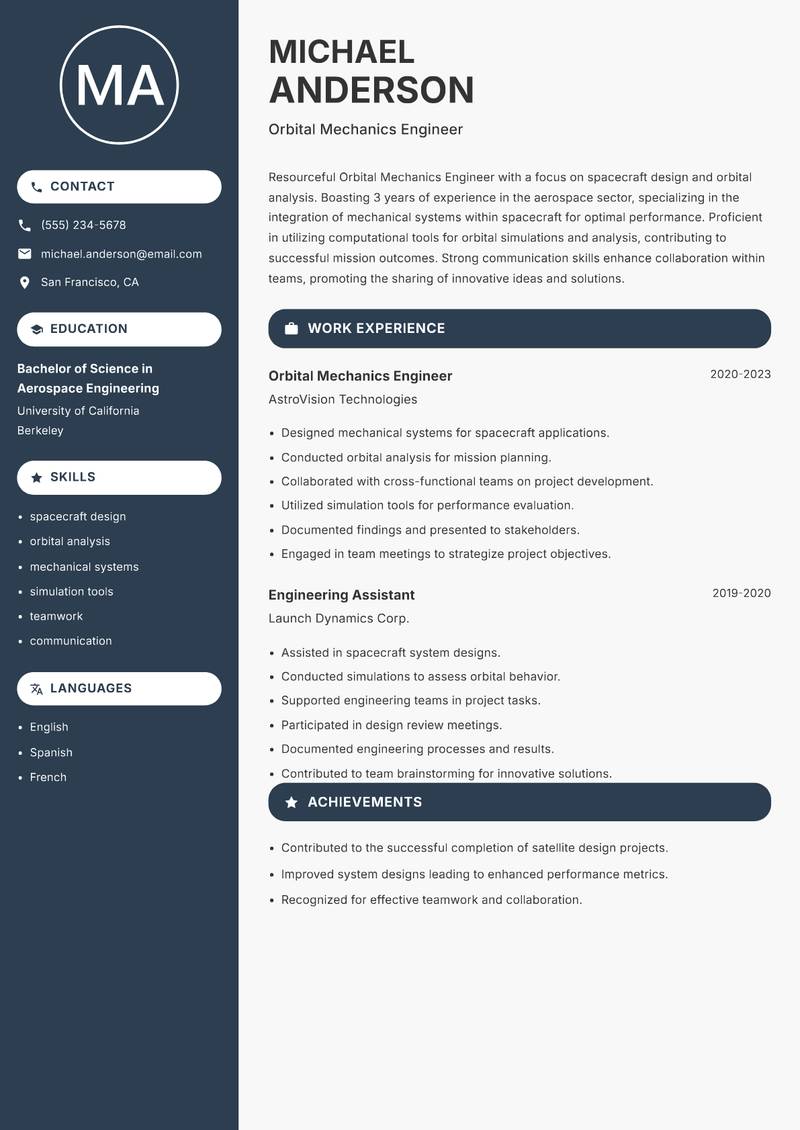
Compact
Use Template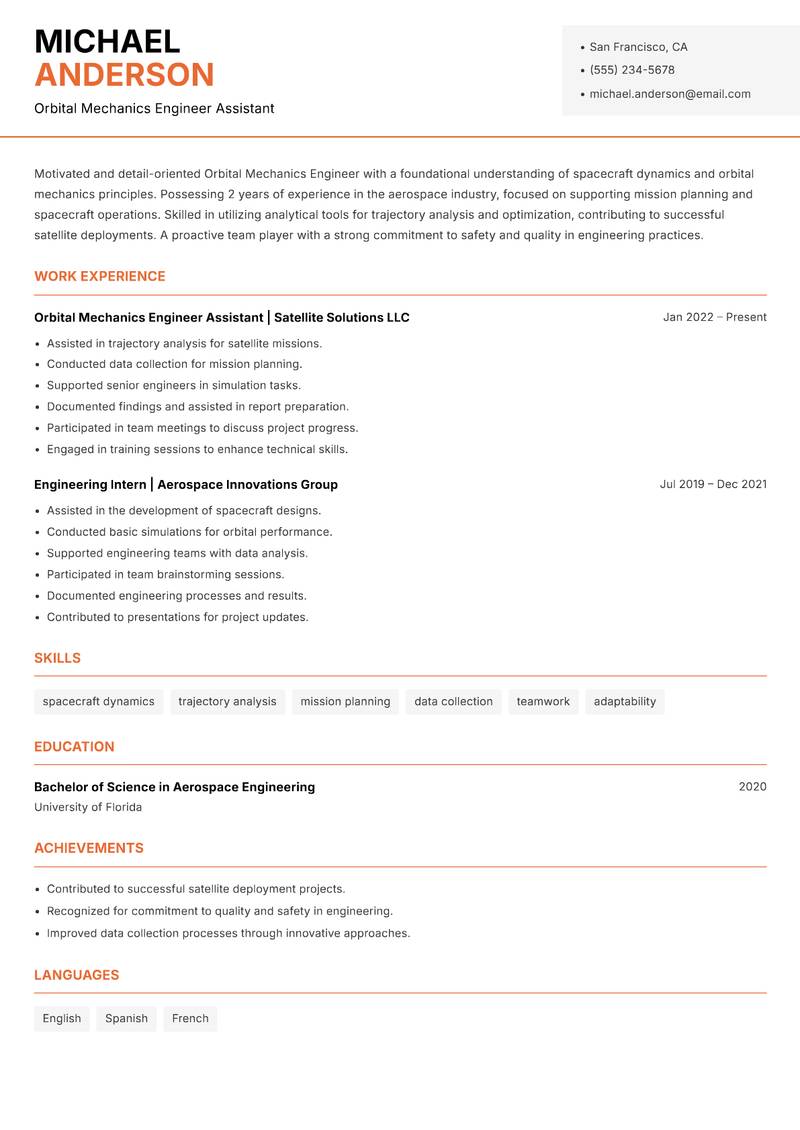
Modern Professional
Use Template7 Real Orbital Mechanics Engineer Resume Examples
Senior Orbital Mechanics Engineer with 11+ Years Experience
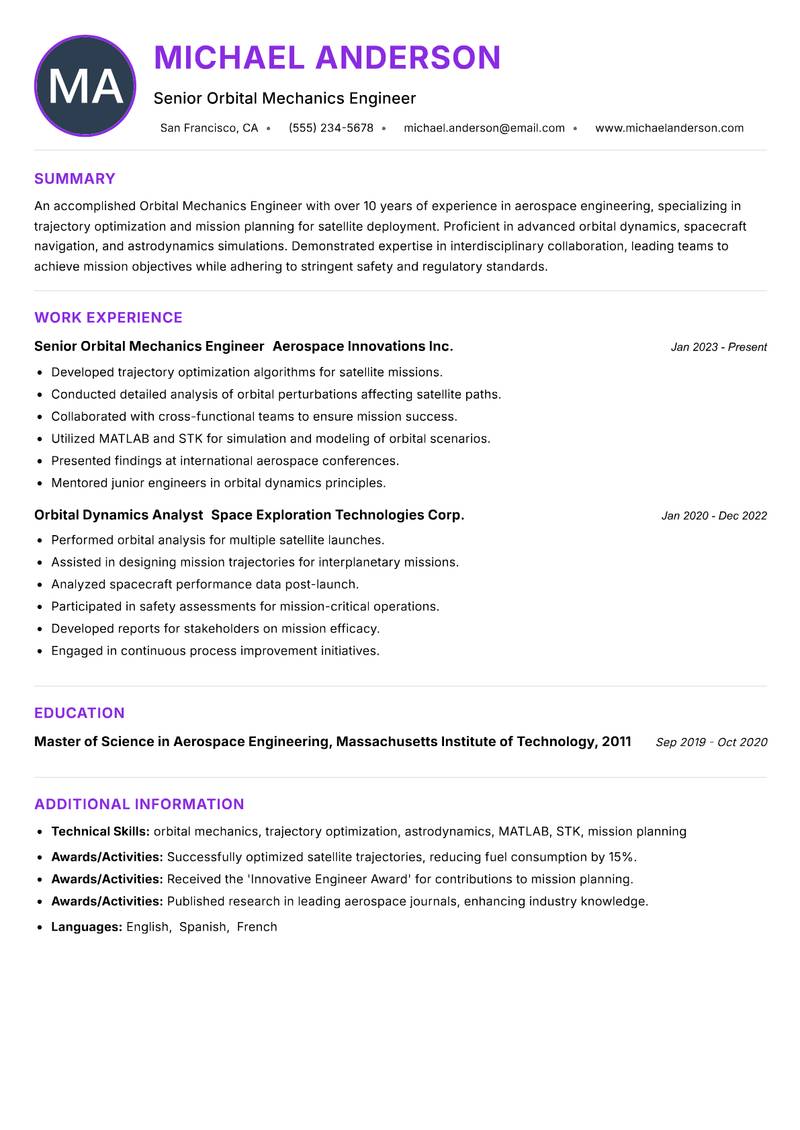
Summary: An accomplished Orbital Mechanics Engineer with over 10 years of experience in aerospace engineering, specializing in trajectory optimization and mission planning for satellite deployment. Proficient in advanced orbital dynamics, spacecraft navigation, and astrodynamics simulations. Demonstrated expertise in interdisciplinary collaboration, leading teams to achieve mission objectives while adhering to stringent safety and regulatory standards. A proven track record of developing innovative solutions that enhance mission efficiency and reduce operational costs. Strong analytical skills complemented by a robust understanding of orbital perturbation modeling and software tools such as MATLAB and STK. Committed to advancing the field of orbital mechanics through research and development initiatives, contributing to the future of space exploration and satellite technology.
Description:
- Developed trajectory optimization algorithms for satellite missions.
- Conducted detailed analysis of orbital perturbations affecting satellite paths.
- Collaborated with cross-functional teams to ensure mission success.
- Utilized MATLAB and STK for simulation and modeling of orbital scenarios.
- Presented findings at international aerospace conferences.
- Mentored junior engineers in orbital dynamics principles.
🏆 Key Achievements
Orbital Mechanics Engineer with 8+ Years Experience
Summary: Dynamic and results-driven Orbital Mechanics Engineer with 8 years of experience in satellite operations and launch vehicle design. Expertise in orbital analysis, mission planning, and spacecraft trajectory design, ensuring successful satellite deployments and operations. Proven ability to leverage advanced computational tools and analytical methods to enhance mission performance and reliability. Strong communication skills foster collaboration across multidisciplinary teams, facilitating the successful execution of complex space missions. Committed to continuous professional development and staying abreast of emerging technologies and methodologies within the aerospace sector. Recognized for delivering innovative solutions that meet both technical and operational requirements.
Description:
- Engineered optimal launch trajectories for commercial satellites.
- Performed risk assessments for satellite operations.
- Collaborated with engineers to develop launch vehicle specifications.
- Utilized software tools for trajectory simulation and analysis.
- Drafted comprehensive mission reports for stakeholders.
- Provided technical support during satellite launch events.
🏆 Key Achievements
Spacecraft Navigation Engineer with 6+ Years Experience
Summary: Accomplished Orbital Mechanics Engineer with a focus on spacecraft navigation and control systems. Over 6 years of experience in the aerospace industry, specializing in the development of algorithms for autonomous spacecraft operations. Proven expertise in utilizing advanced simulation tools and software to model and predict spacecraft behavior in various orbital environments. A collaborative team player with strong problem-solving skills, dedicated to enhancing mission outcomes through innovative engineering solutions. Recognized for contributions to the successful execution of complex space missions, utilizing a combination of analytical and practical approaches to overcome engineering challenges. Committed to fostering a culture of safety and excellence in all engineering endeavors.
Description:
- Developed algorithms for autonomous spacecraft navigation.
- Conducted simulations for spacecraft maneuvers in various orbits.
- Collaborated with software teams to integrate navigation systems.
- Participated in mission design and analysis meetings.
- Analyzed navigation data to enhance system performance.
- Presented technical findings to engineering teams.
🏆 Key Achievements
Orbital Mechanics Engineer with 5+ Years Experience
Summary: Dedicated Orbital Mechanics Engineer with a strong foundation in astrodynamics and space mission analysis. Over 5 years of experience in the aerospace sector, focusing on satellite system design and mission trajectory planning. Proficient in utilizing computational tools to analyze and optimize orbital paths, ensuring mission success and operational efficiency. Strong analytical and problem-solving abilities, complemented by a commitment to continuous learning and professional development within the aerospace industry. Recognized for the ability to work effectively in team environments, delivering results under pressure while maintaining high safety and quality standards. Aiming to leverage expertise in spacecraft dynamics to contribute to innovative space exploration initiatives.
Description:
- Designed satellite system architecture for optimal performance.
- Performed trajectory analysis for multiple satellite missions.
- Utilized software tools for mission planning and analysis.
- Collaborated with engineering teams to ensure mission objectives.
- Analyzed data to improve system reliability and efficiency.
- Presented technical reports to stakeholders and management.
🏆 Key Achievements
Propulsion Systems Engineer with 4+ Years Experience
Summary: Innovative Orbital Mechanics Engineer with a focus on propulsion systems and orbital maneuvering. Over 4 years of experience in the aerospace industry, specializing in the analysis and optimization of propulsion systems for satellites and spacecraft. Adept at using advanced simulation tools to model propulsion effects on orbital dynamics, contributing to mission success. A collaborative team member with strong analytical skills, dedicated to solving complex engineering challenges and enhancing mission performance. Committed to continuous improvement and the application of best practices in all engineering tasks. Recognized for contributions to successful propulsion system designs and their implementation in satellite missions.
Description:
- Analyzed propulsion systems for satellite applications.
- Developed simulation models to predict performance outcomes.
- Collaborated with design teams to optimize system efficiency.
- Conducted testing and validation of propulsion systems.
- Presented findings to engineering leadership.
- Engaged in continuous improvement initiatives.
🏆 Key Achievements
Orbital Mechanics Engineer with 3+ Years Experience
Summary: Resourceful Orbital Mechanics Engineer with a focus on spacecraft design and orbital analysis. Boasting 3 years of experience in the aerospace sector, specializing in the integration of mechanical systems within spacecraft for optimal performance. Proficient in utilizing computational tools for orbital simulations and analysis, contributing to successful mission outcomes. Strong communication skills enhance collaboration within teams, promoting the sharing of innovative ideas and solutions. Dedicated to professional growth and staying updated with the latest advancements in orbital mechanics and spacecraft engineering. Aiming to leverage engineering expertise to support pioneering space exploration projects.
Description:
- Designed mechanical systems for spacecraft applications.
- Conducted orbital analysis for mission planning.
- Collaborated with cross-functional teams on project development.
- Utilized simulation tools for performance evaluation.
- Documented findings and presented to stakeholders.
- Engaged in team meetings to strategize project objectives.
🏆 Key Achievements
Orbital Mechanics Engineer Assistant with 2+ Years Experience
Summary: Driven and detail-oriented Orbital Mechanics Engineer with a foundational understanding of spacecraft dynamics and orbital mechanics principles. Possessing 2 years of experience in the aerospace industry, focused on supporting mission planning and spacecraft operations. Skilled in utilizing analytical tools for trajectory analysis and optimization, contributing to successful satellite deployments. A proactive team player with a strong commitment to safety and quality in engineering practices. Eager to expand expertise in orbital mechanics and contribute to innovative aerospace projects. Recognized for adaptability and quick learning in fast-paced environments.
Description:
- Assisted in trajectory analysis for satellite missions.
- Conducted data collection for mission planning.
- Supported senior engineers in simulation tasks.
- Documented findings and assisted in report preparation.
- Participated in team meetings to discuss project progress.
- Engaged in training sessions to enhance technical skills.
🏆 Key Achievements
Key Skills for Orbital Mechanics Engineer
ATS Optimization Tips
Increase your chances of getting hired
Use Standard Headings
Use common section titles like Experience, Skills, etc.
Include Keywords
Add role-specific keywords from the job description
Keep it Simple
Avoid complex tables, images and graphics
Save in Right Format
Use PDF format unless otherwise specified
Orbital Mechanics Engineer Salary Insights
Average Salary
$107,500
per year
Salary Range
$80,000 - $135,000
per year
Top Paying Cities
Los Angeles, Seattle, Houston, Dallas, Boston
Source: Glassdoor, Payscale, Indeed (Updated July 2025)
Everything you need to write a great Orbital Mechanics Engineer resume
Strong Action Verbs to Use
Resume Writing Tips
- →Highlight experience with tools like MATLAB and orbital simulation software in your resume.
- →Include specific projects that demonstrate successful trajectory optimization.
- →Show your understanding of regulatory standards relevant to aerospace missions.
- →Mention collaboration with other engineering disciplines to illustrate teamwork.
- →Emphasize problem-solving skills with quantifiable outcomes from past experiences.
Common Mistakes to Avoid
- ✕Listing vague responsibilities instead of specific projects you handled.
- ✕Overlooking the importance of showcasing software proficiency relevant to orbital mechanics.
- ✕Failing to tailor your resume keywords to match job descriptions exactly.
- ✕Not including metrics or outcomes that highlight your impact on projects.
ATS Keywords for Orbital Mechanics Engineer
Orbital Mechanics Engineer Career Path
Relevant Certifications
Career Progression
Entry-Level Orbital Mechanics Engineer
Responsible for assisting in the design and analysis of satellite orbits and spacecraft trajectories.
Mid-Level Orbital Mechanics Engineer
Leads the development of orbital data analysis and manages smaller projects involving trajectory optimization.
Senior Orbital Mechanics Engineer
Oversees complex projects and serves as a technical expert, collaborating closely with cross-functional teams.
Principal Orbital Mechanics Engineer
Directs strategic planning in orbital mechanics, providing solutions to optimization problems at a programmatic level.
Orbital Mechanics Engineering Manager
Manages teams of engineers, sets project objectives, and ensures alignment with company goals in aerospace projects.
Orbital Mechanics Engineer Interview Questions
What are some factors you consider when designing a satellite orbit? +
Discuss parameters like altitude, inclination, and mission objectives.
Can you explain the concept of delta-v and its significance in orbital maneuvers? +
Include how delta-v relates to fuel requirements and mission planning.
Describe a project where you used software like MATLAB for orbital simulation. +
Focus on the specific tools and methods you implemented for the simulation.
What are the trade-offs between low Earth orbit (LEO) and geostationary orbit (GEO) for communications satellites? +
Mention aspects like latency, coverage, and operational costs.
How do you stay updated on advancements in orbital mechanics? +
Reference specific journals, conferences, or professional organizations.
Discuss a challenge you faced while optimizing a spacecraft trajectory and how you overcame it. +
Provide an example of your problem-solving skills.
About the Orbital Mechanics Engineer Role
The Orbital Mechanics Engineer applies principles of physics and mathematics to analyze and optimize spacecraft trajectories and orbits. This role merges theoretical knowledge with practical applications, often involving simulation tools to predict orbital behaviors. Engineers in this field work closely with project teams to ensure spacecraft meet mission specifications and regulatory requirements, all while addressing factors such as fuel efficiency and mission timeline.
Frequently Asked Questions
What is the typical work environment for an Orbital Mechanics Engineer? +
Often situated in aerospace firms or government agencies, the environment is collaborative, involving teamwork and extensive use of simulation software.
What are the key skills required for an Orbital Mechanics Engineer? +
Strong analytical skills, proficiency in mathematical modeling, experience with simulation tools, and an understanding of spacecraft dynamics.
What challenges do Orbital Mechanics Engineers face in their roles? +
Challenges include managing orbital debris, refining trajectory predictions under uncertainties, and adhering to strict mission timelines.
How important is teamwork in this field? +
Teamwork is essential as projects involve various engineering disciplines and require alignment towards common mission goals.
What educational background is preferred for this role? +
A degree in Aerospace Engineering, Mechanical Engineering or Physics is commonly required, with advanced degrees often preferred.
Can you work as an Orbital Mechanics Engineer without specific certifications? +
While not always necessary, certifications can enhance credibility and demonstrate a commitment to the field.
More Resume Examples You Might Like
Related Career Paths
Other roles candidates for Orbital Mechanics Engineer positions often also consider.
Will this Orbital Mechanics Engineer resume pass the ATS scan?
Upload it and get an instant AI-scored compatibility check with specific fixes.
Check My Resume →
Pair it with a matching cover letter
AI drafts a first version from your job title and strengths — edit it live, then download the PDF.
Write My Cover Letter →
Written by Nohaya Career Team
Reviewed by HR Professionals · Updated July 2025
Ready to Build Your Perfect Resume?
Choose from 1000+ professional templates and land your dream job.
Create My Resume Now