Build an ATS-Friendly
Irrigation Scientist Resume
That Gets Interviews
Developing cutting-edge irrigation practices requires a blend of scientific analysis and hands-on experimentation in various agricultural settings. Irrigation Scientists often employ advanced hydrological models to ascertain water distribution needs, assessing the specific moisture requirements of diverse crops.…
Irrigation Scientist Resume Templates
Modern Professional
Use Template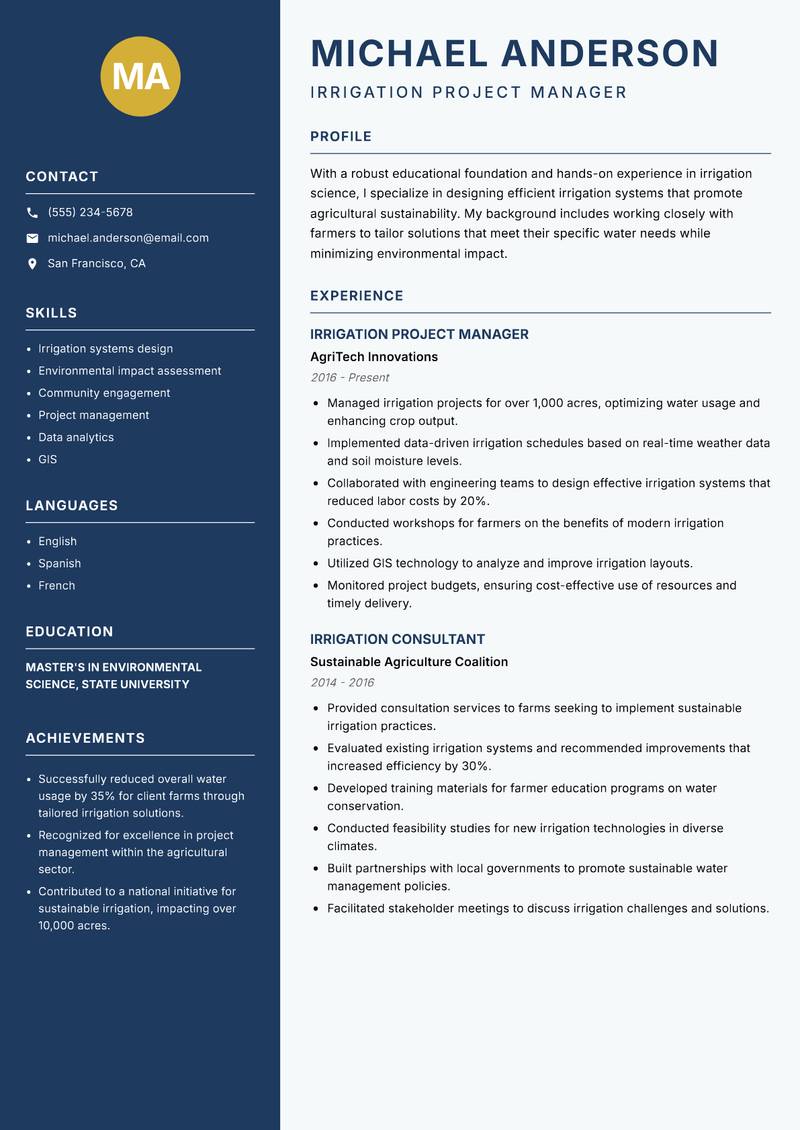
Classic Clean
Use Template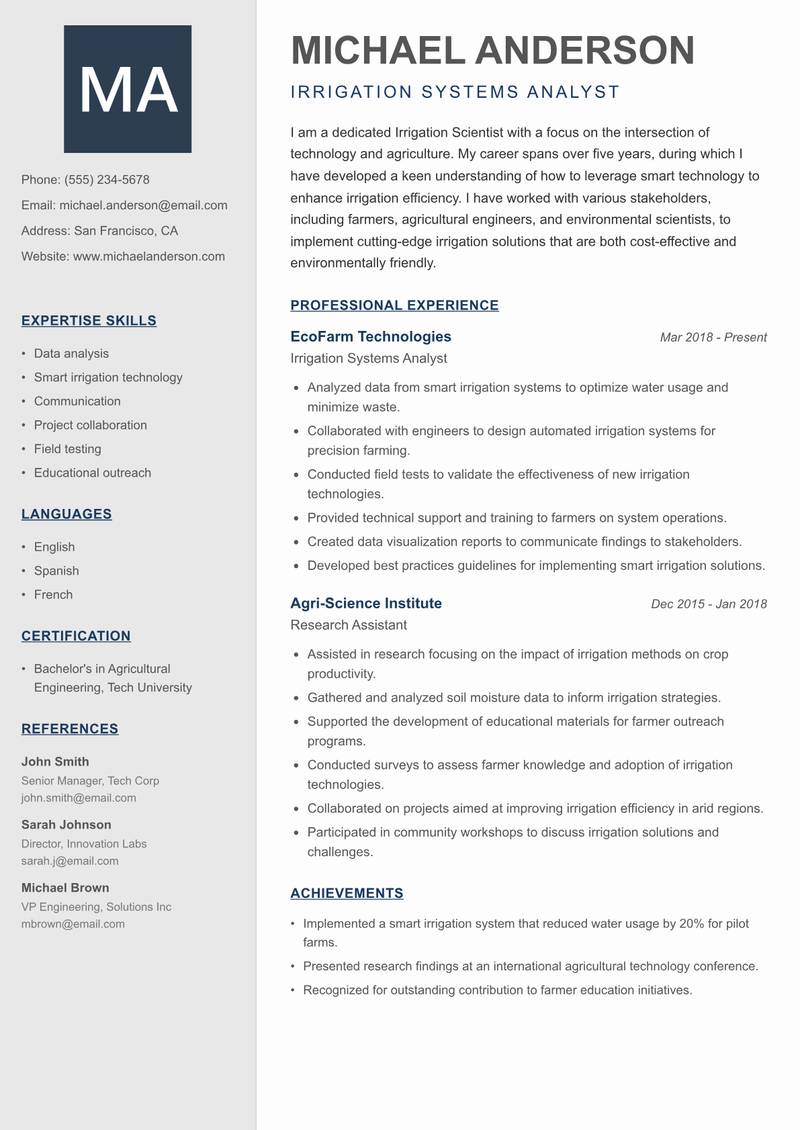
Creative Minimal
Use Template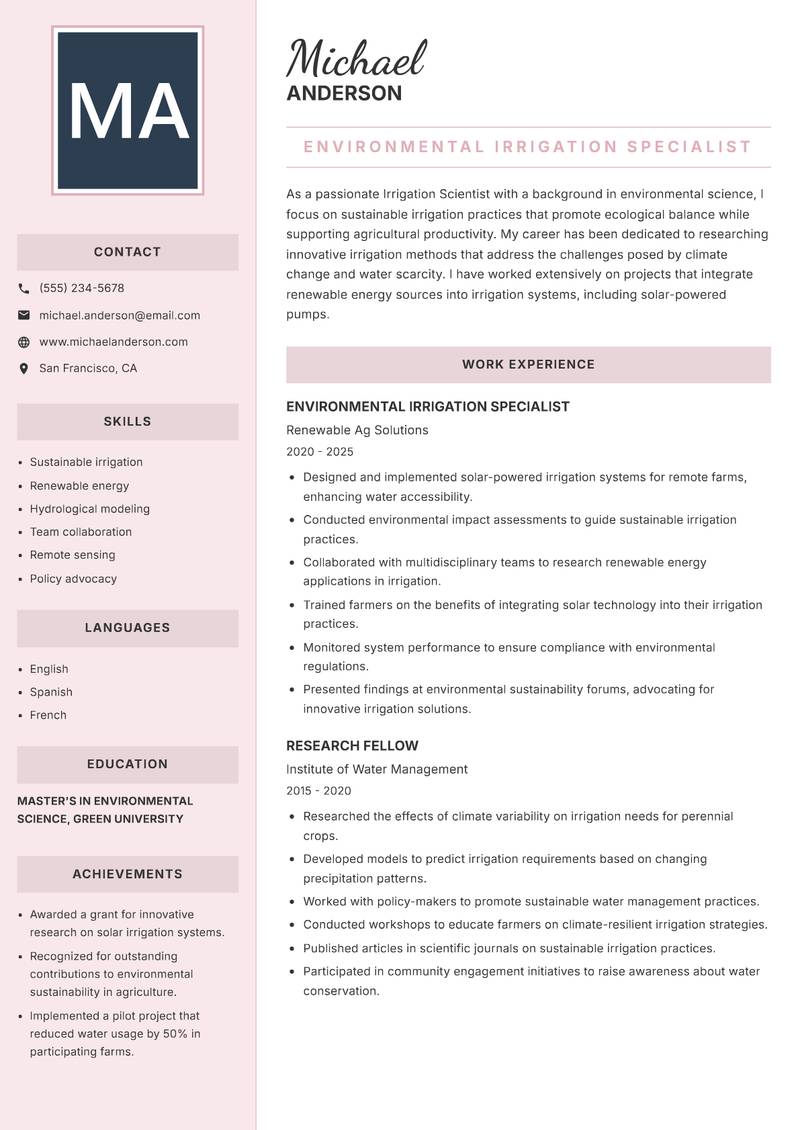
Executive
Use Template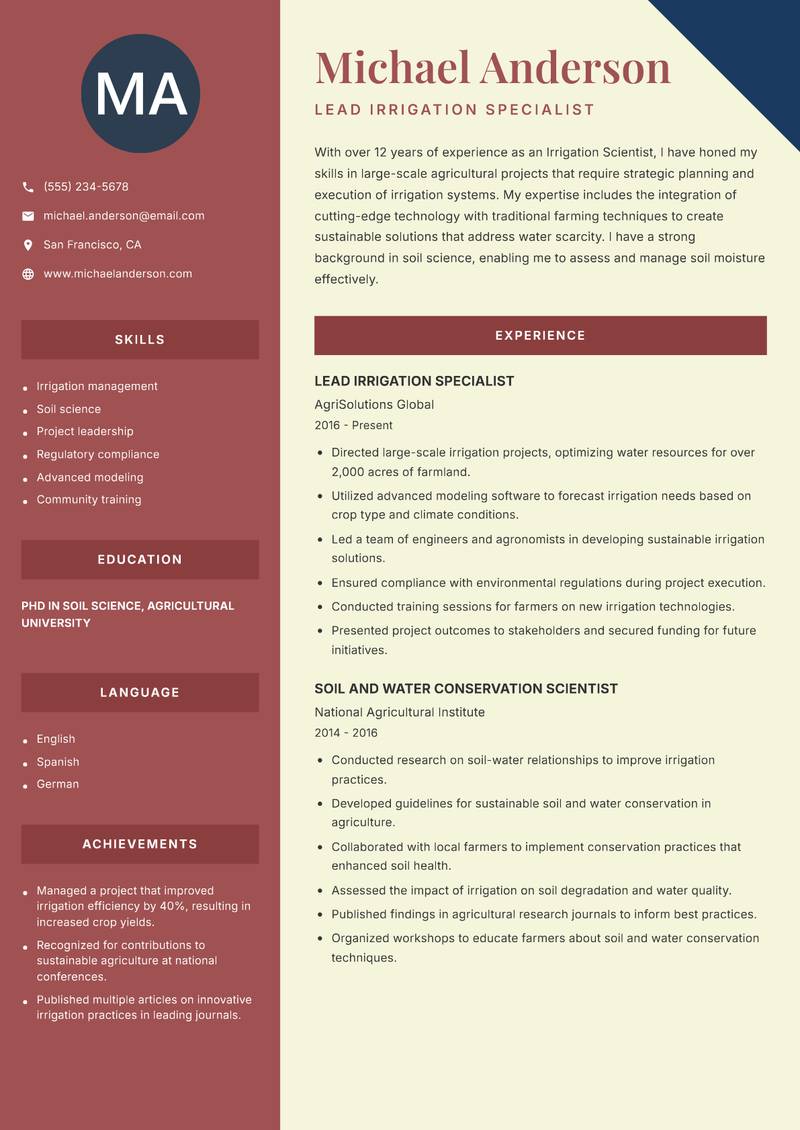
Two Column
Use Template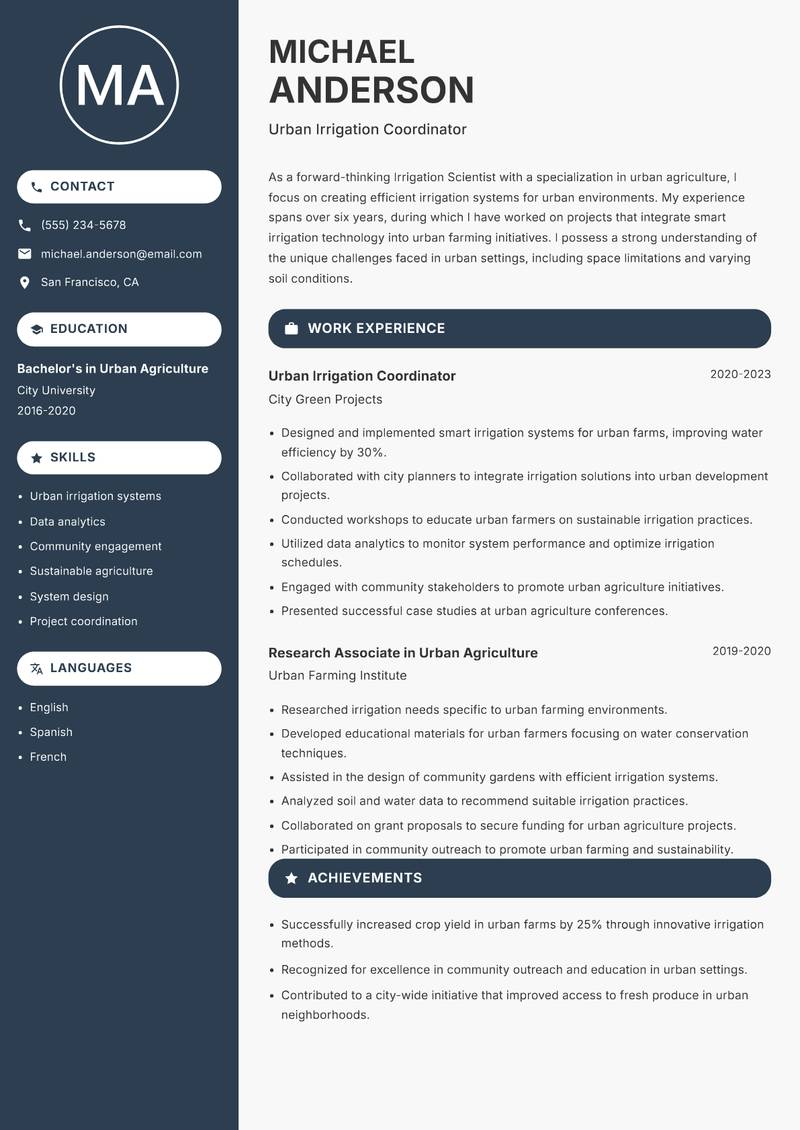
Compact
Use Template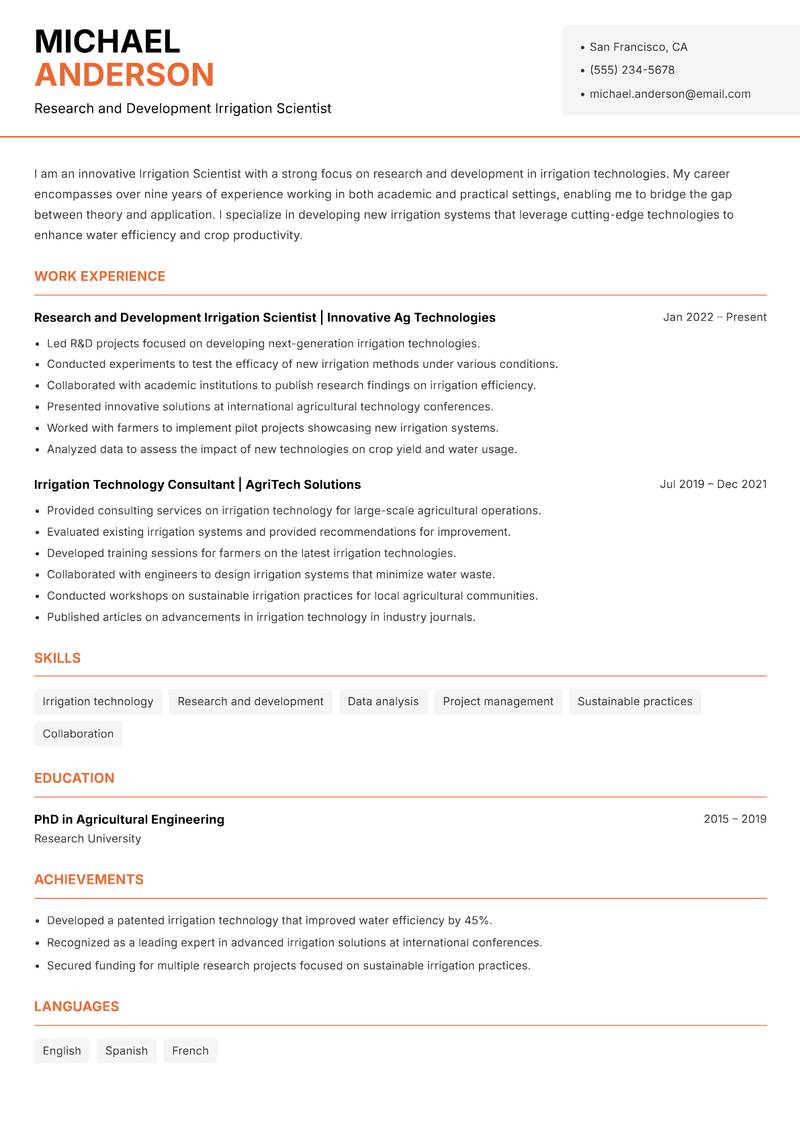
Modern Professional
Use Template7 Real Irrigation Scientist Resume Examples
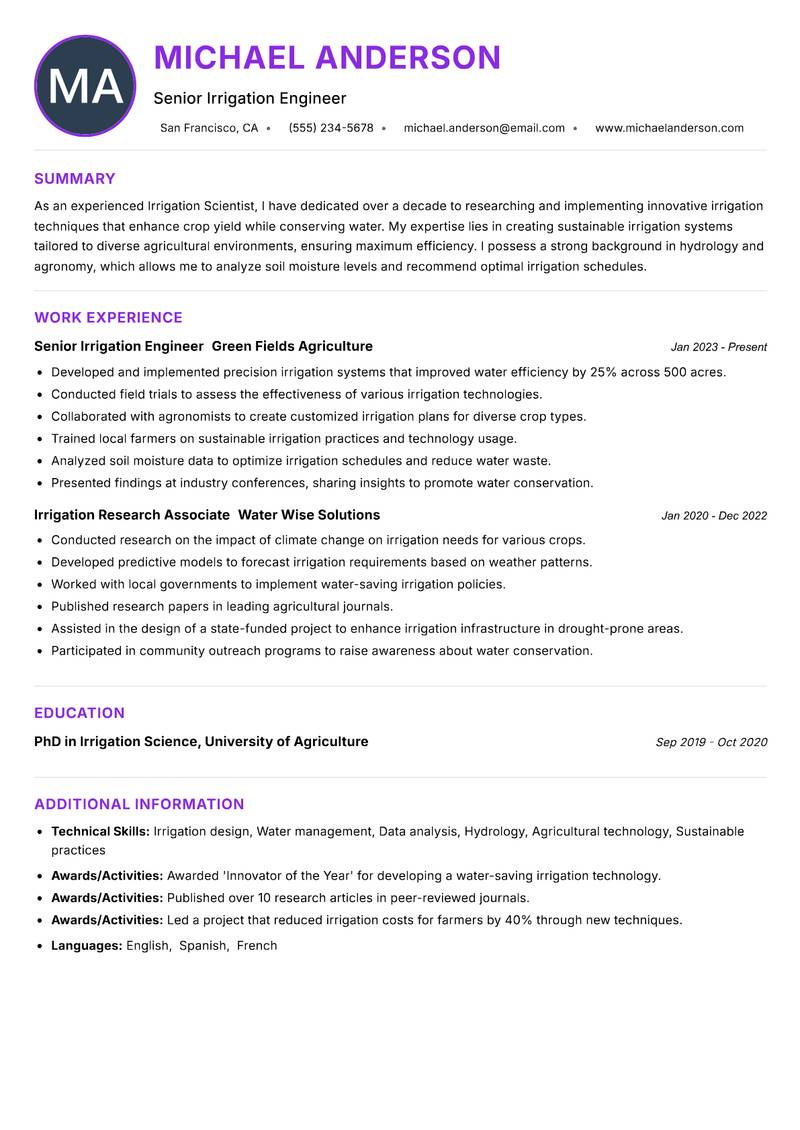
Senior Irrigation Engineer with 10+ Years Experience
Summary: As an experienced Irrigation Scientist, I have dedicated over a decade to researching and implementing innovative irrigation techniques that enhance crop yield while conserving water. My expertise lies in creating sustainable irrigation systems tailored to diverse agricultural environments, ensuring maximum efficiency. I possess a strong background in hydrology and agronomy, which allows me to analyze soil moisture levels and recommend optimal irrigation schedules. My role has often involved collaborating with farmers and agricultural organizations to educate them on the importance of water conservation. I have a proven track record of reducing water usage by up to 30% in various projects, leading to significant cost savings and increased productivity. I am passionate about integrating technology into traditional farming practices and have led initiatives that deploy smart irrigation systems. My goal is to continue advancing the field of irrigation science through research and practical applications that benefit both farmers and the environment.
Description:
- Developed and implemented precision irrigation systems that improved water efficiency by 25% across 500 acres.
- Conducted field trials to assess the effectiveness of various irrigation technologies.
- Collaborated with agronomists to create customized irrigation plans for diverse crop types.
- Trained local farmers on sustainable irrigation practices and technology usage.
- Analyzed soil moisture data to optimize irrigation schedules and reduce water waste.
- Presented findings at industry conferences, sharing insights to promote water conservation.
🏆 Key Achievements
Irrigation Project Manager with 8+ Years Experience
Summary: With a robust educational foundation and hands-on experience in irrigation science, I specialize in designing efficient irrigation systems that promote agricultural sustainability. My background includes working closely with farmers to tailor solutions that meet their specific water needs while minimizing environmental impact. I am particularly skilled in utilizing advanced sensor technology and data analytics to inform irrigation practices, ensuring that crops receive the appropriate amount of water at critical growth stages. Throughout my career, I have focused on developing educational programs that empower local communities to adopt best practices in water management. Additionally, I have successfully managed multiple projects aimed at enhancing the resilience of agricultural systems against climate variability. My goal is to drive innovation in irrigation technology that supports sustainable agriculture and water conservation efforts.
Description:
- Managed irrigation projects for over 1,000 acres, optimizing water usage and enhancing crop output.
- Implemented data-driven irrigation schedules based on real-time weather data and soil moisture levels.
- Collaborated with engineering teams to design effective irrigation systems that reduced labor costs by 20%.
- Conducted workshops for farmers on the benefits of modern irrigation practices.
- Utilized GIS technology to analyze and improve irrigation layouts.
- Monitored project budgets, ensuring cost-effective use of resources and timely delivery.
🏆 Key Achievements
Irrigation Systems Analyst with 5+ Years Experience
Summary: I am a dedicated Irrigation Scientist with a focus on the intersection of technology and agriculture. My career spans over five years, during which I have developed a keen understanding of how to leverage smart technology to enhance irrigation efficiency. I have worked with various stakeholders, including farmers, agricultural engineers, and environmental scientists, to implement cutting-edge irrigation solutions that are both cost-effective and environmentally friendly. My approach involves rigorous data analysis and field testing to ensure that the solutions I provide are practical and effective. I take pride in my ability to communicate complex technical concepts in an accessible manner, facilitating better decision-making in the field. I am eager to continue my work in this rapidly evolving field and contribute to sustainable agricultural practices that lead to both economic and environmental benefits.
Description:
- Analyzed data from smart irrigation systems to optimize water usage and minimize waste.
- Collaborated with engineers to design automated irrigation systems for precision farming.
- Conducted field tests to validate the effectiveness of new irrigation technologies.
- Provided technical support and training to farmers on system operations.
- Created data visualization reports to communicate findings to stakeholders.
- Developed best practices guidelines for implementing smart irrigation solutions.
🏆 Key Achievements
Environmental Irrigation Specialist with 7+ Years Experience
Summary: As a passionate Irrigation Scientist with a background in environmental science, I focus on sustainable irrigation practices that promote ecological balance while supporting agricultural productivity. My career has been dedicated to researching innovative irrigation methods that address the challenges posed by climate change and water scarcity. I have worked extensively on projects that integrate renewable energy sources into irrigation systems, including solar-powered pumps. My technical skills include hydrological modeling, system design, and the application of remote sensing technology. I thrive in collaborative environments where I can share knowledge and work towards common goals in sustainable agriculture. My ambition is to continue developing solutions that enhance the resilience of farming systems in the face of environmental challenges.
Description:
- Designed and implemented solar-powered irrigation systems for remote farms, enhancing water accessibility.
- Conducted environmental impact assessments to guide sustainable irrigation practices.
- Collaborated with multidisciplinary teams to research renewable energy applications in irrigation.
- Trained farmers on the benefits of integrating solar technology into their irrigation practices.
- Monitored system performance to ensure compliance with environmental regulations.
- Presented findings at environmental sustainability forums, advocating for innovative irrigation solutions.
🏆 Key Achievements
Lead Irrigation Specialist with 12+ Years Experience
Summary: With over 12 years of experience as an Irrigation Scientist, I have honed my skills in large-scale agricultural projects that require strategic planning and execution of irrigation systems. My expertise includes the integration of cutting-edge technology with traditional farming techniques to create sustainable solutions that address water scarcity. I have a strong background in soil science, enabling me to assess and manage soil moisture effectively. My role often involves leading cross-functional teams to ensure project success while adhering to regulatory standards. I am adept at using advanced modeling software to simulate various irrigation scenarios and their impacts on crop yield and resource management. I am committed to advancing the field of irrigation science through research, innovation, and practical applications that support the agricultural community.
Description:
- Directed large-scale irrigation projects, optimizing water resources for over 2,000 acres of farmland.
- Utilized advanced modeling software to forecast irrigation needs based on crop type and climate conditions.
- Led a team of engineers and agronomists in developing sustainable irrigation solutions.
- Ensured compliance with environmental regulations during project execution.
- Conducted training sessions for farmers on new irrigation technologies.
- Presented project outcomes to stakeholders and secured funding for future initiatives.
🏆 Key Achievements
Urban Irrigation Coordinator with 6+ Years Experience
Summary: As a forward-thinking Irrigation Scientist with a specialization in urban agriculture, I focus on creating efficient irrigation systems for urban environments. My experience spans over six years, during which I have worked on projects that integrate smart irrigation technology into urban farming initiatives. I possess a strong understanding of the unique challenges faced in urban settings, including space limitations and varying soil conditions. I am passionate about promoting sustainable practices that not only enhance food production but also contribute to community resilience. My skills in data analysis and system design enable me to develop tailored solutions that meet the specific needs of urban farmers. I aim to continue leveraging technology and community engagement to transform urban agriculture through innovative irrigation practices.
Description:
- Designed and implemented smart irrigation systems for urban farms, improving water efficiency by 30%.
- Collaborated with city planners to integrate irrigation solutions into urban development projects.
- Conducted workshops to educate urban farmers on sustainable irrigation practices.
- Utilized data analytics to monitor system performance and optimize irrigation schedules.
- Engaged with community stakeholders to promote urban agriculture initiatives.
- Presented successful case studies at urban agriculture conferences.
🏆 Key Achievements
Research and Development Irrigation Scientist with 9+ Years Experience
Summary: I am an innovative Irrigation Scientist with a strong focus on research and development in irrigation technologies. My career encompasses over nine years of experience working in both academic and practical settings, enabling me to bridge the gap between theory and application. I specialize in developing new irrigation systems that leverage cutting-edge technologies to enhance water efficiency and crop productivity. My work often involves collaboration with interdisciplinary teams to conduct research that informs best practices in irrigation management. I have a deep understanding of the challenges associated with climate change and water scarcity, and I am committed to finding sustainable solutions that can be implemented globally. I look forward to advancing the field through innovative research and practical applications that benefit farmers and the environment alike.
Description:
- Led R&D projects focused on developing next-generation irrigation technologies.
- Conducted experiments to test the efficacy of new irrigation methods under various conditions.
- Collaborated with academic institutions to publish research findings on irrigation efficiency.
- Presented innovative solutions at international agricultural technology conferences.
- Worked with farmers to implement pilot projects showcasing new irrigation systems.
- Analyzed data to assess the impact of new technologies on crop yield and water usage.
🏆 Key Achievements
Key Skills for Irrigation Scientist
ATS Optimization Tips
Increase your chances of getting hired
Use Standard Headings
Use common section titles like Experience, Skills, etc.
Include Keywords
Add role-specific keywords from the job description
Keep it Simple
Avoid complex tables, images and graphics
Save in Right Format
Use PDF format unless otherwise specified
Irrigation Scientist Salary Insights
Average Salary
$80,000
per year
Salary Range
$60,000 - $100,000
per year
Top Paying Cities
Los Angeles, Seattle, Houston, Dallas, Boston
Source: Glassdoor, Payscale, Indeed (Updated May 2025)
Everything you need to write a great Irrigation Scientist resume
Strong Action Verbs to Use
Resume Writing Tips
- →Showcase specific technical skills related to irrigation systems, such as familiarity with drip irrigation technology or automated systems.
- →Highlight collaborative projects with farmers or agricultural organizations that demonstrate real-world impact.
- →Include metrics that quantify your contributions, such as percentage improvements in water efficiency or crop yields.
- →Mention any experience with geographic information systems (GIS) for managing irrigation strategies in different landscapes.
- →Use action-oriented language to describe past projects, emphasizing your role in solving complex irrigation challenges.
Common Mistakes to Avoid
- ✕Focusing too heavily on generic agriculture skills instead of irrigation-specific expertise.
- ✕Neglecting to mention experience with sustainable practices and technologies in water management.
- ✕Omitting key achievements or measurable impacts from previous roles assessing irrigation strategies.
- ✕Using vague language when detailing hands-on work with irrigation systems or technologies.
ATS Keywords for Irrigation Scientist
Irrigation Scientist Career Path
Relevant Certifications
Career Progression
Entry-Level Irrigation Technician
Supports irrigational setups by conducting field assessments and maintaining equipment.
Irrigation Analyst
Analyzes irrigation system performance and makes recommendations for optimization of water use.
Irrigation Scientist
Develops advanced strategies and technologies for improving irrigation efficiency and sustainability.
Research Lead in Agricultural Water Management
Oversees a research team, directing studies on water management practices and their impact on crop yields.
Agricultural Water Policy Advisor
Advises governmental and non-governmental organizations on policies to promote sustainable irrigation practices.
Irrigation Scientist Interview Questions
What techniques do you use to assess soil moisture levels and irrigation efficacy? +
Highlight specific methods and tools you are familiar with.
How do you integrate environmental factors into your irrigation management plans? +
Discuss your approach to evaluating weather and climate data.
Can you describe a successful project where you improved irrigation efficiency? +
Provide specific metrics and outcomes to illustrate your impact.
What software or tools do you prefer for modeling irrigation systems? +
Mention any industry-standard software or personal favorites.
How do you ensure that water conservation practices are adhered to by farm staff? +
Explain training methods or monitoring practices you have implemented.
What role does community engagement play in your irrigation projects? +
Discuss the importance of working with local farmers and stakeholders.
How have you adapted irrigation strategies in response to climate change? +
Provide examples of innovative techniques or technologies you've utilized.
About the Irrigation Scientist Role
Developing cutting-edge irrigation practices requires a blend of scientific analysis and hands-on experimentation in various agricultural settings. Irrigation Scientists often employ advanced hydrological models to ascertain water distribution needs, assessing the specific moisture requirements of diverse crops. Collaborating with farmers and land managers, they implement innovative irrigation technologies that reduce water usage while maximizing crop yield and quality.
Frequently Asked Questions
View all →What does an Irrigation Scientist typically do on a day-to-day basis? +
They analyze soil and water conditions, design irrigation strategies, and collaborate with agricultural stakeholders to implement water-saving technologies.
What educational background is required for an Irrigation Scientist? +
Typically, a degree in agricultural science, environmental science, or related fields is needed, with additional certifications enhancing expertise.
How can new technologies improve irrigation practices? +
Emerging technologies, such as sensors and automated systems, can provide real-time data to improve water management efficiency.
What are the biggest challenges faced by Irrigation Scientists today? +
They must contend with climate change impacts, water scarcity, and the need for sustainable agricultural practices.
How important is fieldwork in the role of an Irrigation Scientist? +
Fieldwork is critical, as it allows scientists to assess conditions firsthand and test the effectiveness of irrigation strategies in real-world settings.
Is there a demand for Irrigation Scientists in today's job market? +
Yes, as agriculture increasingly relies on sustainable practices, the demand for experts in efficient water use is growing.
What tools do Irrigation Scientists use in their work? +
They use a variety of tools, including soil moisture sensors, GIS software, and hydrological modeling programs to optimize irrigation systems.
More Resume Examples You Might Like
Related Career Paths
Other roles candidates for Irrigation Scientist positions often also consider.
Will this Irrigation Scientist resume pass the ATS scan?
Upload it and get an instant AI-scored compatibility check with specific fixes.
Check My Resume →
Pair it with a matching cover letter
AI drafts a first version from your job title and strengths — edit it live, then download the PDF.
Write My Cover Letter →
Written by Nohaya Career Team
Reviewed by HR Professionals · Updated May 2025
Ready to Build Your Perfect Resume?
Choose from 1000+ professional templates and land your dream job.
Create My Resume Now