Build an ATS-Friendly
Incident Commander Resume
That Gets Interviews
In high-stakes situations, the Incident Commander serves as the authoritative figure tasked with directing emergency response operations. Managing diverse teams, this individual ensures that resources are strategically deployed while prioritizing public safety. Familiarity with the Incident Command System (ICS) is…
Incident Commander Resume Templates
Modern Professional
Use Template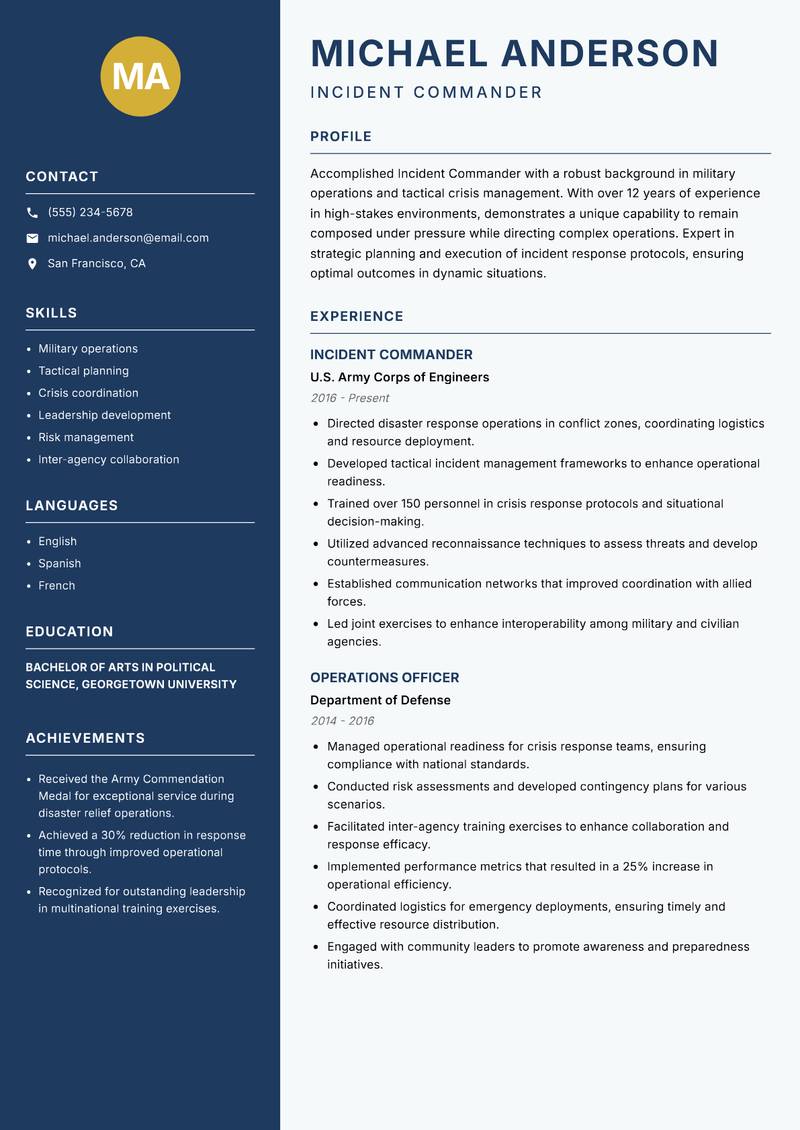
Classic Clean
Use Template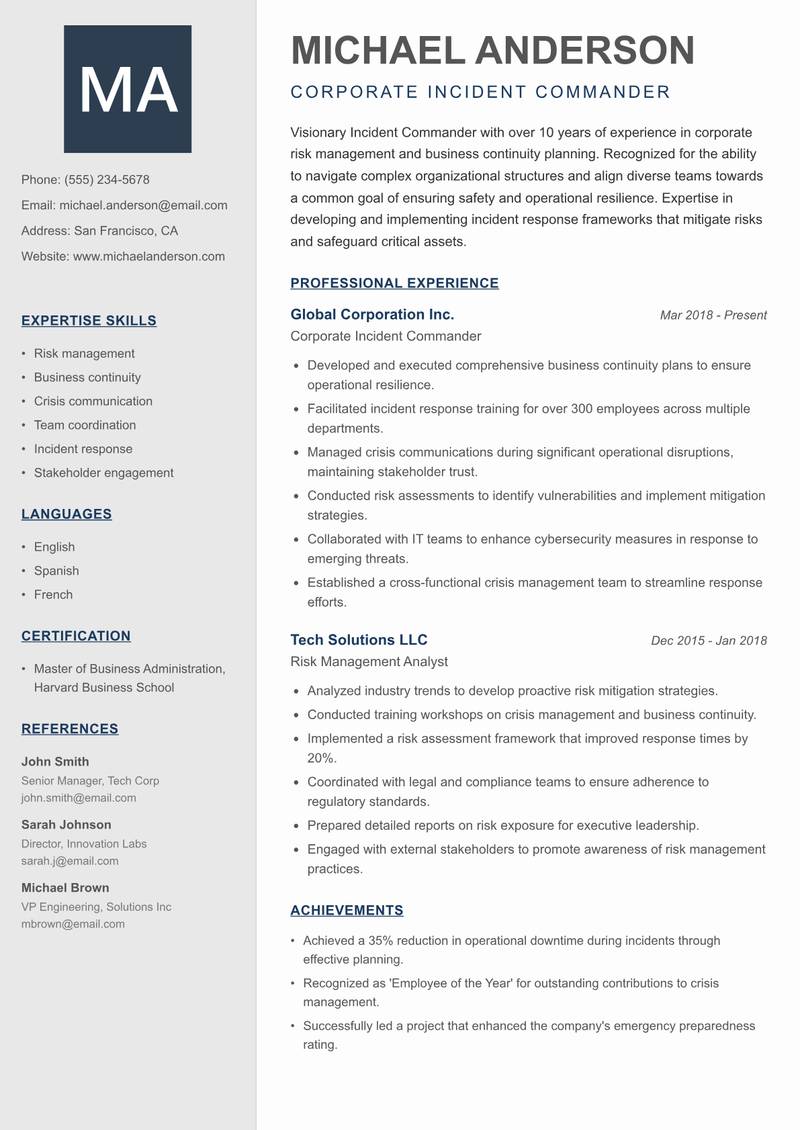
Creative Minimal
Use Template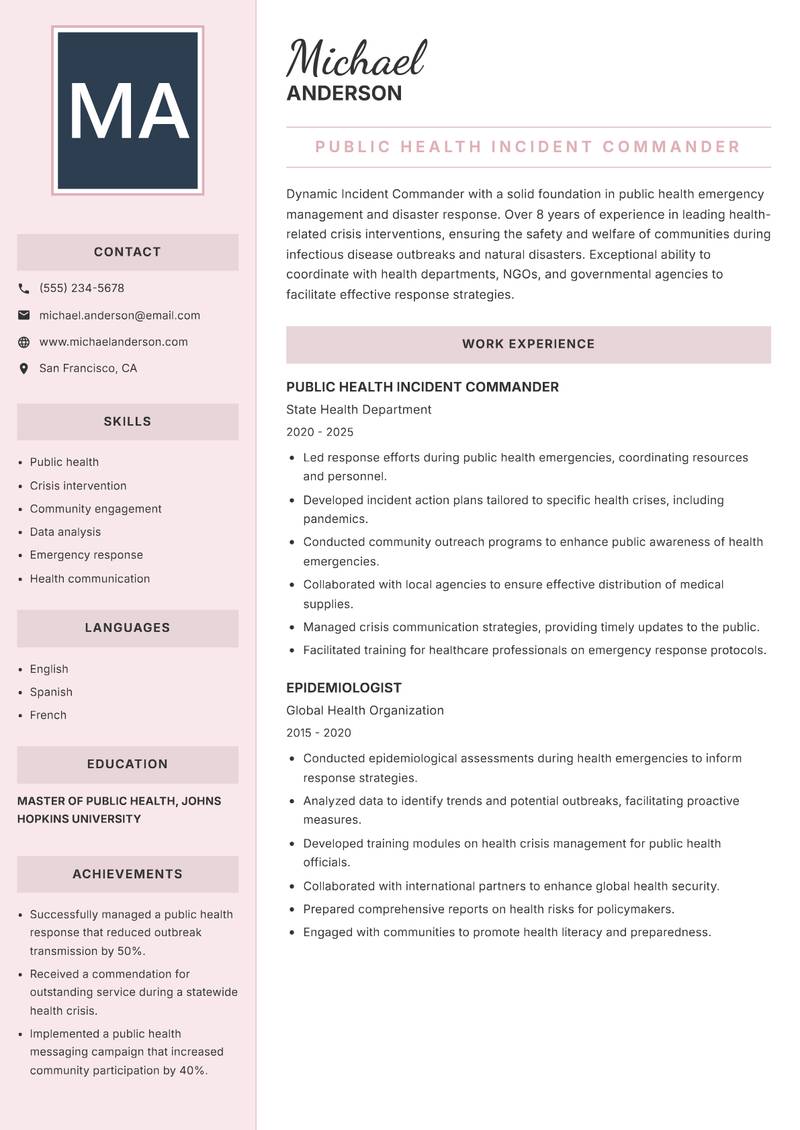
Executive
Use Template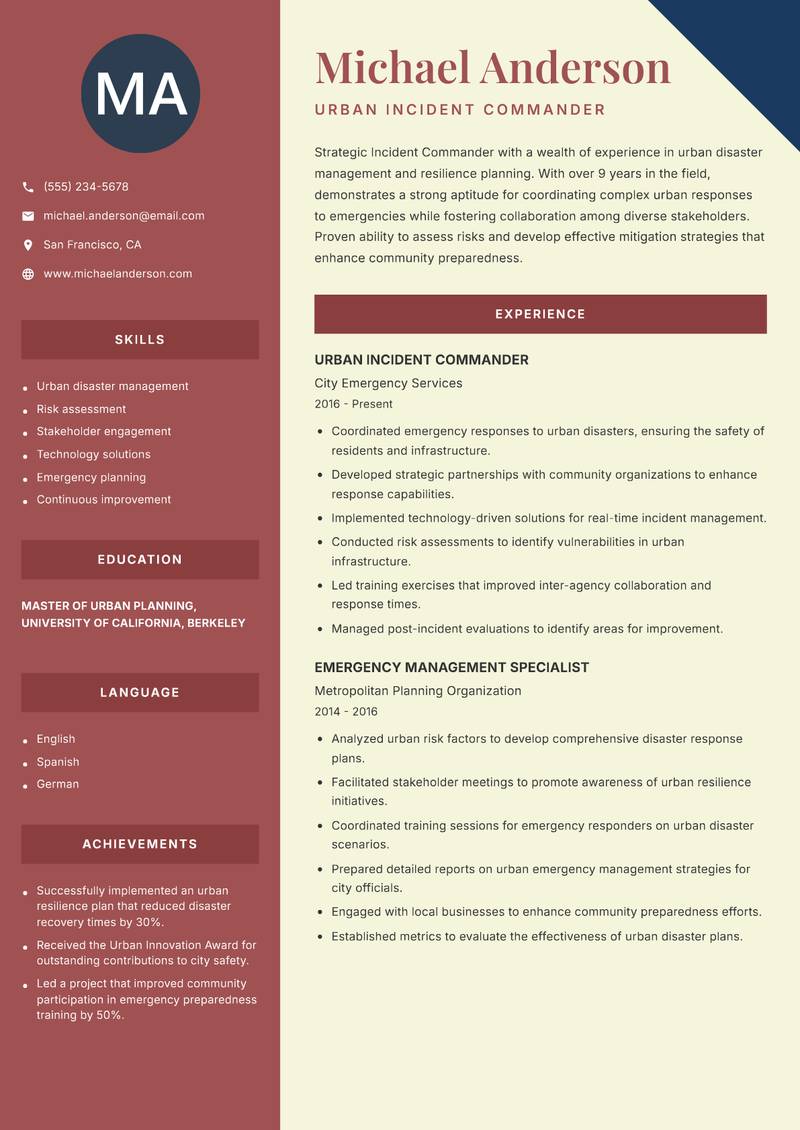
Two Column
Use Template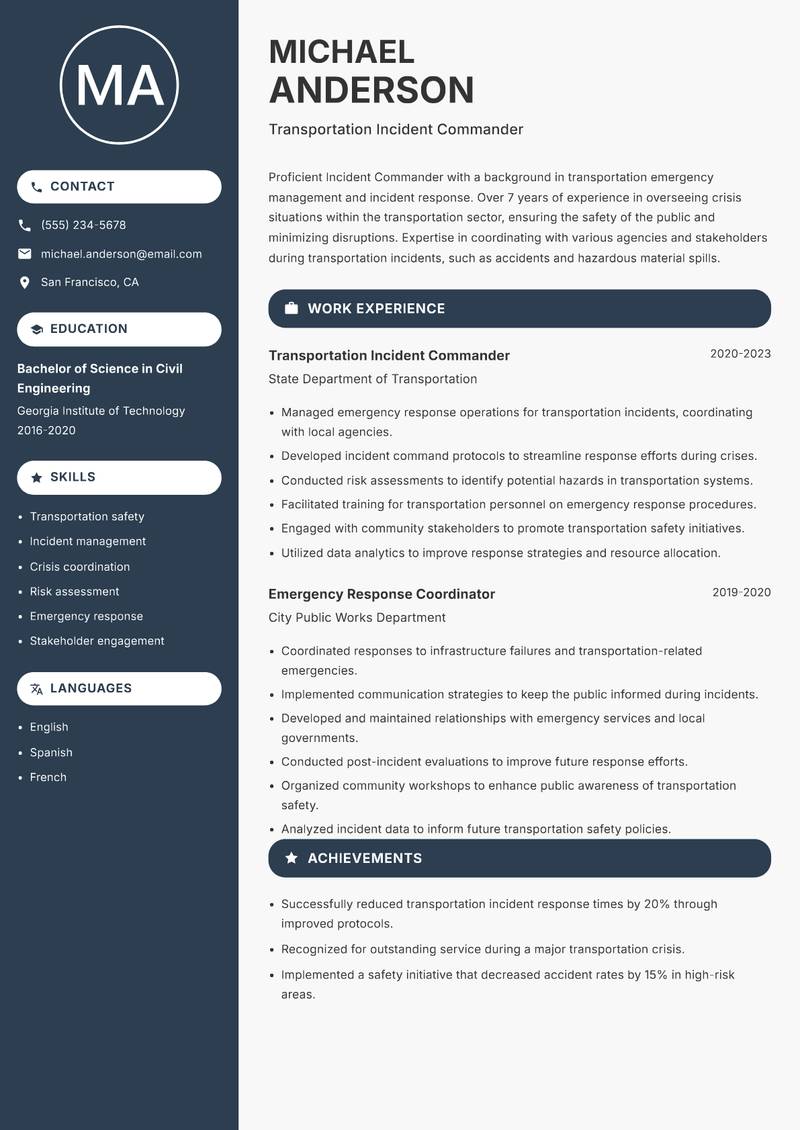
Compact
Use Template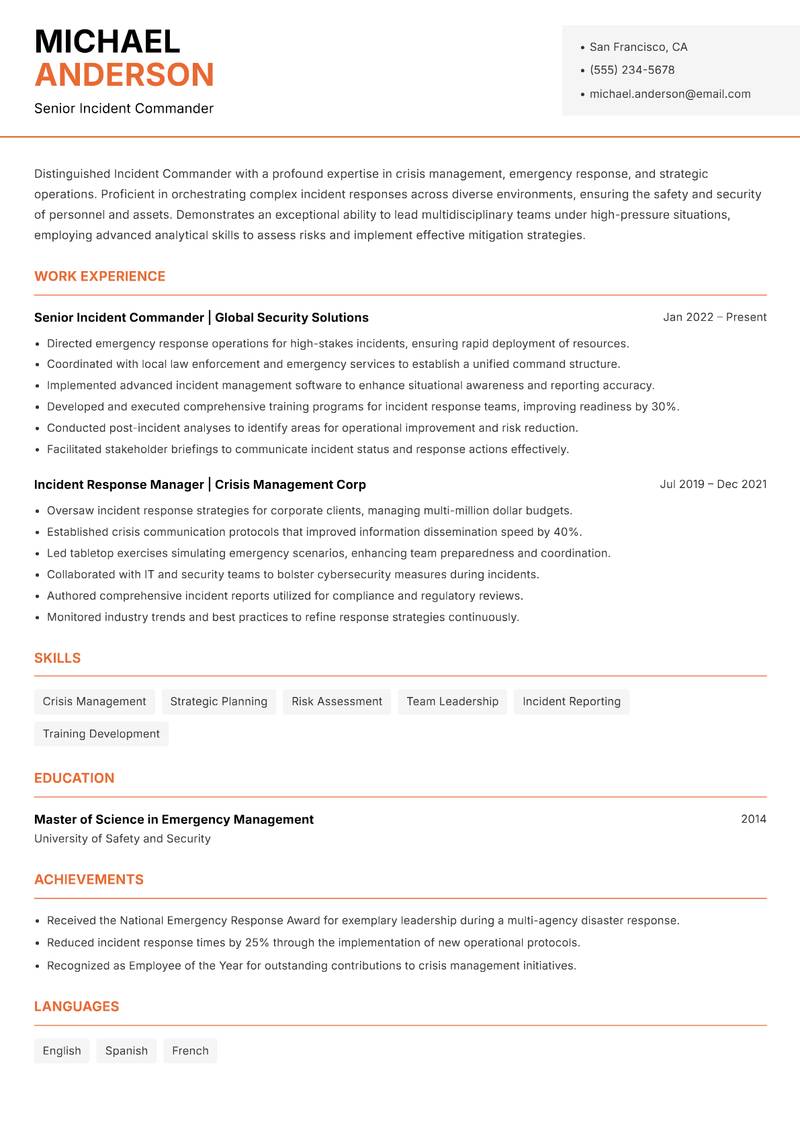
Modern Professional
Use Template7 Real Incident Commander Resume Examples
Senior Incident Commander with 15+ Years Experience
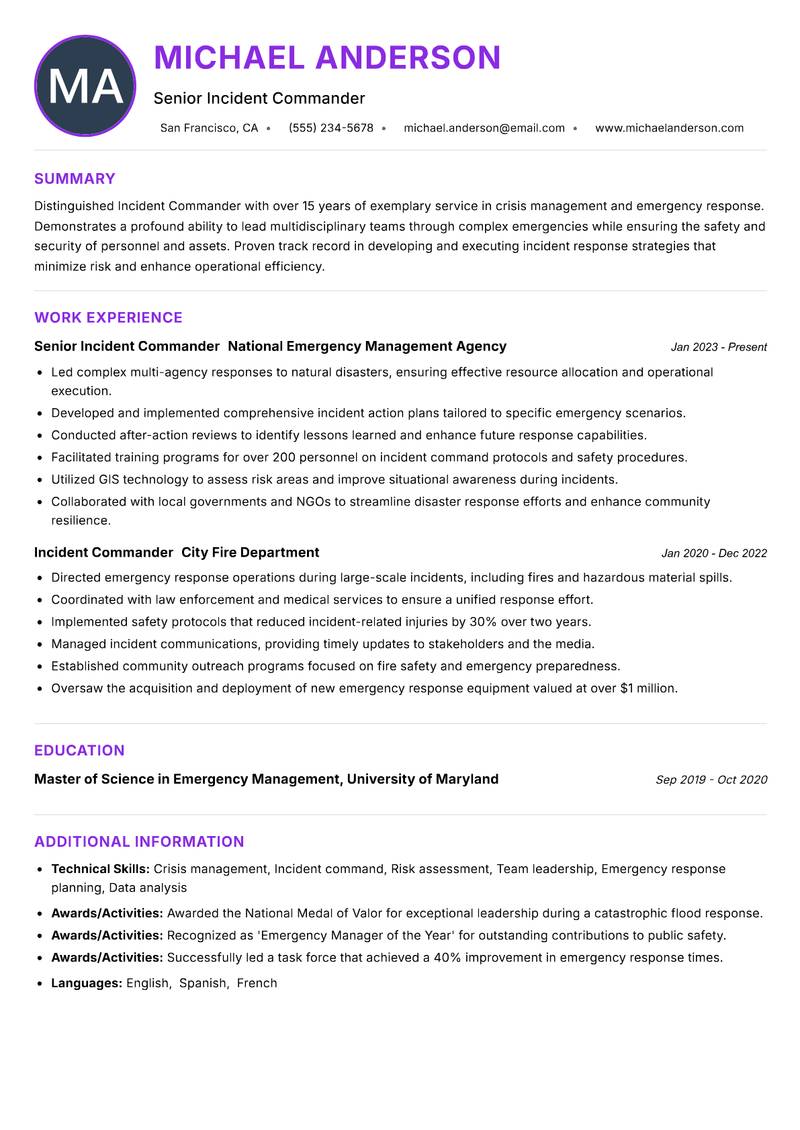
Summary: Distinguished Incident Commander with over 15 years of exemplary service in crisis management and emergency response. Demonstrates a profound ability to lead multidisciplinary teams through complex emergencies while ensuring the safety and security of personnel and assets. Proven track record in developing and executing incident response strategies that minimize risk and enhance operational efficiency. Adept at stakeholder engagement and inter-agency coordination, fostering collaborative environments to achieve mission objectives. Expertise in the utilization of advanced incident command systems and real-time data analytics to inform decision-making processes. Committed to continuous improvement through training, drills, and post-incident evaluations, thereby elevating organizational preparedness and resilience. Recognized for exceptional leadership qualities and unwavering dedication to public safety and community service.
Description:
- Led complex multi-agency responses to natural disasters, ensuring effective resource allocation and operational execution.
- Developed and implemented comprehensive incident action plans tailored to specific emergency scenarios.
- Conducted after-action reviews to identify lessons learned and enhance future response capabilities.
- Facilitated training programs for over 200 personnel on incident command protocols and safety procedures.
- Utilized GIS technology to assess risk areas and improve situational awareness during incidents.
- Collaborated with local governments and NGOs to streamline disaster response efforts and enhance community resilience.
🏆 Key Achievements
Incident Commander with 12+ Years Experience
Summary: Accomplished Incident Commander with a robust background in military operations and tactical crisis management. With over 12 years of experience in high-stakes environments, demonstrates a unique capability to remain composed under pressure while directing complex operations. Expert in strategic planning and execution of incident response protocols, ensuring optimal outcomes in dynamic situations. Proficient in leveraging advanced communication systems and technology to enhance situational awareness and team coordination. Dedicated to fostering a culture of safety and preparedness through rigorous training and development initiatives. Acknowledged for exemplary performance and leadership in both domestic and international missions, reflecting a commitment to excellence in public service. Holds a reputation for decisive action and innovative problem-solving in challenging scenarios.
Description:
- Directed disaster response operations in conflict zones, coordinating logistics and resource deployment.
- Developed tactical incident management frameworks to enhance operational readiness.
- Trained over 150 personnel in crisis response protocols and situational decision-making.
- Utilized advanced reconnaissance techniques to assess threats and develop countermeasures.
- Established communication networks that improved coordination with allied forces.
- Led joint exercises to enhance interoperability among military and civilian agencies.
🏆 Key Achievements
Corporate Incident Commander with 10+ Years Experience
Summary: Visionary Incident Commander with over 10 years of experience in corporate risk management and business continuity planning. Recognized for the ability to navigate complex organizational structures and align diverse teams towards a common goal of ensuring safety and operational resilience. Expertise in developing and implementing incident response frameworks that mitigate risks and safeguard critical assets. Proficient in conducting comprehensive risk assessments and establishing robust communication protocols during incidents. Committed to fostering a culture of preparedness through strategic training initiatives and stakeholder engagement. Proven success in leading cross-functional teams to effectively manage crises while minimizing impact on business operations. Holds a strong reputation for innovative thinking and decisive leadership in corporate environments.
Description:
- Developed and executed comprehensive business continuity plans to ensure operational resilience.
- Facilitated incident response training for over 300 employees across multiple departments.
- Managed crisis communications during significant operational disruptions, maintaining stakeholder trust.
- Conducted risk assessments to identify vulnerabilities and implement mitigation strategies.
- Collaborated with IT teams to enhance cybersecurity measures in response to emerging threats.
- Established a cross-functional crisis management team to streamline response efforts.
🏆 Key Achievements
Public Health Incident Commander with 8+ Years Experience
Summary: Dynamic Incident Commander with a solid foundation in public health emergency management and disaster response. Over 8 years of experience in leading health-related crisis interventions, ensuring the safety and welfare of communities during infectious disease outbreaks and natural disasters. Exceptional ability to coordinate with health departments, NGOs, and governmental agencies to facilitate effective response strategies. Expertise in developing public health messaging and community engagement initiatives that promote awareness and preparedness. Committed to continuous professional development and staying abreast of emerging trends in public health and emergency management. Recognized for strong analytical skills and the ability to make data-driven decisions in high-pressure environments. Maintains a steadfast dedication to enhancing community health and safety through proactive crisis management.
Description:
- Led response efforts during public health emergencies, coordinating resources and personnel.
- Developed incident action plans tailored to specific health crises, including pandemics.
- Conducted community outreach programs to enhance public awareness of health emergencies.
- Collaborated with local agencies to ensure effective distribution of medical supplies.
- Managed crisis communication strategies, providing timely updates to the public.
- Facilitated training for healthcare professionals on emergency response protocols.
🏆 Key Achievements
Urban Incident Commander with 9+ Years Experience
Summary: Strategic Incident Commander with a wealth of experience in urban disaster management and resilience planning. With over 9 years in the field, demonstrates a strong aptitude for coordinating complex urban responses to emergencies while fostering collaboration among diverse stakeholders. Proven ability to assess risks and develop effective mitigation strategies that enhance community preparedness. Expert in leveraging technology and data analytics to inform decision-making and improve operational efficiencies. Committed to fostering a culture of continuous improvement through training, simulations, and stakeholder engagement. Recognized for exceptional problem-solving skills and the ability to maintain composure in high-pressure situations. Holds a reputation for driving innovative solutions in urban emergency management.
Description:
- Coordinated emergency responses to urban disasters, ensuring the safety of residents and infrastructure.
- Developed strategic partnerships with community organizations to enhance response capabilities.
- Implemented technology-driven solutions for real-time incident management.
- Conducted risk assessments to identify vulnerabilities in urban infrastructure.
- Led training exercises that improved inter-agency collaboration and response times.
- Managed post-incident evaluations to identify areas for improvement.
🏆 Key Achievements
Transportation Incident Commander with 7+ Years Experience
Summary: Proficient Incident Commander with a background in transportation emergency management and incident response. Over 7 years of experience in overseeing crisis situations within the transportation sector, ensuring the safety of the public and minimizing disruptions. Expertise in coordinating with various agencies and stakeholders during transportation incidents, such as accidents and hazardous material spills. Adept at developing and implementing response protocols that enhance operational efficiency and safety. Committed to continuous improvement through training and simulation exercises, ensuring readiness for diverse emergency scenarios. Recognized for strong leadership and communication skills, fostering collaborative environments to achieve successful outcomes. Holds a proven track record of effectively managing transportation-related emergencies while maintaining a focus on public safety.
Description:
- Managed emergency response operations for transportation incidents, coordinating with local agencies.
- Developed incident command protocols to streamline response efforts during crises.
- Conducted risk assessments to identify potential hazards in transportation systems.
- Facilitated training for transportation personnel on emergency response procedures.
- Engaged with community stakeholders to promote transportation safety initiatives.
- Utilized data analytics to improve response strategies and resource allocation.
🏆 Key Achievements
Senior Incident Commander with 8+ Years Experience
Summary: Distinguished Incident Commander with a profound expertise in crisis management, emergency response, and strategic operations. Proficient in orchestrating complex incident responses across diverse environments, ensuring the safety and security of personnel and assets. Demonstrates an exceptional ability to lead multidisciplinary teams under high-pressure situations, employing advanced analytical skills to assess risks and implement effective mitigation strategies. Adept at liaising with governmental agencies, public safety organizations, and corporate stakeholders to facilitate seamless communication and coordination during critical incidents. Holds a proven track record of enhancing operational protocols and developing comprehensive training programs that bolster organizational resilience. Committed to continuous improvement and innovation within incident management frameworks, leveraging cutting-edge technologies and methodologies to optimize response efficacy and resource allocation.
Description:
- Directed emergency response operations for high-stakes incidents, ensuring rapid deployment of resources.
- Coordinated with local law enforcement and emergency services to establish a unified command structure.
- Implemented advanced incident management software to enhance situational awareness and reporting accuracy.
- Developed and executed comprehensive training programs for incident response teams, improving readiness by 30%.
- Conducted post-incident analyses to identify areas for operational improvement and risk reduction.
- Facilitated stakeholder briefings to communicate incident status and response actions effectively.
🏆 Key Achievements
Key Skills for Incident Commander
ATS Optimization Tips
Increase your chances of getting hired
Use Standard Headings
Use common section titles like Experience, Skills, etc.
Include Keywords
Add role-specific keywords from the job description
Keep it Simple
Avoid complex tables, images and graphics
Save in Right Format
Use PDF format unless otherwise specified
Incident Commander Salary Insights
Average Salary
$100,000
per year
Salary Range
$80,000 - $120,000
per year
Top Paying Cities
Los Angeles, Seattle, Houston, Dallas, Boston
Source: Glassdoor, Payscale, Indeed (Updated December 2025)
Everything you need to write a great Incident Commander resume
Strong Action Verbs to Use
Resume Writing Tips
- →Highlight specific emergency scenarios you have managed, emphasizing your role.
- →Showcase leadership training and any relevant drills you have conducted.
- →Include measurable outcomes from incidents you oversaw, such as response times or evacuation efficiency.
- →Emphasize technological tools that you’ve mastered for managing crises and communications.
- →Detail your involvement in policy-making or resource allocation beyond operational duties.
Common Mistakes to Avoid
- ✕Listing generic emergency management skills without specifics on incidents handled.
- ✕Neglecting to mention certificated trainings or relevant continuous education details.
- ✕Failing to articulate how past experiences align with the specific requirements of Incident Commander roles.
- ✕Overly focusing on team accomplishments without mentioning your leadership or decision-making contributions.
ATS Keywords for Incident Commander
Incident Commander Career Path
Relevant Certifications
Career Progression
Entry-Level
Begins as an Incident Response Team member, assisting in on-scene operations under supervision.
Mid-Level
Advances to Assistant Incident Commander, taking charge of specific operations or divisions during incidents.
Senior-Level
Promoted to Incident Commander, responsible for the strategic planning and execution of emergency response efforts.
Director
Oversees multiple incident response teams, coordinating training and strategies across regional operations.
Executive
Serves as Chief of Emergency Services, influencing policy and resource allocation for disaster preparedness and response.
Incident Commander Interview Questions
What strategies do you implement to prioritize safety during an emergency? +
Provide examples that highlight your decision-making process and risk assessment skills.
How do you ensure effective communication among diverse stakeholders during an incident? +
Discuss your experience with communication tools and protocols that facilitate clarity and collaboration.
Describe a time you had to adapt your incident response plan on the spot. What did you change and why? +
Focus on your flexibility and analytical skills in high-pressure situations.
Can you share how you have trained or prepared your team for unexpected challenges? +
This should reflect your leadership style and commitment to team development.
What tools or technologies do you rely on most during incident command operations? +
Mention software and resources that assist in situational awareness and logistics.
Tell us about a challenging incident you managed and your approach to resolving it. What were the outcomes? +
Demonstrate your critical thinking and problem-solving skills through concrete examples.
About the Incident Commander Role
In high-stakes situations, the Incident Commander serves as the authoritative figure tasked with directing emergency response operations. Managing diverse teams, this individual ensures that resources are strategically deployed while prioritizing public safety. Familiarity with the Incident Command System (ICS) is essential, along with the ability to adapt plans based on the evolving dynamics of incidents, from wildfires to urban disasters.
Frequently Asked Questions
What is the primary responsibility of an Incident Commander? +
The primary responsibility involves overseeing all aspects of emergency response, including incident analysis, strategizing operational plans, and ensuring resource allocation.
How important is communication in the role of an Incident Commander? +
Communication is crucial; effective interaction with various stakeholders ensures coordinated responses and helps mitigate risks.
What is the Incident Command System (ICS)? +
ICS is a standardized, on-scene, all-hazard incident management approach that enables responders to coordinate effectively during emergencies.
What types of incidents does an Incident Commander manage? +
An Incident Commander may manage crises such as natural disasters, hazardous materials incidents, major accidents, or public safety emergencies.
Are there specific certifications required to become an Incident Commander? +
While not always mandated, certifications through FEMA and advanced training in emergency management enhance qualifications significantly.
What qualities make a successful Incident Commander? +
Strong leadership, adaptability under pressure, excellent communication skills, and strategic thinking are critical for success in this role.
More Resume Examples You Might Like
Will this Incident Commander resume pass the ATS scan?
Upload it and get an instant AI-scored compatibility check with specific fixes.
Check My Resume →
Pair it with a matching cover letter
AI drafts a first version from your job title and strengths — edit it live, then download the PDF.
Write My Cover Letter →
Written by Nohaya Career Team
Reviewed by HR Professionals · Updated December 2025
Ready to Build Your Perfect Resume?
Choose from 1000+ professional templates and land your dream job.
Create My Resume Now