Build an ATS-Friendly
Fish Stock Assessment Scientist Resume
That Gets Interviews
Examining the health and sustainability of fish populations is a fundamental responsibility undertaken by Fish Stock Assessment Scientists. These professionals rigorously collect field data, often utilizing acoustic and tagging technologies, to evaluate fish stocks within a designated marine area. Collaborating with…
Fish Stock Assessment Scientist Resume Templates
Modern Professional
Use Template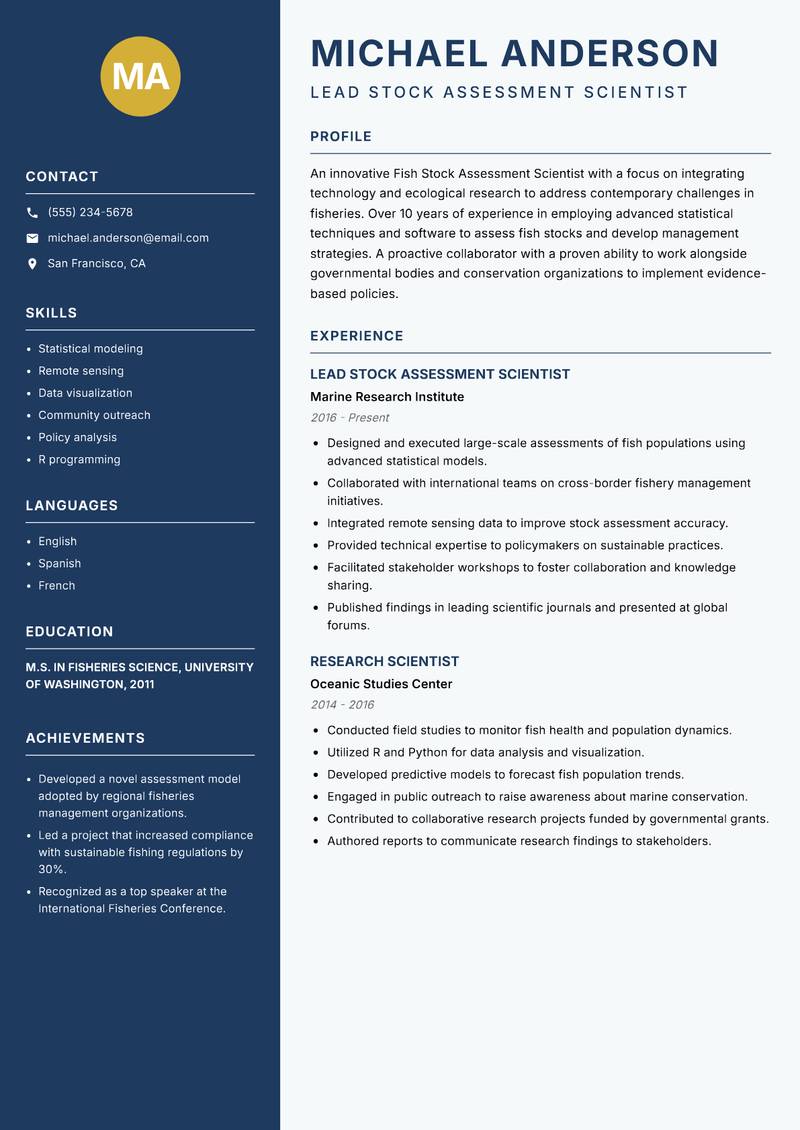
Classic Clean
Use Template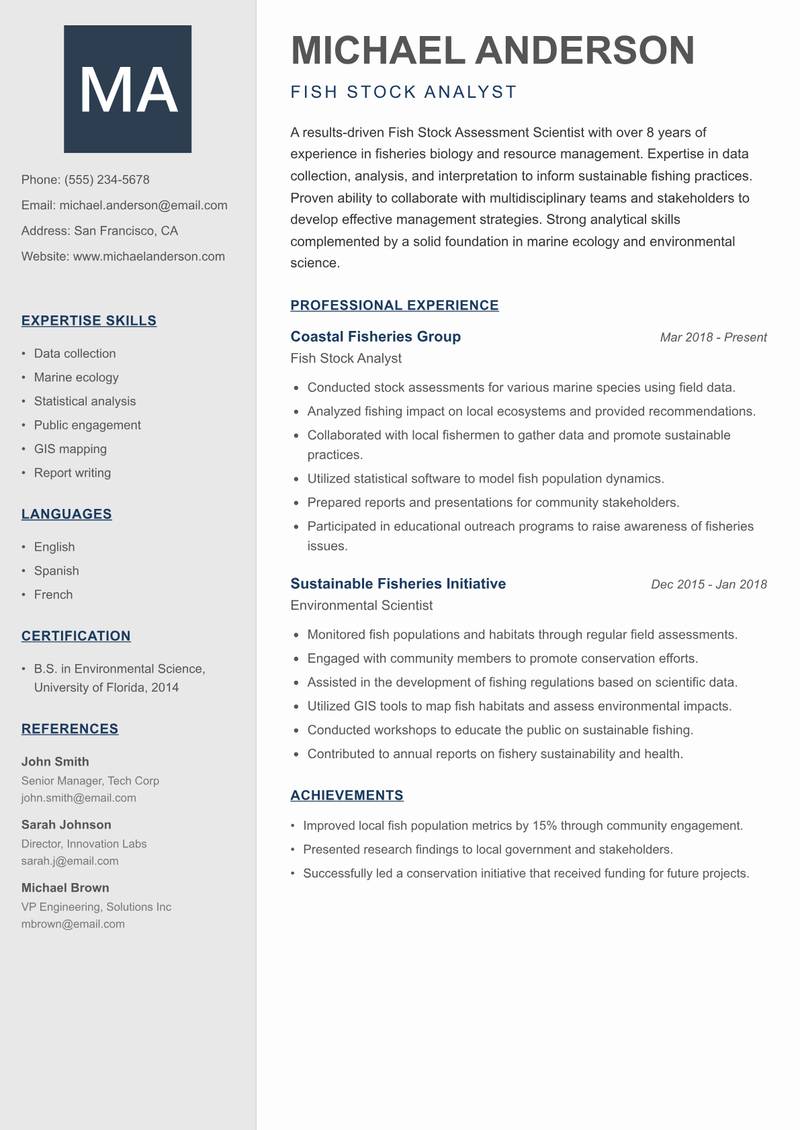
Creative Minimal
Use Template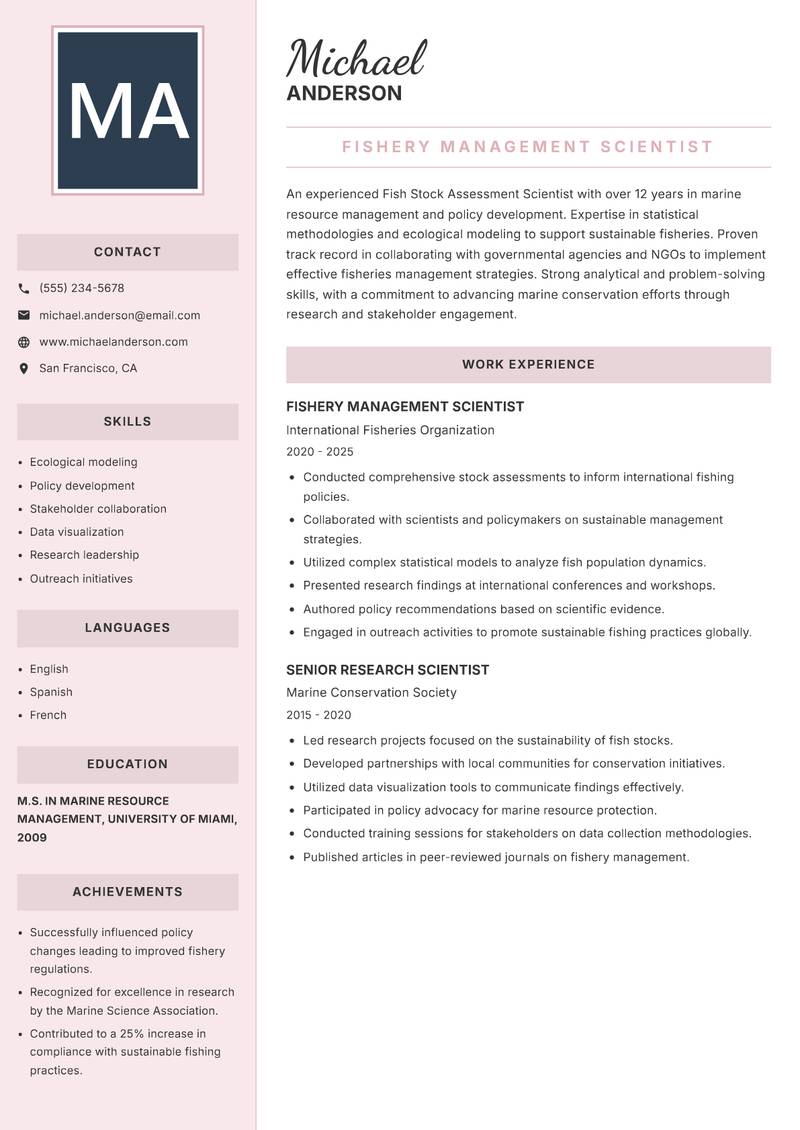
Executive
Use Template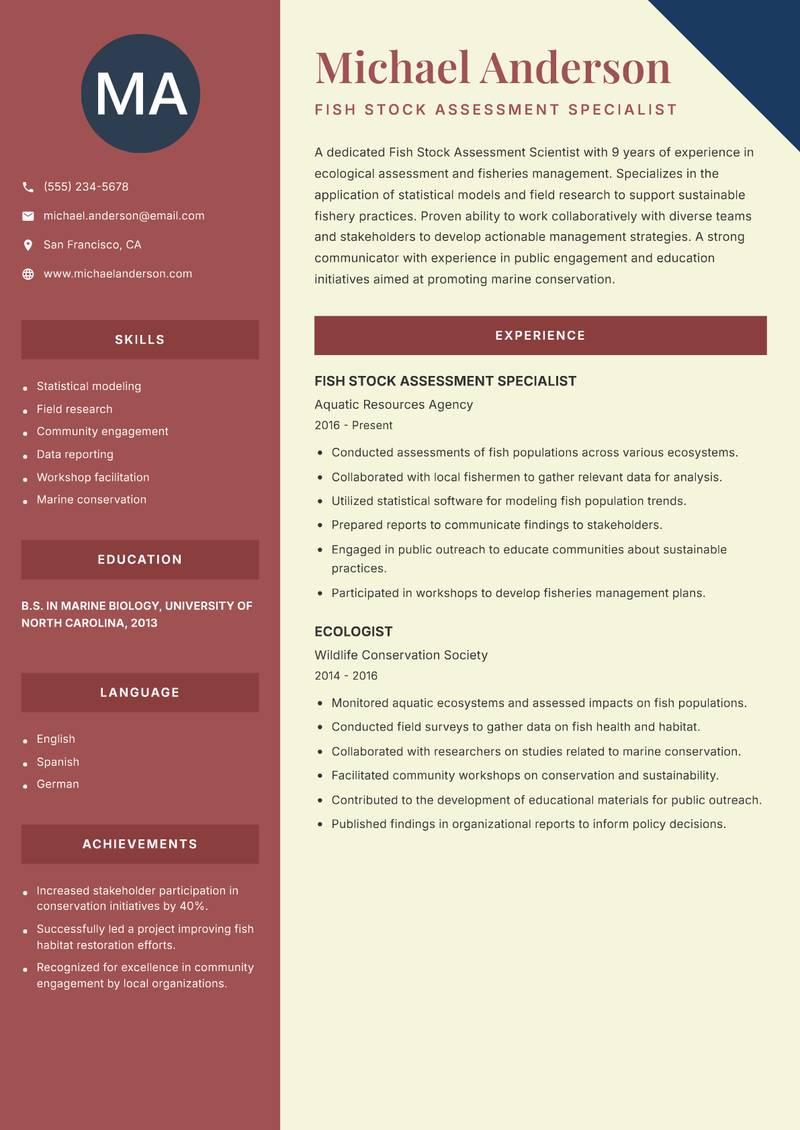
Two Column
Use Template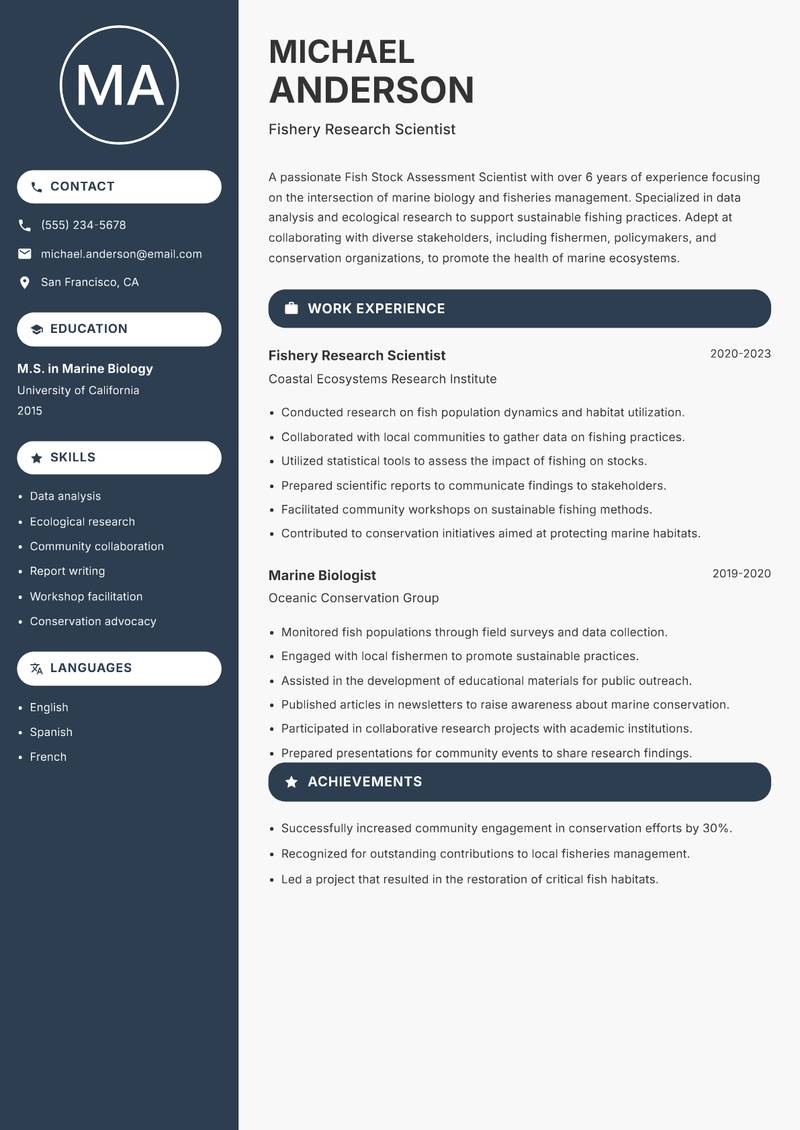
Compact
Use Template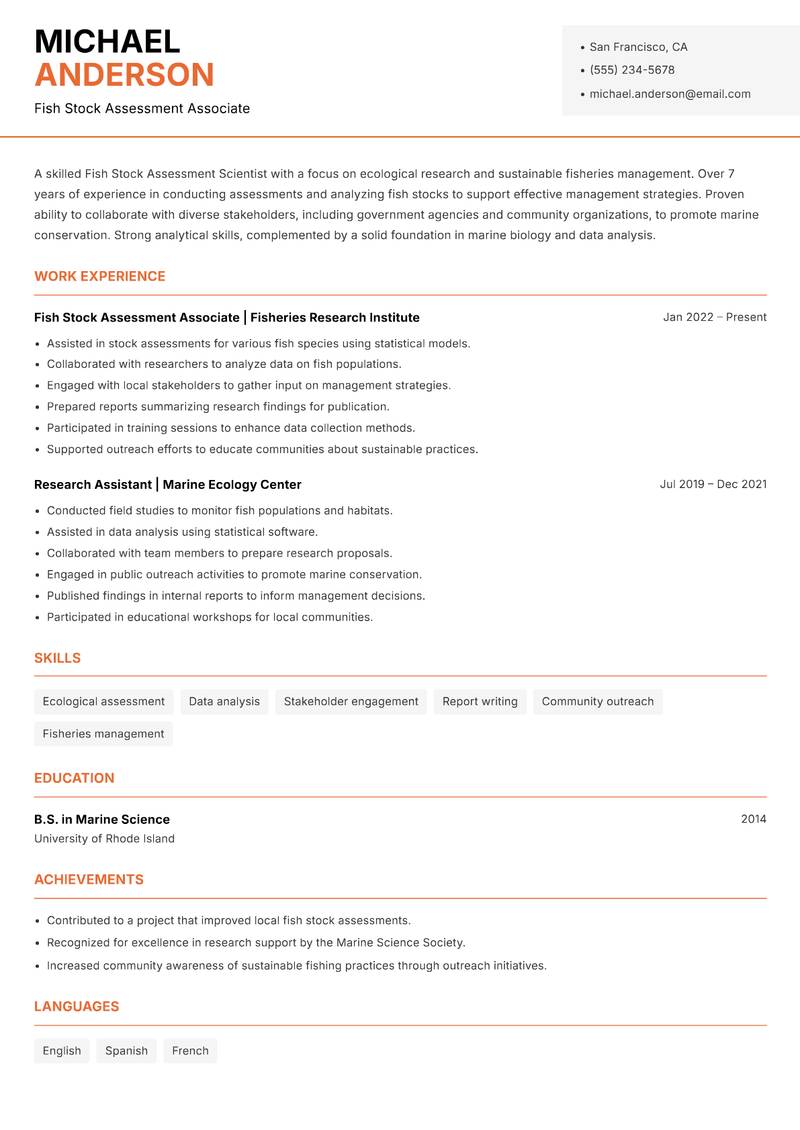
Modern Professional
Use Template7 Real Fish Stock Assessment Scientist Resume Examples
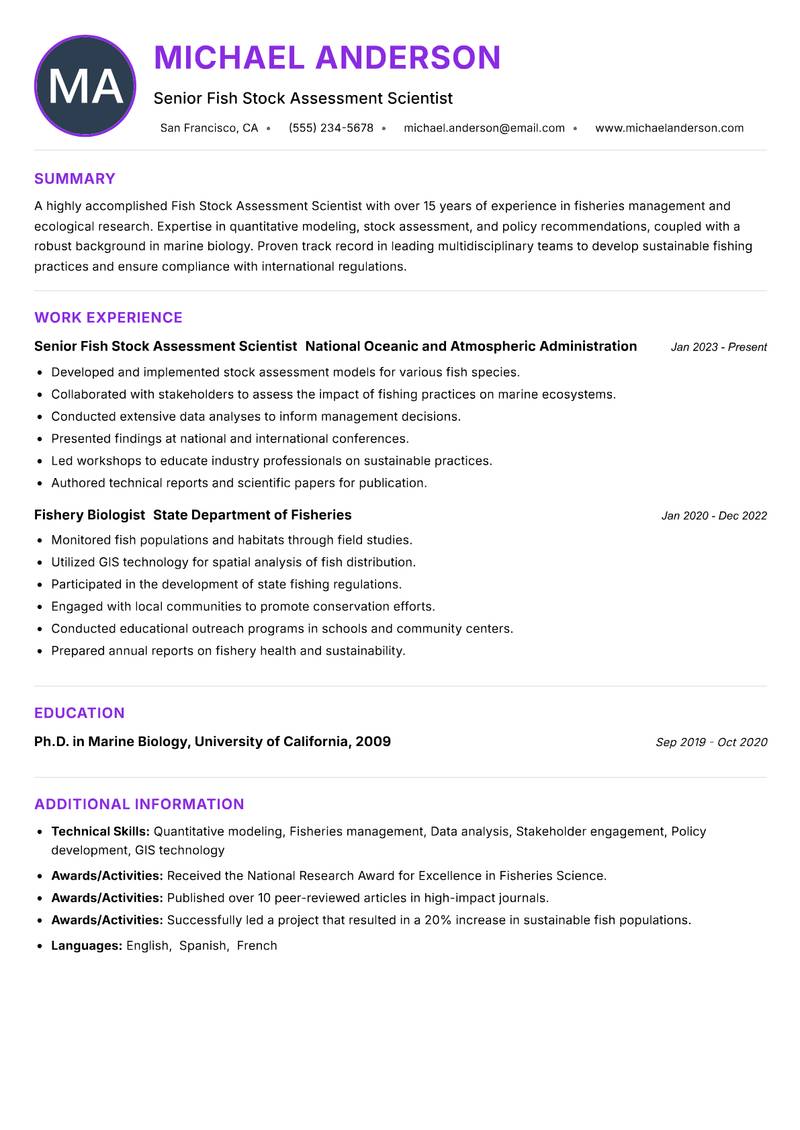
Senior Fish Stock Assessment Scientist with 12+ Years Experience
Summary: A highly accomplished Fish Stock Assessment Scientist with over 15 years of experience in fisheries management and ecological research. Expertise in quantitative modeling, stock assessment, and policy recommendations, coupled with a robust background in marine biology. Proven track record in leading multidisciplinary teams to develop sustainable fishing practices and ensure compliance with international regulations. Demonstrated ability to analyze complex datasets and communicate findings effectively to stakeholders. Committed to advancing scientific knowledge and promoting conservation initiatives through innovative research methodologies and collaboration with governmental and non-governmental organizations. Recognized for significant contributions to the field, including published work in peer-reviewed journals and presentations at international conferences.
Description:
- Developed and implemented stock assessment models for various fish species.
- Collaborated with stakeholders to assess the impact of fishing practices on marine ecosystems.
- Conducted extensive data analyses to inform management decisions.
- Presented findings at national and international conferences.
- Led workshops to educate industry professionals on sustainable practices.
- Authored technical reports and scientific papers for publication.
🏆 Key Achievements
Lead Stock Assessment Scientist with 10+ Years Experience
Summary: An innovative Fish Stock Assessment Scientist with a focus on integrating technology and ecological research to address contemporary challenges in fisheries. Over 10 years of experience in employing advanced statistical techniques and software to assess fish stocks and develop management strategies. A proactive collaborator with a proven ability to work alongside governmental bodies and conservation organizations to implement evidence-based policies. Recognized for pioneering research that bridges gaps between scientific inquiry and practical application in the field. Passionate about promoting sustainable fishing practices and enhancing the resilience of aquatic ecosystems through research and community engagement.
Description:
- Designed and executed large-scale assessments of fish populations using advanced statistical models.
- Collaborated with international teams on cross-border fishery management initiatives.
- Integrated remote sensing data to improve stock assessment accuracy.
- Provided technical expertise to policymakers on sustainable practices.
- Facilitated stakeholder workshops to foster collaboration and knowledge sharing.
- Published findings in leading scientific journals and presented at global forums.
🏆 Key Achievements
Fish Stock Analyst with 8+ Years Experience
Summary: A results-driven Fish Stock Assessment Scientist with over 8 years of experience in fisheries biology and resource management. Expertise in data collection, analysis, and interpretation to inform sustainable fishing practices. Proven ability to collaborate with multidisciplinary teams and stakeholders to develop effective management strategies. Strong analytical skills complemented by a solid foundation in marine ecology and environmental science. Committed to advancing the science of fisheries through innovative research and a passion for conservation. A proactive communicator with experience in public outreach and education initiatives aimed at promoting awareness of marine resource sustainability.
Description:
- Conducted stock assessments for various marine species using field data.
- Analyzed fishing impact on local ecosystems and provided recommendations.
- Collaborated with local fishermen to gather data and promote sustainable practices.
- Utilized statistical software to model fish population dynamics.
- Prepared reports and presentations for community stakeholders.
- Participated in educational outreach programs to raise awareness of fisheries issues.
🏆 Key Achievements
Fishery Management Scientist with 12+ Years Experience
Summary: An experienced Fish Stock Assessment Scientist with over 12 years in marine resource management and policy development. Expertise in statistical methodologies and ecological modeling to support sustainable fisheries. Proven track record in collaborating with governmental agencies and NGOs to implement effective fisheries management strategies. Strong analytical and problem-solving skills, with a commitment to advancing marine conservation efforts through research and stakeholder engagement. Recognized for contributions to policy frameworks that enhance fishery sustainability and promote ecological balance. A dedicated advocate for science-based approaches to resource management.
Description:
- Conducted comprehensive stock assessments to inform international fishing policies.
- Collaborated with scientists and policymakers on sustainable management strategies.
- Utilized complex statistical models to analyze fish population dynamics.
- Presented research findings at international conferences and workshops.
- Authored policy recommendations based on scientific evidence.
- Engaged in outreach activities to promote sustainable fishing practices globally.
🏆 Key Achievements
Fish Stock Assessment Specialist with 9+ Years Experience
Summary: A dedicated Fish Stock Assessment Scientist with 9 years of experience in ecological assessment and fisheries management. Specializes in the application of statistical models and field research to support sustainable fishery practices. Proven ability to work collaboratively with diverse teams and stakeholders to develop actionable management strategies. A strong communicator with experience in public engagement and education initiatives aimed at promoting marine conservation. Committed to employing scientific research to inform policy decisions and improve fishery health. Recognized for contributions to community-based conservation efforts and stakeholder collaboration.
Description:
- Conducted assessments of fish populations across various ecosystems.
- Collaborated with local fishermen to gather relevant data for analysis.
- Utilized statistical software for modeling fish population trends.
- Prepared reports to communicate findings to stakeholders.
- Engaged in public outreach to educate communities about sustainable practices.
- Participated in workshops to develop fisheries management plans.
🏆 Key Achievements
Fishery Research Scientist with 6+ Years Experience
Summary: A passionate Fish Stock Assessment Scientist with over 6 years of experience focusing on the intersection of marine biology and fisheries management. Specialized in data analysis and ecological research to support sustainable fishing practices. Adept at collaborating with diverse stakeholders, including fishermen, policymakers, and conservation organizations, to promote the health of marine ecosystems. Strong analytical skills complemented by experience in statistical modeling and ecological assessment. Committed to advancing the scientific understanding of fish stocks and advocating for sustainable resource management. Recognized for contributions to local conservation projects and educational initiatives.
Description:
- Conducted research on fish population dynamics and habitat utilization.
- Collaborated with local communities to gather data on fishing practices.
- Utilized statistical tools to assess the impact of fishing on stocks.
- Prepared scientific reports to communicate findings to stakeholders.
- Facilitated community workshops on sustainable fishing methods.
- Contributed to conservation initiatives aimed at protecting marine habitats.
🏆 Key Achievements
Fish Stock Assessment Associate with 7+ Years Experience
Summary: A skilled Fish Stock Assessment Scientist with a focus on ecological research and sustainable fisheries management. Over 7 years of experience in conducting assessments and analyzing fish stocks to support effective management strategies. Proven ability to collaborate with diverse stakeholders, including government agencies and community organizations, to promote marine conservation. Strong analytical skills, complemented by a solid foundation in marine biology and data analysis. Committed to bridging the gap between scientific research and practical application in fisheries management. Recognized for contributions to community-based conservation projects and stakeholder education initiatives.
Description:
- Assisted in stock assessments for various fish species using statistical models.
- Collaborated with researchers to analyze data on fish populations.
- Engaged with local stakeholders to gather input on management strategies.
- Prepared reports summarizing research findings for publication.
- Participated in training sessions to enhance data collection methods.
- Supported outreach efforts to educate communities about sustainable practices.
🏆 Key Achievements
Key Skills for Fish Stock Assessment Scientist
ATS Optimization Tips
Increase your chances of getting hired
Use Standard Headings
Use common section titles like Experience, Skills, etc.
Include Keywords
Add role-specific keywords from the job description
Keep it Simple
Avoid complex tables, images and graphics
Save in Right Format
Use PDF format unless otherwise specified
Fish Stock Assessment Scientist Salary Insights
Average Salary
$75,000
per year
Salary Range
$60,000 - $90,000
per year
Top Paying Cities
Los Angeles, Seattle, Houston, Dallas, Boston
Source: Glassdoor, Payscale, Indeed (Updated July 2025)
Everything you need to write a great Fish Stock Assessment Scientist resume
Strong Action Verbs to Use
Resume Writing Tips
- →Highlight specific statistical software you are proficient in, such as R or AD Model Builder.
- →Include a section detailing fieldwork experience, emphasizing the types of ecosystems you’ve worked in.
- →Mention collaborations with fishermen or conservationists to showcase your stakeholder engagement skills.
- →List any papers you have published or contributed to in peer-reviewed journals related to fisheries science.
- →Focus on quantifiable achievements in past assessments to illustrate your contributions clearly.
Common Mistakes to Avoid
- ✕Using overly broad terms that could apply to any marine scientist role, like 'analyzing fish data'.
- ✕Neglecting to specify your direct contribution to fishery management plans or policies.
- ✕Failing to mention specific tools or technologies adapted in your assessments.
- ✕Including generic soft skills instead of emphasizing collaboration and technical communication within fisheries.
ATS Keywords for Fish Stock Assessment Scientist
Fish Stock Assessment Scientist Career Path
Career Progression
Entry-Level Fish Stock Assessment Scientist
Learns foundational scientific methods in marine biology and statistics while supporting senior scientists in data collection and analysis.
Mid-Level Fish Stock Assessment Scientist
Assumes greater responsibility for specific projects, including the development and application of population models to assess stock health.
Senior Fish Stock Assessment Scientist
Oversees comprehensive assessment programs, interacting with regulatory bodies to adapt management strategies based on findings.
Lead Researcher in Stock Assessment
Directs research initiatives, guidance on methodological improvement, and management of complex datasets, often securing funding for projects.
Consulting Scientist
Engages with private sector or governments, providing expert advice on fisheries management and sustainability practices.
Fish Stock Assessment Scientist Interview Questions
What techniques do you use to assess fish populations and their dynamics? +
Discuss specific statistical models you have implemented and the rationale behind choosing those methods.
Can you explain how environmental factors influence fish stock? +
Show understanding of the interplay between ecosystem changes and fish population health.
What is your experience with Pacific and Atlantic fish species in terms of assessment? +
Provide examples of projects or studies involving specific species native to these regions.
How do you ensure your research is aligned with current fisheries management policies? +
Reference examples of collaboration with management agencies or regulatory frameworks.
Describe a challenge you faced while conducting stock assessments and how you overcame it. +
Be specific about the scenario, your approach, and the outcome.
In your experience, how do stakeholder beliefs impact fish assessment processes? +
Address the balance between scientific data and community or commercial interests.
About the Fish Stock Assessment Scientist Role
Examining the health and sustainability of fish populations is a fundamental responsibility undertaken by Fish Stock Assessment Scientists. These professionals rigorously collect field data, often utilizing acoustic and tagging technologies, to evaluate fish stocks within a designated marine area. Collaborating with stakeholders, including government agencies and conservation groups, they provide scientifically-backed recommendations to enhance fisheries management and ensure environmental compliance.
Frequently Asked Questions
What are the primary tools used in fish stock assessment? +
Fish Stock Assessment Scientists commonly use sonar equipment, tagging devices, and statistical software for data analysis.
How does climate change impact fish stock assessments? +
Changes in water temperature and chemistry affect fish behavior and population dynamics, necessitating ongoing adaptations in assessment approaches.
What is the role of international agreements in fish stock assessment? +
Scientists must align their assessments with international fisheries agreements to promote sustainable practices across borders.
What education is needed to become a Fish Stock Assessment Scientist? +
A degree in marine biology, fisheries science, or related fields is typically required; advanced degrees may be preferred for senior roles.
What skills are essential for success in this position? +
Critical thinking, quantitative analysis, strong communication, and proficiency with modeling software are crucial for effectiveness.
More Resume Examples You Might Like
Related Career Paths
Other roles candidates for Fish Stock Assessment Scientist positions often also consider.
Will this Fish Stock Assessment Scientist resume pass the ATS scan?
Upload it and get an instant AI-scored compatibility check with specific fixes.
Check My Resume →
Pair it with a matching cover letter
AI drafts a first version from your job title and strengths — edit it live, then download the PDF.
Write My Cover Letter →
Written by Nohaya Career Team
Reviewed by HR Professionals · Updated July 2025
Ready to Build Your Perfect Resume?
Choose from 1000+ professional templates and land your dream job.
Create My Resume Now