Build an ATS-Friendly
Earthquake Engineer Resume
That Gets Interviews
Designing buildings and infrastructure that resist seismic forces is at the core of an Earthquake Engineer's responsibilities. Through the application of advanced modeling technologies and seismic design principles, these specialists ensure structures can withstand earthquakes and protect occupants. Their work…
Earthquake Engineer Resume Templates
Modern Professional
Use Template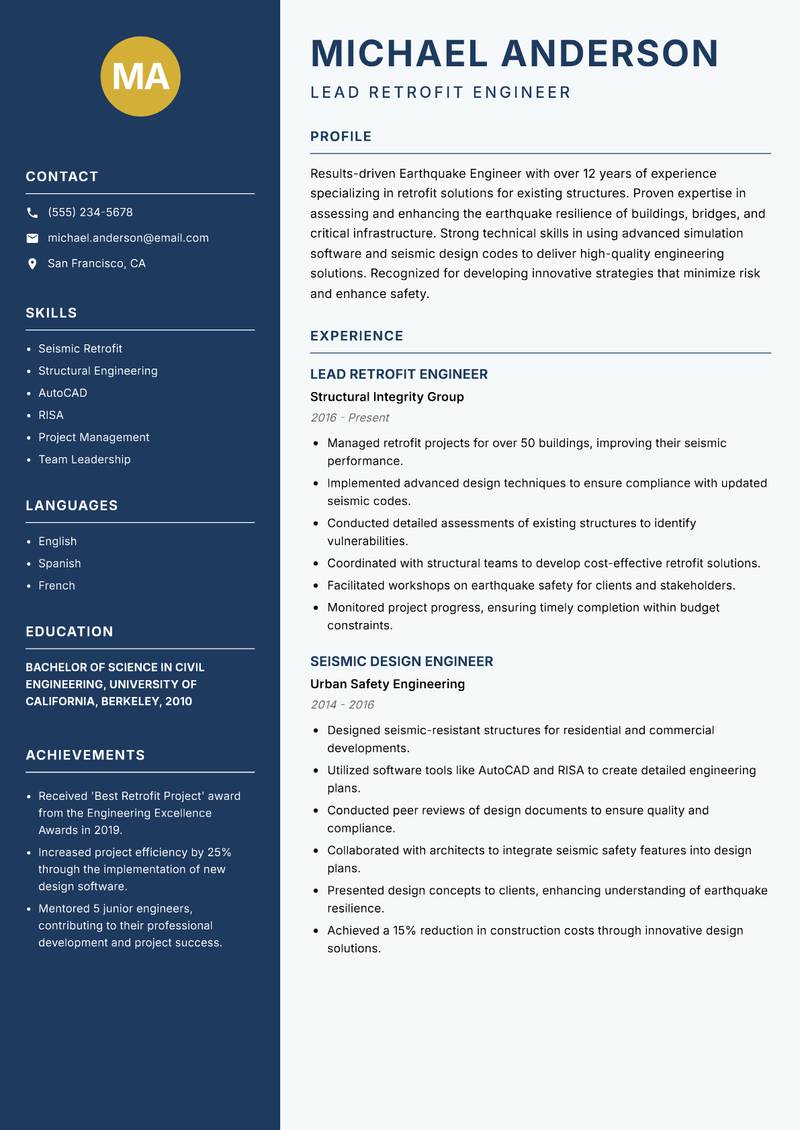
Classic Clean
Use Template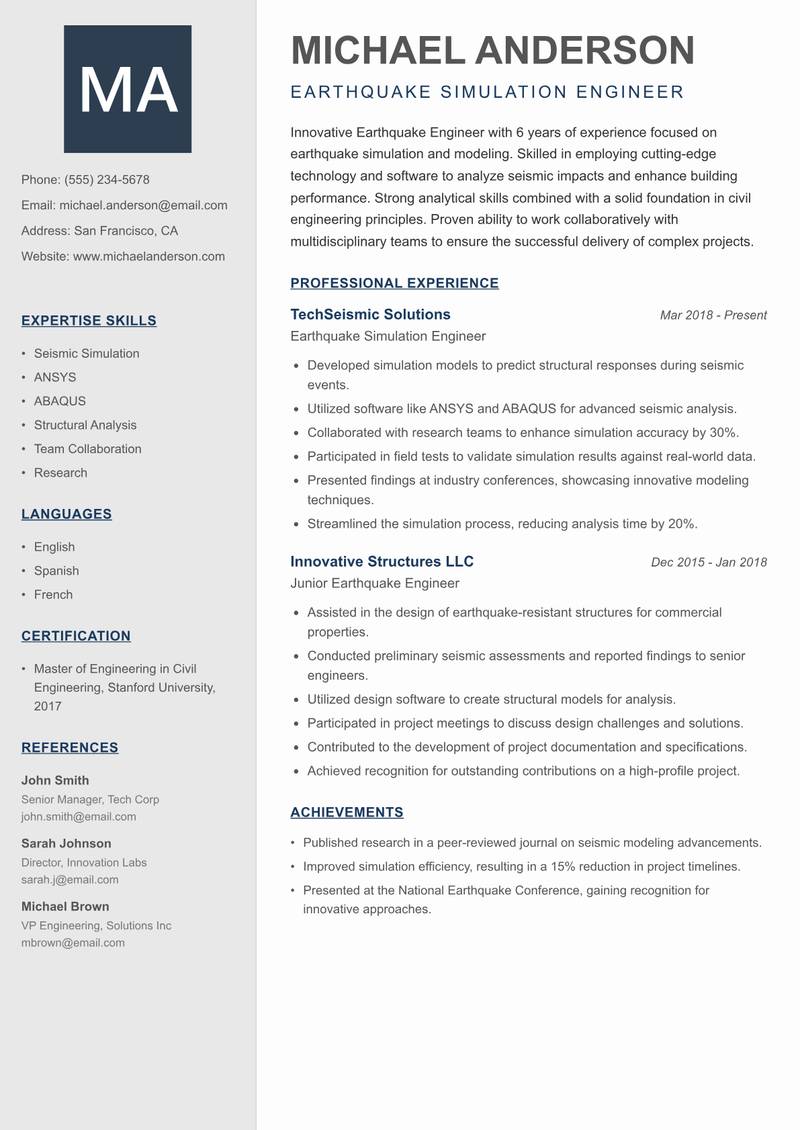
Creative Minimal
Use Template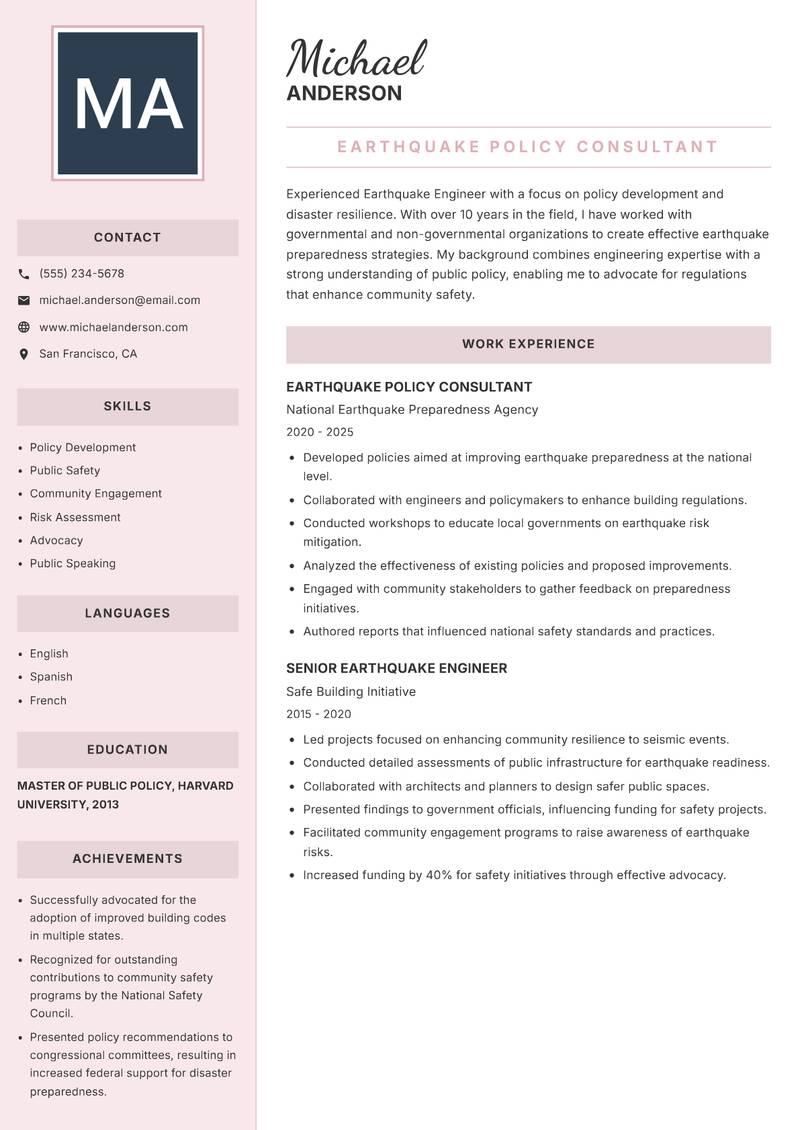
Executive
Use Template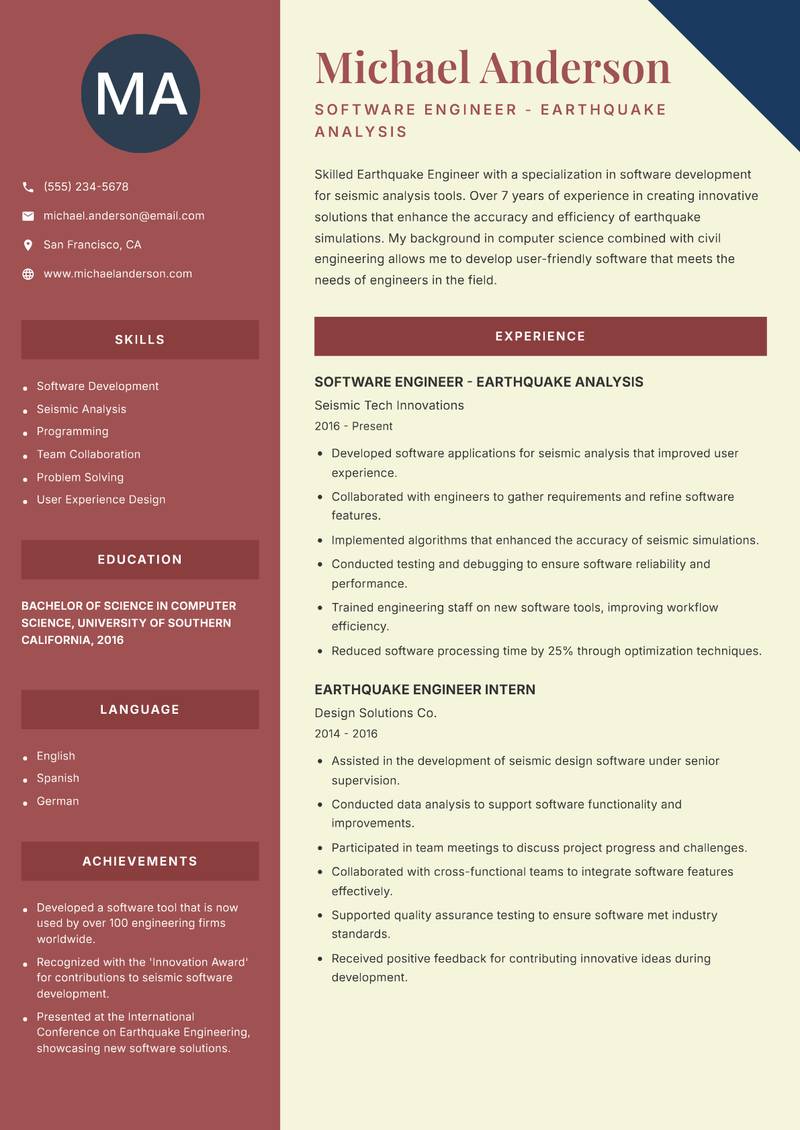
Two Column
Use Template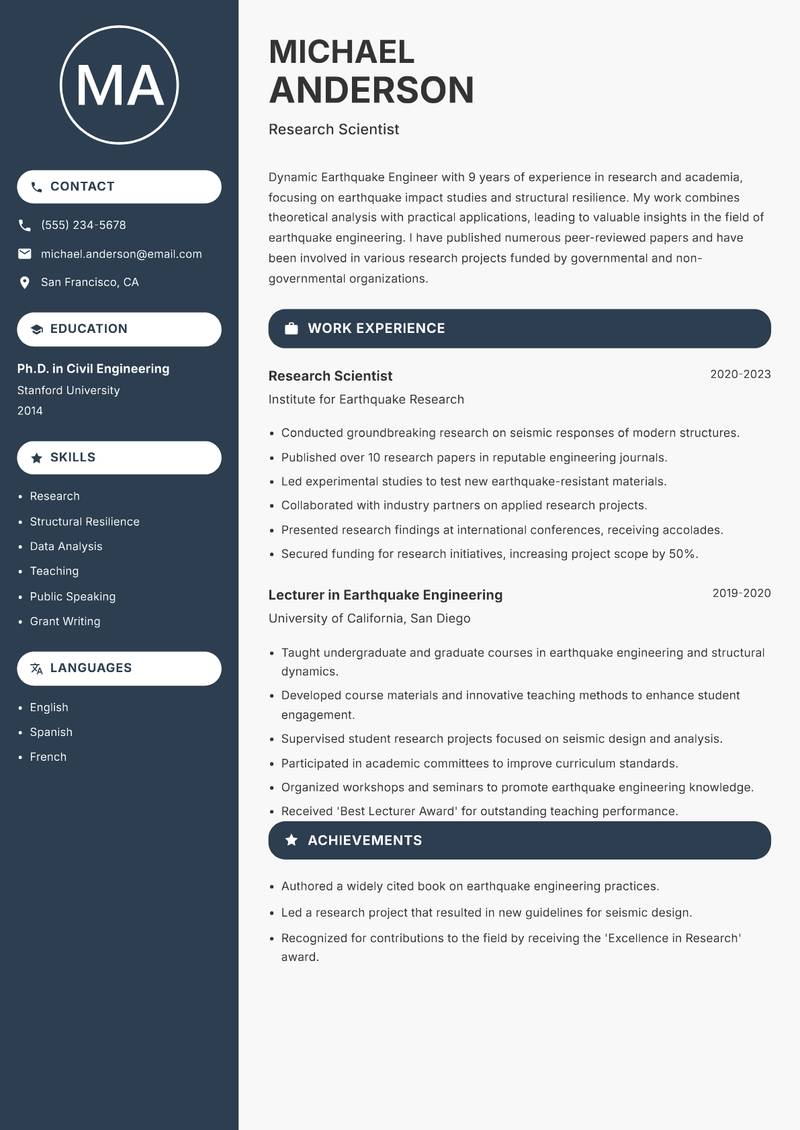
Compact
Use Template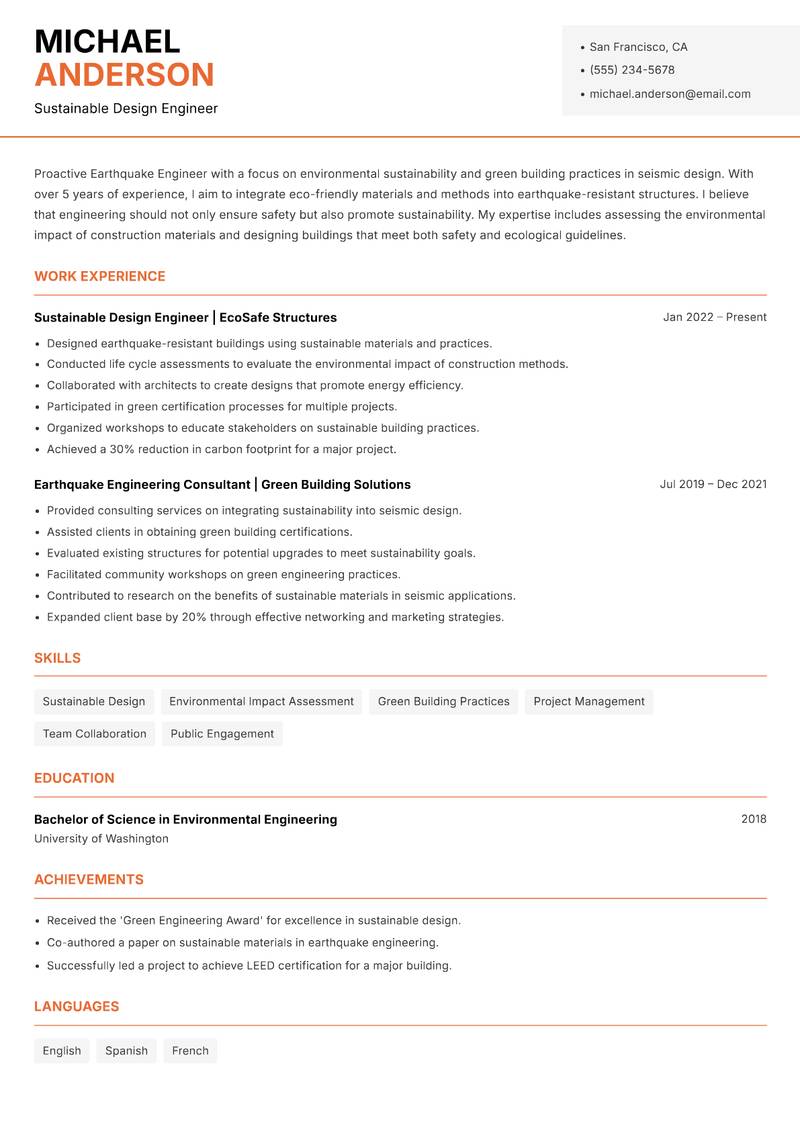
Modern Professional
Use Template7 Real Earthquake Engineer Resume Examples
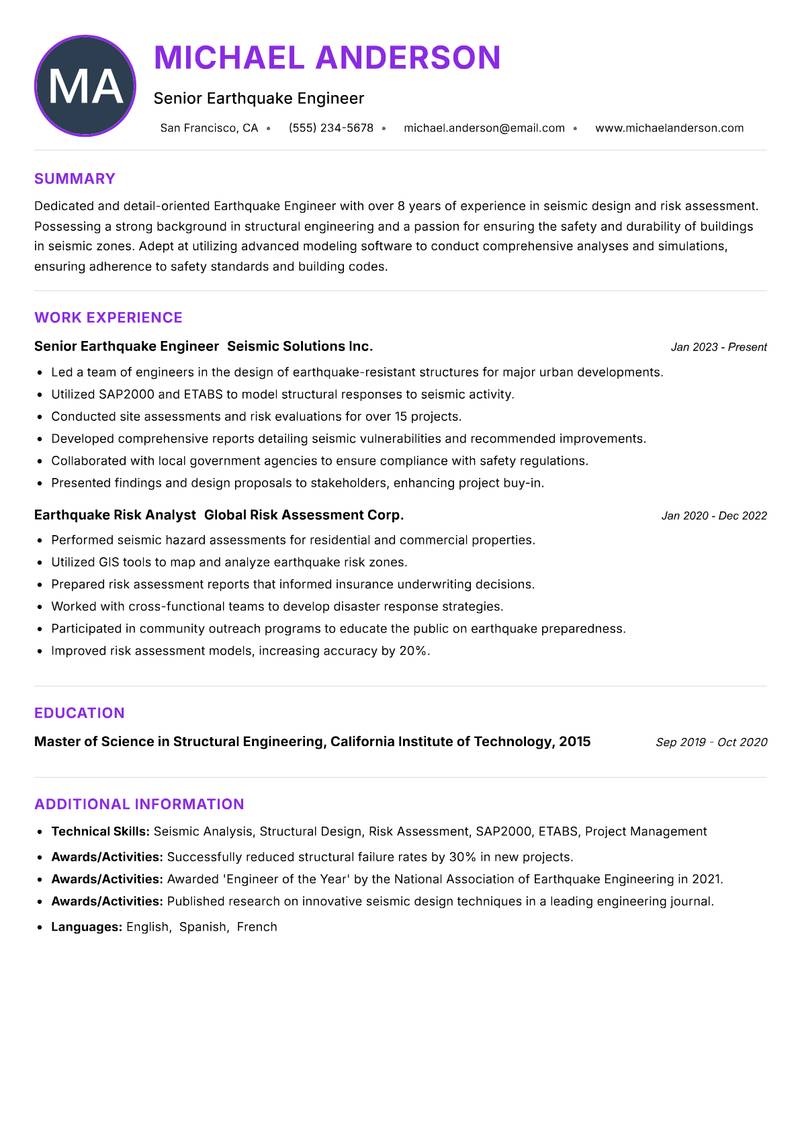
Senior Earthquake Engineer with 8+ Years Experience
Summary: Dedicated and detail-oriented Earthquake Engineer with over 8 years of experience in seismic design and risk assessment. Possessing a strong background in structural engineering and a passion for ensuring the safety and durability of buildings in seismic zones. Adept at utilizing advanced modeling software to conduct comprehensive analyses and simulations, ensuring adherence to safety standards and building codes. Proven track record of collaborating with architects, contractors, and government agencies to implement effective earthquake-resistant designs. Committed to continuous professional development, staying updated with the latest industry trends and technologies. Strong communicator with the ability to convey complex technical concepts to diverse audiences. Recognized for delivering projects on time and within budget while maintaining high quality standards.
Description:
- Led a team of engineers in the design of earthquake-resistant structures for major urban developments.
- Utilized SAP2000 and ETABS to model structural responses to seismic activity.
- Conducted site assessments and risk evaluations for over 15 projects.
- Developed comprehensive reports detailing seismic vulnerabilities and recommended improvements.
- Collaborated with local government agencies to ensure compliance with safety regulations.
- Presented findings and design proposals to stakeholders, enhancing project buy-in.
🏆 Key Achievements
Lead Retrofit Engineer with 12+ Years Experience
Summary: Experienced Earthquake Engineer with over 12 years of experience specializing in retrofit solutions for existing structures. Proven expertise in assessing and enhancing the earthquake resilience of buildings, bridges, and critical infrastructure. Strong technical skills in using advanced simulation software and seismic design codes to deliver high-quality engineering solutions. Recognized for developing innovative strategies that minimize risk and enhance safety. Adept at managing multiple projects simultaneously while maintaining high standards of quality and safety. Excellent problem-solving abilities and a commitment to continuous improvement in engineering practices. Passionate about mentoring junior engineers and contributing to the advancement of earthquake engineering knowledge.
Description:
- Managed retrofit projects for over 50 buildings, improving their seismic performance.
- Implemented advanced design techniques to ensure compliance with updated seismic codes.
- Conducted detailed assessments of existing structures to identify vulnerabilities.
- Coordinated with structural teams to develop cost-effective retrofit solutions.
- Facilitated workshops on earthquake safety for clients and stakeholders.
- Monitored project progress, ensuring timely completion within budget constraints.
🏆 Key Achievements
Earthquake Simulation Engineer with 6+ Years Experience
Summary: Innovative Earthquake Engineer with 6 years of experience focused on earthquake simulation and modeling. Skilled in employing cutting-edge technology and software to analyze seismic impacts and enhance building performance. Strong analytical skills combined with a solid foundation in civil engineering principles. Proven ability to work collaboratively with multidisciplinary teams to ensure the successful delivery of complex projects. Committed to advancing the field of earthquake engineering through research and development. Known for a proactive approach to problem-solving and a keen eye for detail. Excels in fast-paced environments and adapts quickly to changing project demands.
Description:
- Developed simulation models to predict structural responses during seismic events.
- Utilized software like ANSYS and ABAQUS for advanced seismic analysis.
- Collaborated with research teams to enhance simulation accuracy by 30%.
- Participated in field tests to validate simulation results against real-world data.
- Presented findings at industry conferences, showcasing innovative modeling techniques.
- Streamlined the simulation process, reducing analysis time by 20%.
🏆 Key Achievements
Earthquake Policy Consultant with 10+ Years Experience
Summary: Experienced Earthquake Engineer with a focus on policy development and disaster resilience. With over 10 years in the field, I have worked with governmental and non-governmental organizations to create effective earthquake preparedness strategies. My background combines engineering expertise with a strong understanding of public policy, enabling me to advocate for regulations that enhance community safety. I have successfully led initiatives that improve building codes and promote public awareness regarding earthquake risks. My ability to communicate complex technical concepts to non-technical stakeholders has been instrumental in garnering support for crucial safety programs. I am dedicated to fostering partnerships that bridge engineering and public policy for a safer future.
Description:
- Developed policies aimed at improving earthquake preparedness at the national level.
- Collaborated with engineers and policymakers to enhance building regulations.
- Conducted workshops to educate local governments on earthquake risk mitigation.
- Analyzed the effectiveness of existing policies and proposed improvements.
- Engaged with community stakeholders to gather feedback on preparedness initiatives.
- Authored reports that influenced national safety standards and practices.
🏆 Key Achievements
Software Engineer - Earthquake Analysis with 7+ Years Experience
Summary: Skilled Earthquake Engineer with a specialization in software development for seismic analysis tools. Over 7 years of experience in creating innovative solutions that enhance the accuracy and efficiency of earthquake simulations. My background in computer science combined with civil engineering allows me to develop user-friendly software that meets the needs of engineers in the field. I have successfully led teams in designing and implementing software solutions that streamline seismic analysis processes. Passionate about technology and its application in engineering, I am committed to advancing the field through continuous innovation and collaboration. Known for my problem-solving skills and ability to work under tight deadlines, I strive to deliver high-quality results.
Description:
- Developed software applications for seismic analysis that improved user experience.
- Collaborated with engineers to gather requirements and refine software features.
- Implemented algorithms that enhanced the accuracy of seismic simulations.
- Conducted testing and debugging to ensure software reliability and performance.
- Trained engineering staff on new software tools, improving workflow efficiency.
- Reduced software processing time by 25% through optimization techniques.
🏆 Key Achievements
Research Scientist with 9+ Years Experience
Summary: Dynamic Earthquake Engineer with 9 years of experience in research and academia, focusing on earthquake impact studies and structural resilience. My work combines theoretical analysis with practical applications, leading to valuable insights in the field of earthquake engineering. I have published numerous peer-reviewed papers and have been involved in various research projects funded by governmental and non-governmental organizations. My expertise lies in conducting experiments, analyzing data, and developing innovative solutions to enhance building performance during seismic events. A strong advocate for collaboration between academia and industry, I strive to bridge the gap between research findings and practical engineering practices.
Description:
- Conducted groundbreaking research on seismic responses of modern structures.
- Published over 10 research papers in reputable engineering journals.
- Led experimental studies to test new earthquake-resistant materials.
- Collaborated with industry partners on applied research projects.
- Presented research findings at international conferences, receiving accolades.
- Secured funding for research initiatives, increasing project scope by 50%.
🏆 Key Achievements
Sustainable Design Engineer with 5+ Years Experience
Summary: Driven Earthquake Engineer with a focus on environmental sustainability and green building practices in seismic design. With over 5 years of experience, I aim to integrate eco-friendly materials and methods into earthquake-resistant structures. I believe that engineering should not only ensure safety but also promote sustainability. My expertise includes assessing the environmental impact of construction materials and designing buildings that meet both safety and ecological guidelines. I have successfully collaborated with multidisciplinary teams to create innovative solutions that balance performance and sustainability. My commitment to green engineering practices drives me to seek out new technologies and strategies for reducing environmental footprints in construction.
Description:
- Designed earthquake-resistant buildings using sustainable materials and practices.
- Conducted life cycle assessments to evaluate the environmental impact of construction methods.
- Collaborated with architects to create designs that promote energy efficiency.
- Participated in green certification processes for multiple projects.
- Organized workshops to educate stakeholders on sustainable building practices.
- Achieved a 30% reduction in carbon footprint for a major project.
🏆 Key Achievements
Key Skills for Earthquake Engineer
ATS Optimization Tips
Increase your chances of getting hired
Use Standard Headings
Use common section titles like Experience, Skills, etc.
Include Keywords
Add role-specific keywords from the job description
Keep it Simple
Avoid complex tables, images and graphics
Save in Right Format
Use PDF format unless otherwise specified
Earthquake Engineer Salary Insights
Average Salary
$107,500
per year
Salary Range
$75,000 - $140,000
per year
Top Paying Cities
Los Angeles, Seattle, Houston, Dallas, Boston
Source: Glassdoor, Payscale, Indeed (Updated June 2025)
Everything you need to write a great Earthquake Engineer resume
Strong Action Verbs to Use
Resume Writing Tips
- →Highlight specific projects where you improved seismic performance.
- →Use metrics to demonstrate the success of your designs; for instance, reduced failure risks.
- →Tailor your resume to showcase relevant certifications related to seismic safety.
- →Mention software proficiency that directly applies to earthquake engineering projects.
- →Include participation in relevant workshops or conferences to show a commitment to continuous learning.
Common Mistakes to Avoid
- ✕Overlooking technical details specific to earthquake resistance in project descriptions.
- ✕Failing to quantify accomplishments or using vague terminologies.
- ✕Neglecting to mention experience with multidisciplinary teams when relevant.
- ✕Not highlighting relevant certifications or continuing education focused on seismic topics.
ATS Keywords for Earthquake Engineer
Earthquake Engineer Career Path
Relevant Certifications
Career Progression
Entry-Level
Assist senior engineers in conducting seismic analysis, modeling, and simple structural design tasks.
Mid-Level
Manage small to medium-scale projects, perform advanced simulations, and liaise with architects and construction teams for effective design integration.
Senior Engineer
Oversee major earthquake resilience projects, ensuring compliance with building codes and safety regulations, while mentoring junior engineers.
Project Manager
Lead multi-disciplinary teams in the delivery of large earthquake engineering projects, coordinating with government agencies and stakeholders.
Director of Engineering
Set the strategic direction for earthquake engineering initiatives, manage senior teams, and drive innovation in seismic safety technologies.
Earthquake Engineer Interview Questions
What specific seismic design codes are you familiar with, and how have you applied them in your projects? +
Be prepared to discuss your understanding of international, national, and local codes, with examples.
Can you explain the actions taken to assess and improve the resilience of an existing building? +
Provide detailed steps showing your analytical thought process and methods used.
Describe a challenging project where you implemented innovative solutions to earthquake engineering issues. +
Focus on problem-solving techniques and any unique strategies employed.
How do you manage risk assessment in earthquake engineering projects? +
Discuss how you identify, evaluate, and mitigate risks specific to seismic activity.
What role does collaboration with architects and construction teams play in your work as an earthquake engineer? +
Illustrate how multidisciplinary teamwork impacts project success.
Have you ever faced a disagreement with a stakeholder about design choices? How was it resolved? +
Highlight your communication and negotiation skills in conflict resolution.
Which software tools do you prefer for simulations and analyses in your projects? +
Mention tools specific to the industry, showcasing your technical expertise.
About the Earthquake Engineer Role
Designing buildings and infrastructure that resist seismic forces is at the core of an Earthquake Engineer's responsibilities. Through the application of advanced modeling technologies and seismic design principles, these specialists ensure structures can withstand earthquakes and protect occupants. Their work demands constant collaboration with construction teams, architects, and local authorities to ensure adherence to evolving safety standards and building codes.
Frequently Asked Questions
What is the primary role of an earthquake engineer? +
The primary role is to design and analyze structures that can effectively withstand seismic forces, ensuring safety during earthquakes.
What software tools are essential for an earthquake engineer? +
Common tools include SAP2000, ETABS, ANSYS, and other finite element analysis programs for seismic modeling.
What qualifications are necessary to become an earthquake engineer? +
Typically, a degree in civil or structural engineering, relevant certifications, and experience in seismic design are required.
How can I improve my job prospects as an earthquake engineer? +
Building a strong portfolio of seismic projects, gaining certifications, and networking in relevant professional organizations can enhance your prospects.
Is experience in geotechnical engineering relevant for earthqauke engineers? +
Yes, understanding soil behavior during earthquakes is critical for effective seismic design.
What are the most common challenges faced by earthquake engineers? +
Challenges often include staying updated with building codes, managing interdisciplinary teams, and addressing complex site conditions.
More Resume Examples You Might Like
Related Career Paths
Other roles candidates for Earthquake Engineer positions often also consider.
Will this Earthquake Engineer resume pass the ATS scan?
Upload it and get an instant AI-scored compatibility check with specific fixes.
Check My Resume →
Pair it with a matching cover letter
AI drafts a first version from your job title and strengths — edit it live, then download the PDF.
Write My Cover Letter →
Written by Nohaya Career Team
Reviewed by HR Professionals · Updated June 2025
Ready to Build Your Perfect Resume?
Choose from 1000+ professional templates and land your dream job.
Create My Resume Now