Build an ATS-Friendly
Deep Learning Researcher Resume
That Gets Interviews
Deep Learning Researchers drive cutting-edge AI innovations by developing intricate neural network architectures tailored to solve complex problems. They conduct rigorous experiments to refine models, often leveraging vast datasets to optimize performance. A core aspect of their role includes publication in academic…
Deep Learning Researcher Resume Templates
Modern Professional
Use Template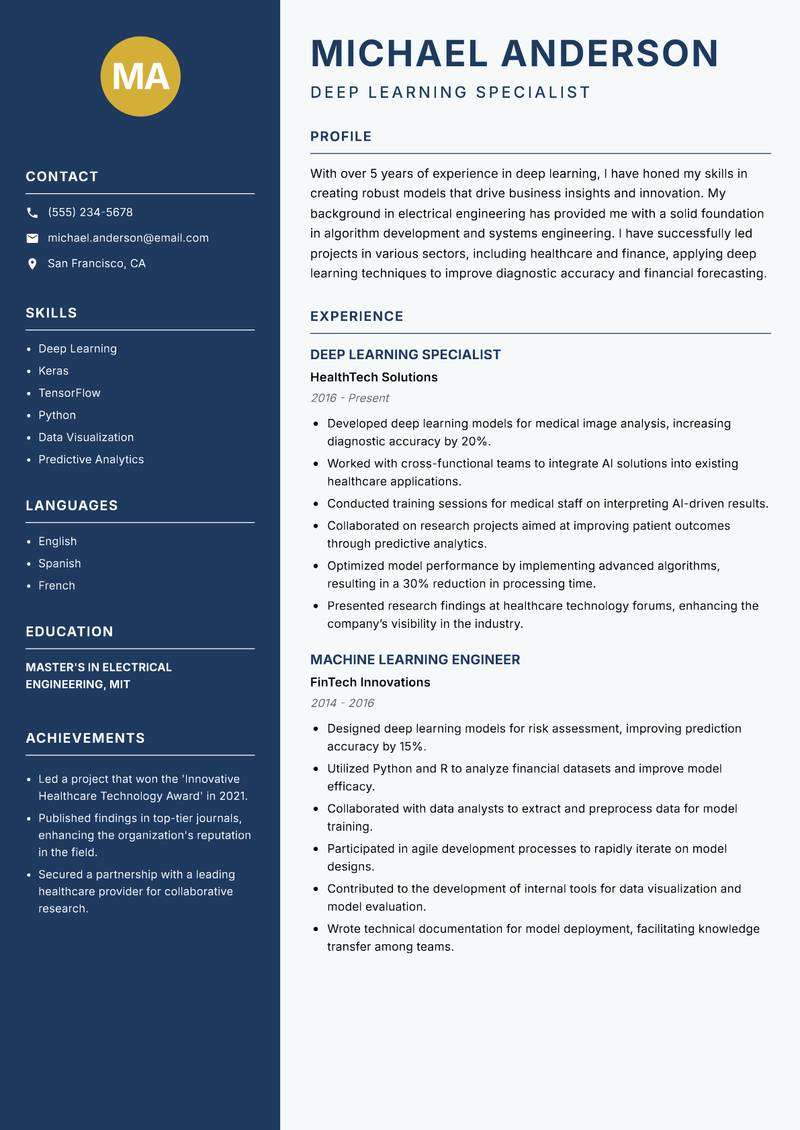
Classic Clean
Use Template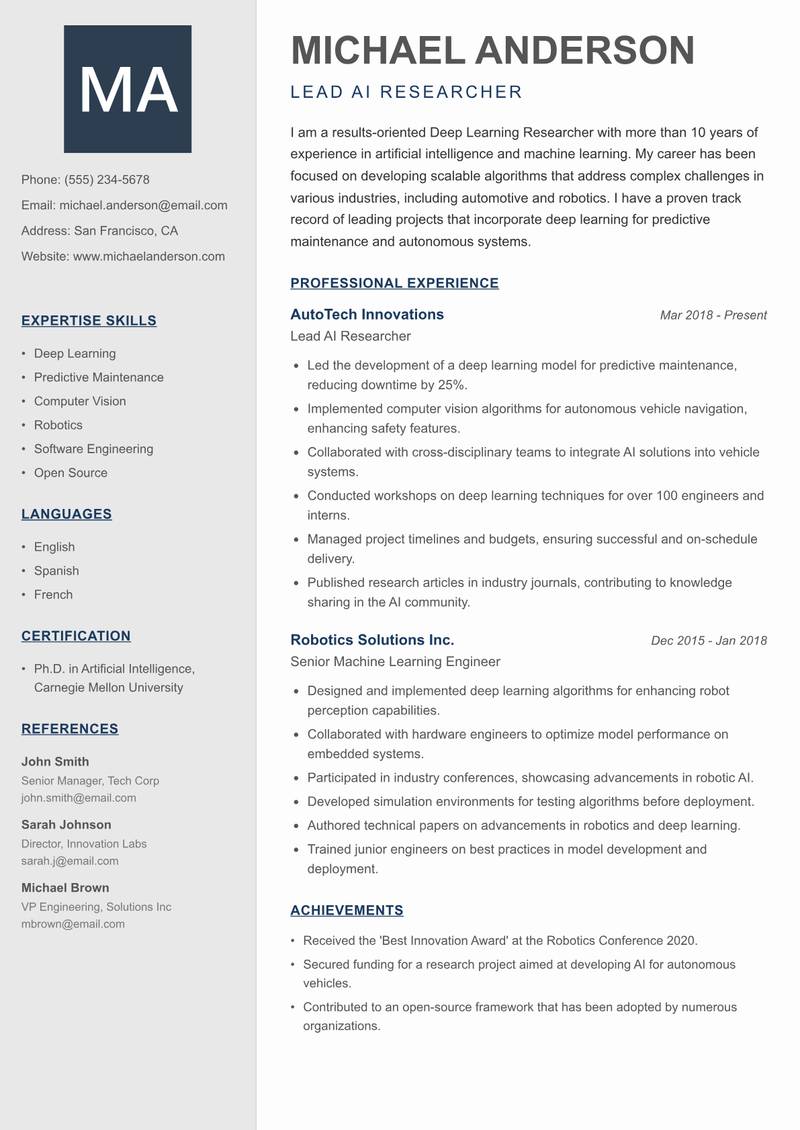
Creative Minimal
Use Template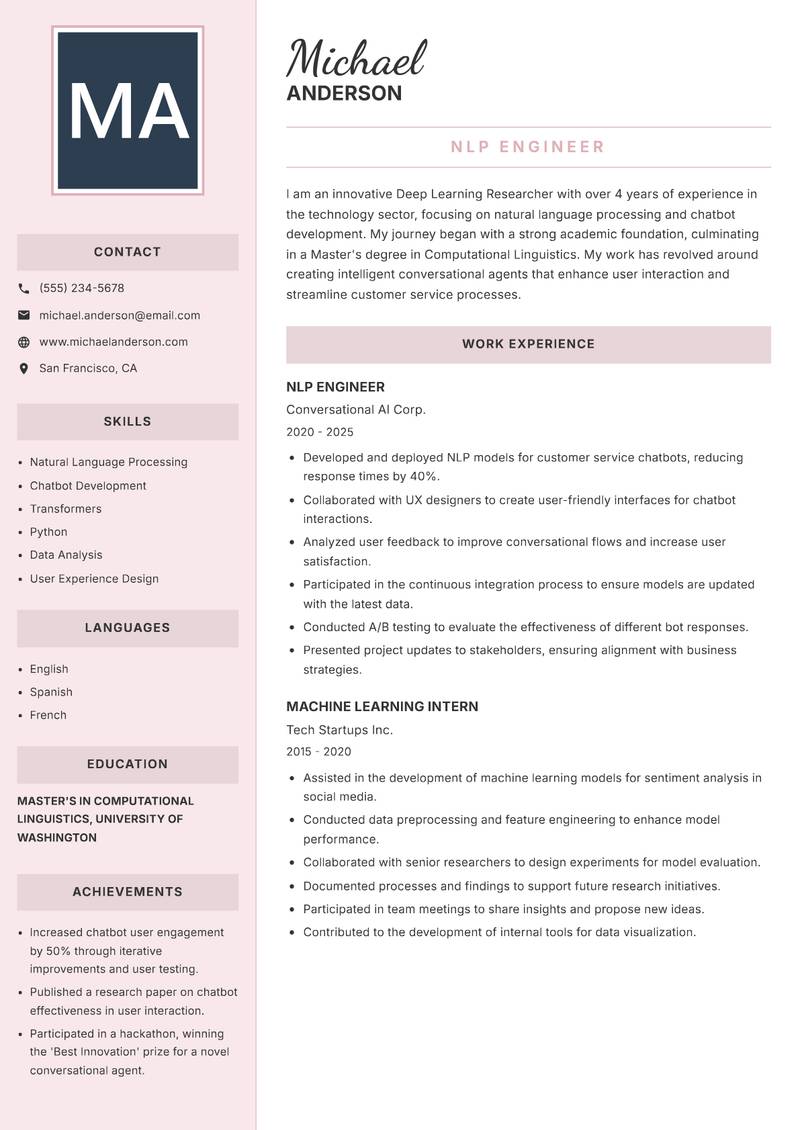
Executive
Use Template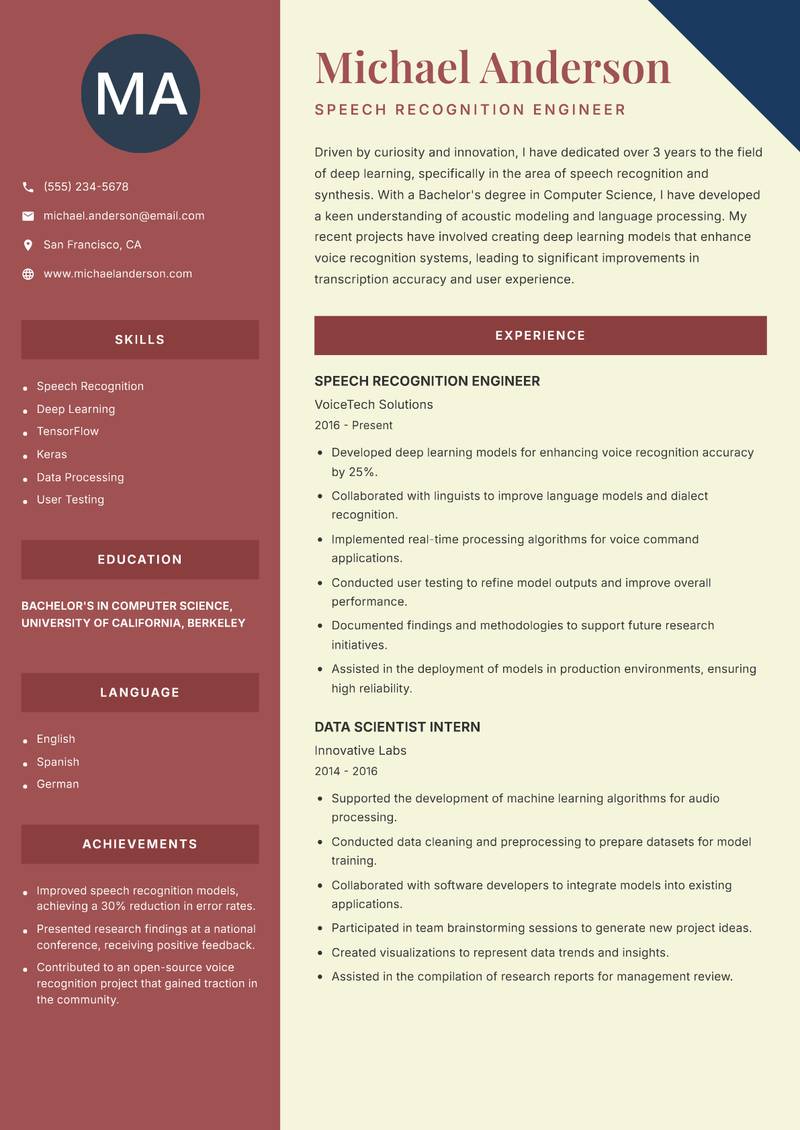
Two Column
Use Template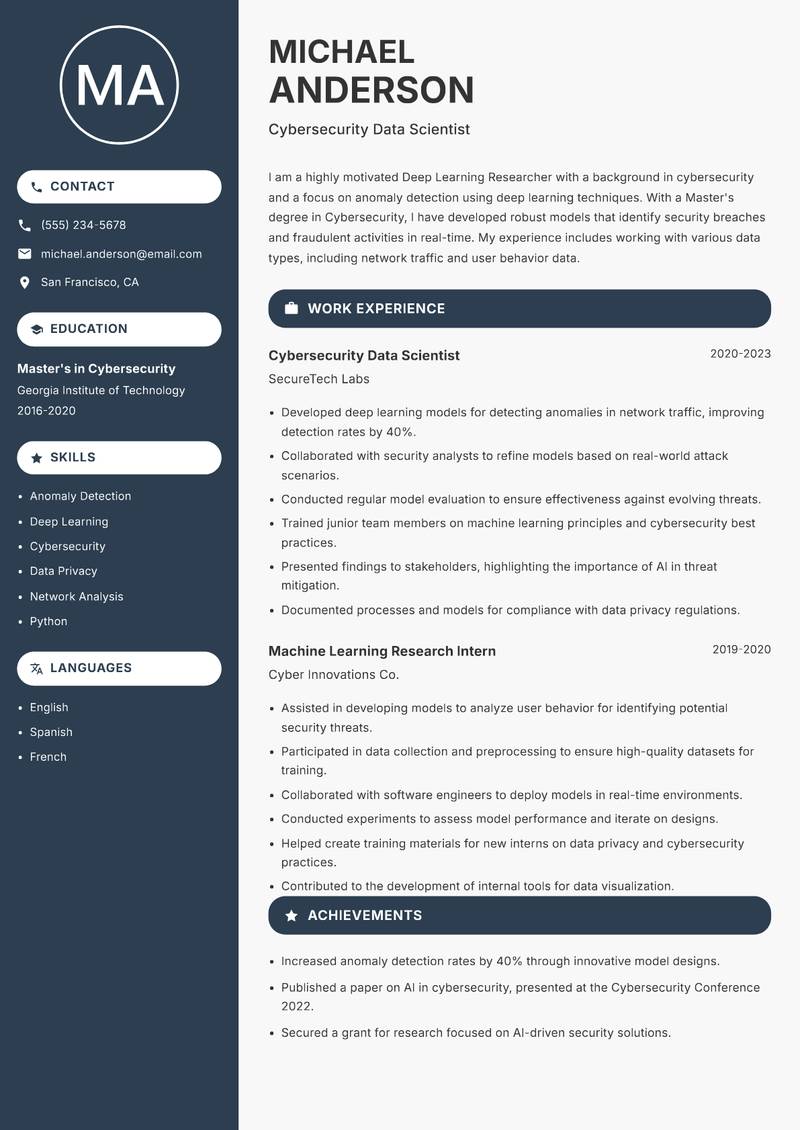
Compact
Use Template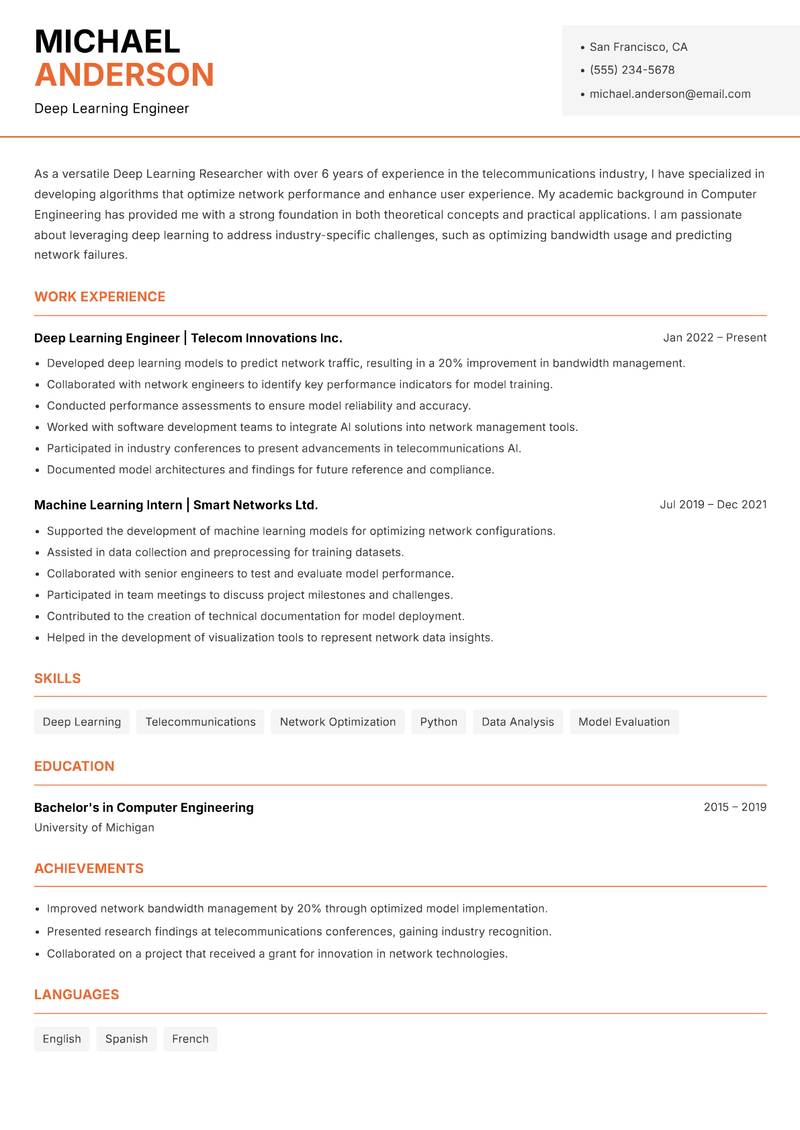
Modern Professional
Use Template7 Real Deep Learning Researcher Resume Examples
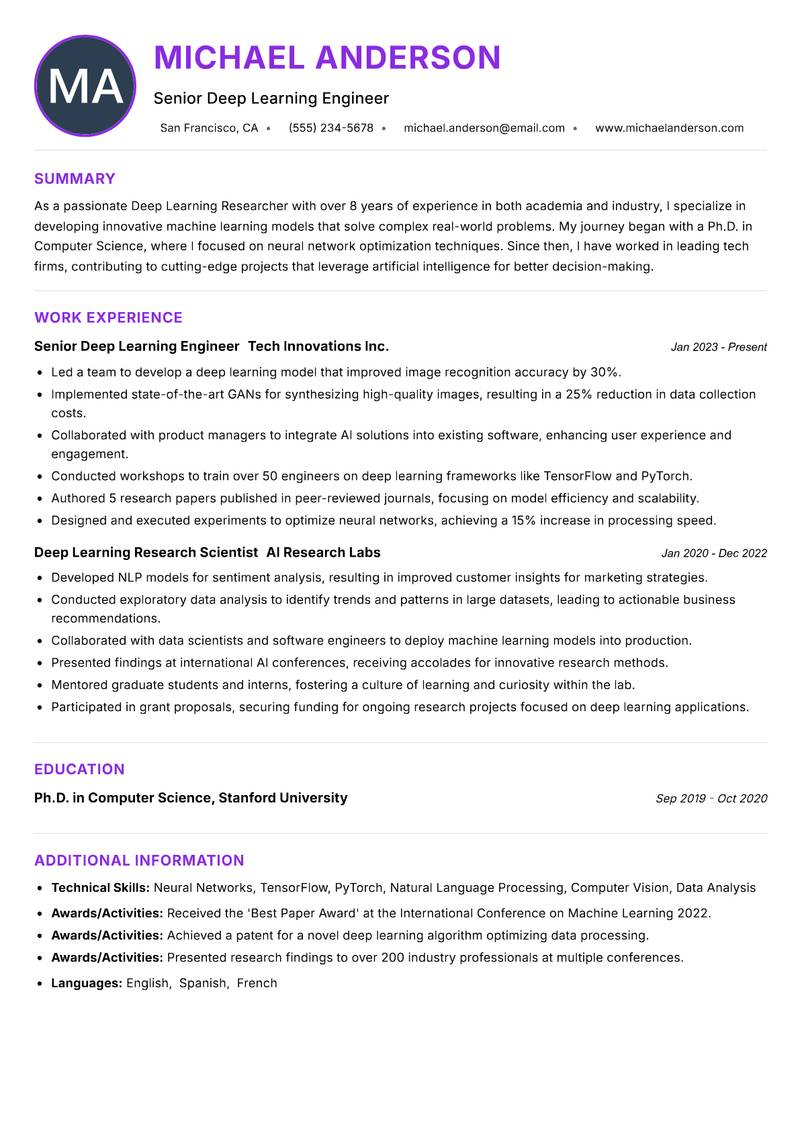
Senior Deep Learning Engineer with 8+ Years Experience
Summary: As a passionate Deep Learning Researcher with over 8 years of experience in both academia and industry, I specialize in developing innovative machine learning models that solve complex real-world problems. My journey began with a Ph.D. in Computer Science, where I focused on neural network optimization techniques. Since then, I have worked in leading tech firms, contributing to cutting-edge projects that leverage artificial intelligence for better decision-making. My expertise includes developing generative adversarial networks (GANs), natural language processing (NLP), and computer vision applications. I thrive in collaborative environments where I can mentor junior researchers and work closely with cross-functional teams to drive impactful results. With a proven track record of publishing in top-tier journals and presenting at international conferences, I am committed to pushing the boundaries of research and fostering innovation within the field of deep learning.
Description:
- Led a team to develop a deep learning model that improved image recognition accuracy by 30%.
- Implemented state-of-the-art GANs for synthesizing high-quality images, resulting in a 25% reduction in data collection costs.
- Collaborated with product managers to integrate AI solutions into existing software, enhancing user experience and engagement.
- Conducted workshops to train over 50 engineers on deep learning frameworks like TensorFlow and PyTorch.
- Authored 5 research papers published in peer-reviewed journals, focusing on model efficiency and scalability.
- Designed and executed experiments to optimize neural networks, achieving a 15% increase in processing speed.
🏆 Key Achievements
Deep Learning Specialist with 5+ Years Experience
Summary: With over 5 years of experience in deep learning, I have honed my skills in creating robust models that drive business insights and innovation. My background in electrical engineering has provided me with a solid foundation in algorithm development and systems engineering. I have successfully led projects in various sectors, including healthcare and finance, applying deep learning techniques to improve diagnostic accuracy and financial forecasting. I am adept at using tools like Keras and TensorFlow to build and deploy machine learning models. My approach is data-driven, and I have a strong belief in the power of collaborative work, often engaging with stakeholders to align AI solutions with business needs. I am committed to staying updated with the latest trends in AI, ensuring that my contributions are both relevant and impactful.
Description:
- Developed deep learning models for medical image analysis, increasing diagnostic accuracy by 20%.
- Worked with cross-functional teams to integrate AI solutions into existing healthcare applications.
- Conducted training sessions for medical staff on interpreting AI-driven results.
- Collaborated on research projects aimed at improving patient outcomes through predictive analytics.
- Optimized model performance by implementing advanced algorithms, resulting in a 30% reduction in processing time.
- Presented research findings at healthcare technology forums, enhancing the company’s visibility in the industry.
🏆 Key Achievements
Lead AI Researcher with 10+ Years Experience
Summary: I am a results-oriented Deep Learning Researcher with more than 10 years of experience in artificial intelligence and machine learning. My career has been focused on developing scalable algorithms that address complex challenges in various industries, including automotive and robotics. I have a proven track record of leading projects that incorporate deep learning for predictive maintenance and autonomous systems. My strong analytical skills, combined with my background in software engineering, allow me to create efficient solutions that optimize performance and reduce costs. I am an advocate for open-source contributions and have actively participated in community-driven projects to advance the field. With a solid understanding of both theory and practical applications, I aim to leverage my expertise to drive innovation in future AI technologies.
Description:
- Led the development of a deep learning model for predictive maintenance, reducing downtime by 25%.
- Implemented computer vision algorithms for autonomous vehicle navigation, enhancing safety features.
- Collaborated with cross-disciplinary teams to integrate AI solutions into vehicle systems.
- Conducted workshops on deep learning techniques for over 100 engineers and interns.
- Managed project timelines and budgets, ensuring successful and on-schedule delivery.
- Published research articles in industry journals, contributing to knowledge sharing in the AI community.
🏆 Key Achievements
NLP Engineer with 4+ Years Experience
Summary: I am an innovative Deep Learning Researcher with over 4 years of experience in the technology sector, focusing on natural language processing and chatbot development. My journey began with a strong academic foundation, culminating in a Master's degree in Computational Linguistics. My work has revolved around creating intelligent conversational agents that enhance user interaction and streamline customer service processes. I have a deep understanding of transformer models and have successfully implemented them in various applications, resulting in significant improvements in user engagement metrics. I am dedicated to continuous learning and adapting to the evolving landscape of AI, ensuring that my work remains impactful and relevant. My ability to communicate complex technical concepts to non-technical stakeholders has proven invaluable in aligning project goals with business objectives.
Description:
- Developed and deployed NLP models for customer service chatbots, reducing response times by 40%.
- Collaborated with UX designers to create user-friendly interfaces for chatbot interactions.
- Analyzed user feedback to improve conversational flows and increase user satisfaction.
- Participated in the continuous integration process to ensure models are updated with the latest data.
- Conducted A/B testing to evaluate the effectiveness of different bot responses.
- Presented project updates to stakeholders, ensuring alignment with business strategies.
🏆 Key Achievements
Speech Recognition Engineer with 3+ Years Experience
Summary: Driven by curiosity and innovation, I have dedicated over 3 years to the field of deep learning, specifically in the area of speech recognition and synthesis. With a Bachelor's degree in Computer Science, I have developed a keen understanding of acoustic modeling and language processing. My recent projects have involved creating deep learning models that enhance voice recognition systems, leading to significant improvements in transcription accuracy and user experience. I am adept at using frameworks such as TensorFlow and Keras, and I enjoy collaborating with interdisciplinary teams to bring ideas from concept to reality. My commitment to research and development allows me to stay ahead of the curve, constantly seeking out new challenges and opportunities in the rapidly evolving landscape of AI.
Description:
- Developed deep learning models for enhancing voice recognition accuracy by 25%.
- Collaborated with linguists to improve language models and dialect recognition.
- Implemented real-time processing algorithms for voice command applications.
- Conducted user testing to refine model outputs and improve overall performance.
- Documented findings and methodologies to support future research initiatives.
- Assisted in the deployment of models in production environments, ensuring high reliability.
🏆 Key Achievements
Cybersecurity Data Scientist with 3+ Years Experience
Summary: I am a highly motivated Deep Learning Researcher with a background in cybersecurity and a focus on anomaly detection using deep learning techniques. With a Master's degree in Cybersecurity, I have developed robust models that identify security breaches and fraudulent activities in real-time. My experience includes working with various data types, including network traffic and user behavior data. I am skilled in using machine learning algorithms to enhance threat detection capabilities and have a strong understanding of data privacy regulations. My ability to communicate complex concepts to both technical and non-technical audiences has been crucial in developing effective solutions that align with business objectives. I aim to contribute to a safer digital landscape through innovative research and development.
Description:
- Developed deep learning models for detecting anomalies in network traffic, improving detection rates by 40%.
- Collaborated with security analysts to refine models based on real-world attack scenarios.
- Conducted regular model evaluation to ensure effectiveness against evolving threats.
- Trained junior team members on machine learning principles and cybersecurity best practices.
- Presented findings to stakeholders, highlighting the importance of AI in threat mitigation.
- Documented processes and models for compliance with data privacy regulations.
🏆 Key Achievements
Deep Learning Engineer with 6+ Years Experience
Summary: As a versatile Deep Learning Researcher with over 6 years of experience in the telecommunications industry, I have specialized in developing algorithms that optimize network performance and enhance user experience. My academic background in Computer Engineering has provided me with a strong foundation in both theoretical concepts and practical applications. I am passionate about leveraging deep learning to address industry-specific challenges, such as optimizing bandwidth usage and predicting network failures. I excel in collaborative environments, working closely with cross-functional teams to integrate AI solutions into existing systems. I am committed to continuous improvement and am always eager to learn about emerging technologies that can further enhance telecommunications services.
Description:
- Developed deep learning models to predict network traffic, resulting in a 20% improvement in bandwidth management.
- Collaborated with network engineers to identify key performance indicators for model training.
- Conducted performance assessments to ensure model reliability and accuracy.
- Worked with software development teams to integrate AI solutions into network management tools.
- Participated in industry conferences to present advancements in telecommunications AI.
- Documented model architectures and findings for future reference and compliance.
🏆 Key Achievements
Key Skills for Deep Learning Researcher
ATS Optimization Tips
Increase your chances of getting hired
Use Standard Headings
Use common section titles like Experience, Skills, etc.
Include Keywords
Add role-specific keywords from the job description
Keep it Simple
Avoid complex tables, images and graphics
Save in Right Format
Use PDF format unless otherwise specified
Deep Learning Researcher Salary Insights
Average Salary
$140,000
per year
Salary Range
$100,000 - $180,000
per year
Top Paying Cities
Los Angeles, Seattle, Houston, Dallas, Boston
Source: Glassdoor, Payscale, Indeed (Updated May 2025)
Everything you need to write a great Deep Learning Researcher resume
Strong Action Verbs to Use
Resume Writing Tips
- →Highlight your publication record in recognized AI journals to demonstrate thought leadership.
- →Detail your contributions to open-source projects related to deep learning if applicable.
- →Include specific metrics that showcase your model performance, such as accuracy or processing time improvements.
- →Showcase collaborations with cross-functional teams as evidence of your ability to communicate complex ideas effectively.
- →Mention any conferences or workshops where you've presented your research findings.
Common Mistakes to Avoid
- ✕Listing generic programming skills without specifying language proficiency related to deep learning (e.g., Python instead of specifying libraries).
- ✕Not emphasizing participation in research or publications, which are crucial in the AI field.
- ✕Focusing too much on theoretical knowledge instead of practical experience with real-world datasets.
- ✕Neglecting to include examples of specific deep learning frameworks used in projects.
ATS Keywords for Deep Learning Researcher
Deep Learning Researcher Career Path
Relevant Certifications
Career Progression
Entry-Level Deep Learning Researcher
Focuses on assisting in research projects by conducting data preprocessing and preliminary analysis.
Mid-Level Deep Learning Scientist
Responsible for designing and implementing deep learning models for specific applications, often collaborating with software engineers.
Senior Deep Learning Researcher
Leads complex research projects, develops novel algorithms, and publishes findings in academic conferences.
Research Lead in Deep Learning
Manages a team of researchers, overseeing projects from conception to execution, and ensures alignment with organizational goals.
Director of AI Research
Sets the strategic direction for deep learning initiatives and oversees multiple research teams while engaging with industry stakeholders.
Deep Learning Researcher Interview Questions
What types of deep learning architectures have you worked with, and what are their specific applications? +
Provide examples of frameworks like CNNs, RNNs, or GANs and discuss how you've implemented them.
Can you describe a challenging problem you solved using deep learning and the methodology you applied? +
Discuss your thought process, the algorithms you considered, and the impact of your solution.
How do you approach the tuning of hyperparameters in a deep learning model? +
Explain your method for systematic tuning and the tools you use.
What is your experience with deploying deep learning models into production? +
Outline your process for taking research models into a real-world environment.
How do you stay updated on the latest research and advancements in the field of deep learning? +
Mention specific journals, conferences, or online platforms you utilize.
Describe your experience with dataset management. How do you handle imbalanced datasets? +
Share your strategies for data augmentation or synthetic data generation.
About the Deep Learning Researcher Role
Deep Learning Researchers drive cutting-edge AI innovations by developing intricate neural network architectures tailored to solve complex problems. They conduct rigorous experiments to refine models, often leveraging vast datasets to optimize performance. A core aspect of their role includes publication in academic journals, contributing to the broader AI community, and working closely with data engineers and product teams to implement findings in real-world applications.
Frequently Asked Questions
What programming languages are most important for a Deep Learning Researcher? +
Python is the most widely used, particularly with libraries like TensorFlow and PyTorch being essential.
Is a PhD necessary for a career in deep learning research? +
While a PhD is advantageous, many roles exist for those with strong practical experience and relevant skills.
What is the significance of publications in this field? +
Publications help establish credibility and demonstrate a researcher's depth of knowledge and engagement with the AI community.
How important are math skills for Deep Learning Researchers? +
Strong knowledge of linear algebra, calculus, and statistics is vital for understanding and developing deep learning algorithms.
What tools do Deep Learning Researchers typically use? +
They commonly use frameworks like TensorFlow, Keras, and PyTorch, along with tools for data manipulation like NumPy and pandas.
Can Deep Learning Researchers work in industries other than tech? +
Yes, deep learning skills are applicable in finance, healthcare, automotive, and many other sectors with data-driven decision-making.
More Resume Examples You Might Like
Related Career Paths
Other roles candidates for Deep Learning Researcher positions often also consider.
Will this Deep Learning Researcher resume pass the ATS scan?
Upload it and get an instant AI-scored compatibility check with specific fixes.
Check My Resume →
Pair it with a matching cover letter
AI drafts a first version from your job title and strengths — edit it live, then download the PDF.
Write My Cover Letter →
Written by Nohaya Career Team
Reviewed by HR Professionals · Updated May 2025
Ready to Build Your Perfect Resume?
Choose from 1000+ professional templates and land your dream job.
Create My Resume Now