Build an ATS-Friendly
Aquaponics Specialist Resume
That Gets Interviews
Designing efficient aquaponics systems involves a unique blend of knowledge in both horticulture and aquaculture. Specialists analyze water chemistry, select compatible fish and plant varieties, and implement sustainable practices to optimize growth and system health. Daily responsibilities include troubleshooting…
Aquaponics Specialist Resume Templates
Modern Professional
Use Template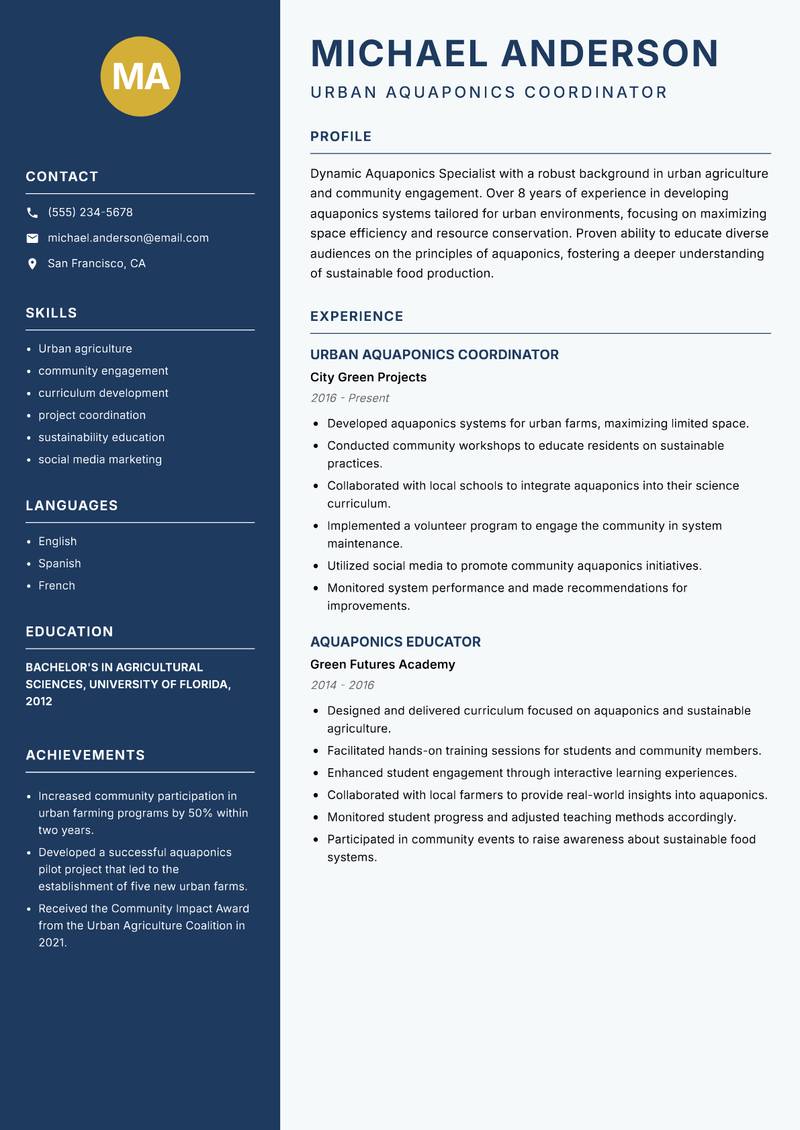
Classic Clean
Use Template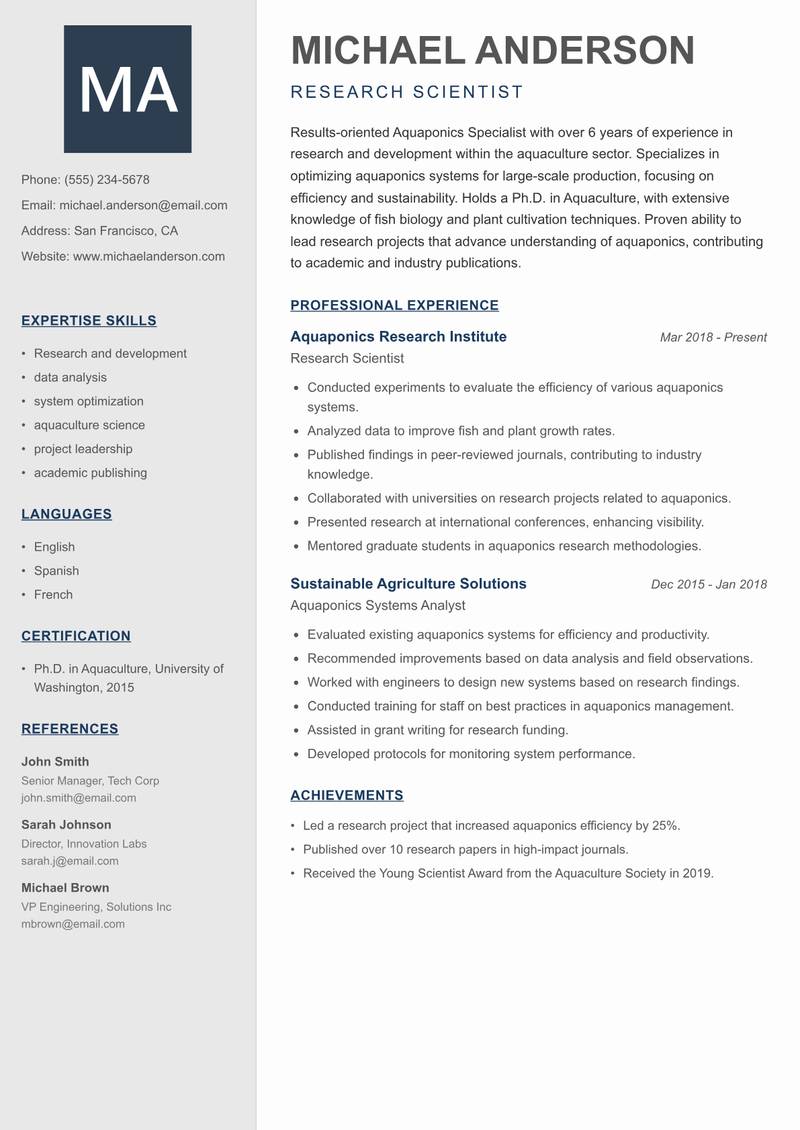
Creative Minimal
Use Template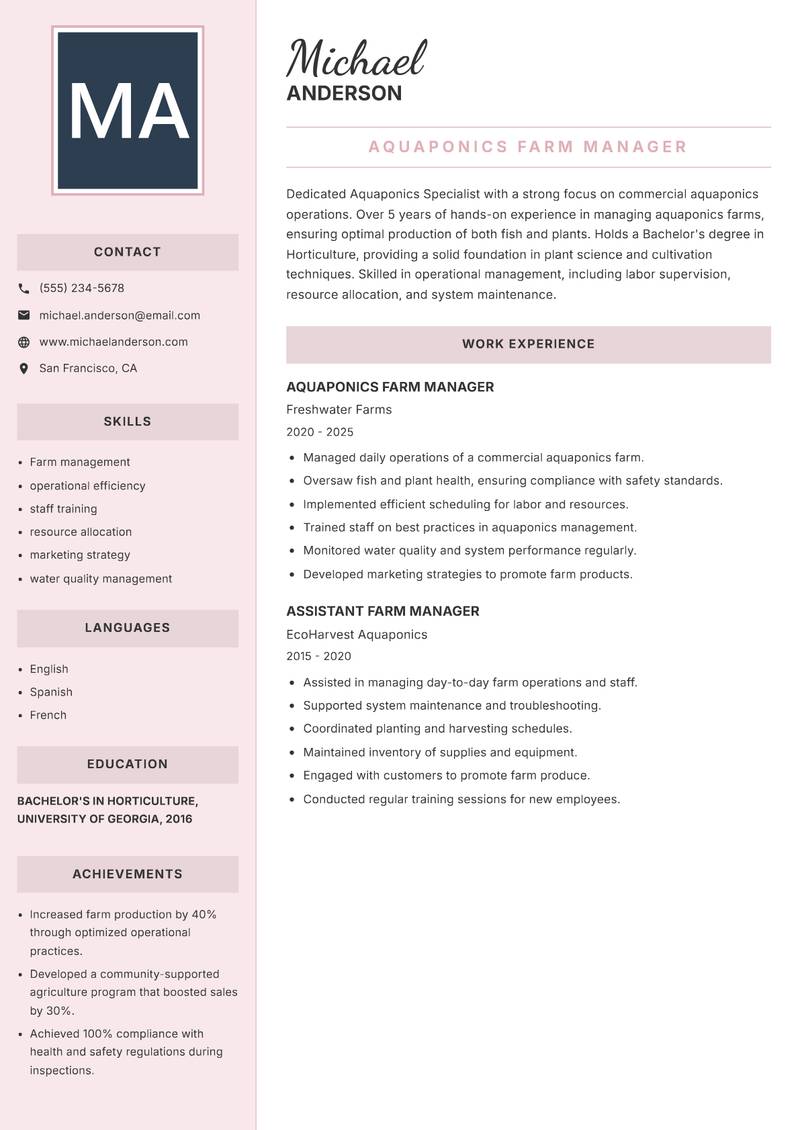
Executive
Use Template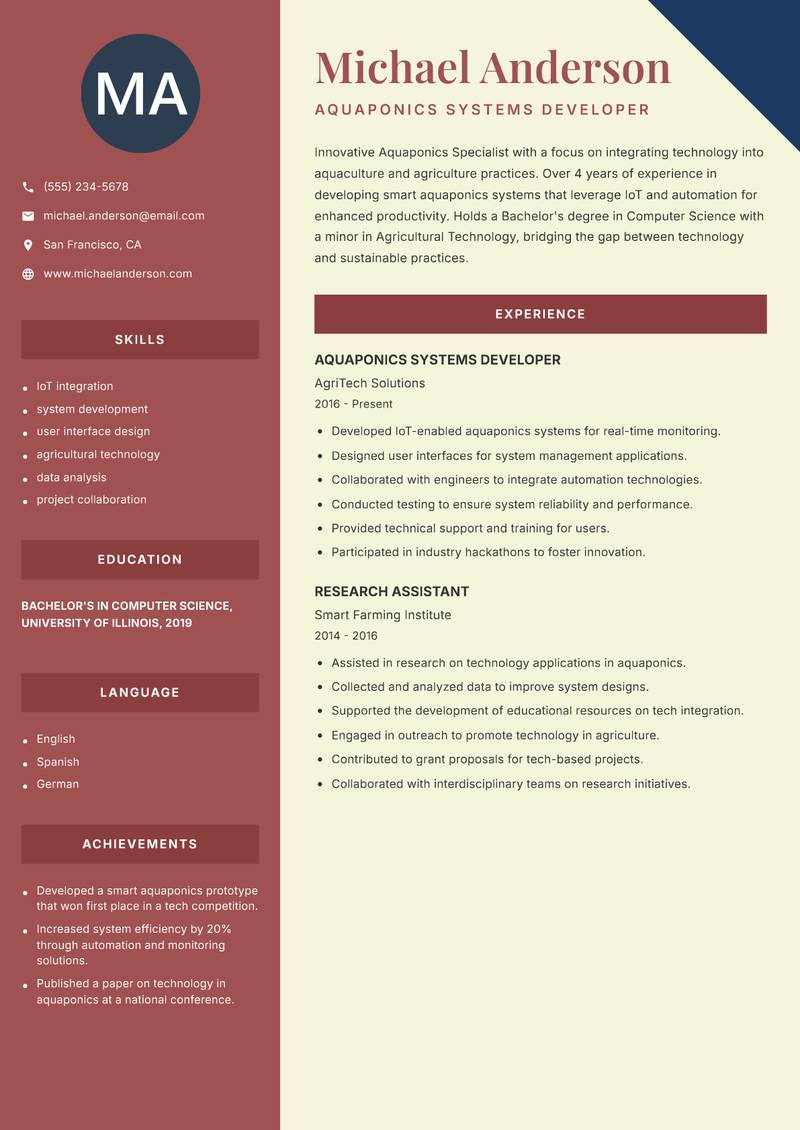
Two Column
Use Template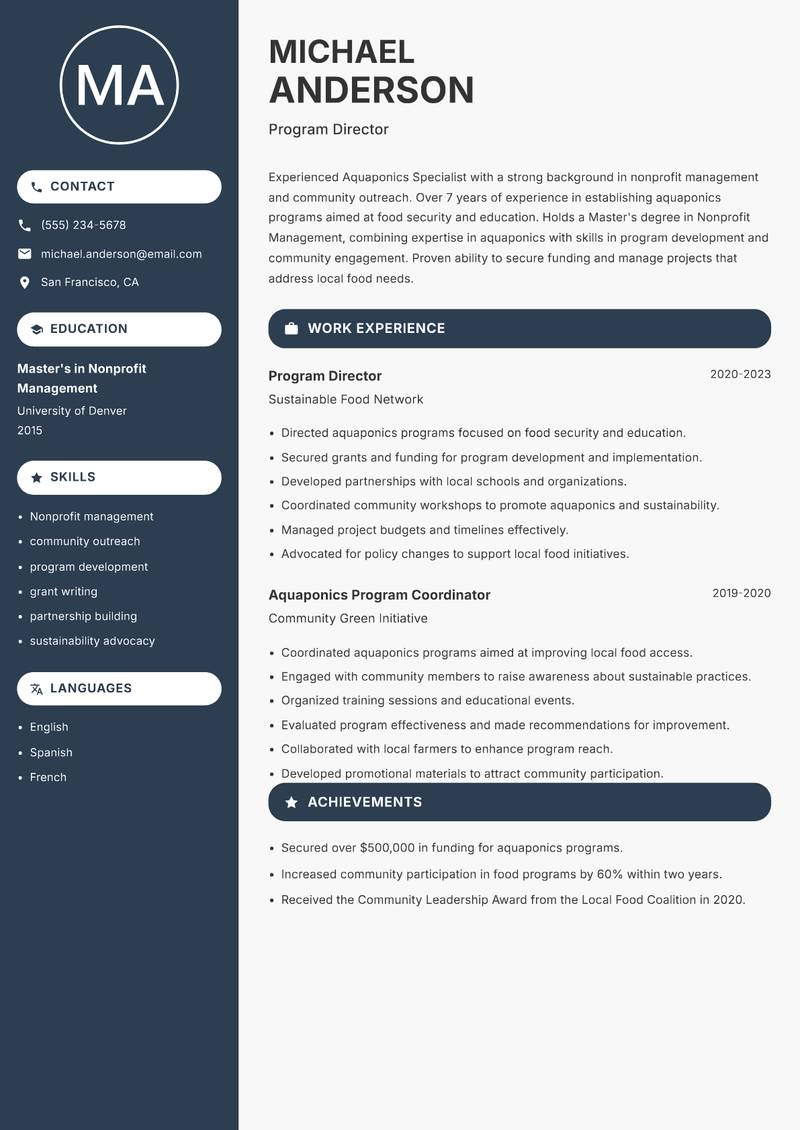
Compact
Use Template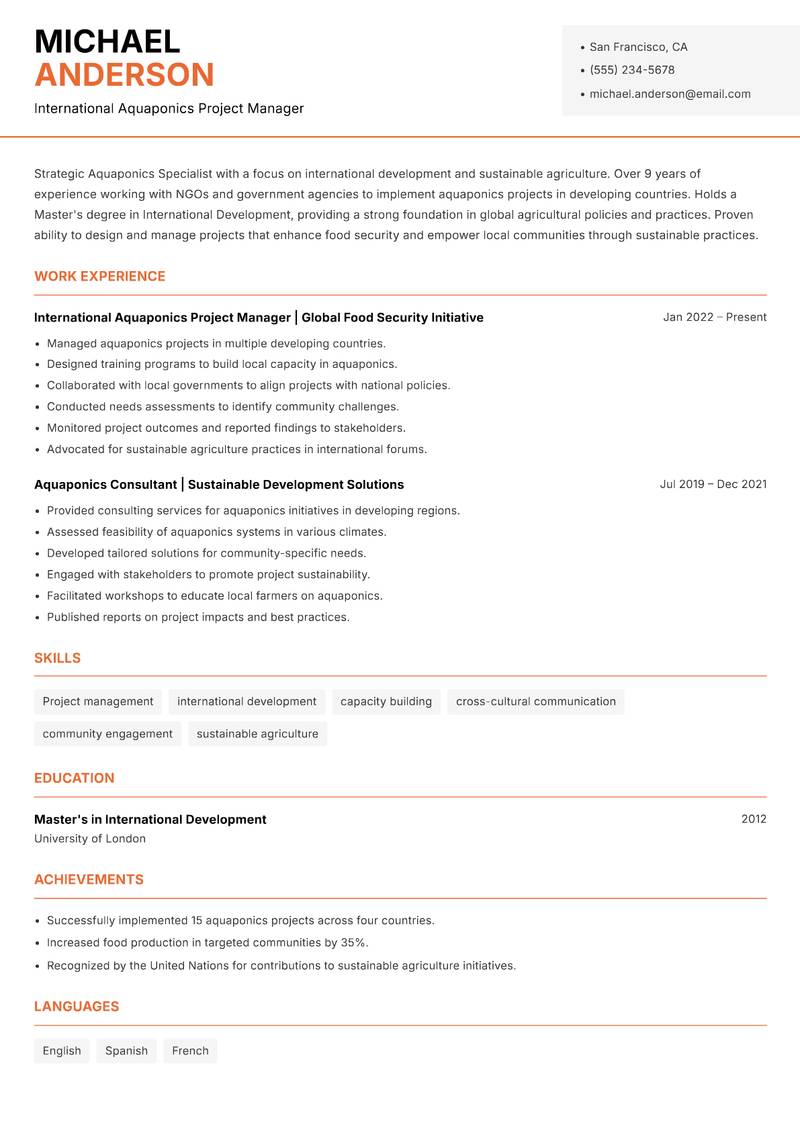
Modern Professional
Use Template7 Real Aquaponics Specialist Resume Examples
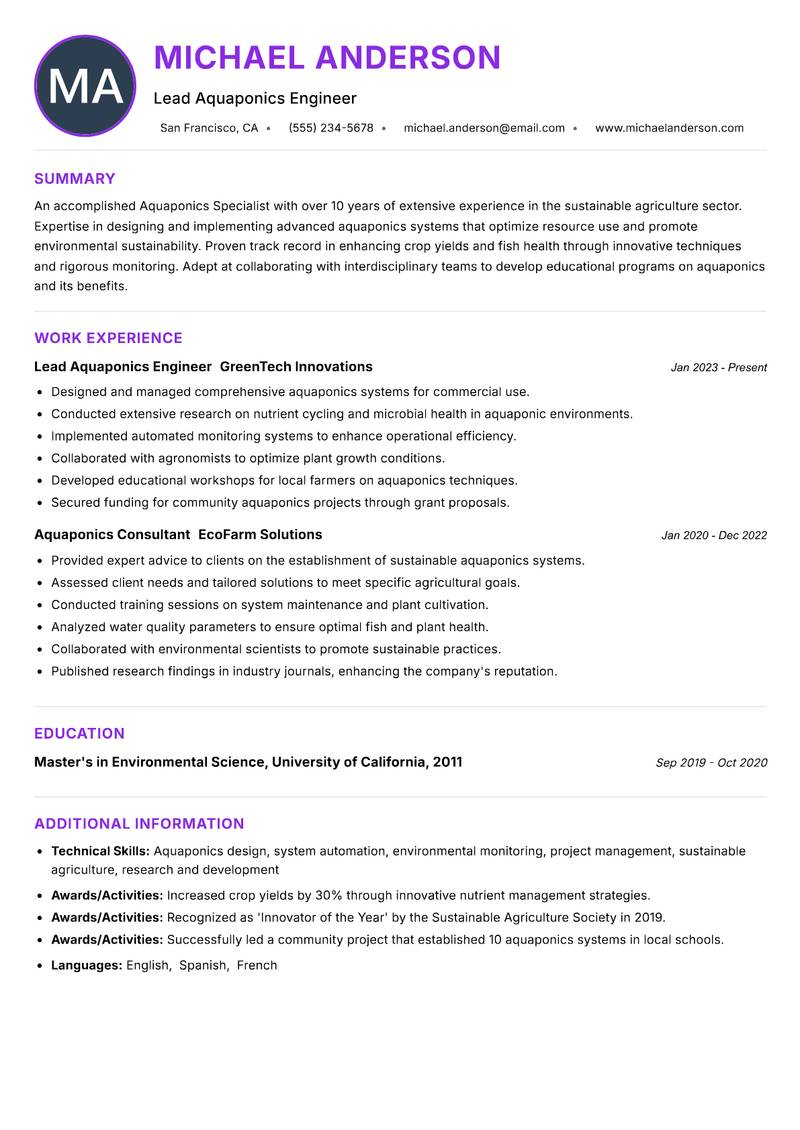
Lead Aquaponics Engineer with 11+ Years Experience
Summary: An accomplished Aquaponics Specialist with over 10 years of extensive experience in the sustainable agriculture sector. Expertise in designing and implementing advanced aquaponics systems that optimize resource use and promote environmental sustainability. Proven track record in enhancing crop yields and fish health through innovative techniques and rigorous monitoring. Adept at collaborating with interdisciplinary teams to develop educational programs on aquaponics and its benefits. Committed to advancing the field through research and practical application of cutting-edge technologies. Holds a Master's degree in Environmental Science, contributing to a solid foundation in ecological principles and sustainable practices. Recognized for outstanding contributions to community-based aquaponics initiatives, fostering local engagement and awareness of sustainable food systems.
Description:
- Designed and managed comprehensive aquaponics systems for commercial use.
- Conducted extensive research on nutrient cycling and microbial health in aquaponic environments.
- Implemented automated monitoring systems to enhance operational efficiency.
- Collaborated with agronomists to optimize plant growth conditions.
- Developed educational workshops for local farmers on aquaponics techniques.
- Secured funding for community aquaponics projects through grant proposals.
🏆 Key Achievements
Urban Aquaponics Coordinator with 9+ Years Experience
Summary: Dynamic Aquaponics Specialist with a robust background in urban agriculture and community engagement. Over 8 years of experience in developing aquaponics systems tailored for urban environments, focusing on maximizing space efficiency and resource conservation. Proven ability to educate diverse audiences on the principles of aquaponics, fostering a deeper understanding of sustainable food production. Skilled in integrating technology into aquaponics systems to enhance productivity and reduce labor costs. Holds a Bachelor's degree in Agricultural Sciences, with a strong emphasis on innovative farming techniques. Recognized for leadership in community workshops and initiatives that promote local food systems and environmental stewardship.
Description:
- Developed aquaponics systems for urban farms, maximizing limited space.
- Conducted community workshops to educate residents on sustainable practices.
- Collaborated with local schools to integrate aquaponics into their science curriculum.
- Implemented a volunteer program to engage the community in system maintenance.
- Utilized social media to promote community aquaponics initiatives.
- Monitored system performance and made recommendations for improvements.
🏆 Key Achievements
Research Scientist with 7+ Years Experience
Summary: Accomplished Aquaponics Specialist with over 6 years of experience in research and development within the aquaculture sector. Specializes in optimizing aquaponics systems for large-scale production, focusing on efficiency and sustainability. Holds a Ph.D. in Aquaculture, with extensive knowledge of fish biology and plant cultivation techniques. Proven ability to lead research projects that advance understanding of aquaponics, contributing to academic and industry publications. Skilled in data analysis and system optimization, ensuring that production meets both economic and environmental standards. Recognized for innovative approaches to system design and implementation, enhancing productivity and sustainability in aquaponics.
Description:
- Conducted experiments to evaluate the efficiency of various aquaponics systems.
- Analyzed data to improve fish and plant growth rates.
- Published findings in peer-reviewed journals, contributing to industry knowledge.
- Collaborated with universities on research projects related to aquaponics.
- Presented research at international conferences, enhancing visibility.
- Mentored graduate students in aquaponics research methodologies.
🏆 Key Achievements
Aquaponics Farm Manager with 6+ Years Experience
Summary: Dedicated Aquaponics Specialist with a strong focus on commercial aquaponics operations. Over 5 years of hands-on experience in managing aquaponics farms, ensuring optimal production of both fish and plants. Holds a Bachelor's degree in Horticulture, providing a solid foundation in plant science and cultivation techniques. Skilled in operational management, including labor supervision, resource allocation, and system maintenance. Proven ability to implement best practices that enhance productivity and sustainability in aquaponics. Committed to continuous improvement and innovation within the field, contributing to the growth of the aquaponics industry through active involvement in professional organizations.
Description:
- Managed daily operations of a commercial aquaponics farm.
- Oversaw fish and plant health, ensuring compliance with safety standards.
- Implemented efficient scheduling for labor and resources.
- Trained staff on best practices in aquaponics management.
- Monitored water quality and system performance regularly.
- Developed marketing strategies to promote farm products.
🏆 Key Achievements
Aquaponics Systems Developer with 5+ Years Experience
Summary: Innovative Aquaponics Specialist with a focus on integrating technology into aquaculture and agriculture practices. Over 4 years of experience in developing smart aquaponics systems that leverage IoT and automation for enhanced productivity. Holds a Bachelor's degree in Computer Science with a minor in Agricultural Technology, bridging the gap between technology and sustainable practices. Proven track record in creating user-friendly interfaces for system monitoring and management. Committed to advancing the aquaponics field through technological innovation and research. Recognized for contributions to tech-driven agricultural solutions and participation in industry-related hackathons.
Description:
- Developed IoT-enabled aquaponics systems for real-time monitoring.
- Designed user interfaces for system management applications.
- Collaborated with engineers to integrate automation technologies.
- Conducted testing to ensure system reliability and performance.
- Provided technical support and training for users.
- Participated in industry hackathons to foster innovation.
🏆 Key Achievements
Program Director with 8+ Years Experience
Summary: Experienced Aquaponics Specialist with a strong background in nonprofit management and community outreach. Over 7 years of experience in establishing aquaponics programs aimed at food security and education. Holds a Master's degree in Nonprofit Management, combining expertise in aquaponics with skills in program development and community engagement. Proven ability to secure funding and manage projects that address local food needs. Recognized for leadership in mobilizing community support and fostering partnerships with local organizations. Committed to promoting sustainable practices and enhancing food access through innovative aquaponics solutions.
Description:
- Directed aquaponics programs focused on food security and education.
- Secured grants and funding for program development and implementation.
- Developed partnerships with local schools and organizations.
- Coordinated community workshops to promote aquaponics and sustainability.
- Managed project budgets and timelines effectively.
- Advocated for policy changes to support local food initiatives.
🏆 Key Achievements
International Aquaponics Project Manager with 9+ Years Experience
Summary: Strategic Aquaponics Specialist with a focus on international development and sustainable agriculture. Over 9 years of experience working with NGOs and government agencies to implement aquaponics projects in developing countries. Holds a Master's degree in International Development, providing a strong foundation in global agricultural policies and practices. Proven ability to design and manage projects that enhance food security and empower local communities through sustainable practices. Recognized for expertise in cross-cultural communication and capacity building. Committed to leveraging aquaponics as a tool for economic development and environmental sustainability in underserved regions.
Description:
- Managed aquaponics projects in multiple developing countries.
- Designed training programs to build local capacity in aquaponics.
- Collaborated with local governments to align projects with national policies.
- Conducted needs assessments to identify community challenges.
- Monitored project outcomes and reported findings to stakeholders.
- Advocated for sustainable agriculture practices in international forums.
🏆 Key Achievements
Key Skills for Aquaponics Specialist
ATS Optimization Tips
Increase your chances of getting hired
Use Standard Headings
Use common section titles like Experience, Skills, etc.
Include Keywords
Add role-specific keywords from the job description
Keep it Simple
Avoid complex tables, images and graphics
Save in Right Format
Use PDF format unless otherwise specified
Aquaponics Specialist Salary Insights
Average Salary
$57,500
per year
Salary Range
$45,000 - $70,000
per year
Top Paying Cities
Los Angeles, Seattle, Houston, Dallas, Boston
Source: Glassdoor, Payscale, Indeed (Updated July 2025)
Everything you need to write a great Aquaponics Specialist resume
Strong Action Verbs to Use
Resume Writing Tips
- →Highlight specific successes or innovations you've introduced in previous aquaponics projects.
- →Emphasize your understanding of the interdependencies between aquatic life and plant growth in floating systems.
- →Include details of any specific software or instrumentation you utilized for managing aquaponics systems.
- →Demonstrate your hands-on experience with various species of fish and plants specific to aquaponics environments.
- →Mention certifications that showcase your commitment to sustainable practices and system optimization.
Common Mistakes to Avoid
- ✕Using overly technical jargon without explaining it, which may alienate non-specialists.
- ✕Neglecting to quantify your impact, such as by citing improvements in yield or reduction in costs.
- ✕Ignoring sustainability practices in your resume, which are crucial in aquaponics.
- ✕Failing to articulate the symbiotic relationship in an aquaponics system succinctly.
ATS Keywords for Aquaponics Specialist
Aquaponics Specialist Career Path
Relevant Certifications
Career Progression
Entry-Level Aquaponics Technician
Involves hands-on maintenance of aquaponics systems, basic water quality testing, and plant management.
Aquaponics Supervisor
Oversees daily operations, trains technicians, and manages system optimization.
Aquaponics Systems Designer
Focuses on designing and implementing innovative aquaponics systems for various scales, from small farms to large commercial operations.
Sustainable Agriculture Consultant
Advises on best practices for sustainable farming methods, specializing in aquaponics techniques and system integration.
Aquaponics Research Scientist
Conducts research on aquaponic methods, crop yields, and environmental impacts, contributing to advancements in sustainable cultivation.
Aquaponics Specialist Interview Questions
What are the key components of a successful aquaponics system? +
Discuss both fish and plant species, water quality parameters, and the symbiotic relationship between the two.
How do you monitor and maintain water quality in an aquaponics setup? +
Explain specific tests and the frequency of monitoring, including pH, ammonia, nitrate, and dissolved oxygen levels.
Can you describe a successful aquaponics project you’ve managed? +
Detail the challenges faced, solutions implemented, and the results achieved with measurable outcomes.
What pest management strategies do you utilize in aquaponics? +
Discuss the use of natural pest control methods instead of chemical pesticides.
How do you select appropriate fish and plant species for aquaponics? +
Emphasize factors such as compatibility, growth rates, and market demand.
What technological tools do you incorporate for system monitoring and control? +
Mention specific software or hardware used to optimize system parameters.
In what ways can climate conditions affect an aquaponics system? +
Discuss temperature, light, and humidity management considerations.
About the Aquaponics Specialist Role
Designing efficient aquaponics systems involves a unique blend of knowledge in both horticulture and aquaculture. Specialists analyze water chemistry, select compatible fish and plant varieties, and implement sustainable practices to optimize growth and system health. Daily responsibilities include troubleshooting system issues, conducting frequent health assessments for plants and fish, and ensuring nutrient balance in a closed-loop ecosystem.
Frequently Asked Questions
View all →What type of environment is ideal for an aquaponics system? +
Aquaponics systems thrive in controlled environments where temperature, light, and humidity can be regulated, often within greenhouses.
How much water is needed for an aquaponics system? +
Aquaponics systems typically require between 5 to 10 gallons of water per fish, depending on the system design and species used.
What are the most common fish used in aquaponics? +
Tilapia, trout, and catfish are among the most commonly used fish due to their resilience and compatibility with various plant species.
How can you scale an aquaponics system? +
Scaling involves careful planning to increase water volume, grow bed area, and fish stocking density while maintaining balance.
What types of certifications should an Aquaponics Specialist pursue? +
Certifications in sustainable agriculture, aquaculture management, and specific aquaponics training programs can enhance your qualifications.
What are the environmental benefits of aquaponics? +
Aquaponics systems reduce water usage by recycling it and eliminate the need for chemical fertilizers, promoting eco-friendly farming.
How do you minimize diseases in fish and plants within aquaponics systems? +
Regular monitoring, maintaining water quality, and selecting disease-resistant breeds are essential to preventing outbreaks.
More Resume Examples You Might Like
Related Career Paths
Other roles candidates for Aquaponics Specialist positions often also consider.
Will this Aquaponics Specialist resume pass the ATS scan?
Upload it and get an instant AI-scored compatibility check with specific fixes.
Check My Resume →
Pair it with a matching cover letter
AI drafts a first version from your job title and strengths — edit it live, then download the PDF.
Write My Cover Letter →
Written by Nohaya Career Team
Reviewed by HR Professionals · Updated July 2025
Ready to Build Your Perfect Resume?
Choose from 1000+ professional templates and land your dream job.
Create My Resume Now